Sternal Closure Integrity: Structural Advancements by a Modern Non-Absorbable Sutures Manufacturer…
Author: Product Development Team, Lotus Surgicals
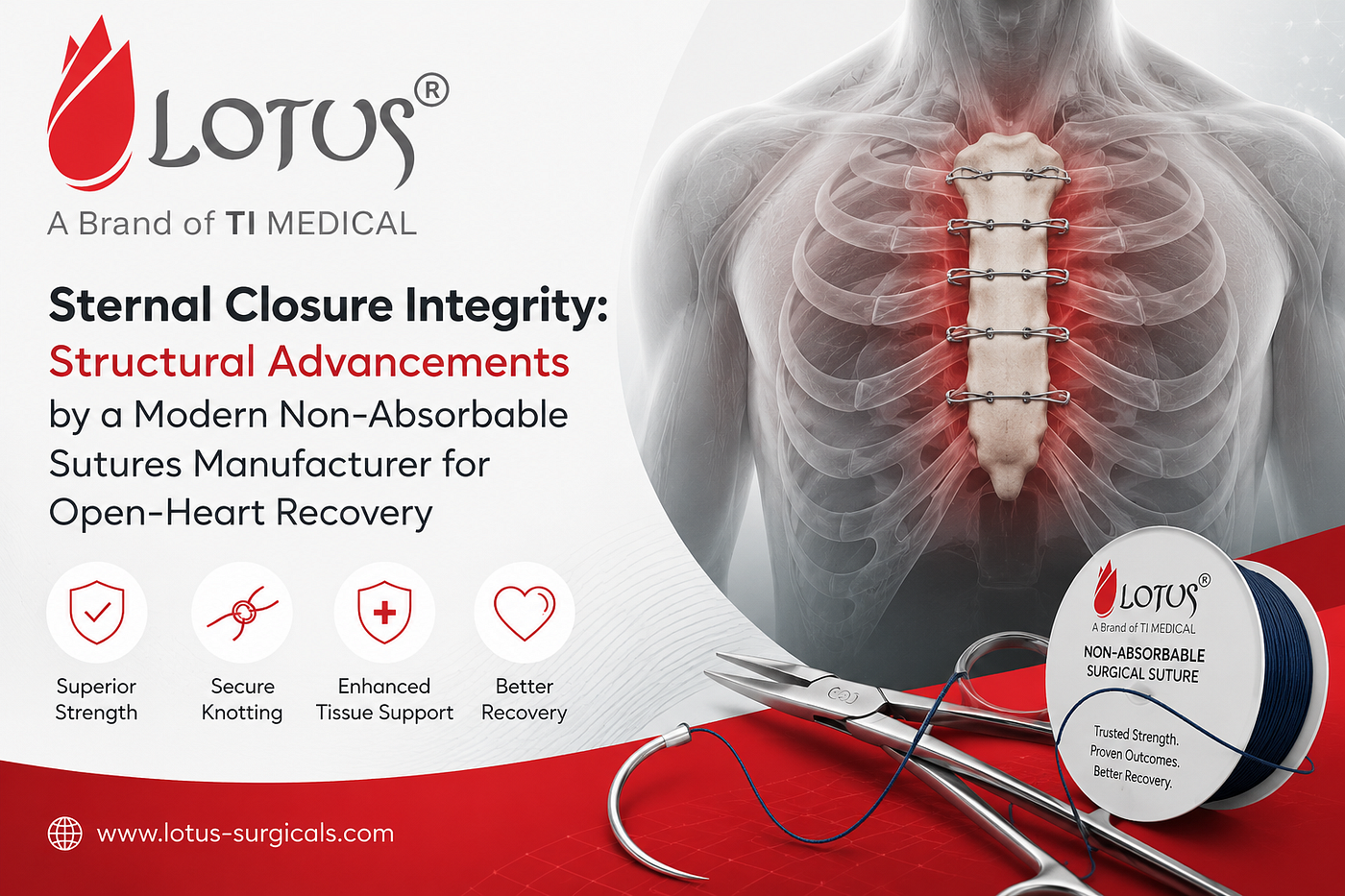
Sternal Closure Integrity: Structural Advancements by a Modern Non-Absorbable Sutures Manufacturer for Open-Heart Recovery
Author: Product Development Team, Lotus Surgicals
Reviewed by: Head of Quality Assurance, Lotus Surgicals
Published:
Open the chest, fix the heart, close it back up. That’s the thirty-second summary of a median sternotomy, and for most people, the story ends there. But if you’ve spent any time around cardiac operating rooms, you know the real cliffhanger isn’t the heart repair itself, it’s what happens after the sternum gets wired or sutured shut and you start hoping it stays put while the patient coughs, rolls over in bed, or just takes a deep breath.
I’ve been on the product development side of a non-absorbable sutures manufacturer** **for years, specifically focused on non-absorbable materials that end up in chests. What’s become obvious to me not from a spec sheet, but from watching case after case and listening to surgeons is that the material you use for sternal closure isn’t a small decision. It’s the difference between a calm recovery and a complication that drags on for months. This isn’t a theoretical argument. It’s something I’ve seen play out in real hospitals, with real patients. So I want to walk through what sternal closure integrity actually means, why it matters more than most people think, and how modern suture systems have quietly changed the game.
What We Really Mean by Sternal Closure Integrity
At its simplest, sternal closure integrity is just the mechanical stability of the breastbone after it’s been split and put back together. That bone has to stay aligned long enough to heal, usually six to eight weeks of daily life, coughing fits, sneezes, and all the small movements we never think about. If the closure fails, the bone starts to shift, and that’s when a straightforward recovery can go sideways.
For decades, stainless steel wire has been the workhorse here. And honestly, for a healthy, low-risk patient, it still does the job. But wire has a personality. It concentrates tension in a small spot, and in someone with soft or brittle bone. Think osteoporosis, long-term steroid use, or a chest that’s been opened before that concentration can turn into a fracture line. This is exactly where non-absorbable sutures like braided polyester, polypropylene, or wide PTFE tape start to shine. They spread the load out, they’re gentler on fragile bone edges, and they don’t carry the same long-term metal fatigue worry.
Good closure integrity, then, isn’t just “strong enough.” It’s mechanical stability plus even load distribution plus an environment where biology can do its thing without constant disruption.
Why This Isn’t a Footnote
I’ve heard people say sternal complications are rare, so why obsess over the closure? The numbers tell a different story. Data from the Annals of Thoracic Surgery puts sternal wound complication rates between 0.3% and 8%, depending on the patient mix. That’s a wide range, but even at the low end, you’re looking at thousands of people every year dealing with pain, extra hospital days, or a second operation.
And the scary part? If a deep sternal complication does set in, mortality and serious morbidity can climb to somewhere between 10% and 40%. That’s not a typo. That’s the kind of jump that makes cardiac centres pay very close attention to how they close, not just what they do inside the heart. Suture choice, closure technique, and the reliability of the material suddenly become front-and-centre clinical decisions.
Everyone at the Table Has a Stake
When we talk about sternal closure, it’s easy to picture just the surgeon. But the reality is a lot broader. Here’s who’s actually affected and what they need:
Cardiac surgeons — predictable tensile strength and knot security they can trust every single time.
Hospital procurement teams — batch-to-batch consistency, solid documentation, and a supplier who doesn’t ghost them.
High-risk patients (obese, osteoporotic, diabetic) — a closure that reduces the odds of the bone pulling apart.
Patients undergoing redo sternotomies — a system built with fragile, irregular bone in mind.
Surgical device distributors — a non-absorbable sutures manufacturer can count on for steady, traceable supply.
When I look at that list, I see one thread running through it: reliability. Not marketing promises, just consistent, proven performance.
Who Needs Extra Thought
Some patients walk into the OR with risk stacked against them. A prospective multicentre trial flagged a BMI over 30, impaired kidney function, peripheral arterial disease, and immunosuppression as independent risk factors for sternal trouble. For these folks, many surgeons have moved beyond plain wire cerclage. They’ll add a figure-of-eight suture reinforcement or use wider tape to spread the load. It’s not overkill, it’s pattern recognition from seeing too many wires pull through soft bone.
Then there are redo sternotomies. These are their own animals. The bone is thinner, less vascular, and often irregular from the first operation. Rigid wire doesn’t bend to accommodate that. Flexible suture systems do. This is where I’ve seen braided polyester or PTFE tape literally reshape the closure plan, turning a high-anxiety moment into something much more controlled.
What’s Actually Changed in Suture Systems
The shift from “just use wire” to a more nuanced approach didn’t happen overnight. But a few practical advances have made a real difference:
Strength that doesn’t waver. Modern braided polyester and monofilament polypropylene are manufactured to tight tensile specs. That means the 12th suture out of a box holds just like the first. No guesswork.
Less digging into fragile bones. Tape-style materials spread force across a wider contact area, so you’re not asking a thin wire to do all the work on a porous sternal edge. I’ve heard surgeons describe this as the difference between cutting butter with a wire versus pressing it with a spatula. One slice, the other holds.
Working around weird anatomy. Flexible sutures can snake around irregular bone, old hardware, or thin spots that would make wire placement dicey. That adaptability matters more than I ever appreciated before seeing it in practice.
Fewer long-term gripes. Metal corrodes and can fatigue over time. Patients with polymer sutures tend to report less discomfort with coughing, deep breathing, or even temperature changes years down the line. It’s not dramatic, it’s just less annoying.
Hybrid closures are now the norm, not the exception. A lot of centres use wire for the main approximation and then reinforce key stress points with a non-absorbable suture. That means the suture material has to be just as trustworthy as the wire. There’s no room for one half of the closure to be “good enough.”
The Materials, Plain and Simple
Not all non-absorbable sutures behave the same once they’re inside a chest for years. Here’s a quick breakdown I find myself returning to:
Material
Key Property
Common Use Case
Stainless steel wire
Highest raw strength
Standard cerclage; lower-risk cases
Braided polyester
Strong, easy to handle, low stretch
Reinforcement in higher-risk patients
Polypropylene (monofilament)
Passes smoothly, low drag
Combined wire-and-suture closures
Expanded PTFE tape
Wide footprint, less tissue-cutting
Osteoporotic or redo cases
Braided polyethylene tape
Very high load capacity
Complex or unstable sternal fractures
Each one has a personality. Picking the right one is about matching that personality to the patient in front of you.
How We Make Something You’d Put in a Chest
I get asked sometimes what goes into manufacturing a reliable suture. It’s less glamorous than you’d think, but every step matters.
Starting material. If the raw polymer or medical-grade steel isn’t right, nothing you do later will fix it. We obsess over this because tensile strength and handling start here.
Braiding and coating. For braided sutures, tension has to stay uniform through every inch. A coating that’s too thick or uneven will snag or slip — both are bad. Done right, you get smooth passage and knots that stay put.
Sterilisation. Everything is run through validated cycles, then packaged to hold sterility until the moment it’s opened. Lot-level traceability is non-negotiable; if there’s ever a question, we can trace a suture back to its raw material batch.
Testing, not sampling. Every batch goes through tensile, diameter, and needle attachment tests before it leaves. Spot-checking isn’t how we work. When something’s going around a sternum, you test it all.
How Long Healing Actually Takes
People often want a timeline, so here’s the rough one I share:
-
Immediately after surgery: soft tissue closure
-
1–2 weeks: early bone stabilisation
-
3–4 weeks: fibrous union starts forming
-
6–8 weeks: bone union matures
-
8–12 weeks: sternal precautions usually lifted
That last stretch can feel long for patients, which is why a stable closure from day one matters — it gives them the confidence to move without fear.
What Still Can Go Wrong (and How We Try to Prevent It)
Even with the best materials, technique and patient factors still call some of the shots.
Dehiscence. One long-term study tracking patients for nearly a decade found non-infectious sternal dehiscence in under 1% of cases, but that number varies by institution. Reinforced closure is one of the most consistent ways to keep it low.
Wire loosening or fracture. This is the classic failure mode of wire-only closures under repetitive stress. Adding suture reinforcement dissipates some of that cyclic load.
Deep wound infection. The suture itself won’t prevent an infection, but an unstable closure creates dead space that makes infection more likely. A solid closure is part of the prevention picture, not the whole solution.
Different Ways Surgeons Close
No two surgeons approach it exactly the same, but broadly, these are the patterns I see:
Standard wire cerclage — still the first choice for straightforward, low-risk patients.
Wire plus suture reinforcement — wire for primary approximation, suture tape at stress points. Very common now.
Suture-only closure — less frequent, but useful when metal hardware isn’t ideal. Relies on high-strength braided or tape sutures.
-Plates with suture support — for complex redo cases, plates are sometimes paired with suture anchors for extra stability.
The common theme is that most modern closures use more than just wire. That shift has made suture quality a front-and-centre concern.
Why Hospitals Work With Us
Choosing a suture supplier isn’t just procurement paperwork, it’s a clinical decision that happens to cross the purchasing desk. At Lotus Surgicals, we’ve built our process around what cardiac surgery actually needs, not around a generic product line stretched thin.
We have braided polyester, monofilament, and tape-style non-absorbable sutures that cover the full range of closure approaches. Our testing isn’t something we do when we feel like it — every batch goes through structured tensile and consistency checks before it ships. We work directly with surgical teams and procurement staff to match the right material and construction to a specific closure protocol, rather than sending a catalogue and hoping for the best. And we treat dependable, traceable supply as something you shouldn’t have to think twice about.
Faqs
Do surgeons use non-absorbable sutures alone, or always with wire?
Both. Wire is still the standard for straightforward cerclage, but reinforcement with suture is now extremely common. And yes, some higher-risk cases go suture-only when the bone can’t handle wire.
Why choose polyester or polypropylene over plain steel wire?
They spread tension over a wider area, cut into fragile bone less, and don’t fatigue or corrode like metal can over time.
How long until the sternum is really healed?
Bone union usually matures around 6–8 weeks, with full return to normal activity around 12 weeks. Individual healing varies.
Should patients worry about sternal dehiscence?
It’s uncommon, especially with reinforced closure, but it’s worth taking risk factors seriously upfront. A thoughtful closure plan goes a long way.
What should a hospital check before picking a non-absorbable suture manufacturer?
Batch testing records, sterilisation validation, a real range of materials for different techniques, and transparent documentation, not just a data sheet.
Are **non-absorbable sutures manufacturers **okay for redo sternotomies?
Absolutely. They’re often preferred because they can adapt to thin, irregular bone in ways rigid wire can’t.
Where This Leaves Us
Sternal closure integrity isn’t an afterthought. It’s one of those quiet factors that determines how a patient’s next few months unfold. As more surgical teams move toward hybrid and suture-reinforced techniques, the material itself becomes just as important as the hands placing it.
At Lotus Surgicals, that’s the standard we hold ourselves to; strength you can trust, handling that’s consistent box after box, and a range wide enough to match the reality of what happens in the OR. If you’re evaluating your next non-absorbable suture manufacturer, I’d say start by asking about that consistency. It’s the thing that matters most when everything is on the line.
To learn more about our surgical suture range, visit Lotus Surgicals.
메타데이터
- post_id
- 8bd10ac2f52e
- slug
- sternal-closure-integrity-structural-advancements-by-a-modern-non-absorbable-sutures-manufacturer-8bd10ac2f52e
- url
- https://medium.com/@lotussurgicals12/sternal-closure-integrity-structural-advancements-by-a-modern-non-absorbable-sutures-manufacturer-8bd10ac2f52e
- canonical_url
- https://medium.com/@lotussurgicals12/sternal-closure-integrity-structural-advancements-by-a-modern-non-absorbable-sutures-manufacturer-8bd10ac2f52e
- author_url
- https://medium.com/@lotussurgicals12
- status
- ok
- fetched_at
- 2026-08-04 09:17:15