China Won. Twenty Years Ago.
You weren’t supposed to notice.
China Won. Twenty Years Ago.
You weren’t supposed to notice.
The language was designed to prevent it. “The energy transition.” “The race to net zero.” “China might win.” Careful, forward-looking, competitive. A race still being run, a result still in doubt, a moment still available for Western resolve to turn things around.
None of that is true. And the people writing it know it isn’t true.
China won the energy transition the same way you win a war before the first shot is fired, by making a sovereign decision, holding it for twenty years, and building everything downstream of that decision while your opponents were still arguing about whether the decision was necessary.
That was the early 2000s. Not last year. Not the IRA. Not the Green New Deal. Two decades ago, Beijing designated renewables as a matter of national industrial strategy, energy security, and geopolitical independence. Not climate virtue. Strategy. The distinction matters enormously because strategy holds when the political weather changes and virtue doesn’t.
What followed was not a subsidy program. It was a civilisational build-out. Battery chemistry. Supply chain depth. Manufacturing scale. Export infrastructure. Grid integration. The vertical integration of an entire energy economy, from raw material to finished product to global distribution.
BYD did not appear from nowhere. It was the harvest.
While that harvest was being planted, the West was having a different conversation. To be precise, it wasn’t just a conversation. It was a managed narrative, funded and directed by the industries with the most to lose from an honest one.
Whether EVs were practical. Whether renewables were reliable. Whether the market would sort it out. Whether China was cheating. Whether we needed to protect our automotive workers. These questions didn’t arise naturally from public curiosity. They were seeded, amplified, and kept alive by hundreds of millions in lobbying, advertising, and strategic media placement. Range anxiety was not a discovery. It was a product. The mockery of early EV adopters was not spontaneous. It was cultivated. The “coal car with a longer extension cord” talking point did not emerge from honest engineering debate. It was manufactured to protect sunk capital.
While China was building the future, Western auto was buying time. The distinction is not minor. One is a strategy. The other is the final push of an industry that, based on its own analysis, knew the model it was defending had already lost, and instead misled its customers rather than adapt.
I wrote about this for the last fifteen years. The response was not engagement. It was the particular social dismissal reserved for people who say uncomfortable things too early, polite ridicule, topic changes, and the raised eyebrow that says you’ve confused enthusiasm for analysis. The framework was there. The evidence was accumulating. The structural logic was not complicated. But early is the one thing consensus systems cannot metabolise. They are built, organically and deliberately, to reject it.
Here’s the part that should make you pause.
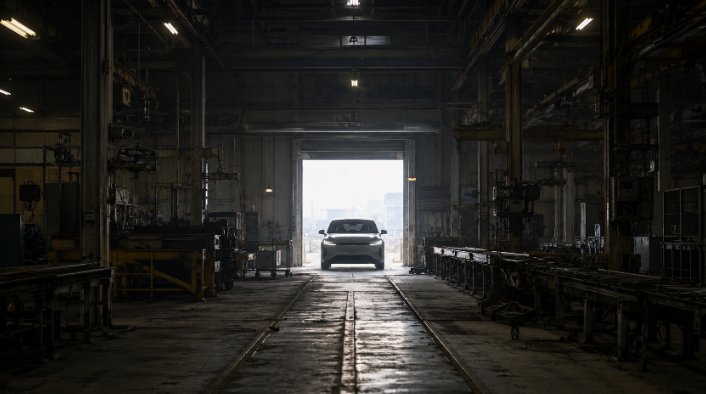
Western automotive manufacturers, the names on the buildings that were supposed to represent industrial sovereignty, national identity, the dignity of making things, are offering space in their empty factories to Chinese producers.
Read that again.
Not partnering on equal terms. Not licensing technology. Not co-developing platforms. Offering floor space. Becoming landlords in their own houses because they can no longer afford to run them as factories.
This is being described, in the financial press, as a strategy. As pragmatism. As “finding ways to remain competitive in a changing landscape.”
It is none of those things. It is absorption. It is the moment when the entity that lost the structural contest offers its physical infrastructure to the entity that won it, in exchange for the employment optics and political cover needed to manage the domestic narrative.
China doesn’t need the factories. It has factories. What it needs, to the extent it needs anything from this arrangement, is a local flag to plant inside the tariff wall, a way to call the product European or American, a way to neutralise the one policy lever the West still holds. The Western partner gets a press release about jobs. China gets regulatory access and a neutralised competitor.
The negotiation is an illusion. The transfer documents are being signed.
What is most revealing about this moment is not the deals themselves. It is the commentary surrounding them. The urgency. The suddenly serious faces. The pivot from “China might win” to “we must act now” without any acknowledgment that acting now is a different thing entirely from acting twenty years ago, when acting would have meant something.
Nobody who dismissed this framework is going to say they were wrong. That is not how consensus systems process failure. What happens instead is vocabulary management. The Overton window moves. The prior position quietly disappears. The same voices that funded the gaslighting, that paid for the ridicule, that commissioned the talking points, update their language and write as though they always understood the structural dynamic. Urgency is performed so it looks like leadership. Late arrival is dressed as awakening.
This is not cynicism. It is a precise description of how institutional narrative repair works.
Here is the thing about energy that every empire in history understood and that the current Western leadership class has chosen to forget.
He who controls the energy lever controls the world. Not metaphorically. Literally, structurally, historically.
Britain did not rule the world because it was virtuous. It ruled because it controlled coal and steam at the precise moment those things determined productive capacity, military reach, and economic dominance. America did not inherit that position through moral superiority. It did so through oil, the internal combustion engine, and the dollar architecture constructed around both. Energy primacy and imperial primacy are not correlated phenomena. They are the same phenomenon wearing different clothes at different moments in history.
Every hegemonic transfer has run through the dominant energy technology of its era. Every single one.
China understood this. The decision made in the early 2000s was not an energy policy. It was a hegemonic bet. A twenty-year programme to acquire control of the technology, the materials, the manufacturing, and the distribution infrastructure of the next energy era. Not just to sell panels and batteries. To hold the lever.
The West didn’t forget this lesson by accident. The people profiting from the existing arrangement had every incentive to ensure it stayed forgotten. The same industry that spent hundreds of millions mocking EVs and manufacturing range anxiety understood perfectly well what was at stake. They chose the next quarter over the next century. And their governments, captured by the same financial logic, let them.
The race framing, “China might win”, is the final act of denial. You don’t use “might” about something that already happened. You use “might” to preserve the psychological fiction that there is still a contest, still an intervention point, still a version of events where Western industrial policy wisdom arrives in time to matter.
There isn’t. The contest ended when the decisions that determined its outcome were made. Everything since has been a consequence.
What remains is not a race. It is a managed transition of industrial and geopolitical weight from one set of hands to another, conducted slowly enough that the populations on the losing end can be kept calm, and dressed in enough competitive language that their leaders can avoid accountability for the decisions, and the decades of deliberate non-decisions, that produced this outcome.
The factories being offered are not part of the strategy. They are a symptom. They are what the end of a structural defeat looks like when it finally becomes impossible to describe as anything else.
The lever has changed hands. What follows from that is not an energy story. It is a power story. And it has only just begun.
I said so. For fifteen years, I said so. Not for the satisfaction of saying it now, that satisfaction is cold comfort when you understand what it actually means. But because the record matters. Because the framework that made it visible twenty years ago is the same framework needed now. Not to reverse what cannot be reversed. But to see clearly, without the managed language and the performed urgency, what is actually being set in motion.
The race is over. The question worth asking now is what kind of world is being built by the side that won it, and whether the side that lost is even capable of asking that question honestly.
Aldo Grech is the author of Silent Echoes, The Great Populism Hustle, and HOW: Elections Are Won in the Digital Age. He writes on political manipulation, narrative capture, and the mechanics of power.
”The future is embedded in the choice”. **Books and [private advisory](http://www.aldogrech.com/)**.
메타데이터
- post_id
- 8bd5537fc49d
- slug
- china-won-twenty-years-ago-8bd5537fc49d
- url
- https://medium.com/@aldogrech55/china-won-twenty-years-ago-8bd5537fc49d
- canonical_url
- https://medium.com/@aldogrech55/china-won-twenty-years-ago-8bd5537fc49d
- author_url
- https://medium.com/@aldogrech55
- status
- ok
- fetched_at
- 2026-06-09 15:37:30