ASM And VAC: The Missing Pieces In The Western Magnet Chain
ASM has the rare-earth alloy bridge. VAC has the magnet customers. Energy Fuels is trying to connect them — but the chain still has to…
ASM And VAC: The Missing Pieces In The Western Magnet Chain
ASM has the rare-earth alloy bridge. VAC has the magnet customers. Energy Fuels is trying to connect them — but the chain still has to prove scale, margin and repeat demand.
The Rare-Earth Story Is Moving Downstream
Australian Strategic Materials delivered 42 tonnes of NdFeB alloy from its Korean Metals Plant in the March 2026 quarter.
That does not make ASM a proven large-scale industrial business.
But it does make ASM different from the usual rare-earth developer selling a mine plan and a future.
ASM has put material through a plant. It has sold product. It has early operating evidence.
VACUUMSCHMELZE, or VAC, is a very different company.
VAC is not trying to prove a mine. It is an old industrial magnet and magnetic materials business. Company and transaction materials describe VAC as having more than a century of history, thousands of employees, more than 1,000 customers, and more than 400 patents.
That is why ASM and VAC now belong in the same conversation.
Energy Fuels announced a proposed acquisition of ASM in January 2026. Then it announced a proposed acquisition of VAC in June 2026.
Those two proposed deals put two very different businesses inside the same Western magnet-chain frame.
ASM has the bridge.
VAC has the customers.
In plain English, ASM and VAC do not do the same job.
ASM makes rare-earth metals and NdFeB alloy. NdFeB means neodymium-iron-boron. It is the key alloy used to make high-strength permanent magnets.
VAC sits further downstream. It makes magnetic materials, permanent magnets, soft magnetic materials and components that go into real industrial products.
That distinction matters.
ASM is closer to the material conversion step.
VAC is closer to the customer and the finished product.
The Western rare-earth problem is not only that the West needs more mines. It also needs the boring industrial middle: metals, alloys, magnets, qualified products and customers willing to buy them.
That is the part China already built at scale.
The West is still trying to rebuild it.
That is why ASM and VAC matter.
Together, they make the Western magnet-chain story more serious.
But they do not make it solved.
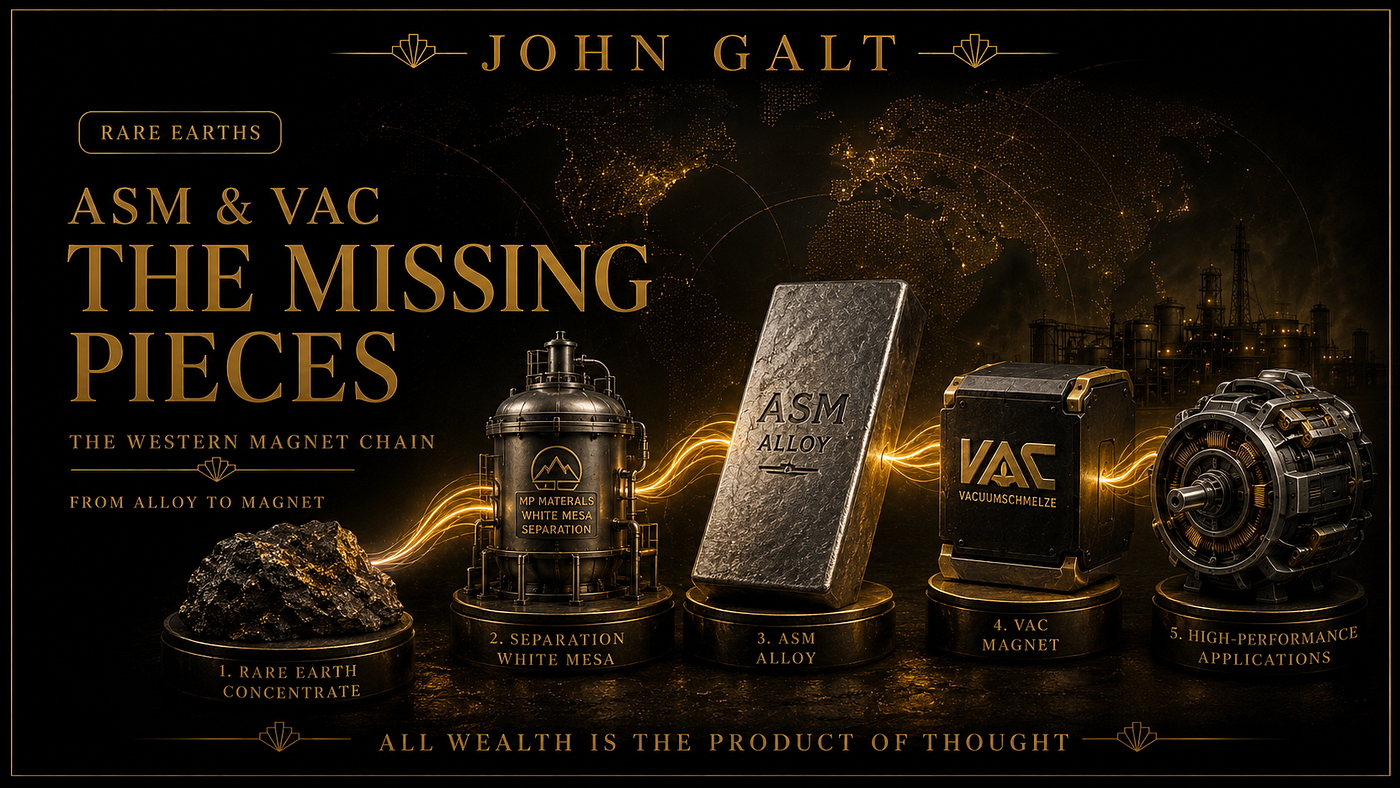
The rare-earth story usually gets sold as a clean diagram.
Mine the material. Separate it. Turn it into metal. Make the alloy. Make the magnet. Sell it to customers.
Easy.
Except it is not easy.
A resource is not a mine. A mine is not a separated oxide. An oxide is not a metal. A metal is not an alloy. An alloy is not a magnet. A magnet is not a qualified customer product. A customer conversation is not repeat demand. And strategic importance is not commercial proof.
Every box in that diagram has to work.
ASM is trying to prove the middle of the chain: rare-earth metals and alloys.
VAC already sits near the customer: magnets, magnetic materials, qualification, manufacturing history and industrial relationships.
That is the opportunity.
The useful question is no longer just: who owns the rare-earth deposit?
The better question is: who can turn rare-earth material into qualified products, at scale, with customers coming back for more?
And for investors, there is one more question.
Who benefits if that chain becomes real?
ASM shareholders may benefit from owning a rare operating bridge in the magnet chain. But ASM has already shown the normal resource-sector problem: a company can become more strategically important while shareholders get diluted along the way.
VAC may be the stronger industrial asset. But public investors cannot buy VAC directly as a standalone listed company.
Energy Fuels shareholders may get a more complete rare-earth business. They also get more complexity, more execution risk and more moving parts.
Customers may get supply-chain optionality.
Governments may get more non-Chinese capacity.
Lenders may protect themselves first.
Sellers may get paid through the transaction.
That is the part investors should not skip.
A Western magnet chain is valuable only if it becomes a margin chain.
The opportunity is real. But the proof still has to show up in volume, margins, repeat demand, financing terms and per-share value.
ASM: The Alloy Bridge
ASM should not be treated like a normal undeveloped rare-earth junior.
That would miss the Korean Metals Plant.
The plant opened in 2022. ASM says Phase 1 has installed capacity of 1,300 tonnes per year of NdFeB alloy. A planned Phase 2 would increase capacity to 3,600 tonnes per year.
This matters because NdFeB alloy sits in the middle of the magnet chain.
It is not mining.
It is not final magnet manufacturing.
It is the step between separated rare-earth material and the magnet producer.
That makes ASM more interesting than a pure “mine someday” story.
But it also raises the standard.
ASM does not get commercial credit just because it owns a strategic mineral project. It has to sell material, get paid, meet specifications, cover costs, and show that customers come back.
The March 2026 quarter gave the market something real to look at.
ASM delivered 42 tonnes of NdFeB alloy. That was more than 70% above the previous quarter. Most of that was tied to an existing 100-tonne contract with Noveon.
After the quarter, ASM received another 84-tonne NdFeB alloy order from an existing customer.
ASM has also reported progress in heavy rare-earth metallization, including 10 kg of terbium metal production.
These are real validation points.
They show ASM can move material through the system.
They do not yet prove large-scale production, strong margins, or a fully funded growth path.
There is also a U.S. angle.
ASM has the Korean Metals Plant today. That is the operating evidence.
But if the Energy Fuels transaction closes, ASM’s metallization and alloy know-how could become relevant beyond Korea. FT reported earlier this year that ASM had plans to build a similar facility in the U.S., and Energy Fuels said ASM’s skills and intellectual property would help it expand rare-earth metal and alloy capacity in the U.S.
That matters because ASM’s value may not be limited to one Korean plant.
The real question is whether ASM’s know-how can travel.
Can the process, customer relationships and operating experience from Korea help build a larger rare-earth metals-and-alloys platform?
That would make ASM more valuable than a single-site alloy story.
But the proof is not the plan. The proof is whether the know-how scales, whether customers return, and whether the economics work outside early production runs.
The financials show why this distinction matters.
ASM reported A$5.965 million of revenue for the half-year to 31 December 2025. Almost all of that came from Korean metal and alloy sales.
It also reported a A$10.953 million loss after tax.
That is not a reason to dismiss ASM.
It is a reason to classify it properly.
ASM is not just a PowerPoint rare-earth company. But it is not yet a self-funding rare-earth materials business.
There is also the share-count problem.
ASM’s shares outstanding increased from 181.34 million at 30 June 2025 to 268.05 million at 31 December 2025.
That is roughly 47.8% dilution in about half a year.
Using the demerger structure from 2020 as a rough starting point, dilution since listing is around 125%.
A shareholder does not own “strategic relevance.”
He owns a percentage of the company.
If the Korean plant, Dubbo and the broader chain need more capital before they generate real cash, ASM can become more important while each share owns less of the final result.
That is the resource-sector trap.
The next step is not another strategic label.
The next step is more volume, more repeat business, clearer margins, and a path that does not require shareholders to keep funding the gap forever.
Dubbo: The Upstream Option
Dubbo is ASM’s long-term upstream asset.
It is not small.
ASM reports 75.18 million tonnes of mineral resources and 18.9 million tonnes of ore reserves.
The project is polymetallic. It includes exposure to rare earths, zirconium, niobium, hafnium and other critical minerals.
ASM describes an initial 20-year project horizon, with additional resource life beyond that.
That gives Dubbo strategic appeal.
If Dubbo becomes financeable, it could give the Western magnet chain something many projects still lack: long-life upstream supply in a friendly jurisdiction, tied to an existing downstream route.
That is the upside.
But Dubbo also brings the normal large-project problem.
Capital.
ASM has discussed a project capital base around A$740 million.
The company has also worked on alternative development routes, including MREP and heap leach concepts. The simple point is this: ASM is studying processing routes that could potentially make Dubbo cheaper to build.
The company has indicated a possible capital reduction of up to around A$200 million, but that remains preliminary.
A pre-feasibility study was expected in the second half of 2026.
That study matters more than the acronym.
If the new route lowers capex without weakening the economics, Dubbo becomes more practical.
If the capital bill remains too heavy, Dubbo stays a large strategic asset with a large funding problem.
A possible capex reduction is not financing.
A PFS is not construction.
A reserve is not cash flow.
A government-friendly commodity is not a business model.
Dubbo could become a serious part of the chain if the economics work and the financing is achievable.
It could give ASM, or a future owner, a long-term source of material in Australia. It could make the downstream business more durable. It could reduce dependence on third-party feedstock.
But Dubbo still has to pass the normal tests: capital cost, operating cost, recoveries, processing performance, permitting, construction risk, offtake support, customer demand and funding terms.
That is the difference between a strategic project and a commercial mine.
Dubbo gives ASM scale.
It does not yet give ASM operating proof.
VAC: Customers, Plants And The U.S. Growth Bet
VAC is the more industrial company in this story.
It makes magnetic materials, rare-earth permanent magnets, soft magnetic materials and components.
This is important because magnets are not just lumps of rare earths.
Different customers need different products. Some need high-performance permanent magnets. Some need soft magnetic materials. Some need components that fit into industrial systems. Some need reliability in applications where failure is expensive or dangerous.
That is why qualification matters.
In advanced magnets, serious customers do not switch suppliers just because a new company has a better story.
They need reliability. They need tight specifications. They need repeatable performance. They need engineering support. They need confidence that the supplier can deliver without creating problems inside machines that cannot fail.
This matters in automotive, defense, aerospace, medical, industrial automation, energy, robotics, data centers and other high-performance markets.
VAC’s history matters here.
The company’s history includes samarium-cobalt magnets in the 1970s and NdFeB products in the 1980s. It has a long industrial record, a broad customer base, product know-how and a large patent portfolio.
That is very different from Dubbo.
A mine developer is trying to prove that rock can become money.
VAC has spent decades proving that materials can become qualified products.
VAC is also not a single-site magnet story.
Reuters reported that VAC supplies more than 1,000 customers from facilities in Germany, the U.S., Malaysia and other countries. Reuters also reported that Energy Fuels intends to keep existing VAC plants open, including one in China, while expanding a facility that opened late last year in South Carolina.
That U.S. angle matters.
VAC’s legacy business gives the story credibility: customers, know-how, patents, qualification and operating history.
The South Carolina plant gives it a growth angle inside the U.S. magnet supply-chain push.
That may be one of the most interesting parts of VAC.
A German industrial magnet business is useful. A qualified magnet business with U.S. expansion potential is more interesting.
Reported figures make the point even sharper. FT reported that VAC’s business excluding the new Sumter, South Carolina facility generated $29 million of adjusted earnings in 2025, while the Sumter facility is expected to generate $130–$140 million in adjusted earnings annually once fully operational.
That does not mean Sumter is already proven.
It means Sumter may be the growth engine inside VAC.
Legacy VAC gives the credibility.
Sumter gives the earnings ambition.
Investors need to know which one they are really paying for.
There is also a data gap.
VAC’s plant-level production is not clearly disclosed in the public information used here. We know VAC has a global footprint. We do not have enough plant-by-plant detail on output, utilization, margins or ramp risk.
That matters.
Without those numbers, investors cannot fully judge how much of VAC is mature cash generation and how much is future ramp ambition.
There is another nuance.
This is not a perfectly clean “China-free” chain from day one.
Existing VAC plants reportedly include one in China, and Energy Fuels intends to keep existing VAC plants open.
That is not automatically bad.
It may be practical.
VAC has customers, assets, employees and production infrastructure. The goal may not be immediate China-free purity. The more realistic goal may be reducing China dependence while keeping a functioning industrial business alive.
That is a more honest way to read the story.
VAC may have customer access that new entrants cannot easily buy.
But the commercial quality of that access still depends on order size, margins, cash flow, U.S. ramp execution, and how much capital the business needs to keep growing.
Where The Full Chain Could Fit Together
This is where Energy Fuels becomes important.
If the transactions close, the proposed chain would look roughly like this:
Vara Mada, Bahia, Donald and other feedstock options on the upstream side.
White Mesa on separation.
ASM on metals and alloys.
VAC on magnets and customer-facing magnetic products.
Dubbo as a possible long-term upstream source.
That is a more complete picture than most Western rare-earth stories can show.
Most companies have one box.
A deposit.
A separation plan.
A magnet dream.
A customer memorandum.
Here, the idea is broader. Energy Fuels is trying to connect upstream feedstock, separation, metallization, alloy production, magnet manufacturing and customers into one platform.
That is why the opportunity is real.
ASM and VAC are not just attaching themselves to a fashionable theme.
ASM has a working middle step.
VAC has a customer-facing magnet business.
Energy Fuels is trying to connect those pieces around a broader rare-earth platform.
If each step strengthens the next step, the chain becomes more valuable.
The upstream assets could become more useful if they provide feedstock into White Mesa.
White Mesa could become more valuable if separated rare-earth products have a clearer route into metal, alloy and magnet demand.
ASM’s Korean Metals Plant could become more useful if it has a clear downstream magnet customer.
ASM’s know-how could become more valuable if it supports a larger U.S. metals-and-alloys buildout.
VAC could become more useful if it has access to a more secure non-Chinese supply route.
Dubbo could become more useful if it supports a real downstream business rather than sitting as an undeveloped resource.
Government support also matters, but only when it becomes something concrete.
ASM’s Dubbo Project has received a A$5 million federal grant for study work. Useful, but small next to the A$740 million project capital base discussed for Dubbo.
Energy Fuels has received a $725 million conditional U.S. loan commitment for domestic rare-earth processing, including separation and metallization. Useful, but conditional is not the same as cash in the bank.
VAC has reported defense-linked demand through a contract to supply magnet materials to the U.S. national defense stockpile, with production expected to start in 2026. That is closer to real demand than a policy speech, but it still has to become production, margins and cash.
Government support is not all equal.
A study grant is not project finance.
A conditional loan is not cash.
A defense-related contract is more useful than political language, but it still needs execution.
That is the version that works: assets, customers, funding and government demand reinforcing each other.
But buying pieces of a chain is not the same as operating a chain.
On a slide, it looks clean.
Upstream feedstock moves toward White Mesa. White Mesa separates. ASM makes metal and alloy. VAC makes magnets and supplies customers. Dubbo may later support the upstream side.
In real life, every link adds capital needs, technical risk, customer risk, working-capital risk and management complexity.
The phrase “vertical integration” sounds great in a presentation.
It creates value only if it lowers costs, improves reliability, increases customer confidence, captures margin or gives the business pricing power.
Otherwise, it just turns a clean diagram into a more complicated business.
For Energy Fuels shareholders, this is the key test.
Does this create a higher-quality business?
Or does it simply create a broader, more capital-intensive story?
A more complete chain can deserve a higher valuation if it improves margins, customer access, reliability or strategic funding.
If it only adds moving parts, the market may eventually treat it as complexity, not value.
The Competition Shows The Real Scale Problem
This is where perspective matters.
ASM and VAC are interesting because they sit in parts of the chain where the West is weak: metals, alloys, magnets and customer qualification.
They are not interesting because they are already large enough to challenge China.
China is still the scale benchmark.
China dominates rare-earth separation, metals, alloys and magnet production. Western companies are not fighting in a balanced market. They are trying to create credible non-Chinese alternatives inside a market China already built at industrial scale.
That is why ASM and VAC matter.
Compared with many Western rare-earth stories, they are more concrete.
ASM has produced alloy.
VAC has customers, plants, qualification history and a U.S. growth angle through Sumter.
MP Materials and USA Rare Earth are trying to build U.S. mine-to-magnet platforms. Lynas and Iluka are more upstream and separation-focused. ASM and VAC are different because they sit in the industrial middle and customer-facing end of the chain.
That does not make them bigger than the competition.
It makes them different.
This is especially important for readers who only follow the mining side.
A rare-earth mine is not enough.
A separation plant is not enough.
The West needs the less glamorous steps after that: metals, alloys, magnets, components, qualification and customer trust.
That is where ASM and VAC sit.
They are not the whole Western answer.
They are test cases for whether the West can rebuild the steps between rare-earth material and real magnet demand.
The Live Verdict
ASM and VAC make the Western magnet-chain story more credible.
That is the positive.
ASM brings real operating evidence through the Korean Metals Plant, rare-earth metals and alloy capability, possible U.S. metals-and-alloys relevance, and long-term upstream optionality through Dubbo.
VAC brings the customer-facing magnet business: qualification, magnetic materials know-how, manufacturing history, customer relationships, a global footprint and a U.S. growth angle through Sumter.
Energy Fuels is trying to connect these pieces into something larger than the individual boxes.
That is why the story is worth watching.
It is not a fake story.
It is a serious attempt to solve real gaps in the Western rare-earth magnet chain.
But serious is not the same as proven.
ASM still has to show that its bridge can become recurring, profitable supply.
Dubbo still has to show that it can become financeable.
VAC still has to show that its legacy business and U.S. expansion can translate into durable cash generation.
Energy Fuels still has to show that putting the pieces together creates a stronger business, not just a larger and more complicated one.
The next test is not whether these assets matter.
They probably do.
The test is whether they can generate margins, fund growth, hold customers, ramp Sumter, scale metals-and-alloys know-how, and leave enough economics behind for common shareholders.
Until then, ASM and VAC are not just missing pieces in the Western magnet chain.
They are proof tests for whether the West can build one that actually pays.

https://johngalt88.substack.com/
A Message from InsiderFinance

Thanks for being a part of our community! Before you go:
- 👏 Clap for the story and follow the author 👉
- 📰 View more content in the InsiderFinance Wire
- 📚 Take our FREE Masterclass
- 📈 Discover Powerful Trading Tools
메타데이터
- post_id
- 8be570a97a41
- slug
- asm-and-vac-the-missing-pieces-in-the-western-magnet-chain-8be570a97a41
- url
- https://wire.insiderfinance.io/asm-and-vac-the-missing-pieces-in-the-western-magnet-chain-8be570a97a41
- canonical_url
- https://wire.insiderfinance.io/asm-and-vac-the-missing-pieces-in-the-western-magnet-chain-8be570a97a41
- author_url
- https://medium.com/@johngalt88
- status
- ok
- fetched_at
- 2026-07-31 07:06:29