I Rarely Trust My First Reaction Anymore. Here’s What I Reach for Instead.
Five questions, one for every kind of challenging moment.
BETTER QUESTIONS · BETTER JUDGMENT · BETTER RESPONSES
I Rarely Trust My First Reaction Anymore. Here’s What I Reach for Instead.
Five questions, one for every kind of challenging moment.
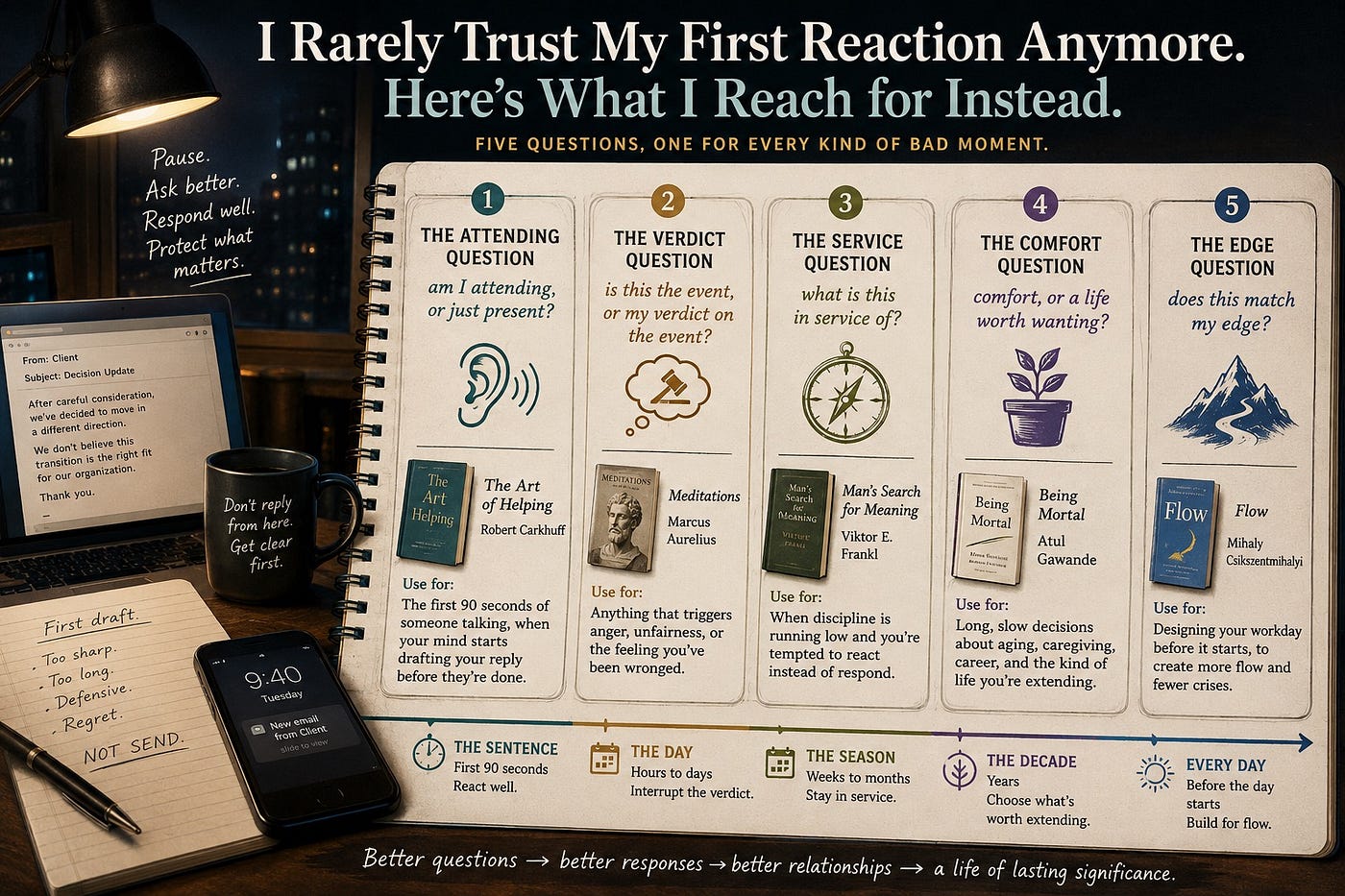
Sometimes the wisest response isn’t your first reaction. It’s the question you ask before you answer. / Author created image using AI
The call came in at 9:40 on a Monday night. A client I’d coached for three years was pulling out of a leadership transition we’d spent four months preparing, and the email explaining why had exactly the tone you’d expect from someone who’d already decided I was the reason it failed.
My first draft of a reply took me six minutes to write and would have taken about six months to recover from if I’d sent it.
I didn’t send it. Instead, without fully noticing, I reached for a couple of the same questions I’ve been running for years, from a small set I keep on hand for exactly this kind of moment. Not all five apply every time. Most days, I only need one, sometimes two. But I’ve never regretted the times I stopped to ask, and I’ve regretted plenty of the times I didn’t.
Here are all five, with the book behind each one and the specific kind of moment each one is actually built for.
The Attending Question: Am I attending, or just present?
This one comes from The Art of Helping, by psychologist Robert Carkhuff, a book I’ve kept since a graduate seminar sixty years ago. Carkhuff broke the entire helping relationship into four learnable skills: attending, responding, personalizing, and initiating. Attending is the first one because it’s the one everyone assumes they already have and almost nobody actually practices.
I ask this question the moment someone else is talking, and I notice my brain has started drafting my response before they’ve finished their sentence. That night, the client’s email deserved to be read twice before I answered it once. The first read is when most bad replies are written, because you’re responding to the version of the message your anxiety has already assembled, not the one actually sent.
The Verdict Question: Is this the event, or my verdict on the event?
This is straight out of Meditations, the private notebook Marcus Aurelius kept during a military campaign, never intended for anyone but himself, which is exactly why it has no performance in it. Aurelius wrote that we have power over our own minds, not outside events, and that realizing this is where real strength comes from.
I use this question for anything that triggers an immediate spike of anger or a sense of unfairness. The client’s email was the event. My interpretation of it as a personal attack and a verdict on three years of work was a separate thing I added a half-second later, entirely on my own. Aurelius made that half-second visible to me years ago. Once you can see it, you can interrupt it before it is sent as an email.
The Service Question: What is this in service of?
Viktor Frankl earned this one the hard way. He was a psychiatrist who survived Auschwitz, and his central finding still stops me cold: the prisoners most likely to survive weren’t the strongest or most resourceful. They were the ones who still had a reason, a person to return to, unfinished work, some thread of meaning pulling them forward through conditions built to strip every reason away.
I run this question when my own discipline is running low, and I’m tempted to react instead of respond. Discipline is a finite resource. It burns out under enough pressure, especially at 9:40 on a Tuesday when you’re tired, and someone just implied three years of your work was wasted. Meaning doesn’t run out the same way. Asking what my reply was actually in service of- the relationship, the client’s real interest, my own integrity, not my ego- changed what I wrote next.
The Comfort Question: comfort, or a life worth wanting?
This one comes from Being Mortal, by the surgeon Atul Gawande, and it’s the newest addition to my list, added after years of sitting at kitchen tables with homebound elderly clients through a nonprofit I help run. Gawande found that modern medicine had gotten so good at extending life that it forgot to ask what kind of life was being extended. In one study he cites, nursing home residents given a single plant to care for, something with a small dependent need of its own, showed measurably better outcomes than residents given nothing to tend.
I don’t use this question in emails. I use it for slower decisions, career moves, how I structure my remaining working years, and how I advise clients thinking about their own decline or their parents’ decline. It’s a check against optimizing for the easiest path when the easiest path and the meaningful path have quietly stopped being the same thing.
The Edge Question: Does this match my edge?
Mihaly Csikszentmihalyi spent decades collecting data on peak human experience for his book Flow, and the findings surprised nearly everyone, including him. It isn’t leisure or relaxation that produces our best hours. It’s total absorption in a task that sits exactly at the edge of your skill level, hard enough to demand full attention, not so hard that it produces anxiety.
I run this question at the start of a workday, not in a crisis. It’s the only one of the five that isn’t about damage control. It’s about designing the hours so the other four questions come up less often in the first place.
How I actually know which one to reach for
I don’t run all five every time something goes wrong. That would be exhausting, and honestly, it would mean I’d stopped trusting my own judgment entirely, which isn’t the goal. The goal is knowing which question belongs to which kind of moment, so I’m not reaching for a decade-scale question during a ninety-second problem, or a ninety-second question during a decision that deserves months of sitting with it.
Questions one and two, Attending and Verdict, live in the first ninety seconds of something going wrong, a sharp email, a tense conversation, a flash of anger in traffic. The Service Question shows up later, when ninety seconds have turned into ninety days and discipline alone has started running thin. The Comfort Question is reserved for the long, slow decisions, the ones about aging, caregiving, or how to spend years you can’t get back, where there’s no single moment to rise to, just a direction to keep choosing. The Edge Question isn’t for damage control at all. It’s what I use before the day starts, to lower how often the other four come up in the first place.
The sentence. The day. The season. The decade. Most advice only knows how to talk to one of these, and gets handed to you as if it applies to all four.
It doesn’t. That’s usually why a piece of advice feels right when you read it and wrong when you try to use it three weeks later on a completely different kind of problem.
What I actually sent
I read the client’s email a second time. I asked what my reply needed to be in service of. Then I wrote something almost embarrassingly short: an acknowledgment that the timing was hard, a specific and honest account of where I thought the transition had actually gotten stuck, and one direct question about whether they wanted to finish it or end it cleanly. No defense of myself. No litigating the four months.
They called the next morning. We finished the transition three weeks later.
You don’t need to have read a single one of these books to use the questions they gave me. But the one that sticks with you longest won’t be the one you found interesting on a page. It’ll be the one you actually reached for at 9:40 on some future Tuesday night, when it mattered which question you had on hand.
Further reading to consider:
About the Author
Gary L. Fretwell is a #1 international best-selling author and practitioner of Intentional Living, blending neuroscience with Stoic philosophy to help creators and leaders build a life of lasting significance.
He’s the author of six books on intentional living and retirement, including the #1 international bestseller The Magic of a Moment, Intentional Retirement, Embracing Retirement, and Rewiring the Ring, which explores the cognitive science of tinnitus. His latest, The Identity Ghost, is a blueprint for designing a life of purpose through ancient wisdom and modern neuroscience.
On Medium, Gary founded and edits Illumination: Retirement, Aging & Legacy and Illumination Beyond Identity, and serves as an editor across the broader ILLUMINATION network.
Off the page, he serves as Board President for Prescott Meals on Wheels and mentors MBA students at Western Governors University.
📖 garyfretwell.com · 📬 The Wise Effort on Substack · ✍️ Follow on Medium
메타데이터
- post_id
- 8c7265aa09d2
- slug
- i-rarely-trust-my-first-reaction-anymore-heres-what-i-reach-for-instead-8c7265aa09d2
- url
- https://medium.com/illumination-curated/i-rarely-trust-my-first-reaction-anymore-heres-what-i-reach-for-instead-8c7265aa09d2
- canonical_url
- https://medium.com/illumination-curated/i-rarely-trust-my-first-reaction-anymore-heres-what-i-reach-for-instead-8c7265aa09d2
- author_url
- https://medium.com/@gary_fretwell
- status
- ok
- fetched_at
- 2026-07-09 22:34:41