The Future of Enterprise AI: How Agentic AI, Semantic Kernel, and Model Context Protocol (MCP) Are…
By Prashant Sharma, Founder & CEO CraticAI (12+ Years in developing AI Systems — Field experience Ex — Accenture, Microsoft)
The Future of Enterprise AI: How Agentic AI, Semantic Kernel, and Model Context Protocol (MCP) Are Building the Next Generation of Intelligent Enterprise Platforms
By Prashant Sharma, Founder & CEO CraticAI (12+ Years in developing AI Systems — Field experience Ex — Accenture, Microsoft)
By Prashant Sharma, Founder & CEO CraticAI (12+ Years in developing AI Systems — Field experience Ex — Accenture, Microsoft)
“Enterprise AI is the future belongs to intelligent platforms where AI agents reason, collaborate, access enterprise systems securely, and execute business workflows autonomously.”
For the past few years, the AI industry has been obsessed with one thing:
Large Language Models.
Every discussion revolved around which model was better.
GPT.
Claude.
Gemini.
Llama.
While foundation models have transformed artificial intelligence, they represent only one layer of an enterprise AI system.
Building enterprise AI is no longer about choosing the smartest model.
It is about building systems that can think, access enterprise knowledge, coordinate multiple services, and execute business processes safely and reliably.
This is where three technologies are shaping the next generation of enterprise software:
- Agentic AI
- Semantic Kernel
- Model Context Protocol (MCP)
Together, they provide the intelligence, orchestration, and connectivity required for production-grade enterprise AI.
Enterprise AI Is Becoming a System, Not a Feature
Most AI applications today still follow a simple pattern.
User → Prompt → LLM → Response
This architecture is sufficient for demonstrations and lightweight assistants.
It is insufficient for enterprise operations.
Real organizations require AI to interact with:
- ERP platforms
- CRM systems
- Manufacturing Execution Systems (MES)
- HR applications
- Finance systems
- SharePoint
- Databases
- IoT devices
- Internal APIs
- Identity providers
- Governance frameworks
Enterprise AI therefore becomes a distributed system rather than a single model.
Agentic AI: From Answers to Autonomous Execution
Agentic AI represents the evolution from conversational AI to goal-oriented AI.
Instead of responding to one prompt at a time, AI agents pursue objectives through reasoning, planning, memory, tool usage, and controlled execution.
A traditional chatbot answers:
“How do I perform equipment maintenance?”
An enterprise AI agent can:
- retrieve the latest maintenance procedure
- verify technician certification
- schedule downtime
- reserve spare parts
- create work orders
- notify supervisors
- log actions for compliance
- escalate exceptions when necessary
The shift is profound.
Enterprise software moves from answering questions to completing work.
Semantic Kernel: The Intelligence Orchestrator
Reasoning alone is not enough.
Enterprise workflows involve multiple decisions, systems, and AI services.
This is where Semantic Kernel becomes important.
Semantic Kernel is Microsoft’s open-source framework for orchestrating AI capabilities alongside traditional software components.
Rather than treating an LLM as an isolated API, Semantic Kernel enables developers to coordinate:
- prompts
- functions
- enterprise APIs
- memory
- planners
- plugins
- business rules
- multiple AI models
into a single intelligent workflow.
Think of Semantic Kernel as the operating layer that coordinates how enterprise AI behaves.
It transforms isolated AI calls into reliable business processes.
Model Context Protocol (MCP): The Universal Connector
Enterprise AI also needs secure and standardized access to organizational systems.
Historically, every AI application required custom integrations for every service.
This created fragmented architectures and duplicated engineering effort.
Model Context Protocol (MCP) introduces a standardized way for AI applications to communicate with external tools, data sources, and enterprise services.
Instead of writing individual connectors for every AI model, organizations expose capabilities through MCP servers.
AI systems discover and use those capabilities consistently.
Just as HTTP standardized communication between web browsers and websites, MCP aims to standardize communication between AI systems and enterprise resources.
How They Work Together
Each technology solves a different challenge.
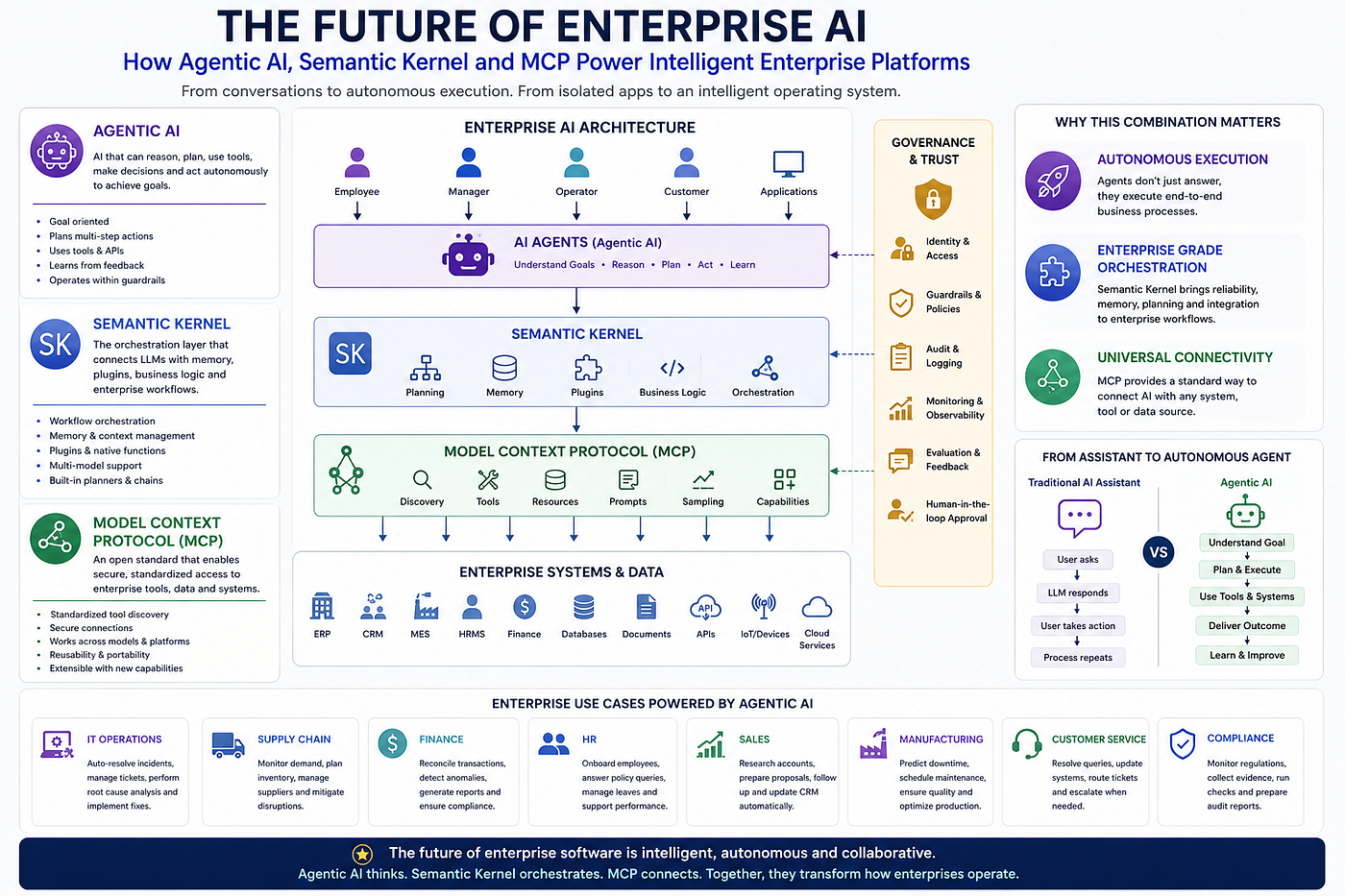
TechnologyPrimary RoleAgentic AIGoal-oriented reasoning and autonomous executionSemantic KernelWorkflow orchestration, planning, memory, and coordinationModel Context Protocol (MCP)Secure, standardized access to enterprise tools, APIs, and data
Together they form a complete enterprise AI architecture.
Enterprise User
        │
        ▼
AI Copilot / AI Agent
        │
        ▼
Semantic Kernel
Planning • Memory • Plugins • Orchestration
        │
        ▼
Model Context Protocol (MCP)
Standardized Tool & Data Access
        │
        ▼
Enterprise Systems
ERP • CRM • MES • HRMS • SharePoint • Databases • APIs • IoT
        │
        ▼
Governance • Security • Audit • Observability
The model generates intelligence.
Semantic Kernel coordinates execution.
MCP provides trusted access to enterprise capabilities.
Business systems remain the authoritative source of data.
Why This Architecture Scales
Enterprise AI succeeds when responsibilities are separated.
- Foundation models focus on language understanding and generation.
- Semantic Kernel coordinates workflows and decision logic.
- MCP standardizes enterprise connectivity.
- Business applications remain systems of record.
- Governance enforces security, permissions, and compliance.
This modular architecture makes it easier to replace models, extend functionality, and scale across departments without redesigning the entire platform.
From One Assistant to an Intelligent Workforce
The future enterprise will not rely on one general-purpose AI assistant.
Instead, organizations will deploy specialized AI agents.
Examples include:
- Engineering Agent
- Compliance Agent
- Procurement Agent
- Maintenance Agent
- Quality Agent
- HR Agent
- Finance Agent
- Customer Support Agent
- Production Planning Agent
- Sales Copilot
These agents collaborate through shared enterprise knowledge, orchestration frameworks, and standardized access to business systems.
The result is a coordinated digital workforce rather than a collection of isolated chatbots.
What This Means for Enterprise Builders
The long-term competitive advantage will not come from using a particular model.
Models evolve rapidly.
Organizations can switch providers.
The durable value lies in building:
- enterprise knowledge platforms
- orchestration layers
- governance frameworks
- secure integrations
- reusable workflows
- domain-specific AI agents
- observability and evaluation systems
- extensible developer ecosystems
These capabilities create sustainable enterprise platforms that continue to improve as organizations generate more data and operational experience.
Looking Ahead
Enterprise AI is entering a new phase.
The conversation is shifting to “How do we build intelligent enterprise systems?”
Agentic AI enables autonomous reasoning and execution.
Semantic Kernel orchestrates complex workflows.
Model Context Protocol provides standardized access to enterprise capabilities.
Together, they transform AI from a conversational interface into an operational layer embedded within the enterprise.
The next generation of software will not simply respond to prompts.
It will understand goals, coordinate specialized agents, interact securely with enterprise systems, and execute business processes under human governance.
That is the future of enterprise AI.
And it has only just begun.
메타데이터
- post_id
- 8c75dbee657b
- slug
- the-future-of-enterprise-ai-how-agentic-ai-semantic-kernel-and-model-context-protocol-mcp-are-8c75dbee657b
- url
- https://medium.com/@prashant.sharma_2931/the-future-of-enterprise-ai-how-agentic-ai-semantic-kernel-and-model-context-protocol-mcp-are-8c75dbee657b
- canonical_url
- https://medium.com/@prashant.sharma_2931/the-future-of-enterprise-ai-how-agentic-ai-semantic-kernel-and-model-context-protocol-mcp-are-8c75dbee657b
- author_url
- https://medium.com/@prashant.sharma_2931
- status
- ok
- fetched_at
- 2026-07-16 23:46:37