How Polish Is Different from English
Why your English logic stops working in Polish
How Polish Is Different from English
Why your English logic stops working in Polish

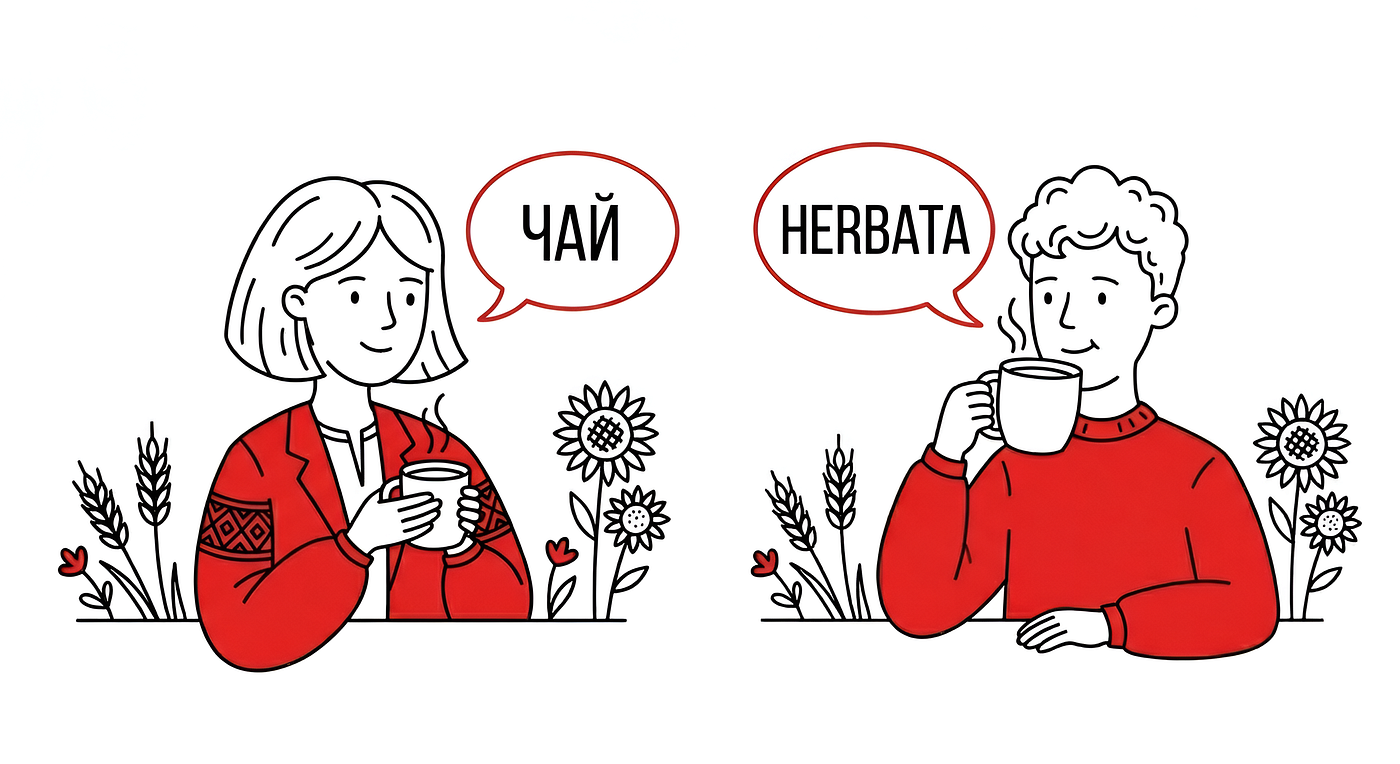
Image generated by the author with Gemini
You open Google Translate, type “I am excited,” hit the microphone, and proudly announce to your Polish colleague: “Jestem podniecony.”
The room goes silent. A child in the corner drops their birthday cake.
Turns out podniecony doesn’t mean excited. It means aroused. Sexually.
Welcome to Polish.
Actually, **podniecony in the dictionary also translates as excited, but it’s better to use [podekscytowany](https://wsjp.pl/haslo/podglad/31075/podekscytowany/5213977/czlowiek)** to avoid any unnecessary interpretations.
Part 1: The Alphabet Is Fine. The Sounds Are a Crime.
Polish uses the Latin alphabet. Great news! You can read it!
Except you absolutely cannot.
Start with something simple.
Happiness.
One of the first words you’d want to know in any language.
In Polish, that’s **szczęście**.
Six letters in English, eight in Polish — and roughly zero of them behave the way you’d expect. The szcz at the start is a single compressed sound. The ę has a nasal hook on it. The whole word sounds nothing like it looks, and yet Polish people say it casually, daily, without thinking twice.
Speaking of hooks — those little tails on ą and ę are not decoration. They’re called nasal vowels, and they are pronounced nothing like a plain a or e. The ą sounds closer to the on in the French word bon. The ę is softer, somewhere between en and a plain e, especially at the end of a word. Skipping the nasal quality makes you sound foreign immediately — and it’s one of the last things learners manage to get right.
Then there’s the ł. It looks like an l with a little strike through it, and beginners dutifully try to pronounce it like an l.
Wrong.
It sounds exactly like the English w — as in water. So Łódź (the name of Poland’s third-largest city) starts with a w sound. Once you know that, you can actually read it.
But knowing it and doing it are different things.
The plain l, meanwhile, sounds like the English l — but softer, with the tongue touching the teeth rather than the roof of the mouth. It’s a small difference that takes weeks to hear, let alone reproduce.
Part 2: Cases, Genders, and the Slow Erosion of Your Sanity
In English, the word dog is dog. Always. Whether you love the dog, walk the dog, give food to the dog, or dream about the dog, it’s still just dog.
In Polish, that same dog is pies, psa, psu, psem, psie — depending on what role the dog plays in the sentence.
There are 7 grammatical cases.
They apply to every noun, every adjective, and every pronoun. Multiply that by singular and plural, and you’re looking at 14 possible forms for a single word.

Screenshot of the Polish word “pies” (dog) as listed on Wikisłownik
“I’ve been studying Polish for 8 months and I still feel like nouns are personally attacking me.”
- — spotted on Threads*
Then there’s grammatical gender. Polish has three: masculine, feminine, and neuter.
But masculine isn’t just masculine — it splits into animate (people, animals) and inanimate (objects). The word dog and the word table are both grammatically masculine, but they decline differently because one of them is alive. Unfortunately, feminine nouns don’t get this distinction. One rule for all.
Oh, and child — *dziecko — is neuter. Grammatically, it’s an it. Not every mother is thrilled to hear her baby referred to as ono*. And honestly, that’s not even a Stephen King reference. It’s just Polish grammar.
If you want a slightly deeper dive into how genders actually work for nouns and why it’s less chaotic than it sounds, I wrote a whole piece on that here:
[embed]Is Polish Grammar Sexist? My students ask me this every yearmedium.com
The FSI (the US government body that ranks language difficulty) estimates English speakers need roughly **1,100 hours** to reach professional fluency in Polish. For comparison, Spanish takes about 600.
Part 3: Word Order, or: How to Sound NOT Like Yoda and Be Grammatically Correct
English word order is fixed and sacred.
“The dog bit the postman” means something very different from “The postman bit the dog.”
You’d never mix those up.
In Polish, both sentences could theoretically contain the same words in different orders — and it would be fine, because the case endings tell you who’s biting whom.
Word order in Polish isn’t about grammar. It’s about emphasis.
- Jutro idę do pracy — I’m going to work tomorrow (neutral).
- Jutro do pracy idę — Tomorrow is when I go to work (stress on when).
- Idę jutro do pracy — I am the one going to work tomorrow (stress on who).
For a Pole or any other Slavic speaker, these nuances are instinctive.
The emphasis lands exactly where they want it.
For an English speaker, all three versions sound like Yoda had a stroke — and yet all three are completely correct. You construct a sentence, feel proud of yourself, and then discover you accidentally stressed the wrong word and now sound passive-aggressive at a dinner party.
So, Should You Learn Polish?
So, if you decide to learn Polish, here’s what to expect:
- Sounds that don’t match the letters — szcz, ą, ę, and ł will challenge your ears and tongue.
- 7 grammatical cases — every noun, adjective, and pronoun changes depending on its role.
- 3 genders, with masculine split into animate and inanimate — even your dog behaves differently from your table.
- Flexible word order — emphasis often decides the meaning, making you feel like Yoda sometimes.
- False friends and tricky words — knowing the right term avoids awkward situations.
Remember: Polish is challenging, quirky, and at times frustrating — but every correct sentence that comes out naturally is the reward. You’ll get there, one step at a time.
Actually, I don’t know your reason for learning Polish.
- Maybe you want to visit Poland — its historically breathtaking old towns, the Baltic coast in summer, a bowl of proper żurek on a cold morning.
- Maybe your partner is Polish, or your grandparents were, and you want to reclaim something that belongs to you.
- Maybe you’re moving there for work.
- Or maybe you’re like Elizabeth Gilbert with Italian — you heard the language once, something clicked, and you decided it was simply worth learning for its own sake.
Whatever the reason, now you know what you’re walking into.
Good luck!
Remember: Polish is challenging, quirky, and at times frustrating — but every correct sentence that comes out naturally is the reward. You’ll get there, one step at a time.
For lifehacks, prompts, and strategies on how to learn a language faster without drowning in information, follow my blog here on Medium. No noise, just what actually works.
메타데이터
- post_id
- 8c7afe2a545a
- slug
- how-polish-is-different-from-english-8c7afe2a545a
- url
- https://medium.com/language-mind/how-polish-is-different-from-english-8c7afe2a545a
- canonical_url
- https://medium.com/language-mind/how-polish-is-different-from-english-8c7afe2a545a
- author_url
- https://medium.com/@polskizleo
- status
- ok
- fetched_at
- 2026-06-12 07:40:50