The Dust Nobody Talks About: Why Blast Hole Drilling Teams Are Losing More Than They Realize
And what a complete dust control system actually looks like in the field
The Dust Nobody Talks About: Why Blast Hole Drilling Teams Are Losing More Than They Realize
And what a complete dust control system actually looks like in the field
There’s a moment every drilling supervisor knows.
The rig starts up. The DTH hammer fires its first cycle. And within sixty seconds, the collar disappears into a grey cloud that swallows the working area whole.
On most sites, nobody stops. The crew pulls their masks up, the operator adjusts the controls by feel, and production continues. Dust is just part of the job.
But that assumption — that dust is an unavoidable cost of doing business in open-pit mining and quarrying — is quietly expensive. And in most cases, it’s based on a misunderstanding of where drilling dust actually comes from, and what can realistically be done about it before the rig turns its first revolution.
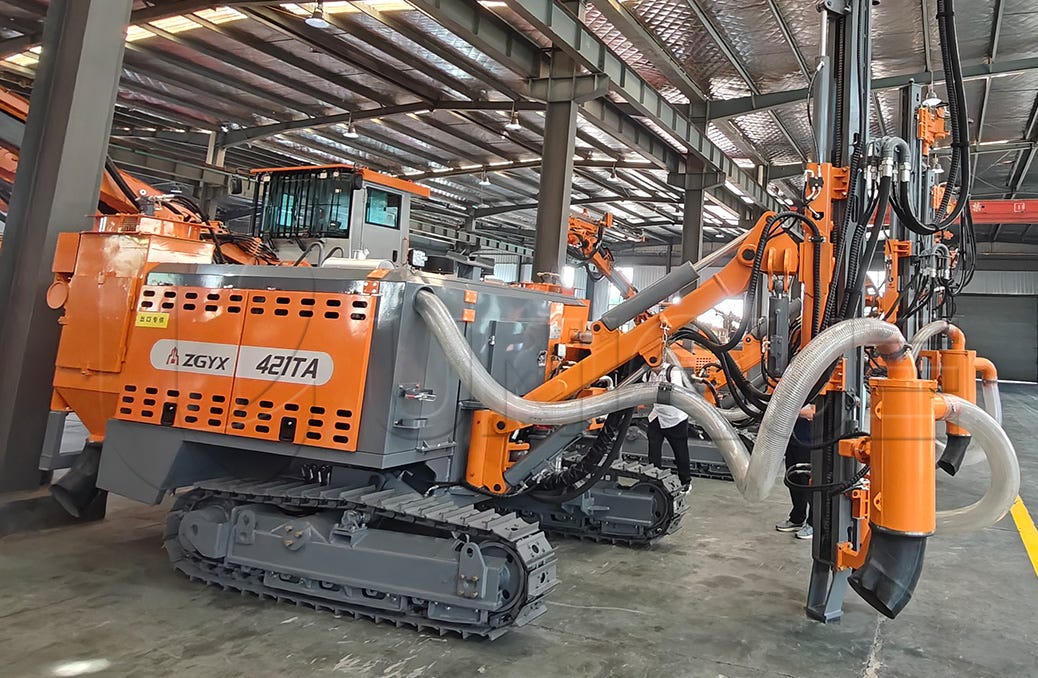
The physics of drilling dust
To control dust in DTH blast hole drilling, you need to understand why it forms in the first place — because the source isn’t random. It’s built into the working mechanism itself.
DTH drilling relies on two systems operating simultaneously: a high-frequency percussion hammer that fractures rock, and a high-pressure compressed air system that evacuates cuttings from the hole. Both are essential. And both contribute directly to dust generation.
The hammer breaks rock into a spectrum of particle sizes. Large fragments are discharged and fall around the collar. Fine particles — the ones light enough to stay suspended — are caught by the upward airflow and carried into the atmosphere above the rig. The stronger the airflow, the wider they disperse.
Three factors push dust generation higher:
Dry and fractured rock formations. Rock that’s already cracked or desiccated produces more fine particles per hammer blow. The structural integrity isn’t there to hold fragments together, so impact breaks material into finer debris than the same hammer would produce in competent rock.
Unoptimized air pressure. This is the most common controllable variable that teams get wrong. More air pressure feels like more performance — faster cuttings evacuation, cleaner hole. In practice, excess airflow beyond what the annular space requires simply accelerates fine dust dispersion across the work zone.
Worn or incorrectly specified drill bits. A button bit in good condition fractures rock on impact. A worn bit grinds it. Grinding produces ultra-fine particles at a far higher rate than clean percussion, and those particles are exactly the size most likely to stay suspended and most hazardous to inhale.

Why DTH drilling is a special case
Not all drilling methods create the same dust problem. DTH is particularly challenging because compressed air is integral to its operation in a way that other technologies — rotary, top hammer — don’t replicate.
The air isn’t auxiliary. It drives the hammer and clears the hole. There’s no separating dust generation from the core working process, which means dust management can’t be an add-on. It has to be engineered into the system from the start.
This is the gap between how most sites approach dust control and how professional operations treat it. On the average site, dust suppression is something that gets addressed after production is already running — a water truck called in, a dust collector retrofitted, operating parameters adjusted after the fact. On well-managed sites, dust suppression is part of the equipment selection conversation, the compressor sizing discussion, and the operating parameter sheet.
The difference in outcome is significant.
What actually works: a system view
Get airflow right — not high
The single most impactful parameter adjustment most sites can make is airflow calibration. The target isn’t maximum airflow. It’s adequate airflow: enough upward velocity in the annular space between drill pipe and hole wall to evacuate cuttings without suspending fine particles further than necessary.
This requires matching airflow to the actual geometry of the hole — diameter, depth, pipe OD — and the actual cuttings load from the rock being drilled. It’s a calculation, not a setting to push to maximum and forget.
Insufficient airflow has its own consequences. Cuttings that don’t evacuate get reground by the bit. Regrinding produces more ultra-fine dust, slows penetration rate, and increases bit wear. The dust problem gets worse precisely because operators didn’t use enough air.
The optimum sits between these failure modes. Find it, and you get cleaner holes, faster drilling, and significantly less airborne dust.
Intercept dust at the collar
Most of the dust that becomes a visibility and health problem on drilling sites isn’t generated in the hole — it’s released at the collar. The orifice is where pressurized, dust-laden air meets the open atmosphere, and without interception, it fans outward immediately.
Collar-level dust control is the highest-leverage physical intervention available because it addresses dust at the moment of release, before dispersion occurs. The options aren’t complicated: collar enclosures that restrict the discharge zone, flexible curtains around the working area, localized extraction equipment positioned at the orifice, or water spray nozzles that knock fine particles down before they travel.
Any combination of these, applied consistently, produces dramatically better results than attempting to control dust after it has already spread across the site.
Use dry dust collection where water isn’t viable
Water-based suppression — injected into the hole or sprayed at the collar — is highly effective where it can be used. It wets cuttings before they reach the air, turns dust into manageable slurry, and handles fine particles that mechanical systems miss.
But water isn’t always available. Arid sites, remote locations, water-restricted permits, and projects where mud accumulation creates its own handling problem all push teams toward dry alternatives.
Dry dust collection solves this cleanly. The system draws dust-laden air from the collar through sealed ducting into a filter unit, captures fine particles, and returns clean air to the atmosphere. No water, no mud, no secondary waste stream to manage.
Integrated configurations mount directly on the rig for compact, mobile operation. Standalone units offer positioning flexibility across multi-point drilling layouts. Either way, a properly specified dry collector provides closed-loop dust capture that matches what water suppression can achieve in favorable conditions.
Replace bits before they start grinding
Bit management is the dust control measure that most teams overlook, because it doesn’t look like dust control. It looks like maintenance.
The connection is direct. A button bit in serviceable condition produces a predictable cuttings distribution — mostly coarse to medium particles that evacuate cleanly. A worn bit loses its fracturing geometry and begins grinding the rock face instead of percussing it. Grinding produces a disproportionate volume of ultra-fine particles — exactly the fraction that stays airborne longest and travels furthest from the rig.
Regular button inspection, matched to the abrasiveness of the rock being drilled, and prompt replacement when wear crosses threshold, is one of the most cost-effective dust reduction measures available. It also protects penetration rate and hammer life simultaneously.
Maintain the air system
The compressor and engine air intakes on a drilling rig operating in a dusty environment are under continuous stress. Filters accumulate material every shift. Intake efficiency degrades gradually, without any single dramatic failure that prompts action.
The consequence is a slow degradation of compressed air output — less volume, less stability — that disrupts both cuttings evacuation and dust suppression. Sites that don’t build air system maintenance into their daily inspection routine find themselves chasing performance problems without a clear cause.
Daily checks, scheduled cleaning, and timely filter replacement aren’t exceptional measures. They’re the baseline for keeping a DTH system performing as specified.

Integrated vs. split configurations: does it matter for dust?
A common question in equipment selection is whether integrated DTH drills — where the rig and compressor share a single chassis — handle dust better than split configurations where the two units are separate.
The short answer is that configuration doesn’t determine dust control outcome. What determines it is whether the dust collection system, airflow parameters, and compressor output are correctly matched to the site conditions, regardless of whether they arrive on one chassis or two.
Integrated units offer easier setup and centralized system management. Split units offer compressor flexibility and positioning options that suit irregular or space-constrained sites. Both can achieve excellent dust suppression with the right matching. Neither does so automatically.
The balance point
It’s worth being direct about one thing: extreme dust suppression isn’t the goal.
Flooding the hole with water beyond what’s needed creates mud handling problems and site cleanliness issues that generate their own operational costs. Running a high-capacity dust collector when the site doesn’t require it accelerates filter consumption and maintenance frequency. Dust control measures have to be proportionate to the actual dust load and site conditions.
The professional standard is a calibrated system — one where efficient cuttings removal, adequate dust suppression, and reasonable operating cost are in balance. Drilling teams that achieve this aren’t sacrificing performance for compliance. They’re running cleaner, faster, and with lower total cost than sites that treat dust as an afterthought.
Planning a DTH blast hole drilling project?
If you’re configuring equipment for an upcoming mining or quarry project, the time to address dust control is before you finalize your compressor sizing, your bit selection, and your operating parameters — not after your first week on site.
UNIQUEMAC’s engineering team works with drilling operations across West Africa, South America, Central Asia, and Southeast Asia. Share your hole diameter, target depth, rock formation type, and site conditions, and we’ll help you configure a system that handles both performance and dust from day one.
📲 WhatsApp: +86 158 9060 9031 🌐 Website: www.uniquedrilling-tech.com
#BlastHoleDrilling #DTHDrilling #DustControl #OpenPitMining #QuarryOperations #MiningEquipment #DrillingEngineering #ZGYX #UNIQUEMAC
메타데이터
- post_id
- 8c80eeb2bc0f
- slug
- the-dust-nobody-talks-about-why-blast-hole-drilling-teams-are-losing-more-than-they-realize-8c80eeb2bc0f
- url
- https://medium.com/@uniquevania83/the-dust-nobody-talks-about-why-blast-hole-drilling-teams-are-losing-more-than-they-realize-8c80eeb2bc0f
- canonical_url
- https://medium.com/@uniquevania83/the-dust-nobody-talks-about-why-blast-hole-drilling-teams-are-losing-more-than-they-realize-8c80eeb2bc0f
- author_url
- https://medium.com/@uniquevania83
- status
- ok
- fetched_at
- 2026-09-08 03:47:45




