When Lab Results Can’t Wait: Designing a Mobile PCR Container Lab for Epidemic Response
How a 40-foot shipping container became a fully functional molecular diagnostic lab capable of processing 1,000+ samples per day at the…
When Lab Results Can’t Wait: Designing a Mobile PCR Container Lab for Epidemic Response
How a 40-foot shipping container became a fully functional molecular diagnostic lab capable of processing 1,000+ samples per day at the point of outbreak.
During Thailand’s COVID-19 surge in 2021, one of the most critical bottlenecks in the response was not the availability of RT-PCR technology — it was the infrastructure to deploy it where it was needed most. Central laboratories were overwhelmed. Sample transport added days. Patients waited 5–7 days for results that should have arrived in hours.
The solution was not to build more centralized labs. It was to bring a fully compliant molecular laboratory directly to the point of outbreak — contained within a 40-foot shipping container.
“Instead of sending samples to the lab, we sent the lab to the samples — deployable, biosafe, and operational within 48 hours of arrival.”
The real problem: workflow containment, not equipment
RT-PCR requires three physically separated zones to prevent cross-contamination: RNA extraction, master mix preparation, and qPCR analysis. These cannot share airspace. Any improvised setup that ignores this separation will produce unreliable results — rendering the testing meaningless at the worst possible moment.
This meant a deployable solution had to be engineered with real biosafety containment: negative pressure rooms, HEPA-filtered exhaust, UV decontamination, and a strict one-way workflow. The container lab delivers all of this in a footprint of 12.19 × 2.44 meters.
Inside the lab: four zones, one direction
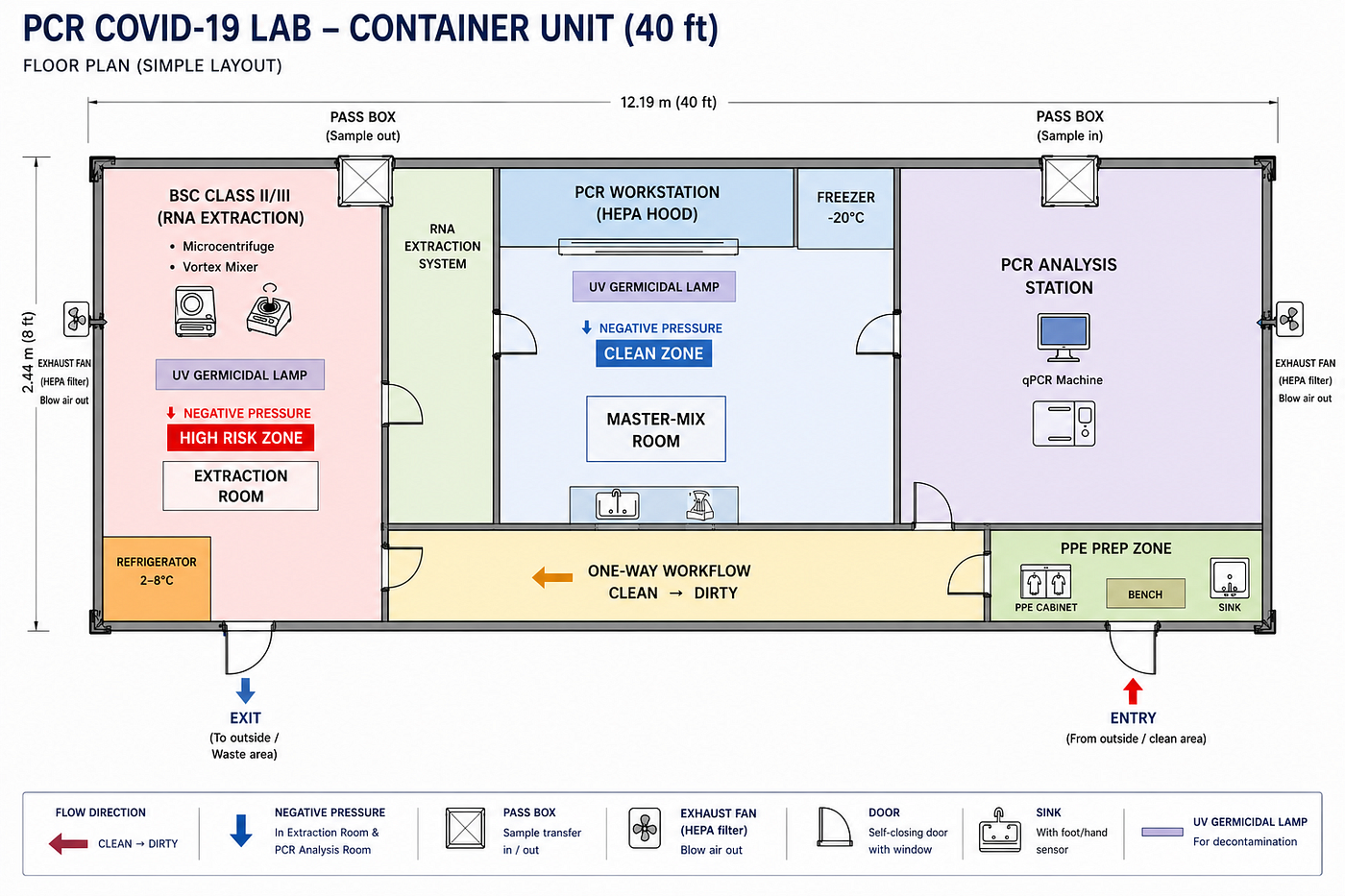
Figure 1: Floor plan of the PCR COVID-19 Container Lab (40 ft / 12.19 m). The layout enforces a strict one-way workflow from clean to dirty zones, with negative pressure maintained in both the Extraction Room and PCR Analysis Station.
All photographs were taken at an actual client site in Pathum Thani Province, Thailand, in 2021 — one of the country’s highest-burden provinces during the Delta wave surge, recording up to 460 new confirmed cases per day and multiple active clusters linked to factory workers and surrounding communities. These images document a fully operational container lab deployed in direct response to that outbreak

Figure 2: Extraction Room (ห้องสกัดสารพันธุกรรม) — the high-risk zone where RNA extraction from patient samples is performed. The room operates under negative pressure with HEPA-filtered exhaust. Biohazard waste containers and reagent storage are clearly visible.

Figure 3: Master Mix Room (ห้องเตรียมสาร PCR) — the clean zone for PCR reagent preparation. Equipped with pipettes, vortex mixer, and dedicated reagent storage shelving, separated from the extraction area to prevent cross-contamination.

Figure 4: PCR Analysis Station inside the container lab. A real-time qPCR machine with integrated touchscreen display is connected to a laptop workstation for result interpretation, housed in a dedicated negative-pressure room with independent air conditioning.
All personnel and samples move in a single direction — clean to dirty — with no backflow permitted. Samples enter via a pass box on the right (Sample In), travel through extraction and amplification, and exit via a dedicated waste route on the left. The Extraction Room and PCR Analysis Station both operate under negative pressure, ensuring any aerosol generated is contained within the zone where it was produced.
Zone breakdown:
- PPE Prep Zone — Entry point, gowning, foot-sensor sink. Clean baseline for all personnel.
- Master Mix Room — PCR reagent preparation under HEPA hood. UV germicidal lamp, –20°C freezer for reagent storage.
- Extraction Room — BSC Class II/III for RNA extraction. Negative pressure, HEPA exhaust, microcentrifuge, vortex mixer. High-risk zone.
- PCR Analysis Station — Real-time qPCR machine with connected workstation. Negative pressure, HEPA exhaust fan, pass box for report output.
Why this model works at scale
A team of three to four Medical Laboratory Scientists can sustain continuous batch processing, achieving throughput exceeding 1,000 samples per day. Because the lab is positioned at or near the collection point, cold-chain risk is minimized and results are available to clinicians within the same shift — enabling real-time isolation and treatment decisions that centralized labs simply cannot support during a surge.
The container unit can be transported by truck, positioned on any level surface, and made operational within 24–48 hours. It requires no construction permits, no permanent infrastructure, and no modification to existing facilities.
“Diagnostic speed is a life-saving intervention. A result delayed by five days is, in epidemic terms, no result at all.”
This model is not COVID-specific. The same principles — zone separation, negative pressure, one-way workflow, and rapid deployability — apply to any molecular outbreak response. Whether the next epidemic involves influenza, mpox, hemorrhagic fever, or a pathogen not yet identified, this container lab model can be installed at the point of outbreak and adapted for the target pathogen with minimal modification. It is reusable, reconfigurable, and built to serve wherever the next threat emerges.
The author is a Medical Laboratory Scientist with MLS(ASCPi)CM certification and hands-on experience in molecular diagnostics and RT-PCR-based testing across institutional and commercial settings in Thailand and the United States.
메타데이터
- post_id
- 8ca34ee49181
- slug
- when-lab-results-cant-wait-designing-a-mobile-pcr-container-lab-for-epidemic-response-8ca34ee49181
- url
- https://medium.com/@potcharanat0383/when-lab-results-cant-wait-designing-a-mobile-pcr-container-lab-for-epidemic-response-8ca34ee49181
- canonical_url
- https://medium.com/@potcharanat0383/when-lab-results-cant-wait-designing-a-mobile-pcr-container-lab-for-epidemic-response-8ca34ee49181
- author_url
- https://medium.com/@potcharanat0383
- status
- ok
- fetched_at
- 2026-06-09 15:37:30