When the Body Becomes the Interface: Martial Arts in 2075
Fifty years from now, the fighter who trains hardest may not be the one who sweats the most — but the one who thinks the deepest.
When the Body Becomes the Interface: Martial Arts in 2075
Fifty years from now, the fighter who trains hardest may not be the one who sweats the most — but the one who thinks the deepest.
Martial arts have always been a dialogue between the human body and physics. Every kick, every lock, every breath is a negotiation with gravity, leverage, and pain. But what happens when the body itself changes — when it is augmented, connected, and partially synthetic? The next fifty years will likely produce combat disciplines we cannot fully name yet. Here is my best attempt at predicting what they will look like.
1. Neuro-Kinetic Fighting: Training the Signal, Not the Muscle
Today’s fighters spend years drilling the same techniques until movement becomes reflex. The limiting factor is the brain-to-body latency — the milliseconds it takes for a decision to become motion. By 2075, brain-machine interface (BMI) technology will likely be precise enough that elite fighters will train at the neurological layer directly.
Rather than repeating a guard break ten thousand times in a gym, practitioners may run neural simulations that encode movement patterns directly into motor cortex pathways. The body still trains, but the mental reps happen at machine speed.
A new discipline will emerge — tentatively called Neuro-Kinetics — focused entirely on optimizing signal latency between intent and execution. Competitions will measure not just who wins, but whose nervous system reacted in fewer milliseconds.
2. Bionics and the End of the Weight Class
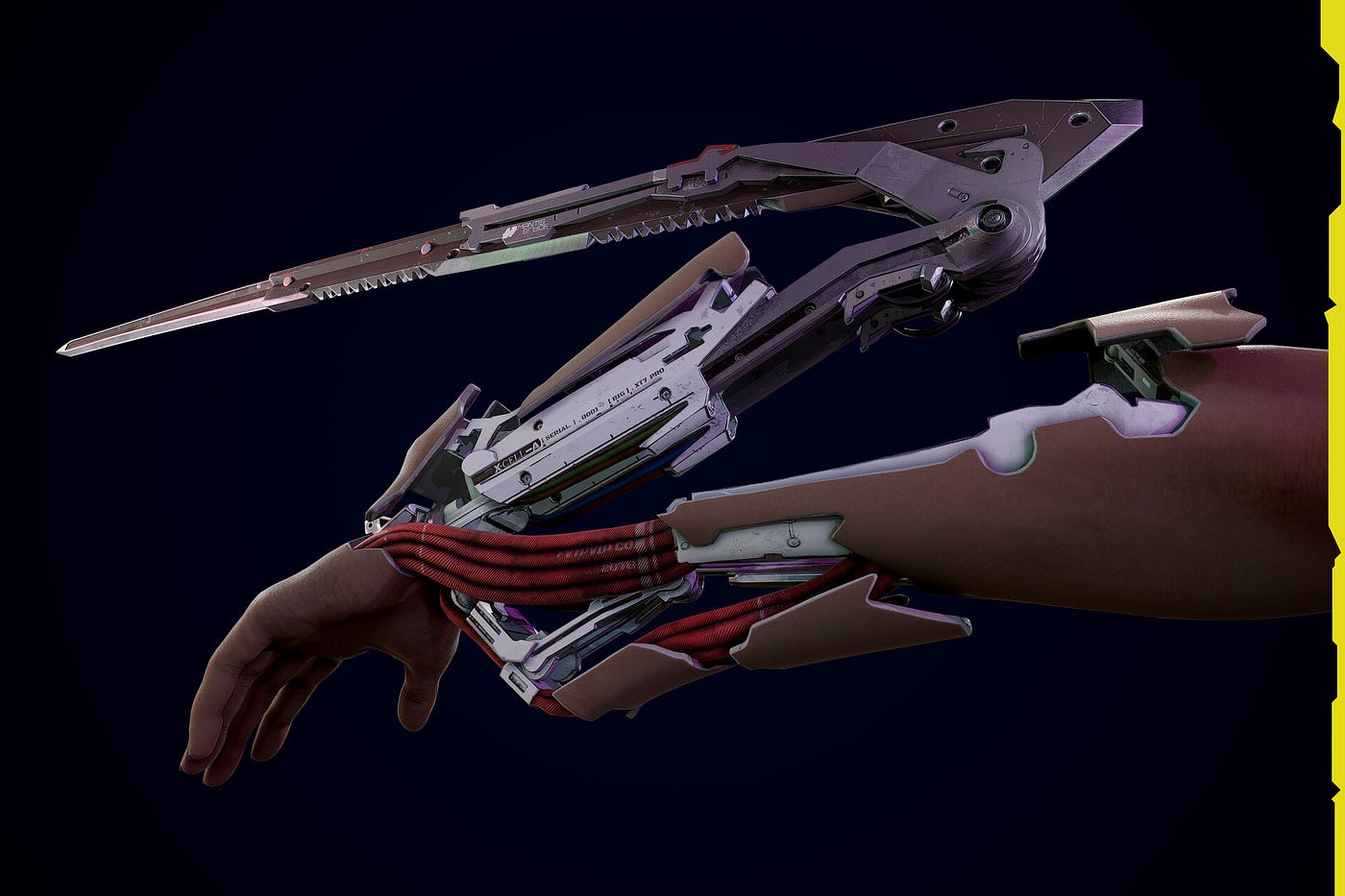
Modern combat sports organize competitors by body weight because mass and reach translate directly into power and leverage. Bionics will shatter this assumption. A fighter with two prosthetic arms engineered for optimized torque does not belong in the same weight class as a fully organic opponent — nor does she belong in a “bionic” class if her legs are biological.
By mid-century, regulatory bodies will almost certainly have to adopt a capability index rather than a weight class — a composite score measuring structural advantages, reaction time augmentation, and pain threshold modification. This will be one of the most contested political battles in the history of combat sports.
“The question won’t be how heavy you are. It will be how much of you is still you.”
The first major international split in martial arts governance will happen over bionic classification. One faction will push for full integration with strict capability caps. Another will insist on an Organic Division where augmentation is banned entirely — preserving what purists will call “the original human martial art.”
3. AI as the Permanent Sparring Partner
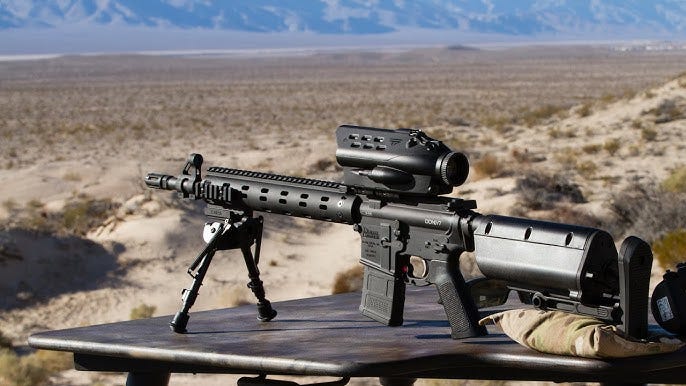
Current AI can already analyze a fighter’s biomechanics from video and identify micro-inefficiencies invisible to the human eye. In fifty years, every serious practitioner will train against a personalized AI opponent — one that has modeled every one of their tendencies, bad habits, and psychological patterns, and that relentlessly exploits them.
This will produce fighters with far fewer technical gaps. But it will also create a new vulnerability: the AI-trained fighter who has never developed genuine instinct under real psychological pressure. The gym that can simulate authentic threat response — not just technique — will become the most valuable training environment on earth.
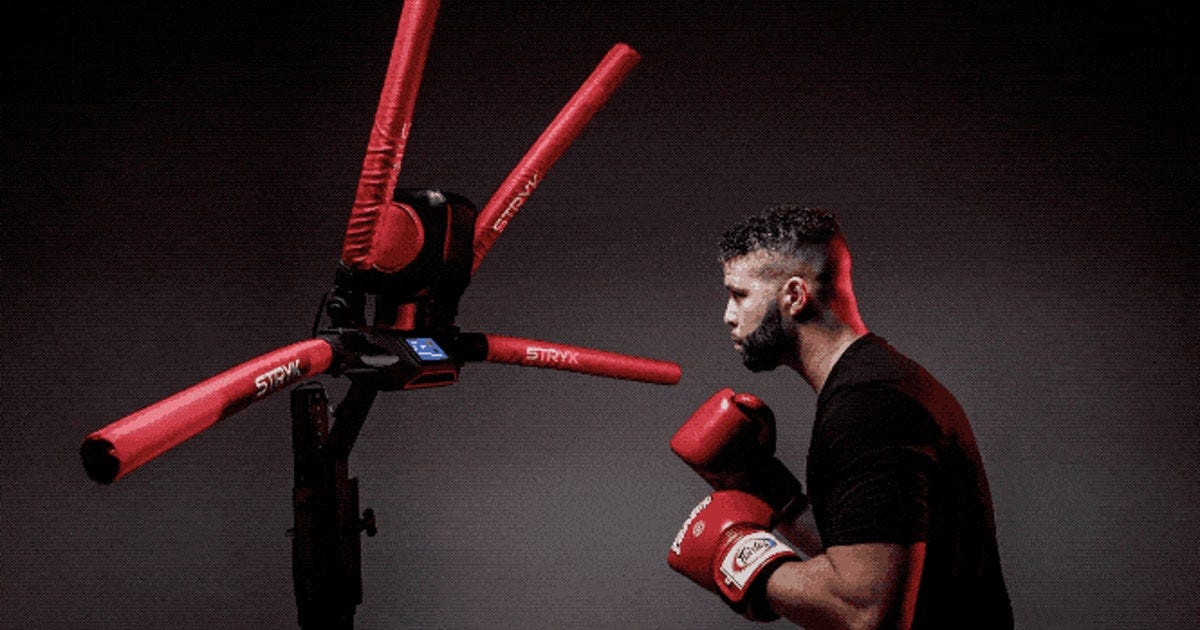
AI-assisted training will create an unintended renaissance in traditional, untracked sparring. Just as vinyl records came back after digital streaming, mat time with no sensors and no AI will become the premium training experience — valued precisely because it cannot be optimized.
4. Environmental Fighting Arts
Contemporary martial arts were mostly developed for flat surfaces, stable footing, and predictable opponents. Future combat — whether in disaster-response scenarios, off-planet environments, or high-density urban terrain — will demand something different. A discipline built for microgravity. One built for flooded streets. One built for the cramped corridors of a space habitat.
These are not science fiction scenarios. Emergency responders already train for rubble environments. As human presence extends into low-gravity environments over the coming decades, the physical grammar of self-defense will need to be rewritten from first principles.
The first recognizable microgravity grappling style will be codified by 2060, originating from long-duration space station crew safety protocols — not from a competitive sport context. It will look nothing like judo or wrestling. Leverage without ground is a completely different problem.
What Stays the Same
For all the transformation ahead, the core of martial arts will remain unchanged: the cultivation of composure under pressure, the relationship between practitioner and body, and the ethics of controlled force. No interface can replace the moment when fear arrives and training either holds or breaks. That is the permanent center of every fighting art, and it will still be there in 2075.
The body will change. The tools will change. The arena will change. The fighter — the person inside all that technology — will not.
5. The Praying Mantis Revisited: Nature’s Blueprint for the Augmented Fighter
Before humans ever theorized about brain-machine interfaces or bionic limbs, a small insect had already solved most of the problems we are now trying to engineer. The praying mantis — Mantodea — is arguably the most biomechanically sophisticated predator on earth relative to its size. And in 2075, its anatomy may serve as the primary design template for augmented combat systems.
This is not a new idea. In 17th-century China, a fighter named Wang Lang watched a mantis defeat a cicada and was so impressed that he reverse-engineered the insect’s movements into a complete fighting system: Tang Lang Quan, or Mantis Boxing. It became one of the foundational styles of Chinese kung fu. What Wang Lang did intuitively — extract and formalize biological principles — future engineers will do with far more precision.
What makes the mantis extraordinary
Strike speed: 50–83 milliseconds
The mantis strike is among the fastest limb movements in the animal kingdom — faster than the human eye can track. It achieves this not through raw muscle power alone, but through a biological spring-latch mechanism that stores elastic energy and releases it instantaneously.
360-degree compound vision
The mantis has five eyes — two large compound eyes and three simple eyes — giving it near-complete spatial awareness with exceptional depth perception. It can track movement across its entire environment without moving its body, eliminating the telegraphing that human fighters cannot avoid.
Controlled stillness as a weapon
The mantis is a master of negative motion — it moves only when it is advantageous to move, and stays completely still otherwise. This stillness is not passive. It is a calculated suppression of all movement cues that a prey animal’s nervous system is wired to detect.
Raptorial forelimbs with serrated grip
The forelegs are engineered for two simultaneous functions: seizing and immobilizing. The inner surface is lined with spines that lock prey in place the moment contact is made. In human terms, this is a takedown and a joint lock executed in a single movement at strike speed.
180-degree neck rotation
The mantis is the only insect capable of turning its head independently of its body — a feature that allows it to track targets with precision while its body remains motionless. The tactical implication is enormous: full situational awareness with zero positional commitment.
“Nature spent 100 million years optimizing the mantis for combat. We are only now developing the tools to understand what it built.”
What 2075 Fighters Will Borrow From It
The spring-latch mechanism — storing energy in a compressed structure and releasing it faster than a muscle alone could fire — is already being studied for prosthetic limb design. A bionic forearm built on this principle would not need to be “swung” like a human arm. It would be pre-loaded, then released. The distinction matters enormously: a telegraphed swing can be read and countered; a latch release cannot.
The mantis’s visual system will likely inspire sensor arrays for augmented fighters — not cameras bolted onto a helmet, but distributed optical sensors integrated at the joint and shoulder level, feeding a processed spatial map directly to the fighter’s perception layer. The goal is not to give the fighter more to look at, but to eliminate blind spots entirely.
And the principle of controlled stillness — the discipline of suppressing movement until the moment of commitment — will almost certainly become a formal training module in augmented combat academies. When your opponent’s AI reads micro-movements, the fighter who generates none has an existential advantage.
By 2070, at least one major combat sport federation will officially certify a fighting style directly derived from mantis biomechanics — not the 17th-century kung fu interpretation, but a new system built from scratch using high-speed imaging, elastic energy modeling, and bionic prototyping. They will almost certainly call it something that honors the original. Tang Lang will come full circle.

- The Reckoning: Which Martial Arts Survive 2075 — and Which Don’t
Most conversations about the future of fighting are careful not to offend anyone. This one will not be. Every martial art is built on a set of assumptions about the human body, the nature of conflict, and the context in which violence occurs. When those assumptions change — and they will change dramatically over the next fifty years — some disciplines will adapt, some will fossilize, and some will simply cease to be relevant. Here is the honest assessment.
“A martial art is only as alive as the threat it was designed to answer. Change the threat, and you change everything.”
THE VERDICT:
Brazilian Jiu-Jitsu (BJJ) → SURVIVES Ground control, leverage, and submission logic are body-agnostic. Even augmented limbs get caught in triangles.
Muay Thai → EVOLVES Eight-point striking system is structurally complete. Will evolve its clinch game for bionic opponents, but the core survives.
Wrestling (Greco-Roman / Freestyle) → SURVIVES Positional control over another body is the most fundamental combat skill. No technology makes takedowns irrelevant.
Judo → EVOLVES Throw mechanics rely on gripping a uniform. Augmented opponents change grip geometry entirely. Judo must reinvent its entry system or become a sport curiosity.
Traditional Karate → MUSEUM Point-sparring, kata performance, and ritual bowing have no combat application against augmented opponents. Will survive only as cultural heritage — not as a fighting system.
Krav Maga → SURVIVES Built entirely around real-world threat scenarios. As threats evolve — drones, bionic attackers, chemical agents — Krav Maga’s doctrine will evolve with them. It has done so before.
Aikido → EXTINCT Redirection-based technique assumes a committed, telegraphed attacker. A 50-millisecond mantis-strike bionic arm is not redirectable. Aikido’s philosophical contributions outlive its combat utility.
Capoeira → EVOLVES Rhythm-based movement and deception are genuinely advanced concepts. The dance disguise becomes more — not less — valuable when opponents use AI pattern recognition. Capoeira’s unpredictability is its future.
Wing Chun → MUSEUM Centerline theory and chain punching are scientifically sound. But the style was designed for close-range organic opponents. Against bionic reach, its range assumptions collapse.
Silat → EVOLVES Weapon integration, low stances, and multi-directional footwork are among the most sophisticated in any tradition. Silat’s environmental adaptability makes it a strong candidate for space-age reformulation.
Tai Chi (as combat) → EXTINCT The internal power theory has never been empirically validated at competitive level. Against data-driven opponents, untestable principles are liabilities, not advantages.
Boxing → SURVIVES Head movement, footwork, and punch economy are universally applicable. Boxing’s simplicity is its immortality — it will be the baseline layer inside every future hybrid system.
Mantis Boxing (Tang Lang Quan) → EVOLVES The only traditional style built directly on biomechanical observation of a superior predator. In 2075, this becomes a research template, not just a style.
— -
Why the “Dead” Arts Will Be Hardest to Let Go
Aikido and Tai Chi as combat systems will almost certainly be extinct by 2075 — and this will be genuinely painful for millions of practitioners. Both traditions carry extraordinary depth in philosophy, movement meditation, and community. Their demise as fighting systems does not diminish that. But confusing spiritual practice with combat effectiveness is a category error that both disciplines have encouraged for decades, and the next generation of data-driven fighters will not make it.
The museum arts — Karate and Wing Chun — face a different fate. They will be preserved with great care and taught in cultural institutions. Children will learn them the way children learn classical music: not to perform professionally, but to understand where their culture came from. This is an honourable end. It is not survival.
Most controversial prediction: The dominant fighting system of 2075 will not have a name yet. It will be a synthesis — a core of Wrestling and BJJ for positional control, Boxing for striking economy, Muay Thai for close-range power, Capoeira for unpredictability, and Silat for weapon and environmental integration — rebuilt from scratch using AI performance data and bionic compatibility testing. It will look like nothing that exists today. And its practitioners will probably still argue about which traditional art it came from.
The Fighter That Was Always There
Fifty years from now, someone will wake up before sunrise, wrap their hands, and step onto a mat. The room will be different. The technology surrounding them will be unrecognizable to us. Their body may carry augmentations we cannot fully imagine. But the act — the deliberate, repeated confrontation with one’s own limits — will be exactly the same as it was ten thousand years ago.
This is what every prediction in this article points toward, if you follow it far enough. The bionic limb is still a limb. The AI sparring partner is still a sparring partner. The mantis-inspired strike still lands on a human being who feels it. Technology changes the tools of fighting. It has never changed, and will never change, why people fight — to know themselves, to test themselves, to be ready.
— -
“The martial arts that survive the next fifty years will not be the ones that were most traditional. They will be the ones that were most honest about what they were.”
— -
The praying mantis did not evolve its strike over a hundred million years because it wanted to be impressive. It evolved because the alternative was starvation. Every martial art that survives to 2075 will do so for the same reason: because it solves a real problem better than anything else available. Sentiment does not factor into it. History does not factor into it. Only the question matters — does this work?
The arts that cannot answer that question will be remembered fondly. The ones that can will still be bleeding on mats somewhere at three in the morning, the way they always have been.
Some things do not change. That is not nostalgia. That is the point.
— -
If this piece made you want to argue — good. That means it was honest. If you train, I’d genuinely like to know which art you think I got wrong. Leave it in the comments.
메타데이터
- post_id
- 8ca3fe0486e1
- slug
- when-the-body-becomes-the-interface-martial-arts-in-2075-8ca3fe0486e1
- url
- https://medium.com/@2031bruce/when-the-body-becomes-the-interface-martial-arts-in-2075-8ca3fe0486e1
- canonical_url
- https://medium.com/@2031bruce/when-the-body-becomes-the-interface-martial-arts-in-2075-8ca3fe0486e1
- author_url
- https://medium.com/@2031bruce
- status
- ok
- fetched_at
- 2026-07-12 01:29:19