Financial Inclusion through QRIS and Digital Payment in Rural Communities
Inclusive finance is an important tool for promoting inclusive and sustainable economic development. Financial inclusion means that…
Financial Inclusion through QRIS and Digital Payment in Rural Communities
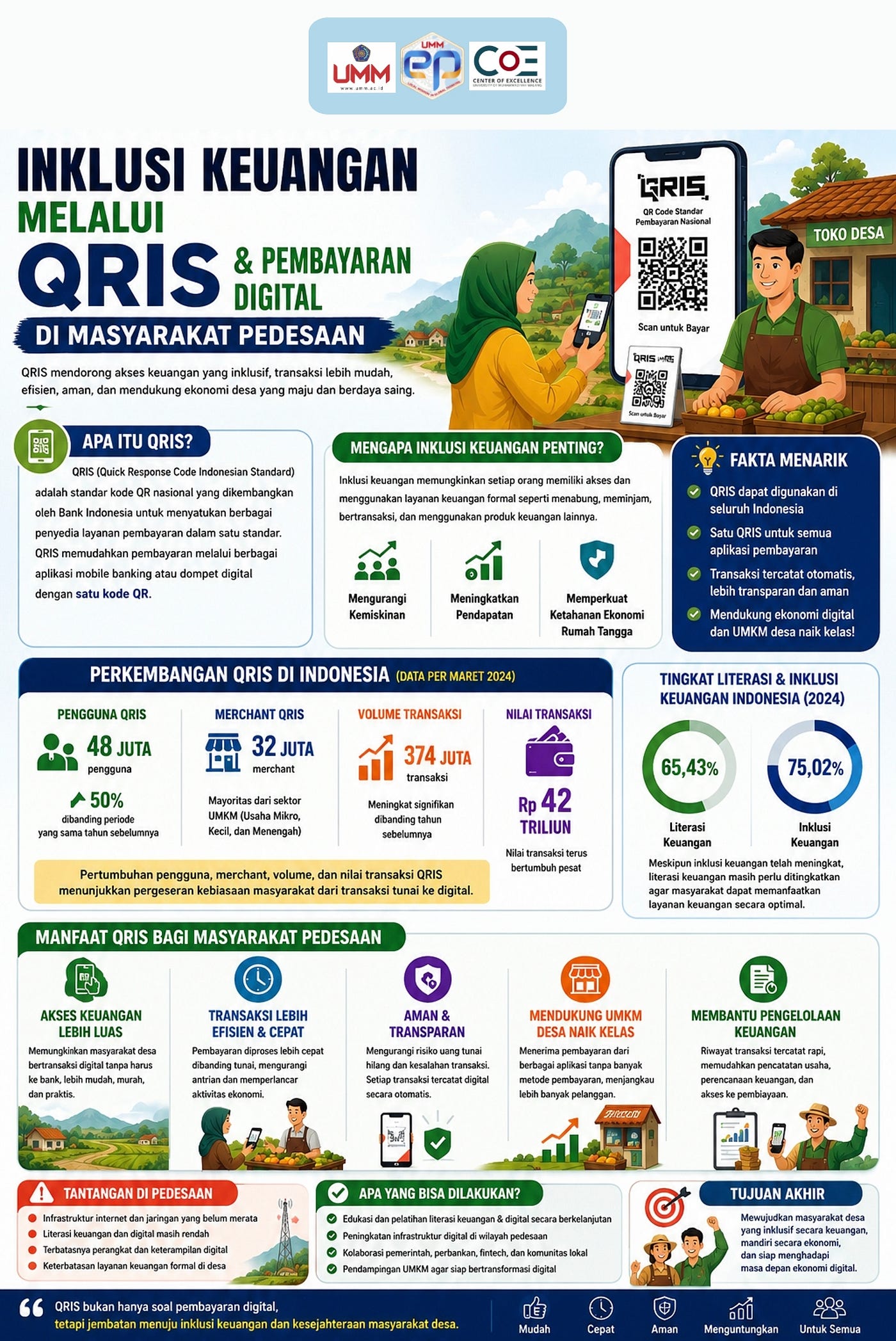
Inclusive finance is an important tool for promoting inclusive and sustainable economic development. Financial inclusion means that everyone in society has access to and can use formal financial services, such as saving, getting loans, making payments, and using other financial products. The availability of easily accessible financial services not only helps improve people’s welfare but also encourages more productive economic activity. According to the World Bank (2022), financial inclusion is one of the factors that helps reduce poverty, increase income, and strengthen household economic resilience. Therefore, increasing public access to formal financial services has become a top priority in the national development plans of many countries, including Indonesia.
In the Indonesian context, efforts to increase financial inclusion still face many challenges, especially in rural areas. Poor financial infrastructure, uneven distribution of banking institutions, and low financial literacy are factors that influence the limited use of formal financial services by rural communities. This situation causes some people to still rely on cash transactions and informal financial systems to meet their economic needs. According to the 2024 National Financial Literacy and Inclusion Survey (SNLIK), Indonesia’s financial inclusion rate is 75.02%, while its financial literacy rate is 65.43% (Financial Services Authority, 2024). These data indicate that although access to financial services has increased, the public still needs a better understanding of how to use financial products and services.
Advances in information and communication technology have brought significant changes to the modern financial system. Digital transformation in the financial sector has driven the development of numerous innovations aimed at expanding access to formal financial services for the general public. One form of this innovation is a digital payment system that allows people to conduct financial transactions electronically without using cash. The digitization of payment systems is seen as capable of reducing geographical barriers, lowering transaction costs, and increasing efficiency in economic activities. Demirgüç-Kunt et al. (2022) explain that the use of digital financial technology plays a crucial role in expanding financial inclusion, especially for groups previously excluded from formal financial services.
One of the fastest-growing digital payment innovations in Indonesia is the Quick Response Code Indonesian Standard (QRIS). QRIS is a national QR code standard developed by Bank Indonesia to unify various payment service providers into a single, uniform standard. The presence of QRIS allows people to make payments through various mobile banking applications or digital wallets using just one QR code. This national standard aims to improve transaction efficiency, increase acceptance of digital payments, and support the growth of the digital economy (Bank Indonesia, 2024).
The use of QRIS in Indonesia shows a very positive trend. According to data from the Indonesian Payment System Association (ASPI), the number of QRIS users in March 2024 reached around 48 million, which is an increase of around 50 percent compared to the same period the previous year (Ahdiat, 2024a). In addition, the number of merchants who have adopted QRIS has reached 32 million, mostly from the micro, small, and medium enterprise (MSME) sector (Ahdiat, 2024b). This growth shows that more and more people accept digital payment systems as part of their daily economic activities.
The increase in QRIS use is also indicated by the continuous growth in transaction value. In March 2024, the QRIS transaction volume reached around 374 million transactions with a total transaction value of IDR 42 trillion (Ahdiat, 2024c). This achievement shows that QRIS has become one of the important digital payment tools that has made a significant contribution in supporting national economic activities. Consistent transaction growth indicates that people are changing their habits, shifting from using cash to using more practical and efficient digital payment systems.
In rural areas, QRIS holds significant potential to expand access to formal financial services. Limited access has historically been a major obstacle preventing rural communities from obtaining adequate financial services. With QRIS, people can conduct various financial transactions digitally without the need to visit a bank or other financial institution. This convenience allows individuals to participate in the formal financial system at lower costs and with a simpler process.
The use of QRIS also offers the advantage of increasing the efficiency of economic transactions. The online payment system allows for faster payment processing compared to cash methods. Furthermore, implementing QRIS can reduce the risk of cash loss and minimize errors in the transaction process. Every transaction made through QRIS is recorded digitally, providing greater transparency. This transparency can help people manage their finances in a more structured and transparent manner.
For MSMEs in rural areas, QRIS opens up opportunities to increase business competitiveness. As a sector with a significant contribution to the national economy, MSMEs need support from an efficient and accessible payment system. Using QRIS allows businesses to accept payments from various digital payment platforms without having to offer multiple payment methods. This convenience can improve the quality of service to consumers while expanding market reach. With the increasing number of consumers using digital payments, the existence of QRIS is a crucial element supporting business sustainability amidst the development of the digital economy.
In addition to increasing transaction effectiveness, the use of QRIS can also support MSMEs in building well-structured financial records. Digitally stored transaction records can be a valuable source of information for financial institutions in assessing business performance. This historical data has the potential to increase the likelihood of MSMEs obtaining access to financing from formal financial institutions. In other words, QRIS functions not only as a payment method but also as a platform that can expand access to various other financial services.
Despite its numerous advantages, QRIS implementation in rural areas still faces various challenges. One major issue is the lack of digital infrastructure. Unequal internet connection quality prevents digital payment services from operating optimally across all rural areas. Meanwhile, reliable internet access is a key requirement for utilizing digital financial services. Therefore, the development of telecommunications infrastructure is a crucial element in efforts to expand digital-based financial inclusion.
The next challenge relates to the public’s low level of digital and financial literacy. Some potential users don’t fully understand how to use digital payment services and the benefits they can gain from implementing financial technology. Furthermore, there is still a lack of information regarding the security of digital transactions, leading some to prefer using cash. This situation demonstrates that increasing financial inclusion depends not only on the availability of technology but also on ongoing education about the benefits of digital financial services.
Unequal distribution of digital device ownership is also a factor influencing the extent of QRIS adoption in rural areas. Not all individuals have the smartphones necessary to access digital payment services. Certain groups, particularly those with lower incomes and the elderly, often experience difficulties accessing this technology. Therefore, a comprehensive plan is needed to ensure that digital transformation in the financial sector reaches all levels of society without creating new challenges.
Overall, QRIS is an innovation in digital payment systems that plays a strategic role in increasing financial access in rural areas. Ease of access, efficiency in transaction processes, security when making payments, and the ability to connect with formal public financial services make QRIS a significant tool in supporting inclusive economic development. The surge in the number of users, which includes 48 million individuals, the number of merchants reaching 32 million, and a total transaction value of IDR 42 trillion in 2024, indicates that QRIS has become a crucial element in transforming the payment system in Indonesia. With adequate digital infrastructure, increased financial understanding, and collaboration between the government, financial institutions, and technology providers, the use of QRIS has the potential to expand financial access and encourage more equitable economic growth in rural areas.
메타데이터
- post_id
- 8cabd3f1c847
- slug
- financial-inclusion-through-qris-and-digital-payment-in-rural-communities-8cabd3f1c847
- url
- https://medium.com/@mitharacill/financial-inclusion-through-qris-and-digital-payment-in-rural-communities-8cabd3f1c847
- canonical_url
- https://medium.com/@mitharacill/financial-inclusion-through-qris-and-digital-payment-in-rural-communities-8cabd3f1c847
- author_url
- https://medium.com/@mitharacill
- status
- ok
- fetched_at
- 2026-06-21 07:44:09



