Astrology’s Mirror: Full-Phase Aspects
By Michael Erlewine
Astrology’s Mirror: Full-Phase Aspects
By Michael Erlewine
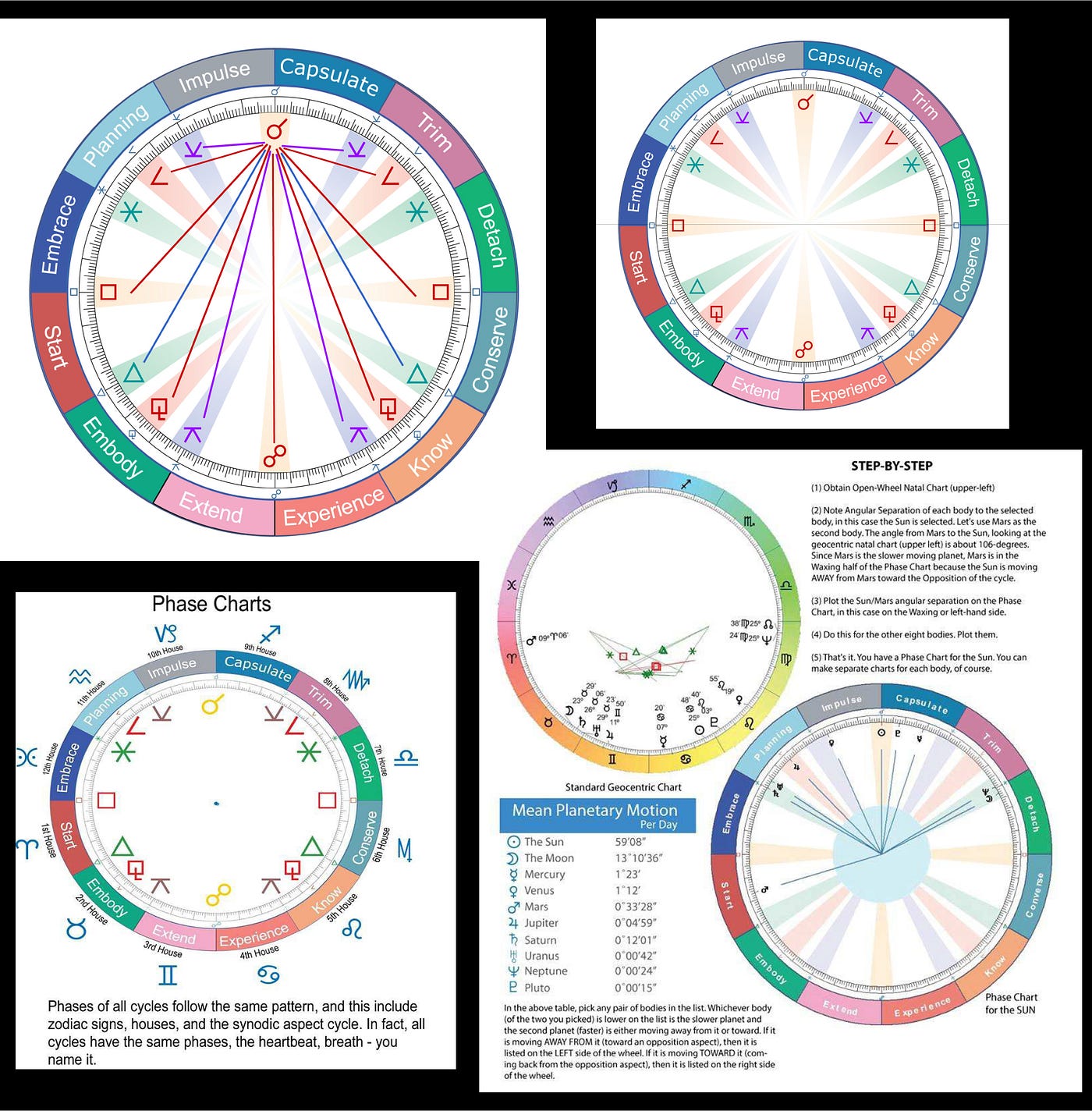
What I have found important, important to me and also important to my clients is what I call ‘context’, although perhaps a better term could be ‘story’, that if reading a chart, whether to myself, or for others tells a story or is somehow organic, it communicates better. It’s out story.
With that in mind, here is a interesting way to look at aspects, using the same astrological tools you have always been using. There is nothing new added from outside, just some rearranging of what we already know. When I came across it, I was amazed, as chart after chart told me its story.
All of these years I had been playing with the various aspects, like most astrologers, and then one day they began to fit together in a new way, like pieces in a crossword puzzle. Before I knew it, all of these parts I knew so well came together, and before me was a picture or the story of my own chart I had never seen so clearly.
I want to share that technique with you, and it is all about how to use the aspects. This article makes it easy for you to learn to look at aspects in a new light and see for yourself. This article is, however, for astrologers, yet see for yourselves.
Most astrologers have a particular set of aspects and orbs that they use. Some just use the standard Ptolemaic aspects, and others of us add to that list, even to the point of wandering into the various harmonic series.
The aspect orbs that we use determine whether that aspect is going to show up on our radar screen when we look at a chart, especially if we are using a computer. Obviously, the tighter the orbs, the less aspects that show up on the screen, and with wider orbs, we, of course, see more aspects.
What Are Aspects?
Before we go any further into this, let’s agree what we mean by aspects. Take any two heavenly bodies; it does not matter if it is the Sun or Moon, or a couple of the planets. One of any two bodies is moving faster and the other moves more slowly. The net effect is that the faster-moving planet describes a 360-degree circle or cycle of aspects to the slower moving body. The faster-moving planet goes from a conjunction with the slower body through a circle/cycle of 360-degrees and back around to the next conjunction. This is called a synodic cycle. That is called the aspect cycle, and is what aspects are all about. Let’s take the familiar solunar cycle as an example.
The solunar cycle (and astronomers is also a “synodic” cycle) begins with the Sun and Moon conjunct in the same zodiac degree at the moment of the New Moon.
The Moon, being the faster-moving body, then begins to move away from the conjunction with the Sun and starts to form aspects (angular arcs of separation) with the Sun, the most familiar being the First Quarter Moon (90 degrees), the Full Moon (180 degrees), and the Fourth Quarter Moon (270 degrees), after which the Moon moves to conjunct the Sun again, for another New Moon. The cycle continues on around, month after month.
This same type of synodic cycle of aspects takes place with any two heavenly bodies; it makes no difference which two you select. There is always one that moves faster, and one that moves more slowly. Aspects are formed, endlessly. It is happening now in the sky above. Each planet out there is in the process of forming or separating from one aspect or another with all the other planets.
In fact, the Sun, Moon, and planets are always involved with one another in these various aspect cycles, some 45 pairs of them (geocentrically), all going on at once. Astrologers are aware of these.
Why These Points?
Perhaps because there are so many aspects to consider all at once, astrologers have over the centuries picked certain points on the 360-degree aspect cycle and found them to be especially significant. We mentioned (using the solunar cycle) the 90-degree points (Square), and the halfway point (Opposition), which is the 180 degree point in the circle. Most astrologers add to this list, the 60-degree points (Sextile) and the 120-degree points (Trine). Still others want to include the 45-degree points (Semi-Square), and so on it goes.
If we kept adding points along the circle or cycle, we would eventually have all 360 degrees marked out. Some folks do, and the Sabian Symbols by Marc Edmund Jones has an interpretation for all 360 degrees of the zodiac. But let’s back up a moment.
We mentioned the 90-degree or Square points on the cycle, but there are two of these in any cycle. In the solunar cycle, there is the 90-degree point that marks the First Quarter Moon, but there is also the 90-degree point after the Opposiotn that marks the Fourth Quarter Moon. Each of these aspects is 90 degrees, and few astrologers would want to confuse a First Quarter Moon with a Fourth Quarter Moon. One leads to the light of the Full Moon, and the other to the dark of the New Moon. The same is true for the 60-degree (Sextile) and 120-degree (Trine) aspects. There are two of these in each cycle, as well. What are we to do with this fact that there are two of most aspects?
The Other Shoe
In modern astrology, almost all astrologers treat the 90-degree or square aspect as the same thing, whether it is that first 90-degree aspect (the waxing Square) or the second 90-degree aspect (the waning Square). The interpretation is the same. Yes, many astrologers would perhaps make an exception with the familiar solunar cycle, and differentiate between a First Quarter Moon and a Fourth Quarter Moon, but when it gets to the planets, in all their various combinations, there is usually only one interpretation given.
A Square is a Square is a Square, and so on. However, not everyone agrees. I certainly don’t.
It is true that a very few astrologers have pointed out to the rest of us that, reasonably speaking, we ought to interpret a waxing Square differently from a waning Square, just as we do in the solunar cycle, most notably L. Edward Johndro and in particular Dane Rudhyar. Both of these authors writings have made it clear that we are missing something very important by grouping all squares, all sextiles, all trines, etc. together and interpreting each pair in the same manner. What are they trying to tell us?
The Message about Aspects
If we read these authors (and I have), and others on this subject, here is their message to us. I will paraphrase and summarize what they have said:
These cycles are living events in the heavens above, with a beginning, a middle, and an end, starting at the point of the conjunction of the two bodies, extending to the opposition, and then back to the next conjunction. It can be important for us to know, when we speak of an aspect like a Square, whether we are referring to the square at the beginning or the square at the end of the cycle.
If you asked me to help you plan a social outing, and I told you to have your social event “after” the Square aspect between the Sun and the Moon, it would be important, according to the tradition of astrology, to designate that it is the waxing Square we want, after which you should hold the party, and not the waning Square. If you threw the party after the waning Square, you would be holding it right before the New Moon, and the dark of the Moon in both Eastern and Western astrology is more of a time to hunker down, and not a time to celebrate.
Everyone knows that the Full Moon is when to get together. You get the idea, and I believe most of you would agree. We have this discrimination for the solunar cycle, but we don’t extend this to the planetary aspects. Why is that?
Waxing and Waning Aspects
The point here is that, according to Dane Rudhyar (with whom I have personally talked and he has been to my home) and others, we should discriminate in our interpretation between what are called waxing and waning aspects. An aspect is waxing if it occurs after the Conjunction and before the Opposition point (180 degrees), and it is waning if it takes place after the Opposition and before the next Conjunction. There is the going out to the opposition, and the coming back from the Opposition, Waxing and Waning..
Therefore, we would have a waxing Square and a waning Square, and same goes for Sextiles (60 degree), Trines (120 degree), Semi-Squares (45 degree), Sesqui-Quadrates (135 degree), Inconjunct (150 degree), and any other aspects you might care to use.
The only aspects that are not mirrored in this way are the Conjunction (zero degrees) and Opposition (180 degrees). They are the beginning and midpoints of the cycle, and, in that sense, they stand alone.
Discriminating between waxing and waning aspects takes us a long way to re-invigorating our astrological interpretations. The question of how the interpretations differ between waxing and waning aspects is something I want to get to, but first there is a more important point to be made about the wholeness of cycles as they relate to individual aspects.
Inconvenient Aspects
While it may have been a great convenience to astrologers over the centuries to have fixed upon a series of aspects, like the Square and Trine, and to have more-or-less ignored whatever takes place in between those aspects, we now need to take a good look at what we have been ignoring, and that is: the essential wholeness or continuum of these planetary cycles, a process.
If we use aspect orbs and most astrologers do, then no matter what orbs we use, there will always be the case where a planet is just one degree out of the orb we have set, and that aspect will not be taken into consideration by us. This is particularly true if we are using computerized astrology, which will simply not list an aspect if it is out-of-orb. What are we to do with these unlisted aspects?
We do know by looking at the chart that the unlisted aspect is either an aspect waiting to happen or an aspect that has just happened recently. It certainly is not any other aspect, and the fact that the aspect is very close to the particular aspect we have set orbs to, we can know it is at the very least in the same ballpark.
Regardless of what orbs we may have set, each and every planet is somewhere in its journey or relationship with every other planet. It is never “not out there,” and it never somehow drops out of the cycle, but it always continues, degree by degree, on its appointed round of the zodiac. In the entire 360-degree orbit, every degree is essential. We can’t get along without each one of them because they are there.
An Analogy
Here is a simple analogy that will point out two areas where we, as astrologers, may be missing out. Suppose I was to send one of my daughters on a round trip to Ann Arbor, by way of Kalamazoo on the outgoing leg and Flint Michigan on the incoming.
Let’s say that Kalamazoo, Michigan is one of the stops (aspects) she will make along the way that I want to designate as a key point, like an aspect. We have placed that city at the 120-degree aspect point from Big Rapids, which is the Trine aspect in traditional astrology. But if she calls me on the phone and is having car trouble and I say, “Where are you?” I don’t only want to know when she is in Kalamazoo; I want to know where she is any time in between. This is analogous to setting absolute orbs on aspects and completely ignoring the planet and aspect if it falls just outside of the orb.
My daughter tells me she has broken down just outside of Kalamazoo, even though she is not within the orb for Kalamazoo I had planned. The place she has broken down, no matter where that place happens to be, is information I need to have and that is useful. It tells me a lot, for example, if she is still on her way to Ann Arbor (waxing) or already on her way back (waning), and closer to Flint, Michigan. If her car breaks down somewhere in between, that too is important. “Where” is always important, not just at some predefined points or aspects. You get the idea. Got it? Let’s move on.
While we have this analogy up, let’s look at the other problem, the fact that astrologers generally fail to interpret between waxing and waning aspects. To most astrologers today, as mentioned, a Trine is a Trine is a Trine. In the diagram, this would be equivalent to only wanting to know if my daughter was in Kalamazoo or in Flint, each of which is a Trine or 240-degree aspect from Big Rapids. We can all see very clearly that these two places are in very different parts of the aspect cycle. In the first, Kalamazoo, she is still on her way to Ann Arbor, and with the other, Flint, she is already on her way home. Both of these points are addressed with full-phase aspects.
As an initial step, I stopped using strict orbs with aspects decades ago and, instead, began to ask myself: where is this planet on its 360-degree journey in relation to the planet it is aspecting? After all, it is not nowhere. It is always somewhere, and that somewhere, no matter where it is, is important.
My daughter may not be in Kalamazoo, but if she is on the outskirts, I have learned a lot about her situation, for example that she is in a heavily populated area. I find it similar with all the aspects and no longer find orbs meant to help that useful. I would rather just look to see how close the planet is to a traditional aspect, and this helps me to see where the planet is in the overall aspect picture. It is never “not” doing something, so to speak.
The Standard Aspect Cycle
I do not argue that the various points of exact traditional aspects (90, 60, 120, etc. degrees) are not important. Of course they are, but there is no degree or point in the aspect circle/cycle that is not essential, although it may have a different kind of importance. Perhaps we have never inquired about the kind of importance of each area of the cycle.
In fact, after a short while, I found myself doing away with the concept of there being “any” point in the 360-degree cycle that is not somewhere in the vicinity of a major aspect, at least the ones that most astrologers use. For example, using what I consider the most commonly-used aspects, and as the author of scores of astrological programs, you can be sure my users have told me what aspects they want in their software, and they are:
The Standard Aspects
000 Conjunction
030 Semi-Sextile (waxing)
045 Semi-Square (waxing)
060 Sextile (waxing)
090 Square (waxing)
120 Trine (waxing)
135 Sesquiquadrate (waxing)
150 Inconjunct (waxing)
180 Opposition
210 Inconjunct (waning)
225 Sesquiquadrate (waning)
240 Trine (waning)
270 Square (waning)
300 Sextile (waning)
315 Semi-Square (waning)
330 Semi-Sextile (waning)
What about Orbs?
These are the sixteen most commonly used aspects. And if you have to have orbs, let’s just divide the space between any two of these 16 aspects in half, and use that midpoint in space as the marker as to the end of one aspect and the beginning of the next.
And, for now, we won’t play favorites, giving some aspects more space (greater orbs) and others less. For instance, I find that the Semi-Squares are very, very important, and yet most astrologers used reduced orbs when considering them. Why bother? Just look at the chart.
Using this method, there are no un-aspected planets. A planet is always in the general area or ballpark of one of these traditional aspects or another. If it is not right on top of the aspect, then it is forming or coming to be, or it is past the exact point and in the process of fading away. Either way, there is still the flavor of that aspect around them.
Looking at a chart this way, each planet is always at a very natural point in relation to every other planet. It is never un-aspected. We can see at a glance what phase of the cycle a planet is in as it relates to any other planet. We don’t even have to measure, for we can just look at the chart and get a ballpark idea of each relationship. If a Square (90 degrees) is quite wide, then it is still like a Square. At least it is ‘Square-ish’. It has an effect.
This is perhaps some kind of holistic way of looking at aspects.
Thanks for your patience; we are almost there, but there is one little twist I want to present to you, and I hope it does not throw you off the track, yet I’m afraid it will.
Phase Relationships
What we are looking at so far here is what is called the “phase relationship” or angular separation of one planet to another. We can divide the cycle of aspects between any two bodies into as many phases or parts as we wish, but we will always want to know if the faster moving planet is in a waxing phase or a waning phase to the other, as in: is the angular separation between the two bodies progressing to the opposition (the equivalent of the Full Moon in the solunar cycle) or is it progressing back toward the conjunction (the equivalent of the New Moon in the solunar cycle). In the first case, the angle is waxing, and in the second, waning. That is what we need to know.
Looking at the chart, it is not difficult to examine any pair of planets and decide which is the faster moving planet, and which is the slower moving planet. And, by “faster” or “slower,” I don’t mean is it faster or slower on a given day. A fast moving planet like Mercury might be retrograde on a given day or stationary, meaning it appears to not move at all. What we mean here is “faster” or “slower” in the traditional sense of the speed of the planets. Here is the list, from fast to slow:
Moon, Mercury, Venus, Sun, Mars, Jupiter, Saturn, Uranus, Neptune, and Pluto. That is the order, in terms of speed, to use, not whether at any given moment it is stationary and not moving, or even moving retrograde and backward.
The Open-Wheel
I find it most helpful to view the planets in what is called the “Open Wheel,” the chart wheel of 360 degrees, where each degree is given equal space. In that way, we can better see the various arcs or angular separation separating any two planets or bodies.
However, it can be tedious looking at each planet pair and having to remember which is the faster and which the slower, because only that will tell us if the aspect is waxing or waning, and therefore which phase the planets are in one to the other.
To make this easier for myself, I made a very simple program that does this for me, and lets me look at any planet, one at a time, in relation to the rest of the planets. I simply place the planet I am interested in at the top of a 360-degree wheel and place the other planets around the wheel, but in their various angular relationships to the selected planet, the one in focus. But there is a twist.
If you have a PC, the program Blue*Star made by my brother Stephen Erlewine and myself is available that does all this for you. It was the last program I designed before I retired, and I put in it all the special techniques that I use and would want to be available in my retirement. I have no monetary relationship with Matrix Software any longer, which I founded and built. I just need the techniques myself. Here is the program I use:
“Blue*Star”
https://astrologysoftware.com/pro/bluestar/index.html
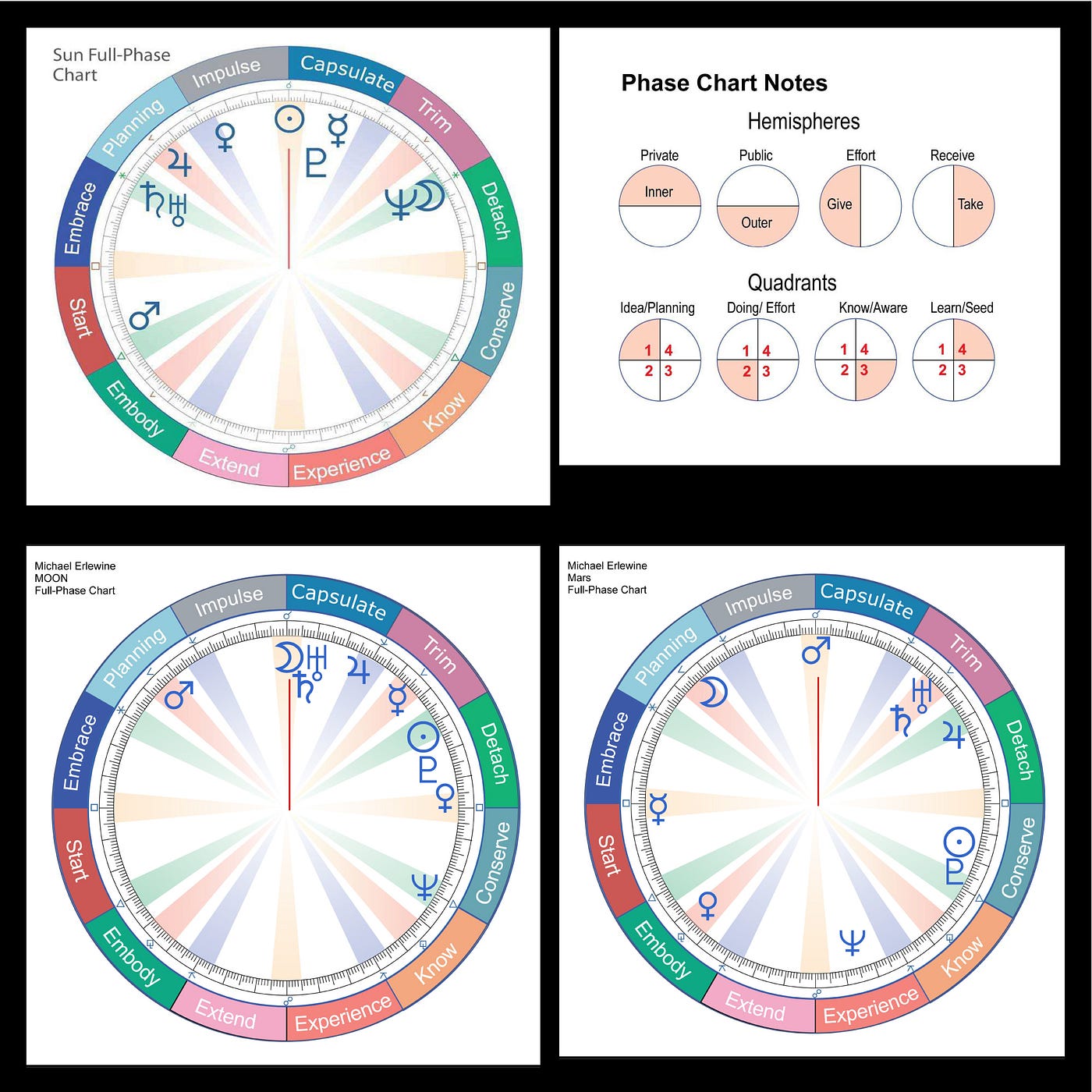
The chart wheel shown here represents the 360-degrees cycle of any two planets or bodies. If I place any single planet (the slower planet of the planetary pair) at the top of the chart at what we can call the zero-degree point, and then watch the aspects the faster planet makes to that point, you have the diagram above. Only HERE I have placed all of the planets on the chart wheel, each in the particular angular relationship (aspect) they have in my natal chart.
For example, Venus was separating from the Sun in my birth chart, and Mercury was applying toward to Sun, about to conjunct it. But don’t be lulled into thinking this is just my natal chart with the Sun place at the top point. It is a little more complicated than that, but not much.
This method of charting places the waxing planets on the left side of the chart, and the waning aspects on the right, just as they aspect each other in the actual chart.
This kind of Full-Phase Wheel is very easy to read, although (as mentioned) you must be clear that we are no longer looking at the arrangement of the planets as laid out in my natal chart. Let’s look at an example, using my geocentric natal chart, with the Sun selected, and placed at the top of the chart, which we will call the zero, Conjunction, the equivalent of the New Moon point.
Full-Phase Charts
The 360-degrees of the Full-Phase Chart Wheel starts at the top (Conjunction) and moves counter-clockwise in a circle. At the bottom of the wheel is the Opposition or 180-degree aspect, and so on, around. This constitutes a cycle or circle.
You can see all the other nine bodies arranged with the same angular separation as in my natal chart, but NOT exactly as they are in my natal chart. Here, we are interested to see which planet pairs are waxing or building in strength, and which are waning or lessening in strength, and this chart does that, by dividing the two types and placing waxing planets on the left and waning planets on the right half of the chart wheel, displayed by their angular separation or aspect. I have even drawn in 6-degree orbs on either side of the traditional aspects in pastel colors, for those who might find it helpful. You can see at a glance if a planet falls within a colored orb.
As you can see, the Sun is at the point of the Conjunction (zero degrees of separation) at the top of the wheel. We can see that the planet Venus has moved away from the Conjunction and is nearing the 30-degree point, what is called a Semi-Sextile.
Next, note that Jupiter is almost an exact Semi-Square (45 degrees) to the Sun. However, please notice that the Sun and Jupiter are ‘flipped” in this chart, to preserve the ability to show the phase. In my actual chart, it is the Sun that is out ahead of Jupiter, by about 45 degrees. Here the two symbols have switched places to maintain the phase relationship, and to keep the planet in focus (in this case the Sun) at the top of the chart. I hope this does not confuse you. Once you understand it, it will not bother you again, so take time to think it through.
You can see my Moon is in the Fourth Quarter, some 300 degrees (Sextile) to the Sun.
Phase Cycles
Before you can understand this next part, you need to read and study the basic phases of any cycle.
Now let’s look at the Sun Full-Phase Wheel again, and do some interpreting, based on our understanding of cycle phases. It does not matter what the cycle is, for the phases of any cycle are all the same. Here we are looking at the cycle of the Moon’s aspects to the Sun.
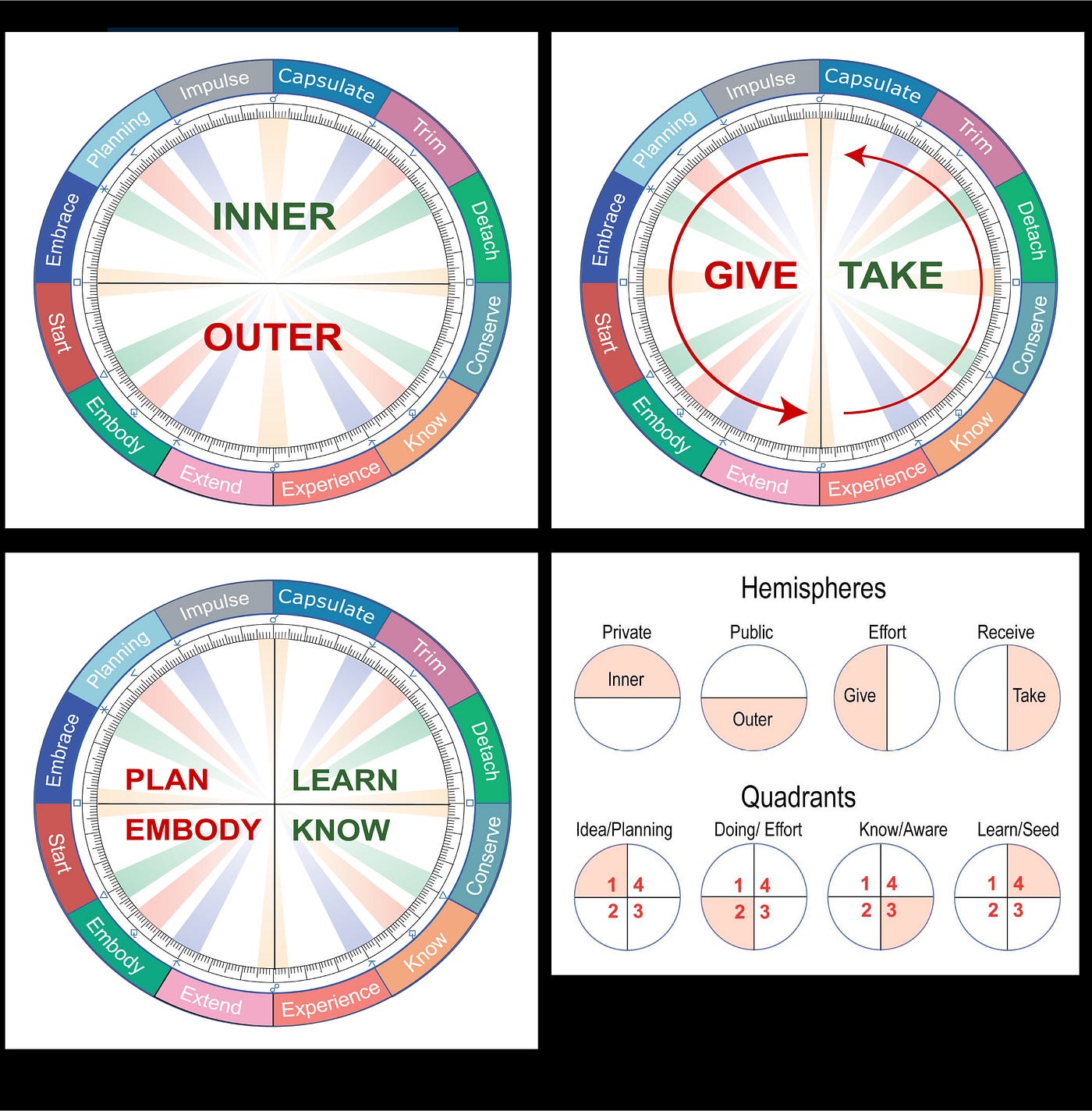
For one, the planets as they relate to the Sun (the Sun stands for the concept of the Self in traditional astrology) are almost all within the upper or inward hemisphere — the top half. Only one planet, Mars, has crossed from the upper (inner) half of the chart into the lower or outer (public) hemisphere.
This would suggest not only that Mars is very important in my chart (Sun) expression, but is perhaps the only or main way I reach out from within to the outside world.
Therefore, Mars or ambition is very pronounced in this chart. My ambition is very visible, we might say. Little else is.
The other planets are equally divided between waxing and waning hemispheres, but they are all inward, in the upper or inner hemisphere, so regardless of how I might try to be outward, that is: no matter what I may think, I am by nature a very inward or deep person.
The Four Hemispheres
Now let’s see how a chart, all by itself, will tell us a story that is useful. Let’s look at the meaning of the four hemispheres or halves of the aspect chart, before we go further into this, as they are important. Two of the halves are, of course, the upper or inner half, and the lower or outer half. The other two are the left or waxing side of the chart, and the right or waning side.
If you have taken the time to read the material above on cycle phase interpretation and the various correspondences between the phases of any complete cycle, you are ready for this discussion. If not, now would be a good time to go over that material.
The outward-moving, building, or forming half of the phase wheel is the waxing part of any cycle, where an impulse or idea builds or forms into something physical, into some kind of experience ant the Opposition aspect. The inward-going, deconstructing, and dissolving half of the phase wheel is the waning part of the cycle, where whatever was built up at the Opposition aspect is now taken down, and we absorb whatever meaning or value we can from the experience. Again: this is all covered in the material about phases or by looking at any synodic cycle, like the phases of the Moon..
The lower or outer hemisphere constitutes everything out in the open, physically visible, and in this world to be seen — everything that matters, so to speak. The upper or inner hemisphere is all that is not physical, whatever does not matter yet (waxing) or does not matter still (wanning), within our mind and experience. The left side of the inner hemisphere holds that which is not yet manifest, and the right side of the inner hemisphere holds that which is not manifest any longer — going out and coming back.
The Waxing Aspects
I am not suggesting here that this information I am pointing out is not found in all the various pieces of traditional astrological technique. Of course it is, but here the pieces fit together in a slightly different way, like a picture jig-saw puzzle, to provide what for me is a clearer picture of the natal chart, a picture that anyone can read, after only a brief introduction.
Again, using my Sun Phase-Wheel as an example: We can see at a glance that the concept of my Self is very inward, call it mental, subjective, secret, private, deep — what have you? The point is that there is only one planet, Mars, that is in the outer hemisphere, and it is at the Aries or First House position. We can see I like to start things and, as an entrepreneur who has started many businesses, this makes a lot of sense.
The planets in the inward half, those on the waxing side, are where I am taking inspiration or ideas and building them into plans to make into reality, trying to make my dreams come true.
Let’s look at them, using traditional astrological interpretations. We can see that Venus is very near the cusp of the Semi-Sextile aspect, corresponding to Aquarius or the 11th house of community, therefore I have dreams and plans to build a community. As a child of the 60’s, this is so true.
The sometimes-troublesome planet Saturn and close by, Uranus, are positioned at the Sextile aspect, giving great energy and freedom of movement or ease. It is easy for me to do things, to get things done, and very inventive things at that, like this technique.
This leaves Jupiter, exactly at the 45-degree or Semi-Square aspect, and this is definitely one of the challenge points in the wheel. The Sanskrit word for Jupiter is “Guru,” so Jupiter is our path or way through life. In my case Jupiter is my career, and suggests that my life path or career is not a slam dunk, but may involve a lot of obstacles or challenges.
However, if you read the phase article, this particular Semi-Square is one where we don’t take “no” for an answer, but press on, suggesting that gentle movement forward will remove any career blocks and ensure steady progress.
The Waning Aspects
Now let’s look at the waning side of the chart, in my case all the bodies are in the upper inner part of the chart. The waning right-side hemisphere of the chart tells us about the returns of our life, how we receive from life, we could even say our “destiny.” This is where life presents things to us, without our having to do anything.
Doing is the waxing left-side of the chart, where we GIVE or put out. If we were talking martial arts, we would have to say that the waxing side of the chart is Judo, and the waning side of the chart is Aikido. With Judo, we strike outward, with Aikido, we passively use force and momentum already in play to our advantage. One is aggressive (Giving), one is passive (Taking). One hand places and the other hand takes away.
The Moon is my leading or most outward planet, along with Neptune, which is a very tight Sextile. Both of these planets are strong Sextiles, so, again, this suggests ease and facility. However, both of these planets are inward, rather than outward, so this points to a more private sense, and perhaps more internal activities, not reaching out, but reaching in. In dharma cycles, Neptune and the Moon are at the Dakini part of the monthly solunar cycle, as well, somewhere around 300-degrees.
It is a fact that I played music for the public, but always from a very inward or shy stance. You get the idea as to how I am interpreting here. Mercury and Pluto are much more inward, deep, with Pluto being my most inward planet on the receptive side. My interest in occultism and initiation on a somewhat inner or deep level might be indicated here.
Astrologer’s Heaven
I have always hated the part of astrology where each astrologer I meet or read begins to delineate their own or some famous person’s chart (usually that of Hitler), point by point. I have never done that, until now. All I can say in my defense is that, until now, I have shown great restraint, and waited some forty years before doing this, and only do it now because I feel this
technique really is special, at least for me, so please forgive me for going on a bit. I am not the first astrologer to do this. We are legion.
And there is something else: When I first looked at these Phase Wheel charts, I was, of course, fascinated, but I also gave in to what I believe is an ingrained habit with many astrologers, of trying to make the various planets and aspects fit my preconceived idea of what things should mean, in particular when it comes to looking at my own chart.
What I learned, gradually, was that this habit of preconception removes all the opportunity to really have your mind open, that is: when I pigeonhole every factor, shoving it into the nearest available interpretation box, and thus avoiding any new thoughts.
Gradually, I found that if something did not make sense or fit in with what I felt to be the “way I was,” I would just leave it alone, and let the factor tell me the story of what it has to say. These charts don’t lie, and the planets are just where they are, not where I might like them to be. We don’t even need a birth time to use this technique, although it helps with the fast-moving Moon.
On the waning hemisphere of my Sun full-phase chart, we have Neptune and the Moon in the Sextile phase, both very close. These are my most outward-oriented planets, and being waning, this is where I reap or where things come most easily to me.
Remember, that the waxing hemisphere is where we build and invest, and the waning hemisphere is where we deconstruct and get our returns. One hand puts the rabbit in the hat, and the other takes it back out. Give and Take.
The Moon Full-Phase Wheel
Now, if we look at my Moon’s Phase Wheel, we have a very different story. Mars is the only planet in the waxing side of the chart, and it alone must carry my investment or outreach. All the other planets are on the waning side, and have to do with returns, with the Moon or supportive environment bringing things to me. In other words, as far as the Moon (supportive environment) in life, things should come my way.
And here, Neptune is the sole planet out in the public or outer hemisphere, so my Neptune is very conspicuous. Perhaps it makes sense that I was a musician when I was young, founded the largest music database on the planet, and am, even today, a very “Neptunian astrologer.” My Neptune is very outwardly prominent. Also, Neptune is exactly conjunct the North Node of the Moon and my Midheaven in my natal chart of houses.
This is even more clear if you look at my Mars Phase Wheel, where Neptune is right in the middle of the house of experience, right out there for everyone to see, and indicates how I manifest myself to the public — through Neptune. Neptune is my way to manifest outwardly, and it is interesting that I founded the largest music database on the planet (allmusic.com) and one of the two largest film databases (allmovie.com), both topics connected to Neptune.
Also, what is remarkable about the Mars Full-Phase chart is the equal spacing of the planets. To me, this means that mars is stable, dependable, giving me great energy to accomplish things. The spacing of planets, the space between them, is very important to interpret, and it seldom has been done.
This is how this technique can work. Of course, you will each have your own astrological associations. Here is a free e-book for those who want to look into this technique.
“Astrology’s Mirror: Full-Phase Aspects”
https://www.startypes.com/pdf/e-books/FullPhase%20Aspects.pdf
[Graphics by me]
EMAIL Michael@Erlewine.net Note: If you would like to have access to other free books, articles, and videos on these topics, here are the links: SpiritGrooves.net.
For a limited time, I am doing a few Zoom astrology readings. If interested, please email me with the subject “READINGS.”
As Bodhicitta is so precious,
May those without it now create it,
May those who have it not destroy it,
And may it ever grow and flourish.
메타데이터
- post_id
- 8cb610d35a55
- slug
- astrologys-mirror-full-phase-aspects-8cb610d35a55
- url
- https://medium.com/@MichaelErlewine/astrologys-mirror-full-phase-aspects-8cb610d35a55
- canonical_url
- https://medium.com/@MichaelErlewine/astrologys-mirror-full-phase-aspects-8cb610d35a55
- author_url
- https://medium.com/@MichaelErlewine
- status
- ok
- fetched_at
- 2026-07-13 06:23:13