Navigating Complexity: UX Research and Usability Testing of a Taxonomy-Based Reporting Tool
Regardless of industry, meaningful design begins with listening, this is how we tested one of our most complex tools.
Navigating Complexity: UX Research and Usability Testing of a Taxonomy-Based Reporting Tool

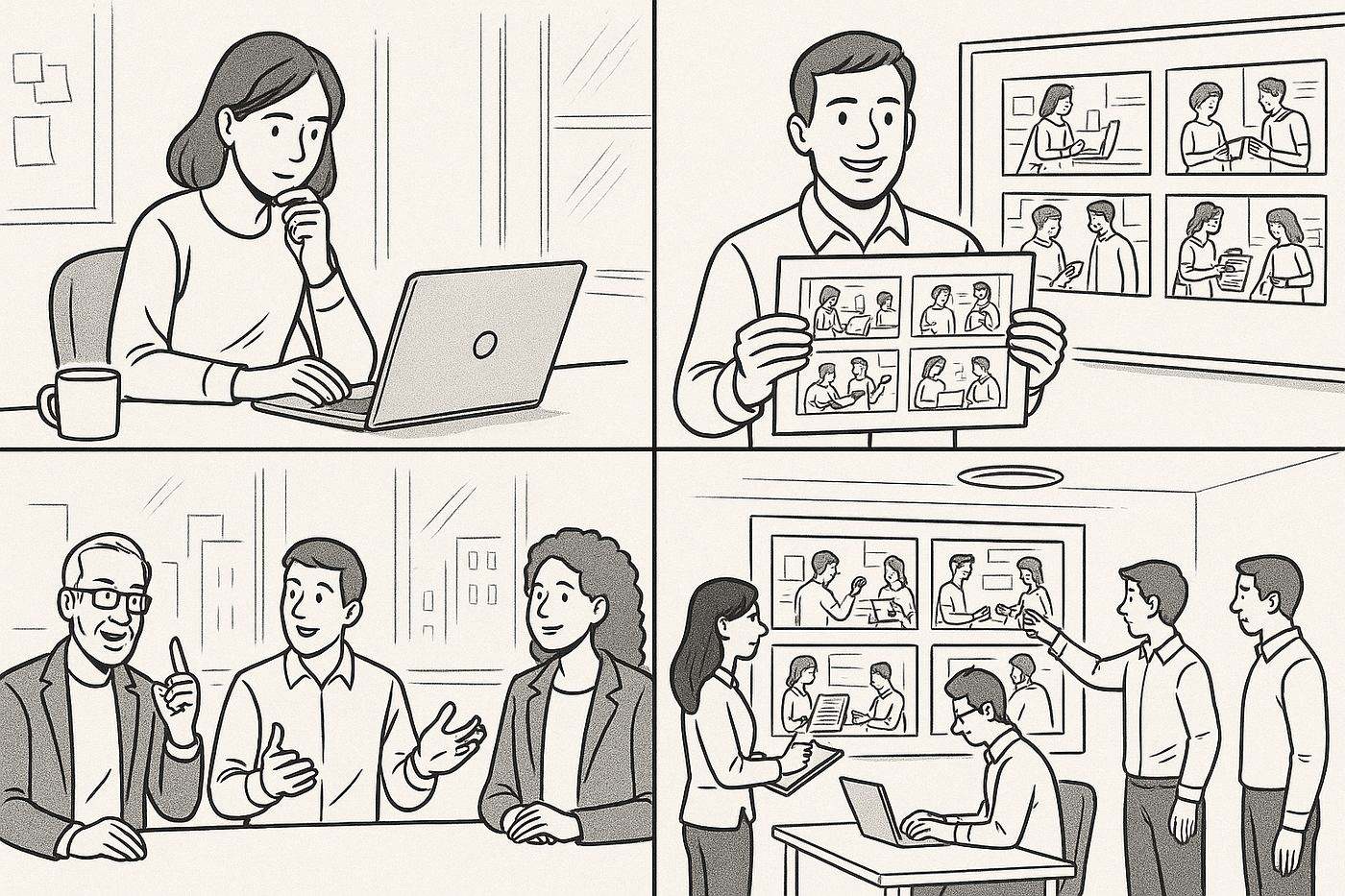
AI Image generated from Adobe Firefly
Context and Problem
Working Across Domains, One Constant Remains
Over the years, my work in UX research and usability testing has spanned multiple industries. From pharmaceuticals and retail to automotive and, most recently, sustainability. Each domain brings its own constraints, regulations, and user expectations. Yet one thing remains consistent: the need to deeply understand users and validate solutions through testing.
Why Research Still Matters
Regardless of industry, meaningful design begins with listening.
- UX research helps move beyond assumptions
- Usability testing validates whether a product truly supports user behaviour
- Insights help align user needs with the product vision
What I’ve learned is that successful products sit at the intersection of user needs and product vision. Research helps map this intersection, translating insights into clear requirements, aligning stakeholders, and ensuring that what we build is not only functional, but relevant and usable. Whether it’s a highly regulated pharmaceutical tool or a sustainability platform aimed at long-term impact, the process of understanding users and testing early and often remains the foundation of good UX.
Why It Mattered
Internal Reviews Aren’t Enough
While internal reviews with designers, product owners, and stakeholders are valuable, they have limitations. Internal teams are often influenced by:
- Familiarity with the product
- Organisational context
- Unconscious assumptions
The real validation begins when real users interact with the product.
What Usability Testing Reveals
A structured usability testing approach allows researchers to systematically evaluate key usability parameters such as effectiveness, efficiency, and satisfaction. By combining quantitative metrics (like task success rates, time on task, and error frequency) with qualitative insights (such as user feedback, observations, and behavioural patterns), teams gain a well-rounded understanding of the user experience.
This balance of data not only strengthens design decisions but also helps communicate findings more effectively to stakeholders.
Ultimately, usability testing bridges the gap between design intent and real-world use. It ensures that products are not just well-designed in theory, but intuitive, usable, and meaningful in practice.
Approach and Methodology
Designing a Focused Testing Strategy
Our usability testing approach is intentionally structured and goal-driven.
We aim to:
- Identify key user roles
- Map roles to core workflows
- Define realistic, task-based scenarios
- Evaluate results using consistent UX metrics
Testing a Taxonomy-Based Reporting Tool
This study focused on ZERO by KINTO a platform built on the **European Sustainability Reporting Standards (ESRS) under the [Corporate Sustainability Reporting Directive](https://www.efrag.org/en/sustainability-reporting/about-sustainability-reporting) (CSRD)**.

Screen shot from ‘ZERO by KINTO’ showing an XBRL based reporting cycle template
Key characteristics of the product:
- Built for ESG reporting requirements
- Structured to the **XBRL taxonomy**
- Designed for accuracy, consistency, and compliance
This raised an important question: how does usability testing a taxonomy-based reporting tool differ from testing a tool built for more common, consumer-facing use cases? The answer lies in the nature of the product itself. This tool is grounded in the European Sustainability Reporting Standards (ESRS), developed under the Corporate Sustainability Reporting Directive (CSRD), which represents a significant shift in how organisations report on non-financial performance.
However, the goal of our testing was not to assess users’ knowledge of ESRS, CSRD, or ESG regulations. Instead, our focus was firmly on usability, measuring how effectively and efficiently users could complete tasks, and how satisfied they felt while using the tool.
Separating domain expertise from product usability allowed us to evaluate the experience on its own merits and ensure the tool supports users, rather than relying on their regulatory knowledge to compensate for design gaps.
What We Did Differently

AI Image generated from Adobe Firefly
Avoiding Cognitive Overload
Early in scenario design, we realised that tasks closely tied to XBRL taxonomy could overwhelm participants — especially in an unmoderated testing environment, where:
- No facilitator is available for clarification and
- First-time users rely entirely on the interface
Our challenge was to ensure users could progress confidently without being blocked by unfamiliar regulatory language.
Designing Neutral, Familiar Scenarios
To address this, we redesigned our test scenarios to feel familiar and relatable.
Instead of ESRS-driven tasks, participants were asked to:
- Build a form for others to fill out
- Configure fields for a specific reporting cycle
- Enter and structured data using common form controls
This approach allowed us to focus on what we truly wanted to evaluate: whether users could effectively create a form using the interface elements provided, such as text, numeric, and date input fields, text formatting options, drop-downs, radio buttons, and other controls.
Our assumption was that by keeping tasks generic and intuitive, users would concentrate on completing the task itself rather than struggling with unfamiliar ESG terminology. As a result, we were able to gather clearer insights into the tool’s usability without domain complexity skewing the findings.
Key Insights
The usability testing largely confirmed our initial assumptions and hypotheses about how users would engage with the platform. Participants naturally gravitated toward the interface itself, prioritising interaction and task completion over understanding ESRS-specific terminology.
This behaviour reinforced our belief that the UI should absorb most of the cognitive load, allowing users to work efficiently without needing deep domain knowledge.
Discoverability Issues
A key challenge was the discoverability of certain input methods.
- Some controls were harder to find than expected
- Users hesitated or relied on trial and error
- Placement and visual affordances needed improvement
Another recurring expectation was around real-time feedback.
- Users assumed configuration changes would update instantly
- Delayed or absent feedback caused uncertainty
- This revealed gaps in the interaction model
Outcome / Impact
The decision to keep tasks free from ESRS-specific terminology proved effective. All participants were able to successfully complete their assigned tasks, while also offering valuable feedback throughout the process. By shifting the focus away from domain-heavy language, users were able to concentrate on the interface and task execution rather than deciphering terminology.
Where Friction Appeared
More complex interactions still caused challenges, especially:
- Conditional logic (e.g., “If date of birth is before X, require attachment”)
- Multi-step configurations
These moments highlighted opportunities to improve:
- System logic clarity
- Feedback mechanisms
- Progressive guidance
Role of Step-by-Step Instructions
Providing structured instructions helped by:
- Guiding users through complex tasks
- Preventing deviation from core objectives
- Producing more focused and actionable feedback
Learnings & takeaways

AI Image generated from Adobe Firefly
One of the key learnings from testing a complex taxonomy-driven platform was that limited resources do not have to limit the quality or usefulness of usability insights.
Constraints such as the absence of domain experts with deep knowledge of reporting structures, or the inability to run fully moderated usability sessions, can feel like significant blockers at the outset. However, our experience showed that these limitations do not prevent teams from gathering meaningful evidence about what is and isn’t working.
Neutral Testing Unlocks Better Insights
By removing domain dependency and minimising prior explanations, we were able to evaluate the product without influencing user behaviour or expectations. This neutral approach allowed participants to interact with the interface based solely on what they saw and understood in the moment.
As a result, we were able to:
- Test the interface on its own merits Users relied entirely on the app’s visual cues, labels, and flow to complete tasks. This helped us assess whether the interface was intuitive, self-explanatory, and usable without external guidance, revealing gaps in clarity, navigation, and affordances.
- Observe natural user interpretation Participants interpreted features, icons, and actions based on their own mental models rather than domain knowledge. This surfaced authentic user assumptions, misunderstandings, and expectations, providing valuable insight into how first-time or non-expert users experience the product.
Ultimately, the goal of usability testing is not to validate domain expertise, but to understand how real users make sense of a system. When tests are designed around this principle, even a diverse group of non-expert users can generate enough qualitative and behavioural data to meet core research objectives.
This approach not only makes usability testing more accessible under tight constraints, but also ensures that the product is understandable and usable by a broader audience.
메타데이터
- post_id
- 8cd5c92ea98a
- slug
- navigating-complexity-ux-research-and-usability-testing-of-a-taxonomy-based-reporting-tool-8cd5c92ea98a
- url
- https://medium.com/the-design-loop/navigating-complexity-ux-research-and-usability-testing-of-a-taxonomy-based-reporting-tool-8cd5c92ea98a
- canonical_url
- https://medium.com/the-design-loop/navigating-complexity-ux-research-and-usability-testing-of-a-taxonomy-based-reporting-tool-8cd5c92ea98a
- author_url
- https://medium.com/@anupam.sharma_47940
- status
- ok
- fetched_at
- 2026-06-13 07:35:29