Why StarRocks Is Better Than ClickHouse for Chat BI Agents
The Rise of Chat BI: When Business Users Talk Directly to Data
Why StarRocks Is Better Than ClickHouse for Chat BI Agents
The Rise of Chat BI: When Business Users Talk Directly to Data
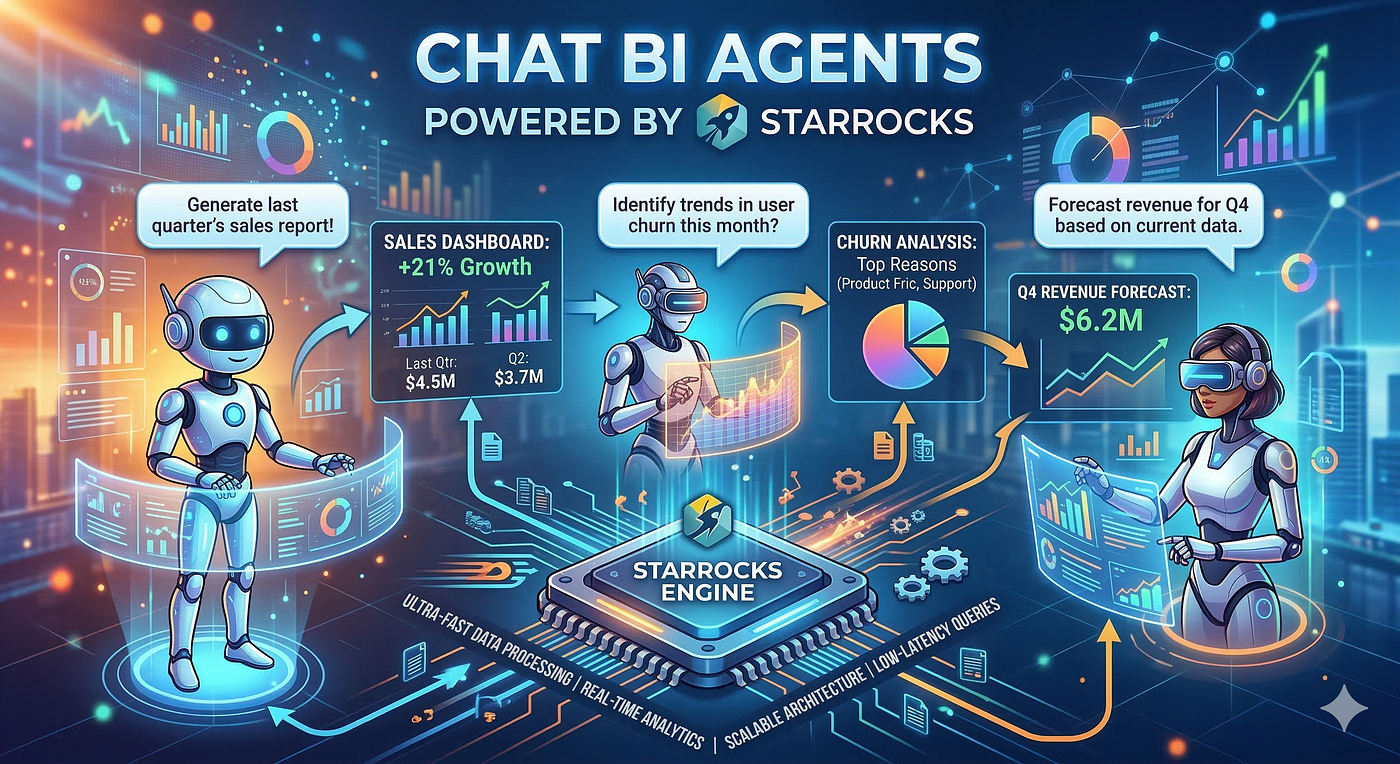
The way people interact with data is undergoing a fundamental shift. Traditional BI tools required users to navigate dashboards built by analysts, wait days for custom reports, or learn SQL themselves. Chat BI agents, powered by large language models (LLMs) and Text-to-SQL technology , promise something far more compelling: ask a question in plain English, get an answer in seconds.
“What was our revenue last week by region?” “Which product categories saw the sharpest drop in Q1?” “Show me the top 10 customers by order value who haven’t purchased in the last 30 days.”
These questions get translated by an LLM into SQL, executed against an analytical database, and returned to the user as a natural language response, chart, or table — in real time, without a data analyst in the loop.
The technology is maturing rapidly. Microsoft’s Windows team reports that about 10% of all SQL queries against their analytical cluster are now AI-generated. Salesforce’s Horizon Agent, which entered GA in January 2025, freed up dozens of engineering hours per week by letting users self-serve answers directly from a Slack chatbot.
But here’s the critical insight most teams miss: the quality of a Chat BI agent depends not just on how good your LLM is, but on how well your underlying database is suited to serve it. Not all analytical databases are created equal for this workload — and the differences between StarRocks and ClickHouse are stark.
What Chat BI Agents Actually Demand from a Database
Before comparing the two systems, let’s be precise about what a Chat BI agent needs from its backend database:
- Standard ANSI SQL compliance — LLMs are trained on vast corpora of SQL. The closer the target dialect is to standard SQL, the more accurate the generated queries.
- Native multi-table JOIN support — Real business data lives across many normalized tables. A Chat BI agent must be able to answer questions that naturally span multiple entities.
- High concurrency — Many users ask questions simultaneously. The database must handle hundreds or thousands of concurrent query sessions without degradation.
- Sub-second to low-second query latency — Chat BI is an interactive experience. Delays of 10+ seconds kill user trust and adoption.
- Real-time data freshness — Business questions often need up-to-the-minute answers, not stale snapshots.
- Support for mutable data (UPDATE/DELETE) — Real-world data pipelines produce corrections, late arrivals, and updates. The database must handle them gracefully.
- Intelligent query acceleration — Since LLM-generated queries are unpredictable, the database should have mechanisms to automatically accelerate queries without requiring manual tuning per query.
Let’s see how StarRocks and ClickHouse stack up on each of these dimensions.
Dimension 1: Standard SQL — The Language LLMs Speak Best
This is perhaps the most under appreciated advantage StarRocks holds. LLMs — GPT-4, Claude, Llama, and their kin — were trained primarily on standard ANSI SQL from PostgreSQL, MySQL, and similar systems. The more a database deviates from standard SQL, the more likely the LLM is to generate incorrect or non-executable queries.
ClickHouse’s SQL dialect is famously non-standard. It doesn’t support certain standard JOIN syntaxes, has its own proprietary functions that diverge from ANSI standards, and lacks features like foreign keys and transactions that SQL-literate LLMs naturally try to use. A practitioner using LLMs with ClickHouse explicitly noted choosing it because “LLMs have likely encountered fewer examples of this dialect during training, making the task more challenging” — that’s a warning sign, not a feature.
Research in cross-dialect SQL translation further validates this concern: LLMs achieve lower than 38.5% accuracy on average when translating queries across database dialects, and ClickHouse is explicitly called out as a system with high system-specific syntax complexity.
StarRocks, by contrast, natively supports industry-standard ANSI SQL as its sole query language. There is no proprietary “SQL-like” layer to work around. Window functions, subqueries, CTEs, standard JOIN syntax, standard aggregate functions — all work exactly as an LLM would generate them. This dramatically reduces the rate of LLM SQL errors, which means fewer retry loops, faster responses, and a better user experience.
Dimension 2: Multi-Table JOINs — The Heart of Real Business Questions
This is where the gap between StarRocks and ClickHouse is not just large — it is architectural.
ClickHouse was designed for single-table query performance. Its columnar storage and execution engine are optimized for scanning wide, pre-aggregated, denormalized tables at extreme speed. JOIN support exists, but it is a known weakness. As CelerData’s own competitive analysis documents state plainly: “JOIN relationships are the foundation of modern analytics (such as star schema), but ClickHouse has tried to circumvent this challenge by focusing on single-table query performance. Because of this, users have to flatten joined tables into a single table in ClickHouse. This step adds pipeline delay and requires extra resources.”
This denormalization requirement creates a cascading problem for Chat BI:
- Business data that naturally spans
orders,customers,products, andregionstables must be pre-flattened into a single giant table. - The engineering team must predict in advance which join combinations will be needed and pre-compute them.
- But Chat BI agents generate ad-hoc queries — they join tables in combinations that no one anticipated.
- When a user asks “which customers in the Northeast bought premium products in Q1 but not Q4?”, that query may require joining tables that were never pre-flattened together.
The result: ClickHouse-based Chat BI agents either fail on such queries, return incorrect results, or require a massive, expensive denormalization engineering effort that defeats the agility Chat BI is supposed to provide.
StarRocks solves this at the engine level. It is built with a native Cost-Based Optimizer (CBO) and supports all standard JOIN types — INNER, LEFT/RIGHT OUTER, FULL OUTER, SEMI, ANTI — with high performance. Its benchmark results show 2x to 10x better performance than competitors on multi-table queries without any denormalization. In TPC-H 100G multi-table testing — which ClickHouse cannot even complete due to JOIN limitations — StarRocks delivers results that ClickHouse simply cannot match.
Real-World Proof: NAVER
NAVER, South Korea’s leading web portal, manages over 200 interconnected services and 20+ PB of data in an Apache Iceberg Lakehouse. When they ran ClickHouse, the lack of JOIN support forced reliance on denormalized tables, limiting users to fixed, pre-defined dimensions and making real-time interactive analysis impossible. Engineers had to request custom pipelines for every new analytical question — the opposite of what Chat BI promises.
After migrating to StarRocks, engineers could directly query raw data using standard SQL with multi-table JOINs. Multi-table JOIN and multi-column GROUP BY queries execute significantly faster, even across datasets that include real-time upserts and deletes. Overall performance doubled on the same hardware — and for the first time, analytical flexibility matched what Chat BI agents need.
Dimension 3: Concurrency — Serving Many Users at Once
Chat BI is inherently a multi-user workload. In any organization of meaningful size, dozens or hundreds of users might be asking the agent questions simultaneously. Each question generates one or more SQL queries against the database. The database must handle this gracefully.
ClickHouse was designed for internal analytical users with limited concurrency requirements. Supporting hundreds or thousands of concurrent sessions is “complicated and can be expensive” with ClickHouse, as its architecture was optimized for throughput on single heavy queries, not high concurrency.
StarRocks was built with high concurrency as a first-class design goal. Its concurrency capacity can reach 10,000 QPS. At the storage layer, it uses a strategy of first partitioning, then bucketing, to minimize I/O for each query. Its pipeline execution engine handles many concurrent queries efficiently without resource contention.
For a Chat BI deployment that may eventually serve an entire enterprise — not just a handful of analysts — this difference is not theoretical. It determines whether the system degrades or holds steady as adoption grows.
Dimension 4: Query Latency — Conversational Speed Matters
Chat BI requires conversational speed. If a user asks a question and waits 30 seconds for an answer, the experience breaks down. Research and practitioner experience consistently show that user trust drops sharply when AI-generated answers take more than a few seconds.
On single-table workloads using the SSB (Star Schema Benchmark) at 100G scale, StarRocks delivers 1.7x greater performance than ClickHouse. This is on ClickHouse’s home turf — the single wide-table scenario it is optimized for. For multi-table scenarios that Chat BI agents actually generate, the advantage grows further: StarRocks’ query response time on TPC-H is dramatically faster than alternatives, while ClickHouse cannot complete many TPC-H queries at all.
Third-party evaluations reinforce this. In an independent database evaluation, StarRocks demonstrated “excellent and consistent performance across all SQL queries regardless of query complexity and dataset type.” Remarkably, “query execution time did not seem much affected by the time range — queries requesting two years of data ran almost as fast as those asking for the last 30 days.” This consistency is exactly what Chat BI requires: users ask unpredictable questions spanning arbitrary time ranges and dimensions, and the database must respond quickly regardless.
Dimension 5: Real-Time Data — Fresh Answers, Not Stale Snapshots
Business questions are often time-sensitive. “How many support tickets opened in the last hour?” or “What is today’s revenue vs. yesterday?” require data that is minutes — not hours — old.
StarRocks supports real-time ingestion from Kafka, OLTP databases via Flink-CDC, and other sources, with data freshness at the sub-second to 15–30 second level. It processes inserts and updates during high-speed streaming ingestion while maintaining excellent query performance — meaning real-time data doesn’t degrade query latency.
ClickHouse also supports streaming ingestion, but its handling of mutable data is a weakness. ClickHouse does not support UPDATE and DELETE operations natively — it provides an asynchronous MUTATION operation that is not suited for real-time correction workflows. In StarRocks, mutable data is handled natively and updated analytics results are calculated immediately. For Chat BI agents serving use cases where data corrections and late-arriving events are common (orders being cancelled, fraud flags being applied, records being updated), this is a significant difference.
Dimension 6: Materialized Views with Automatic Query Rewriting — LLM Query Insurance
Here is a capability that is uniquely powerful for the Chat BI use case and where StarRocks has a distinct architectural advantage.
LLM-generated SQL is inherently unpredictable. Unlike a fixed dashboard with known query patterns, a Chat BI agent can generate SQL in any shape — different grouping columns, different filter predicates, different aggregation levels. Traditional pre-aggregation strategies designed for fixed dashboards do not apply well.
StarRocks’ asynchronous materialized views support automatic query rewriting. When a user’s question generates a SQL query, StarRocks’ optimizer can automatically detect that a precomputed materialized view satisfies that query — even if the LLM-generated SQL doesn’t explicitly reference it — and rewrite the query to use the materialized view. The result: LLM-generated queries that might scan billions of rows instead hit pre-aggregated results in milliseconds, without any change to the LLM, the prompt, or the SQL it generates.
This is a powerful safety net for Chat BI deployments. Even when the LLM generates a “heavy” query, StarRocks can silently accelerate it using pre-computed aggregates. ClickHouse has no equivalent automatic query rewriting capability.
Putting It All Together: The Chat BI Stack
When you design a Chat BI agent on StarRocks, the architecture is clean and powerful:
- User asks a natural language question via chat interface (Slack, web app, embedded widget).
- LLM translates the question to standard ANSI SQL, using table schemas and business context provided in the prompt — the same SQL that would work in MySQL or PostgreSQL.
- StarRocks executes the query — joining normalized tables natively, rewriting to materialized views where applicable, handling concurrent requests from many users, returning results in under a second.
- LLM interprets the results and responds in natural language, generates a chart, or asks a clarifying question.
Every step of this pipeline works better with StarRocks than with ClickHouse:
- LLM-generated ANSI SQL runs without dialect errors.
- Multi-table JOINs that reflect actual data normalization execute natively.
- Concurrent users don’t bottleneck each other.
- Automatic materialized view rewriting accelerates unpredictable ad-hoc queries.
- Real-time data means answers reflect the current state of the business.
Conclusion
ClickHouse is an excellent database for a specific workload: high-throughput analytical queries on wide, pre-denormalized single tables, serving a small number of internal users. In that context, its performance is impressive.
But Chat BI agents don’t fit that workload. They generate standard ANSI SQL. They produce multi-table JOIN queries that reflect the natural structure of normalized business data. They serve many concurrent users simultaneously. They require answers that are fresh, fast, and automatically accelerated even for unpredictable query shapes.
StarRocks was built for exactly this. Its native multi-table JOIN performance, ANSI SQL compliance, 10,000 QPS concurrency support, automatic materialized view query rewriting, and sub-second streaming data freshness make it the right foundation for Chat BI agents in 2025 and beyond.
The Microsoft Windows team learned this the hard way — building complex, expensive denormalization pipelines on ClickHouse before migrating to StarRocks and cutting hardware costs in half while finally enabling the AI-generated SQL workflows they wanted. NAVER doubled their analytical performance and unlocked ad-hoc flexibility that denormalized ClickHouse tables could never provide.
When it comes to Chat BI, the database is not a commodity choice. Choose the one your LLM can speak to clearly, and that can answer the questions your users actually ask.
StarRocks is that database.
메타데이터
- post_id
- 8cdb19a276cb
- slug
- why-starrocks-is-better-than-clickhouse-for-chat-bi-agents-8cdb19a276cb
- url
- https://medium.com/@indomitability/why-starrocks-is-better-than-clickhouse-for-chat-bi-agents-8cdb19a276cb
- canonical_url
- https://medium.com/@indomitability/why-starrocks-is-better-than-clickhouse-for-chat-bi-agents-8cdb19a276cb
- author_url
- https://medium.com/@indomitability
- status
- ok
- fetched_at
- 2026-07-12 01:08:50