The LeetCode Shortcut Nobody Tells Beginners About
A pattern-first system for building interview intuition faster — without mistaking memorization for skill
The LeetCode Shortcut Nobody Tells Beginners About
A pattern-first system for building interview intuition faster — without mistaking memorization for skill

Thumbnail Image: The LeetCode Shortcut Nobody Tells Beginners About
You can spend an hour on an “easy” LeetCode problem, read the answer, understand every line — and still fail to solve a similar problem two days later.
I used to treat that as proof that I was bad at DSA. The real problem was my learning loop. I was testing myself on patterns I had never been taught, then measuring progress by the number of problems completed.
If you are preparing for interviews, this matters because interview performance is not quiet problem-solving. You must recognize a direction(pattern), explain it(Why choose it), write correct code and respond to hints at the same time. Raw persistence helps. A structured pattern library helps more.
The beginner trap: struggle first, learn later
The popular routine looks more common: open a curated list, attempt question one, struggle, check the solution, then repeat.
But early in a topic, every problem can feel unrelated. You have no mental index yet. (This is the most common mistake beginners do)
Consider binary trees. A beginner may see five separate questions.
An experienced candidate sees recurring moves: DFS, BFS, returning information from children, carrying state down a path, or maintaining an ordering rule.
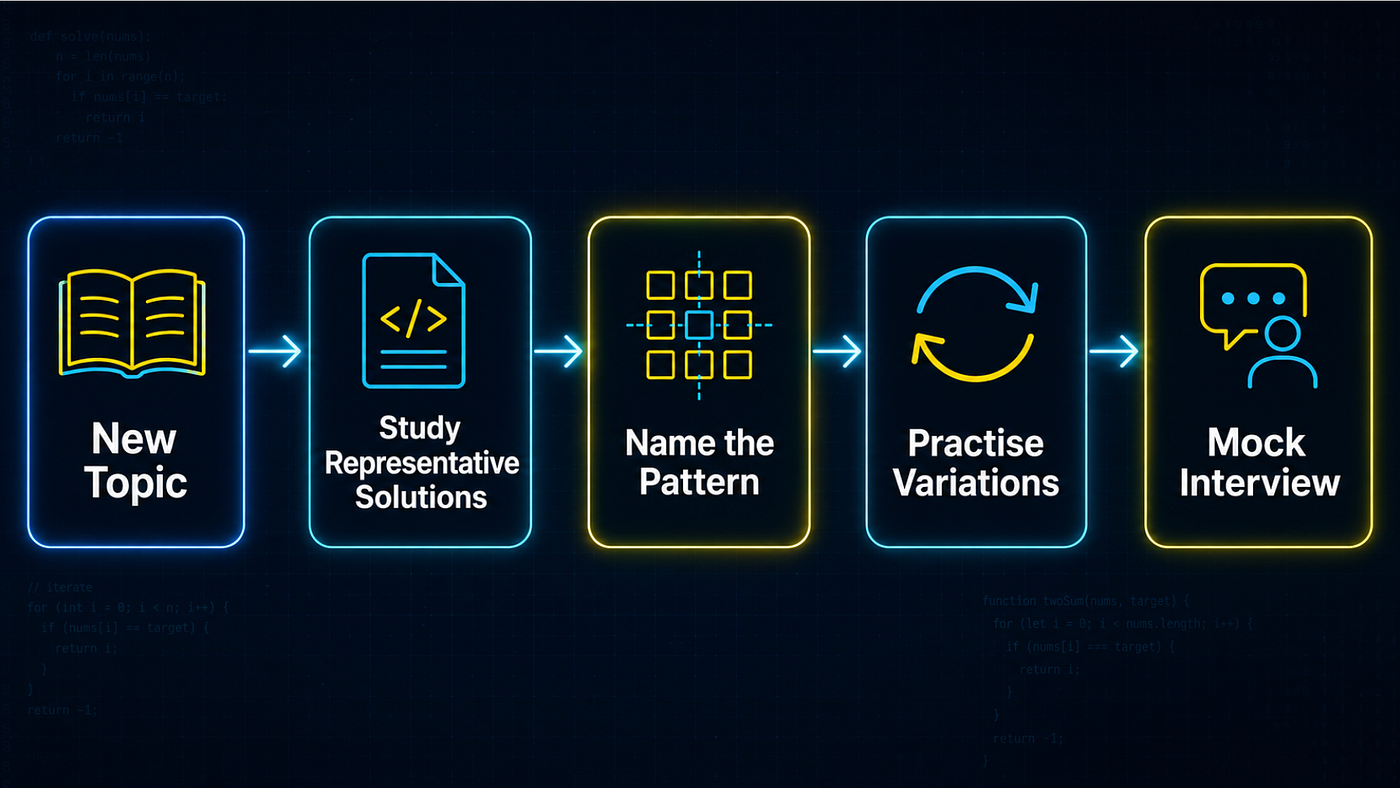
Flowchart: New Topic → Study Representative Solutions → Name the Pattern → Practise Variations → Mock Interview
Learn the map before testing your navigation
A better starting point is to split each topic into two sets.
Set A — pattern exposure: common easy and medium questions whose solutions you study deliberately.
Set B — retrieval practice: similar questions you attempt without help.
For Set A, do not copy code and move on. Ask what signal points to the approach, what state is required, and what would break the solution. Then close the answer and rebuild it.
A small pattern note is more useful than a solved counter
I keep notes closer to debugging records than textbook chapters. For a tree-level traversal, the reusable idea might look like this:
function levelOrder(root) {

  if (!root) return [];


  const queue = [root];

  const result = [];


  while (queue.length) {

    const levelSize = queue.length;

    const level = [];


    for (let i = 0; i < levelSize; i++) {

      const node = queue.shift();

      level.push(node.val);

      if (node.left) queue.push(node.left);

      if (node.right) queue.push(node.right);

    }

    result.push(level);

  }

  return result;

}
The important line is not the traversal itself. It is levelSize = queue.length. That snapshot separates one level from the next. A common mistake is checking queue.length inside the loop condition; newly added children then leak into the current level.
In JavaScript, shift() is also costly for large queues because array elements are re-indexed. In an interview, mention the tradeoff and use a pointer when needed:
let head = 0;

while (head < queue.length) {

  const node = queue[head++];

  // process node

}
This is what learning a solution should produce: a trigger, an invariant, a failure mode and an implementation detail — not a memorized block of code.
Note: Most people think what’s the use of notes in DSA, but believe me nothing can help you better than your, self made notes.
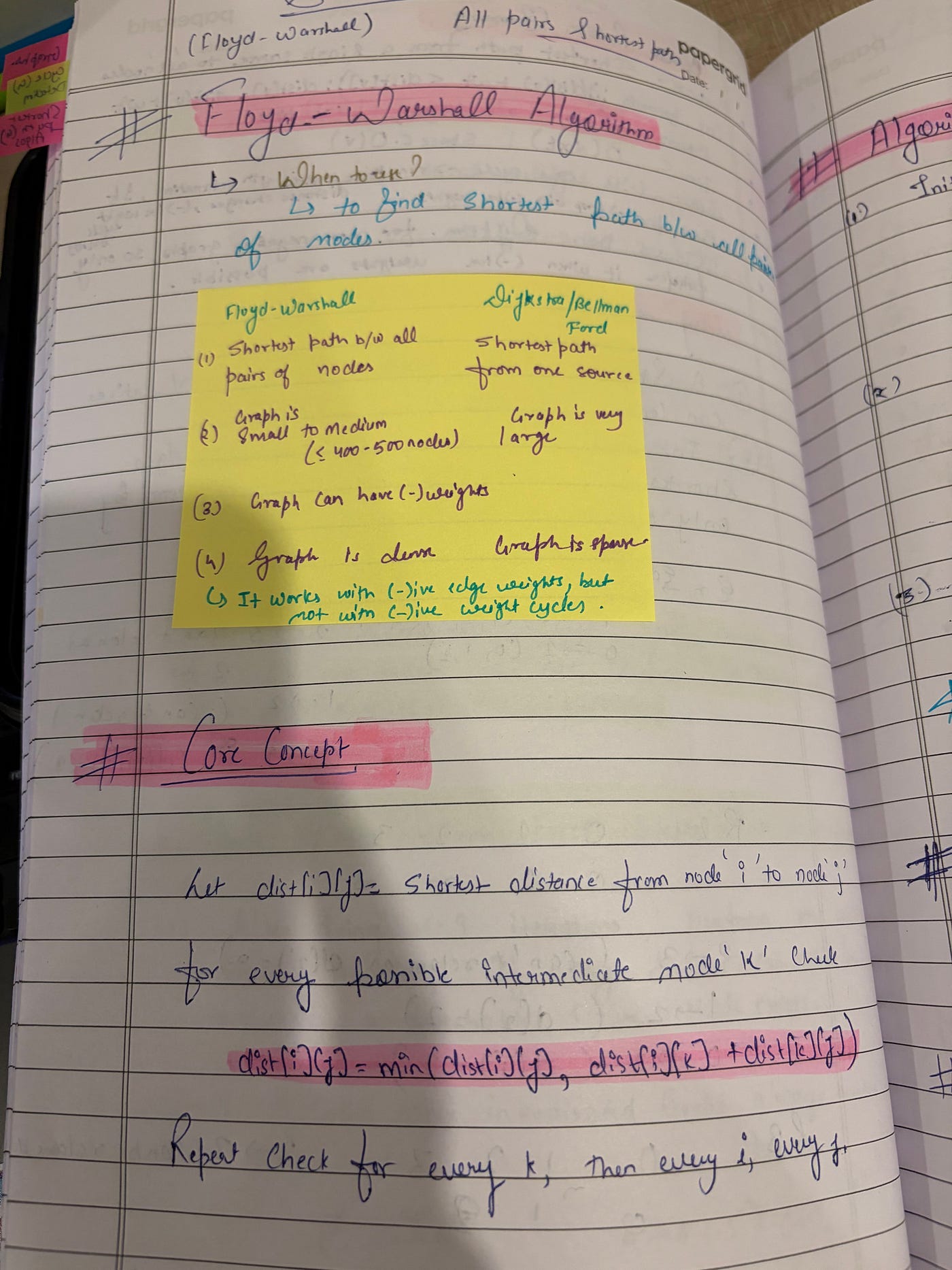
Image of My Notes
Recognition is only half the interview
Here is the catch. Solving alone lets you pause for ten silent minutes. An interview rarely does. Your attention is divided between reasoning and communication, so a familiar pattern can suddenly feel inaccessible.
After you can solve medium problems, add mock interviews. Practise saying:
- the brute-force idea and why it is too slow;
- the pattern you suspect and the evidence for it;
- the invariant your code must preserve;
- time and space complexity, including language-specific costs.

Image: showing pattern recognition, explanation, coding and testing
Not every topic deserves equal time
Quantity matters, but only after the roadmap is sensible. Foundational patterns usually deserve more repetitions because they combine into harder questions. Less frequent topics still matter, yet their interview questions may stay closer to standard forms.

Practice Mode and its best use
Mistakes that make practice look productive
- Chasing the shortest or most exotic solution. Interviews reward clear, defensible code more reliably than cleverness.
- Spending hours on a genuinely new pattern. Set a limit, study the solution, then revisit it from memory.
- Counting solved problems without tracking patterns. Ten variations of one idea do not equal ten new skills.
- Ignoring company context. Previously reported questions can reveal topic emphasis, though they should guide preparation rather than be treated as guarantees.
For hiring-manager rounds, technical preparation is only part of the job. Research the product, engineering constraints and likely scaling challenges. A thoughtful conversation can demonstrate judgment that another puzzle cannot.
Reflection: what changed for me
Once I stopped treating every problem as a fresh intelligence test, DSA became easier to diagnose.
If I failed, I could ask whether I missed the pattern, misunderstood the invariant, or made an implementation mistake. Those are fixable problems.
The unexpected lesson was that reading solutions was not the shortcut I needed to avoid.
Passive reading was. Studying a solution, reconstructing it, and then adapting it under interview pressure is real practice.
The practical takeaway
- Start with one topic.
- Choose a small set of representative problems, study them deeply, and write down the trigger and invariant for each.
- Then solve a second set without help. Once medium questions feel manageable, practise them aloud under a timer.
Your goal is not to remember every LeetCode answer. It is to make common structures familiar enough that your working memory is free to handle the variation in front of you.
What does your current practice track: problems completed, or patterns you can recognize and explain?
From Tech By Neha Gupta
- 👏 Enjoyed the article? Don’t forget to leave a clap.
- 💬 Have thoughts or questions? Share them in the comments.
Before you go
- Please take a moment to like the post and follow the writer!
- Did you know that over 400,000 developers share what they’re building, learning, and discovering across our platforms every month? Learn how you can contribute here
메타데이터
- post_id
- 8cea02e7f1ad
- slug
- the-leetcode-shortcut-nobody-tells-beginners-about-8cea02e7f1ad
- url
- https://javascript.plainenglish.io/the-leetcode-shortcut-nobody-tells-beginners-about-8cea02e7f1ad
- canonical_url
- https://javascript.plainenglish.io/the-leetcode-shortcut-nobody-tells-beginners-about-8cea02e7f1ad
- author_url
- https://medium.com/@techbynehagupta
- status
- ok
- fetched_at
- 2026-07-17 06:05:59