Why Faridabad Remains a Trusted Hub for Precision Forged Components?
When procurement managers and design engineers go looking for gear blanks manufacturers in Faridabad, they’re rarely just searching for a…
Why Faridabad Remains a Trusted Hub for Precision Forged Components?
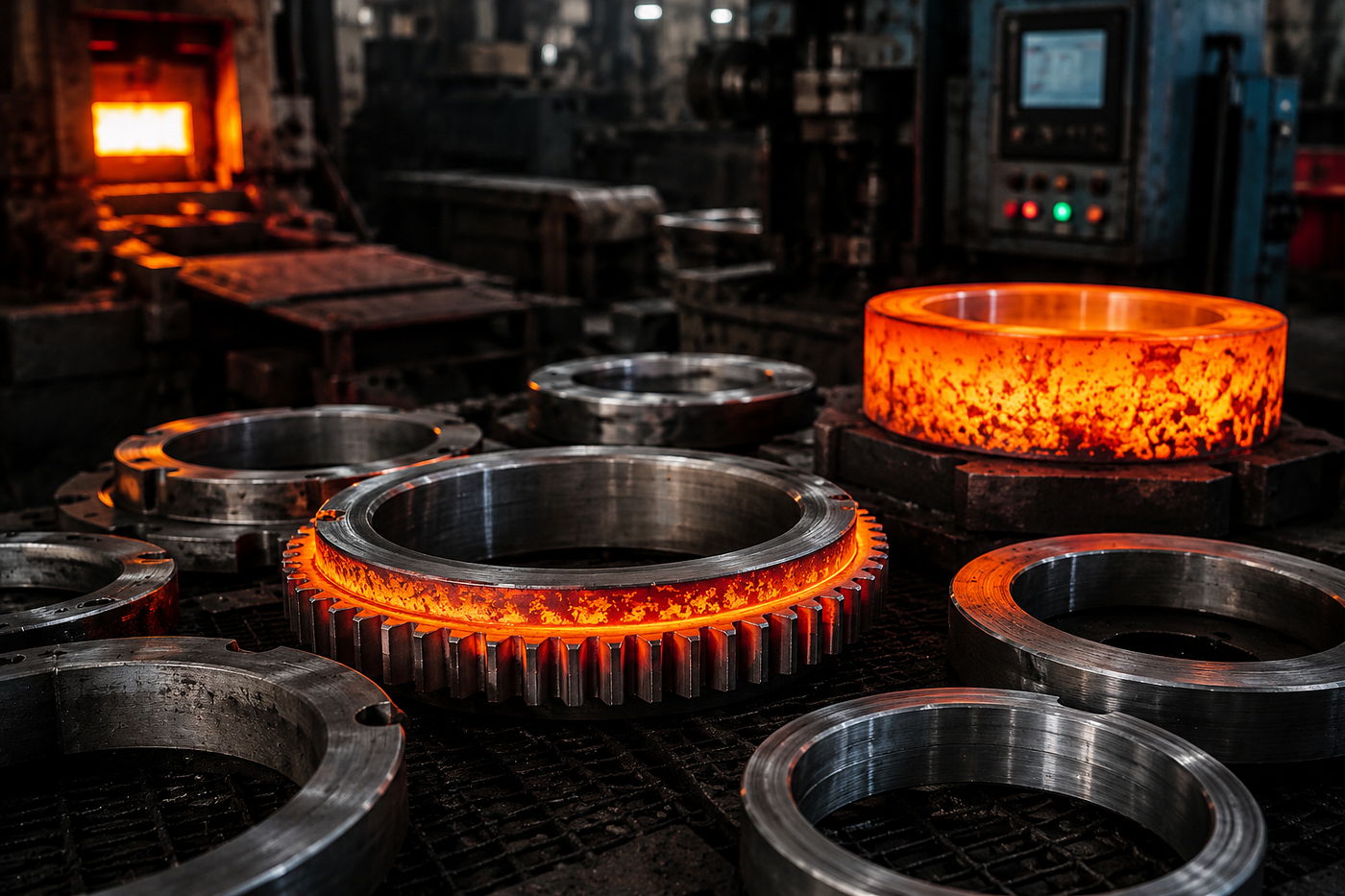
When procurement managers and design engineers go looking for gear blanks manufacturers in Faridabad, they’re rarely just searching for a supplier. They’re searching for a partner — someone who understands that a poorly forged gear blank doesn’t fail on a drawing; it fails mid-operation, sometimes catastrophically. That distinction matters, and it’s exactly why companies across India and abroad keep returning to Faridabad’s established forging belt rather than chasing cheaper alternatives elsewhere.
Forgewell Limited, operating out of 24 DLF Industrial Area, Phase II, Faridabad, has spent nearly five decades building that kind of reputation. Founded in 1978 with a single drop hammer, the company has grown steadily into a multi-line forging operation without losing the accountability that comes from being a family-managed business.
What Actually Separates a Good Forging from a Great One?
Forgings aren’t complicated to understand at a surface level — you apply heat, apply force, shape metal. But the variables that determine whether the final piece holds up under real stress are considerably less obvious. Grain structure, die design, forging temperature windows, cooling rates — each of these quietly determines whether a component lasts three years or thirty.
Forgewell works with drop hammers for parts ranging from 500 grams to 40 kg, and with ring rolling lines for rolled rings up to 25 kg. These aren’t just capacity numbers. The ring rolling process, specifically, produces a continuous grain flow along the circumference of the part — which is why rolled rings and forged gear blanks carry fundamentally better fatigue resistance compared to machined-from-bar alternatives.
For buyers evaluating **gear blanks manufacturers in Faridabad**, this matters because a gear blank’s job isn’t finished when it leaves the forge. It goes to a gear cutting shop, gets hobbed or shaved, and eventually ends up in a gearbox under real load. Any internal defect or inconsistent grain structure that survives the forging stage will find its way to the surface under stress — usually at the worst possible time.
The Pulverizer Bowl: A Component That Demands More Than It Gets
There’s a reason that **pulverizer bowls manufacturers in Faridabad **don’t exactly crowd the market. Pulverizer bowls — used in laboratory and industrial grinding applications — are among the more demanding forgings to produce well. They need to withstand repeated impact, resist wear from hard materials, and maintain dimensional accuracy across hundreds or thousands of cycles.
Forgewell manufactures pulverizer bowls in a range of capacities: 400cc, 800cc, 1000cc, 2000cc, and 5000cc. Each variant serves a different volume requirement, but all of them share the same fundamental demand — they cannot deform, crack, or wear unevenly in service. The material selection and heat treatment behind each piece is what separates a bowl that lasts from one that doesn’t.
This is where Forgewell’s in-house infrastructure makes a visible difference. Most contract forges outsource their heat treatment. Forgewell does it on-site, which means the thermal cycles applied to every piece — whether a pulverizer bowl or a rolled ring — are part of the same quality loop as the forging itself. There’s no handoff gap where a batch sits for days before treatment, which can affect metallurgical outcomes.
Infrastructure Built to Match Accountability
It’s worth looking at what Forgewell actually has under one roof, because the combination is less common than it sounds:
- Drop Hammer Lines for closed-die forgings across weight classes
- Ring Rolling Lines for seamless rolled rings and gear blanks
- In-house Heat Treatment for controlled thermal processing
- CNC and VMC Machining for finish dimensions
- Deep Hole Gun Drilling and Broaching for components requiring internal features
- Laboratory and Tool Room for die maintenance and material testing
Having machining and inspection in-house means Forgewell can deliver components to near-net or finished dimensions — which reduces the buyer’s downstream processing time and gives a single point of accountability for dimensional compliance.
The laboratory function is equally important. Every batch of incoming material is tested for chemical and metallurgical properties, including hardness, before it enters the forge. Materials processed include an extensive range: 20MnCr5, 16MnCr5, 42CrMo4, SAE 4140, EN43BCr, SS 304, SS 316, and several others. This isn’t a company sourcing the cheapest steel and hoping the final hardness tests out — the chain of custody for every piece starts before forging begins.
Serving Industries That Can’t Afford Surprises
Forgewell’s product range covers suspension components, compressor parts, railway and defence parts, mining and machinery parts, and miscellaneous forgings alongside their rolled rings and gear blank line. The breadth isn’t accidental — it reflects decades of building tooling, process knowledge, and customer relationships across sectors that have very different but uniformly strict quality requirements.
Railway and defence components, for instance, go through additional scrutiny at Forgewell because the consequences of failure in those environments are unambiguous. That same engineering discipline carries over to how pulverizer bowls and gear blanks are produced — the company doesn’t switch gears between “critical” and “standard” based on end application. The quality system treats everything as critical.
For eMobility applications, Forgewell has extended its rolled ring capability to produce rings suitable for electric vehicle drivetrain components — an indication that the company is actively tracking where industrial demand is heading rather than coasting on existing product lines.
A Central Documentation Cell That Earns Trust
One detail worth noting for buyers who deal with export markets or regulated industries: Forgewell maintains a central documentation cell that records the complete history of each product — forging parameters, stage inspection reports, manufacturers’ test certificates for incoming material, and hardness test results. These are compiled into a data book per batch.
For customers who face end-customer audits or regulatory requirements, this kind of traceability isn’t a nice-to-have. It’s often the deciding factor when qualifying a new supplier.
Why Faridabad, and Why Forgewell?
Faridabad’s industrial identity has been built over decades on metal forming, precision engineering, and component manufacturing. The ecosystem of skilled tradespeople, toolmakers, and material suppliers that has grown around this cluster gives companies like Forgewell a practical advantage that’s hard to replicate in a greenfield location.
Forgewell Limited takes that geographic advantage and backs it with nearly 50 years of process experience, a well-equipped facility, and a quality system that documents what it does. For anyone seriously evaluating sources for gear blanks, rolled rings, pulverizer bowls, or other precision forgings, that combination is worth a conversation.
You can reach them at 24 DLF Industrial Area, Phase II, Faridabad 121003, or through their website at forgewell.com.
메타데이터
- post_id
- 8d2374bbe415
- slug
- why-faridabad-remains-a-trusted-hub-for-precision-forged-components-8d2374bbe415
- url
- https://medium.com/@forgewell2026/why-faridabad-remains-a-trusted-hub-for-precision-forged-components-8d2374bbe415
- canonical_url
- https://medium.com/@forgewell2026/why-faridabad-remains-a-trusted-hub-for-precision-forged-components-8d2374bbe415
- author_url
- https://medium.com/@forgewell2026
- status
- ok
- fetched_at
- 2026-06-25 07:00:49