The Financial Mistakes Killing UK Startups
Nine out of ten startups fail. But it’s rarely because the product was bad, the market didn’t exist, or the team wasn’t smart enough.
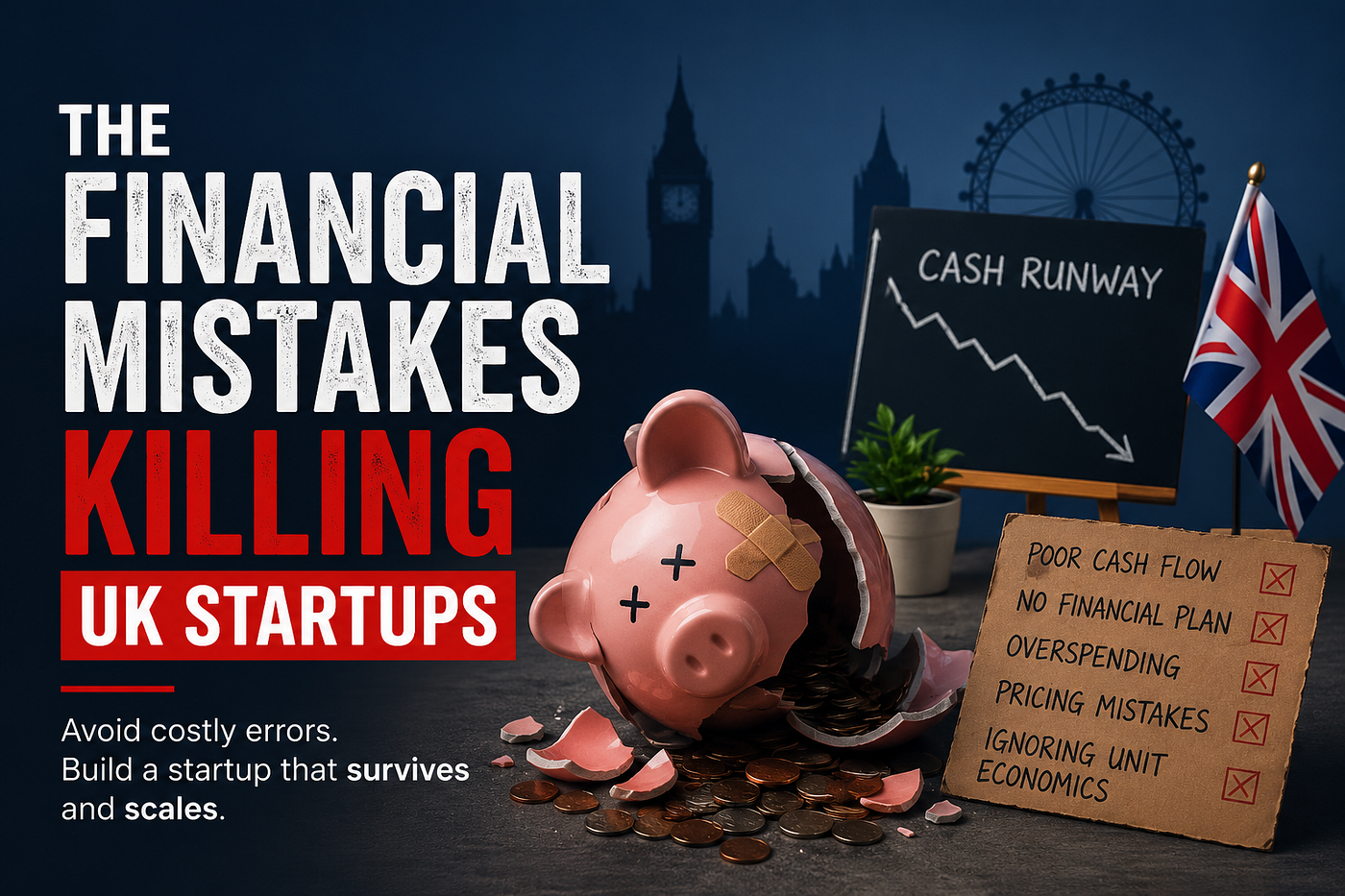
The Financial Mistakes Killing UK Startups
The Financial Mistakes Killing UK Startups
Nine out of ten startups fail. But it’s rarely because the product was bad, the market didn’t exist, or the team wasn’t smart enough.
It’s almost always because of one thing: cash.
A startup runs out of cash. They can’t pay their team. They can’t fulfil customer orders. They can’t invest in growth. The business collapses, not because it was unsustainable, but because they didn’t manage money properly.
What’s shocking is that most of these failures are completely preventable. Not through luck or more funding, but through basic financial discipline.
After working with dozens of startup founders over the past decade, I’ve seen the same financial mistakes repeated over and over. This guide outlines the five biggest ones — and how to avoid them.
Mistake 1: Confusing Revenue With Cash
This is the #1 killer of startups.
You land a £50,000 contract with a big corporate client. The deal is done. You’ve “made” £50,000.
But the client has payment terms: Net 60. They’ll pay you 60 days after delivery.
Meanwhile, you need to pay:
-
Your team (weekly or monthly)
-
Your suppliers (often upfront or Net 30)
-
Your office rent (monthly)
-
Your software subscriptions (monthly)
You’ve got £50,000 in “revenue,” but £0 in cash for 60 days. Your team doesn’t work for free. Your suppliers don’t wait. Your landlord won’t accept “we have a contract coming in.”
You run out of cash on day 30.
This is revenue vs. cash flow failure. You were profitable on paper, but broke in reality.
How to Avoid It:
- Map your cash cycle: How long between spending money and getting paid?
-
Days to buy inventory or supplies
-
Days to deliver the product/service
-
Days until the customer pays
-
Total cash cycle
- Plan for it: If your cash cycle is 60 days, you need 60 days of expenses in the bank before you start.
- Negotiate better terms: Ask for 50% upfront, 50% on delivery. Or ask to pay suppliers in 45 days instead of 30.
- Use a line of credit: A bank overdraft or invoice financing line lets you cover the gap while you wait for payment. Cost: 5–10% of invoice value. Worth it to stay alive.
- Track daily: Use software (Xero, QuickBooks, FreeAgent) to see your cash position every single day. Not weekly, not monthly. Daily.
If you catch a cash problem on day 20, you have options. If you notice on day 29, you’re in crisis mode.
Mistake 2: Not Separating Business and Personal Money
This one is simple but crucial: never mix business and personal money.
Open a separate business bank account. Use it exclusively for business. Don’t pull £5,000 “for personal use” every other week. Don’t pay your personal electricity bill from the business account.
Why this matters:
- You’ll never know where you stand. If business and personal money are mixed, you don’t know if you have £10,000 in the bank or £2,000.
- HMRC hates it. If you get audited, mixed accounts make it nearly impossible to prove what’s business expense and what’s personal. HMRC will assume it’s all personal and you owe more tax.
- You can’t scale. Once you hire team members or bring in investors, they need to see clean financial records. Startups with mixed accounts look chaotic.
- Accounting is a nightmare. Your accountant will spend hours trying to categorise transactions. You pay more in accounting fees.
The fix: Take 20 minutes today and open a business bank account. Use it exclusively for business transactions.
If you need personal money, pay yourself a salary or dividend. Don’t just draw cash whenever.
Mistake 3: No Monthly Financial Check-In
Most startup founders check their finances once per year (usually in panic mode when the tax deadline is looming).
메타데이터
- post_id
- 8d2a331ef4dd
- slug
- the-financial-mistakes-killing-uk-startups-8d2a331ef4dd
- url
- https://medium.com/@waldenwayandco1/the-financial-mistakes-killing-uk-startups-8d2a331ef4dd
- canonical_url
- https://medium.com/@waldenwayandco1/the-financial-mistakes-killing-uk-startups-8d2a331ef4dd
- author_url
- https://medium.com/@waldenwayandco1
- status
- ok
- fetched_at
- 2026-06-27 18:20:27



