Building Resilience through Renewable Energy: The Ma’asina Story
Powered by the Sun, Strengthened by Community
Building Resilience through Renewable Energy: The Ma’asina Story
Powered by the Sun, Strengthened by Community
When the power went out across Fagaloa Bay (situated on the northeastern coast of Upolu island in Samoa) on three separate nights earlier this year in January, darkness settled over most villages. But in Ma’asina, the lights stayed on.
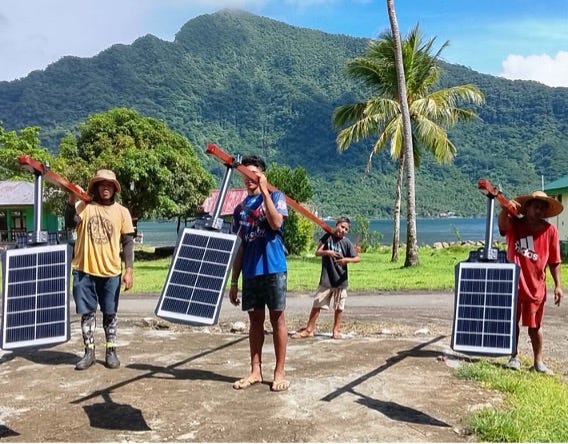
Children woke before dawn to prepare for school, parents carried on with their morning routines without searching for candles, and elderly residents moved safely through illuminated pathways. For the more than 100 people of Ma’asina, the solar indoor and street lighting systems installed through funding from the Global Environment Facility Small Grants Programme (GEF SGP), implemented by the United Nations Development Programme (UNDP), proved their true value when it mattered most.
For Sele Togia, President of the Ma’asina Fagaloa Catholic Women’s Fellowship, those nights demonstrated how a simple renewable energy solution could transform an entire community.
“The solar indoor and street light project has been one of the most beneficial development initiatives ever implemented in our village,” she said. “It has transformed the daily lives of our families and strengthened our resilience during times of uncertainty.”
Before the project, Ma’asina relied entirely on the national electricity grid. Whenever outages occurred, homes were left in darkness, disrupting children’s education, family activities, safety, and community life. The impacts were felt most by elderly people, young children, and families who depended on electricity for their daily routines.
The January power outages changed the way the community viewed renewable energy. While neighbouring villages experienced complete blackouts, Ma’asina remained illuminated through its solar-powered indoor and street lights, becoming one of the few villages in the bay able to continue daily life with minimal disruption.
For students, reliable lighting meant they could continue studying and prepare for school without interruption. Parents no longer worried about finding candles or alternative light sources, and children were able to maintain their routines despite the power failures.

The benefits extend well beyond the household.
Solar street lights have significantly improved safety and security throughout the village. Community members now walk confidently to church activities, visit relatives, and participate in evening events knowing that roads and public spaces are well lit. For elderly residents, the improved visibility has made moving around the village safer and more accessible, giving families greater peace of mind.
The project has also sparked a broader conversation about renewable energy and environmental sustainability. Villagers have seen firsthand that solar energy is not only a clean and environmentally friendly alternative but also a practical investment that strengthens community resilience during emergencies and power disruptions.
Even as occasional electricity interruptions continue, the solar lighting systems provide dependable light for homes and public spaces, reducing the impact of these disruptions on everyday life. The community now has greater confidence that essential activities can continue, regardless of challenges affecting the main power supply.

Fagaloa Bay where the village of Ma’asina is located. Photo: UNDP Samoa/Laufālē’ainā Lesā
The success of the initiative has inspired Ma’asina to explore additional renewable energy opportunities, demonstrating how community-level investments can deliver lasting benefits for families, schools, churches, and the wider village. More importantly, it has shown that sustainable energy solutions can improve quality of life while building resilience for the future.
Reflecting on the journey, Sele Togia believes the project represents something much greater than infrastructure.
“The solar indoor and street light project is more than just an energy project,” she said. “It is a source of hope, security, resilience, and sustainable development for our community. Its benefits will continue to be felt for many years to come.”
In Ma’asina, the power of the sun has become more than a source of light — it has become a symbol of a community better prepared for tomorrow, where children can continue learning, families can feel safe, and sustainable development shines bright even when the grid goes dark.
The GEF SGP has supported nearly 30,000 grants at the local level to drive initiatives that address global environmental issues and improve livelihoods for over 30 years. The GEF SGP operationalizes a whole‑of‑society approach by placing civil society — especially Indigenous Peoples, women, youth, and local communities — at the center of climate and environmental action.
Yi Liu, Technical Advisor and Regional Focal Point for Asia and the Pacific, the Global Environment Facility Small Grants Programme (GEF SGP)
메타데이터
- post_id
- 8d47b203d644
- slug
- building-resilience-through-renewable-energy-the-maasina-story-8d47b203d644
- url
- https://medium.com/@undpsamoa/building-resilience-through-renewable-energy-the-maasina-story-8d47b203d644
- canonical_url
- https://medium.com/@undpsamoa/building-resilience-through-renewable-energy-the-maasina-story-8d47b203d644
- author_url
- https://medium.com/@undpsamoa
- status
- ok
- fetched_at
- 2026-07-09 17:12:49