Interoperable 1600ZR/ZR+ Interfaces
The Optical Internetworking Forum (OIF) continues to play a key role in achieving industry consensus to promote coherent transmission…
Interoperable 1600ZR/ZR+ Interfaces
The Optical Internetworking Forum (OIF) continues to play a key role in achieving industry consensus to promote coherent transmission interoperability. Although 800G coherent pluggables that address both OIF 800ZR and 800G ZR+ based on interoperable probabilistic constellation shaping (PCS) defined in OpenROADM have only recently been announced, the OIF is already making progress towards interoperable 1600ZR and 1600ZR+ implementation agreements.
OIF Defining Both 1600ZR and 1600ZR+ Standards Unlike previous coherent standardization efforts at 400G and 800G, in which enhanced “ZR+” performance links were defined outside of OIF, the OIF has launched initiatives to define both 1600ZR and 1600ZR+. Having both efforts occurring simultaneously enables the OIF to make decisions with both 1600ZR and 1600ZR+ in the same scope of discussions. This helps keep the two implementations as aligned as possible, which is beneficial for the industry considering the large investments of technology required. The focus of these investments includes advanced CMOS nodes to maintain low power consumption within the envelope of QSFP-DD and OSFP form-factor requirements, and advanced designs in high-speed RF/mixed-signal as the modulation approaches the Class 4 240Gbaud range.
As we saw in both the 400G and 800G generations, the foundation of 16QAM (4 bits/symbol) modulation was adopted and this is likely to also happen with the 1600G generation. For 1600G transmission, 16QAM modulation implies ~236+Gbaud data rate operation.
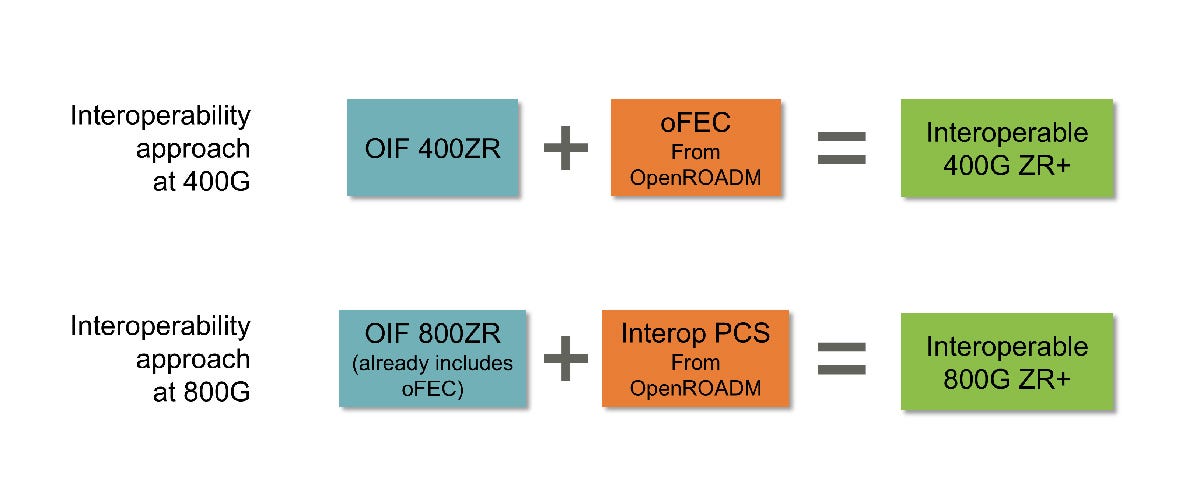
In addition to modulation order, the type of forward error correction (FEC) has also been a key parameter that required industry agreement. At 400G, the OIF adopted concatenated FEC (CFEC) as the 400ZR FEC and OpenZR+ MSA adopted oFEC (a high-performance FEC) for 400G ZR+. At 800G, the OIF decided to adopt oFEC for ZR, aligning it with ZR+ modes. To provide an enhanced performance mode beyond 800ZR, OpenROADM MSA defined an interoperable PCS for 800G ZR+ (Figure 3). It is likely that oFEC will be similarly adopted for both 1600ZR and combined with some interoperable PCS for 1600ZR+ modes.

With 200G per lane electrical PAM4 solutions recently introduced, network operators now have a path towards supporting 1600G host router I/O ports by using eight parallel electrical lanes (Figure 1). Similar to 400G and 800G generations, this is a key motivator in developing coherent pluggable modules to be plugged into these 1600G router ports for inter-data center optical links. However, along with the progress on the host interface side, there is still much work to be done to ensure a technically feasible and robust interoperable design for 1600ZR/ZR+ coherent pluggable modules.
메타데이터
- post_id
- 8d7b1fc70fb8
- slug
- interoperable-1600zr-zr-interfaces-8d7b1fc70fb8
- url
- https://medium.com/@sonicomp20/interoperable-1600zr-zr-interfaces-8d7b1fc70fb8
- canonical_url
- https://medium.com/@sonicomp20/interoperable-1600zr-zr-interfaces-8d7b1fc70fb8
- author_url
- https://medium.com/@sonicomp20
- status
- ok
- fetched_at
- 2026-06-26 21:52:29