Fighting hypertension with the “celery-anise” scented leaves of the orchard.
You walk past it every day.
Fighting hypertension with the “celery-anise” scented leaves of the orchard.
You walk past it every day.
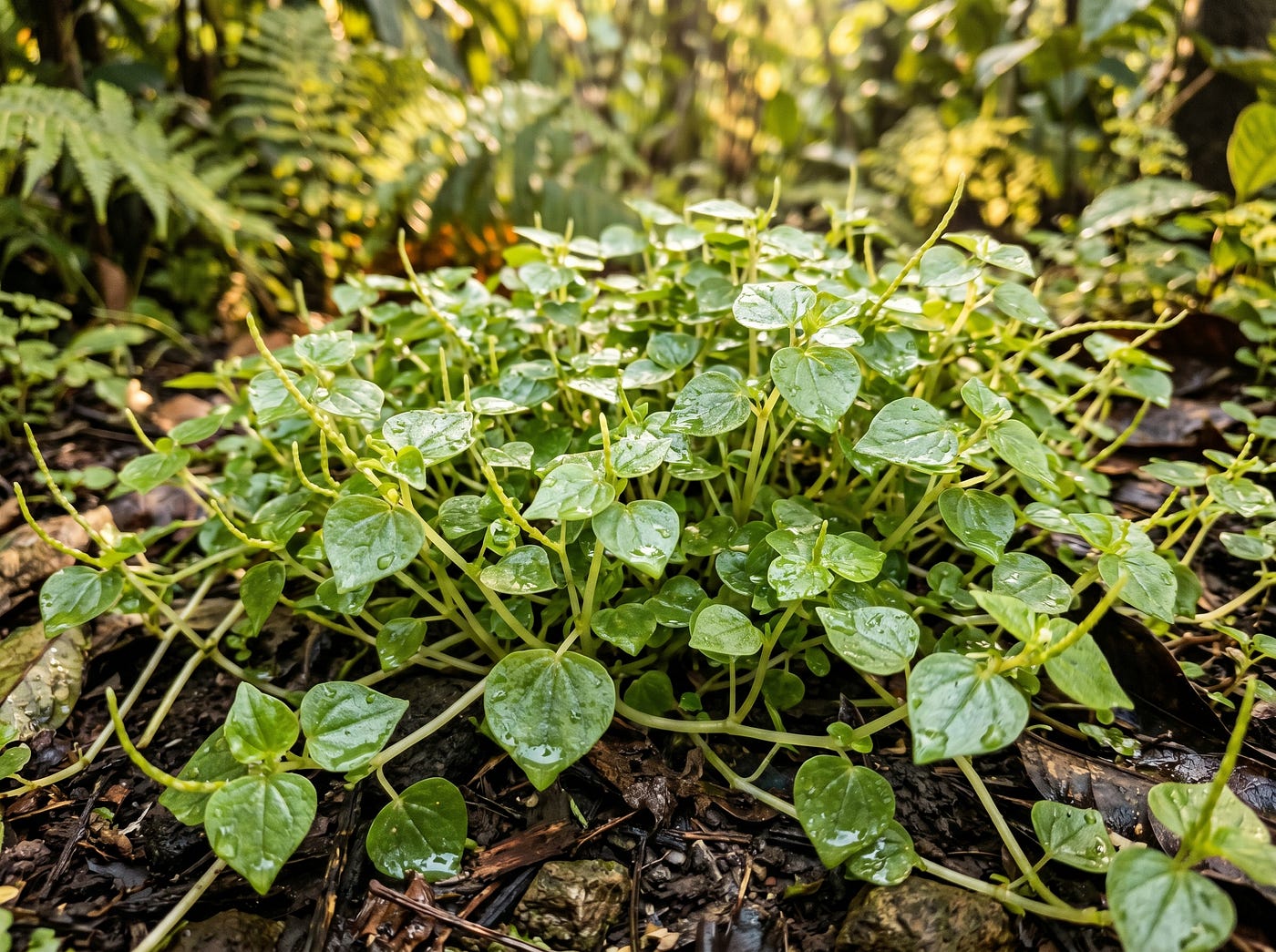
In the damp corners of your garden. Under the shade of fruit trees. Along the edges of pathways where water collects after rain. A small, unassuming plant with heart-shaped leaves and thin, succulent stems. It doesn’t flower dramatically. It doesn’t demand attention.
Crush a leaf between your fingers, and something unexpected happens.
The air fills with a clean, sharp aroma — celery and anise, licorice and green. It’s pleasant. It’s distinctive. And it’s the first clue that this humble weed is doing something remarkable.
In the Philippines, it’s called pansit-pansitan — named for its resemblance to a thin noodle (pansit). Elsewhere, it’s known as pepper elder or shiny bush. Scientists call it Peperomia pellucida.
And for generations, traditional healers have used it for one condition above others: high blood pressure.
Not because they understood the mechanisms we know today — diuresis, angiotensin-converting enzyme inhibition, uric acid reduction — but because they observed that people who drank pansit-pansitan tea had lower pressure, fewer headaches, and less of the heaviness that accompanies hypertension.
Modern science is now catching up. And what researchers are finding is that this unremarkable weed, growing in orchards across the Philippines, contains a suite of bioactive compounds that hit high blood pressure from multiple angles.
Let me show you how it works, why you’ve never heard of it, and how to use it safely.
The Plant That Does Three Things at Once
Most blood pressure medications are one-trick ponies.
ACE inhibitors block an enzyme. Diuretics make you pee. Calcium channel blockers relax blood vessels. Each does one thing, well. But hypertension is rarely a one-thing problem.
Pansit-pansitan is different. Based on the available research — and confirmed by traditional use — it works through at least three distinct mechanisms simultaneously.
Mechanism 1: Diuresis without potassium loss.
Like pharmaceutical diuretics, pansit-pansitan increases urine output. More urine means lower blood volume. Lower blood volume means lower pressure on your vessel walls.
But here’s the critical difference: pharmaceutical diuretics (hydrochlorothiazide, furosemide) waste potassium in the process. Low potassium causes muscle cramps, fatigue, and cardiac arrhythmias. Pansit-pansitan appears to be potassium-sparing — a massive advantage for long-term use.
A 2010 study published in the Journal of Ethnopharmacology confirmed the diuretic activity of Peperomia pellucida extract in animal models. The effect was dose-dependent and comparable to standard diuretics, without the associated electrolyte disturbances.
Mechanism 2: ACE inhibition.
This is the same pathway targeted by lisinopril, enalapril, and other prescription ACE inhibitors. Pansit-pansitan contains compounds (flavonoids and other phenolics) that inhibit angiotensin-converting enzyme, reducing production of angiotensin II — a potent vasoconstrictor. Less constriction means wider blood vessels. Wider vessels mean lower pressure.
A 2014 study in BMC Complementary and Alternative Medicine identified specific flavonoids in Peperomia pellucida with ACE-inhibitory activity, including quercetin and kaempferol derivatives. The effect was significant but gentle — not enough for severe hypertension, but ideal for mild to moderate cases.
Mechanism 3: Uric acid reduction.
Here’s the wildcard.
High blood pressure and high uric acid travel together. About 25 to 40 percent of people with untreated hypertension also have hyperuricemia (elevated uric acid). The relationship is bidirectional — high uric acid damages blood vessels and promotes sodium sensitivity, raising pressure. High pressure damages kidneys, reducing uric acid excretion.
Pansit-pansitan has a long traditional use for gout (uric acid crystals in joints). Modern studies have confirmed its xanthine oxidase inhibitory activity — the same mechanism as allopurinol, a prescription gout medication. By lowering uric acid, pansit-pansitan addresses a root driver of hypertension in a subset of patients.
A 2013 study in the Asian Pacific Journal of Tropical Biomedicine found that Peperomia pellucida extract inhibited xanthine oxidase by up to 70 percent in vitro, with effects comparable to allopurinol.
One plant. Three mechanisms. That’s not a single bullet. That’s a coordinated strategy.
Why This Plant Matters Now
Let me step back and tell you why I’m writing about a humble weed instead of a flashy tropical flower.
The hypertension epidemic is out of control. One billion people worldwide. Millions on medication. Millions more undiagnosed. And the standard approach — catch it late, prescribe a pill, manage side effects — is failing.
But here’s the part that bothers me most: we already have solutions growing in plain sight.
Pansit-pansitan isn’t rare. It’s not endangered. It’s not even cultivated intentionally in most cases. It’s a weed that shows up wherever the conditions are right — damp, shaded, disturbed soil. Orchards. Gardens. Roadsides. Empty lots.
You don’t need a pharmacy. You don’t need a prescription. You need to know what to look for and how to prepare it.
That’s not anti-medicine. That’s pro-knowledge. The pharmaceutical industry will never advertise pansit-pansitan because there’s no profit in it. You can’t patent a weed. You can’t charge fifteen dollars for a tea that grows for free.
But your health doesn’t care about business models. Your blood pressure only responds to biology. And pansit-pansitan delivers the biology.
The Traditional Use You Never Heard About
In the Philippines, pansit-pansitan has multiple traditional applications.
For wounds and skin infections, the leaves are pounded into a poultice and applied directly. For fever, the whole plant is boiled into a tea. For stomach pain, it’s eaten raw as a salad.
But the most interesting use — the one that kept showing up in my conversations with elderly healers — is for mataas na presyon (high blood pressure) and bato sa bato (kidney stones).
The connection between these two conditions is uric acid. High uric acid causes both hypertension and kidney stones. The traditional healers didn’t know the biochemistry, but they observed that people with both problems improved when they drank pansit-pansitan tea regularly.
That’s not mysticism. That’s empirical medicine expressed in a different language.
How to Identify and Harvest Pansit-Pansitan
Before you use this plant, you need to be certain you have the right one.
Visual identification:
- Grows 15 to 45 centimeters tall (6 to 18 inches)
- Stems are thin, succulent, translucent, often reddish at the base
- Leaves are heart-shaped, 2 to 4 centimeters long, smooth and shiny, arranged alternately on the stem
- Flowers are tiny, spike-like, emerging from leaf axils
- No significant branching — the plant grows as a single stem with leaves directly attached
Aroma test (critical): Crush a leaf between your fingers. It should smell distinctly like celery crossed with anise or licorice. If it smells musty, bitter, or like nothing, you may have the wrong plant.
Habitat: Grows in damp, shaded areas. Under fruit trees. Along drainage ditches. In gardens after rain. It’s an annual, most abundant during wet season.
Look-alikes: Some Peperomia species are similar but not traditionally used for blood pressure. Stick to the aroma test. If it doesn’t smell like celery-anise, don’t use it medicinally.
Harvesting: Cut the whole plant just above the root. Use fresh within 24 hours for maximum activity, or dry in the shade for later use.
The Basic Protocol (Full details in paid version)
Here’s the framework. The complete protocol — including exact dosages, timing variations, combination strategies with other botanicals, and safety precautions — is in the paid Substack post.
Fresh plant tea:
- 10 to 15 grams fresh whole plant (about a handful)
- Chop roughly
- Simmer (not boil) in 2 cups water for 10 minutes
- Strain
- Drink 1 cup morning, 1 cup afternoon
Dried plant tea:
- 1 to 2 tablespoons dried, chopped plant
- Steep in 1 cup boiling water for 10 minutes
- Drink 1 to 2 cups daily
Duration: Effects build over 2 to 4 weeks. Do not expect immediate drops.
Expected effect: 5 to 10 mmHg systolic reduction in most people with mild to moderate hypertension.
Who Should NOT Use Pansit-Pansitan
I’m not reckless. This plant is gentle, but it has limits.
Do not use if:
- You’re already on prescription diuretics or ACE inhibitors without medical supervision (additive effect may drop pressure too low)
- You have known kidney disease (diuresis stresses the kidneys — consult your nephrologist)
- You’re pregnant or nursing (insufficient safety data)
- Your blood pressure is consistently above 160/100 (see a doctor first — this is not a DIY condition)
- You have a known allergy to Peperomia species (rare but possible)
Monitor for:
- Excessive urination (reduce dose)
- Dizziness upon standing (pressure may be too low)
- Dehydration (drink extra water)
The Economic and Philosophical Argument
I want to end this free post with something bigger than blood pressure.
We live in a culture that has pathologized weeds. A plant that grows without cultivation, without expensive inputs, without corporate oversight — we call it a “weed” and treat it as worthless.
But weeds are often the most resilient, the most pharmacologically active, the most adaptable plants in any ecosystem. They’ve evolved to survive without human help. And in that survival chemistry, they’ve produced compounds that happen to press exactly the right buttons in the human body.
Pansit-pansitan is a weed. It grows in orchards, ignored, stepped on, pulled out and thrown away. And it contains a natural ACE inhibitor, a potassium-sparing diuretic, and a xanthine oxidase inhibitor all in one delicate stem.
You can’t buy that at a pharmacy. Not because it doesn’t work, but because there’s no way to package it into a profitable product.
That’s not a flaw in the plant. That’s a flaw in the system.
The good news is that you don’t need the system. You need the plant, a pot of water, and the knowledge to use it correctly.
The knowledge starts here. The plant is growing somewhere near you. Go find it.
Your Practical Next Step
You’ve just learned about one Filipino healing plant for hypertension. But there are four that replace common pharmacy drugs — including a second plant for blood pressure that works through a completely different mechanism (calcium channel blockade).
Get the free guide here: 👉 4 Filipino Healing Plants That Replace Common Pharmacy Drugs
One guide. Four plants. Your blood pressure deserves better than a weed pulled from your orchard? Actually, that weed might be exactly what you need.You walk past it every day.
In the damp corners of your garden. Under the shade of fruit trees. Along the edges of pathways where water collects after rain. A small, unassuming plant with heart-shaped leaves and thin, succulent stems. It doesn’t flower dramatically. It doesn’t demand attention.
Crush a leaf between your fingers, and something unexpected happens.
The air fills with a clean, sharp aroma — celery and anise, licorice and green. It’s pleasant. It’s distinctive. And it’s the first clue that this humble weed is doing something remarkable.
In the Philippines, it’s called pansit-pansitan — named for its resemblance to a thin noodle (pansit). Elsewhere, it’s known as pepper elder or shiny bush. Scientists call it Peperomia pellucida.
And for generations, traditional healers have used it for one condition above others: high blood pressure.
Not because they understood the mechanisms we know today — diuresis, angiotensin-converting enzyme inhibition, uric acid reduction — but because they observed that people who drank pansit-pansitan tea had lower pressure, fewer headaches, and less of the heaviness that accompanies hypertension.
Modern science is now catching up. And what researchers are finding is that this unremarkable weed, growing in orchards across the Philippines, contains a suite of bioactive compounds that hit high blood pressure from multiple angles.
Let me show you how it works, why you’ve never heard of it, and how to use it safely.
The Plant That Does Three Things at Once
Most blood pressure medications are one-trick ponies.
ACE inhibitors block an enzyme. Diuretics make you pee. Calcium channel blockers relax blood vessels. Each does one thing, well. But hypertension is rarely a one-thing problem.
Pansit-pansitan is different. Based on the available research — and confirmed by traditional use — it works through at least three distinct mechanisms simultaneously.
Mechanism 1: Diuresis without potassium loss.
Like pharmaceutical diuretics, pansit-pansitan increases urine output. More urine means lower blood volume. Lower blood volume means lower pressure on your vessel walls.
But here’s the critical difference: pharmaceutical diuretics (hydrochlorothiazide, furosemide) waste potassium in the process. Low potassium causes muscle cramps, fatigue, and cardiac arrhythmias. Pansit-pansitan appears to be potassium-sparing — a massive advantage for long-term use.
A 2010 study published in the Journal of Ethnopharmacology confirmed the diuretic activity of Peperomia pellucida extract in animal models. The effect was dose-dependent and comparable to standard diuretics, without the associated electrolyte disturbances.
Mechanism 2: ACE inhibition.
This is the same pathway targeted by lisinopril, enalapril, and other prescription ACE inhibitors. Pansit-pansitan contains compounds (flavonoids and other phenolics) that inhibit angiotensin-converting enzyme, reducing production of angiotensin II — a potent vasoconstrictor. Less constriction means wider blood vessels. Wider vessels mean lower pressure.
A 2014 study in BMC Complementary and Alternative Medicine identified specific flavonoids in Peperomia pellucida with ACE-inhibitory activity, including quercetin and kaempferol derivatives. The effect was significant but gentle — not enough for severe hypertension, but ideal for mild to moderate cases.
Mechanism 3: Uric acid reduction.
Here’s the wildcard.
High blood pressure and high uric acid travel together. About 25 to 40 percent of people with untreated hypertension also have hyperuricemia (elevated uric acid). The relationship is bidirectional — high uric acid damages blood vessels and promotes sodium sensitivity, raising pressure. High pressure damages kidneys, reducing uric acid excretion.
Pansit-pansitan has a long traditional use for gout (uric acid crystals in joints). Modern studies have confirmed its xanthine oxidase inhibitory activity — the same mechanism as allopurinol, a prescription gout medication. By lowering uric acid, pansit-pansitan addresses a root driver of hypertension in a subset of patients.
A 2013 study in the Asian Pacific Journal of Tropical Biomedicine found that Peperomia pellucida extract inhibited xanthine oxidase by up to 70 percent in vitro, with effects comparable to allopurinol.
One plant. Three mechanisms. That’s not a single bullet. That’s a coordinated strategy.
Why This Plant Matters Now
Let me step back and tell you why I’m writing about a humble weed instead of a flashy tropical flower.
The hypertension epidemic is out of control. One billion people worldwide. Millions on medication. Millions more undiagnosed. And the standard approach — catch it late, prescribe a pill, manage side effects — is failing.
But here’s the part that bothers me most: we already have solutions growing in plain sight.
Pansit-pansitan isn’t rare. It’s not endangered. It’s not even cultivated intentionally in most cases. It’s a weed that shows up wherever the conditions are right — damp, shaded, disturbed soil. Orchards. Gardens. Roadsides. Empty lots.
You don’t need a pharmacy. You don’t need a prescription. You need to know what to look for and how to prepare it.
That’s not anti-medicine. That’s pro-knowledge. The pharmaceutical industry will never advertise pansit-pansitan because there’s no profit in it. You can’t patent a weed. You can’t charge fifteen dollars for a tea that grows for free.
But your health doesn’t care about business models. Your blood pressure only responds to biology. And pansit-pansitan delivers the biology.
The Traditional Use You Never Heard About
In the Philippines, pansit-pansitan has multiple traditional applications.
For wounds and skin infections, the leaves are pounded into a poultice and applied directly. For fever, the whole plant is boiled into a tea. For stomach pain, it’s eaten raw as a salad.
But the most interesting use — the one that kept showing up in my conversations with elderly healers — is for mataas na presyon (high blood pressure) and bato sa bato (kidney stones).
The connection between these two conditions is uric acid. High uric acid causes both hypertension and kidney stones. The traditional healers didn’t know the biochemistry, but they observed that people with both problems improved when they drank pansit-pansitan tea regularly.
That’s not mysticism. That’s empirical medicine expressed in a different language.
How to Identify and Harvest Pansit-Pansitan
Before you use this plant, you need to be certain you have the right one.
Visual identification:
- Grows 15 to 45 centimeters tall (6 to 18 inches)
- Stems are thin, succulent, translucent, often reddish at the base
- Leaves are heart-shaped, 2 to 4 centimeters long, smooth and shiny, arranged alternately on the stem
- Flowers are tiny, spike-like, emerging from leaf axils
- No significant branching — the plant grows as a single stem with leaves directly attached
Aroma test (critical): Crush a leaf between your fingers. It should smell distinctly like celery crossed with anise or licorice. If it smells musty, bitter, or like nothing, you may have the wrong plant.
Habitat: Grows in damp, shaded areas. Under fruit trees. Along drainage ditches. In gardens after rain. It’s an annual, most abundant during wet season.
Look-alikes: Some Peperomia species are similar but not traditionally used for blood pressure. Stick to the aroma test. If it doesn’t smell like celery-anise, don’t use it medicinally.
Harvesting: Cut the whole plant just above the root. Use fresh within 24 hours for maximum activity, or dry in the shade for later use.
The Basic Protocol (Full details in paid version)
Here’s the framework. The complete protocol — including exact dosages, timing variations, combination strategies with other botanicals, and safety precautions — is in the paid Substack post.
Fresh plant tea:
- 10 to 15 grams fresh whole plant (about a handful)
- Chop roughly
- Simmer (not boil) in 2 cups water for 10 minutes
- Strain
- Drink 1 cup morning, 1 cup afternoon
Dried plant tea:
- 1 to 2 tablespoons dried, chopped plant
- Steep in 1 cup boiling water for 10 minutes
- Drink 1 to 2 cups daily
Duration: Effects build over 2 to 4 weeks. Do not expect immediate drops.
Expected effect: 5 to 10 mmHg systolic reduction in most people with mild to moderate hypertension.
Who Should NOT Use Pansit-Pansitan
I’m not reckless. This plant is gentle, but it has limits.
Do not use if:
- You’re already on prescription diuretics or ACE inhibitors without medical supervision (additive effect may drop pressure too low)
- You have known kidney disease (diuresis stresses the kidneys — consult your nephrologist)
- You’re pregnant or nursing (insufficient safety data)
- Your blood pressure is consistently above 160/100 (see a doctor first — this is not a DIY condition)
- You have a known allergy to Peperomia species (rare but possible)
Monitor for:
- Excessive urination (reduce dose)
- Dizziness upon standing (pressure may be too low)
- Dehydration (drink extra water)
The Economic and Philosophical Argument
I want to end this free post with something bigger than blood pressure.
We live in a culture that has pathologized weeds. A plant that grows without cultivation, without expensive inputs, without corporate oversight — we call it a “weed” and treat it as worthless.
But weeds are often the most resilient, the most pharmacologically active, the most adaptable plants in any ecosystem. They’ve evolved to survive without human help. And in that survival chemistry, they’ve produced compounds that happen to press exactly the right buttons in the human body.
Pansit-pansitan is a weed. It grows in orchards, ignored, stepped on, pulled out and thrown away. And it contains a natural ACE inhibitor, a potassium-sparing diuretic, and a xanthine oxidase inhibitor all in one delicate stem.
You can’t buy that at a pharmacy. Not because it doesn’t work, but because there’s no way to package it into a profitable product.
That’s not a flaw in the plant. That’s a flaw in the system.
The good news is that you don’t need the system. You need the plant, a pot of water, and the knowledge to use it correctly.
The knowledge starts here. The plant is growing somewhere near you. Go find it.
Your Practical Next Step
You’ve just learned about one Filipino healing plant for hypertension. But there are four that replace common pharmacy drugs — including a second plant for blood pressure that works through a completely different mechanism (calcium channel blockade).
Get the free guide here: 👉 4 Filipino Healing Plants That Replace Common Pharmacy Drugs
One guide. Four plants. Your blood pressure deserves better than a weed pulled from your orchard? Actually, that weed might be exactly what you need.
메타데이터
- post_id
- 8d84e2641587
- slug
- fighting-hypertension-with-the-celery-anise-scented-leaves-of-the-orchard-8d84e2641587
- url
- https://medium.com/@maryjoy032889/fighting-hypertension-with-the-celery-anise-scented-leaves-of-the-orchard-8d84e2641587
- canonical_url
- https://medium.com/@maryjoy032889/fighting-hypertension-with-the-celery-anise-scented-leaves-of-the-orchard-8d84e2641587
- author_url
- https://medium.com/@maryjoy032889
- status
- ok
- fetched_at
- 2026-07-15 15:09:51


