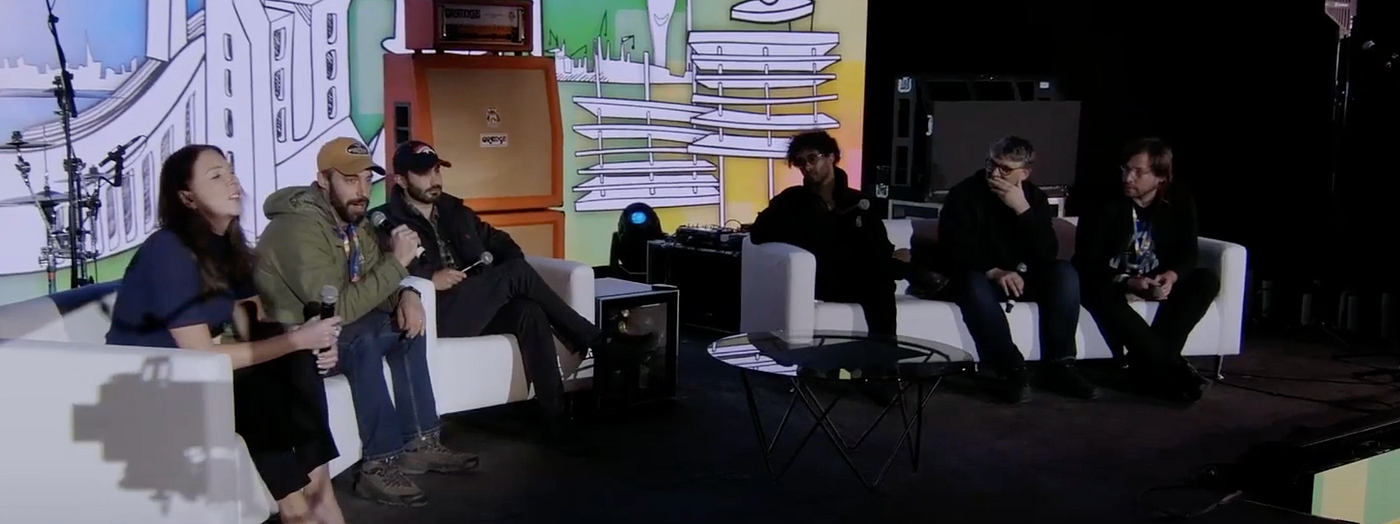
Revisiting some of the recent Aleo community calls. #71 — zkML discussions.
On call #71 Frank from Aleo introduces Zero-Knowledge Machine Learning, explains Verifiable Machine Learning and AI, and gives use case…
Revisiting some of the recent Aleo community calls. #71 — zkML discussions.
On call #71 Frank from Aleo introduces Zero-Knowledge Machine Learning, explains Verifiable Machine Learning and AI, and gives use case examples such as verifying chatGPT models, fighting deepfakes, assessing financial risk, and more. Youtube

Call #71 started with Viv introducing Frank and Konstantin. They were going to give a short presentation on zkML (zero-knowledge Machine Learning).
Frank started by describing his intentions, which were to give a little primer so that people understood what zero-knowledge machine learning is and then have better mental models as to understanding where this industry can go and some of the use cases surrounding it. To bring people up to speed, he started by describing what zero-knowledge proofs are and how they apply to machine learning. He reminded all that zero-knowledge proofs allow us to make mathematical proofs so anyone can prove to anyone that they know a secret without revealing what that secret is.

In machine learning, zero-knowledge machine learning in particular, they are taking a machine learning model and translating it into a zero-knowledge circuit. So that machine learning becomes verifiable machine learning because the various characteristics of AI can now be provable and verifiable, without disclosing sensitive information.
Then Frank gave a simple description of the essence of how machine learning models work: ''A model is just a mathematical representation of a real-world system. So you have really really simple models such as linear regression. Have a bunch of points. We’re drawing a line through these points and the line tells us something about the relationship between those points". And more complex ones: "Something as complex as ChatGPT, where it’s a large language model. There are things that are happening that even I don’t understand or know about, but I think the basic premise is the same — which is a model allows me to make some sort of new prediction based on some of the data inputs that I give it".

And then Frank described the way these models are trained: "So training a model essentially just means I'm feeding it a bunch of known data and sort of like radio dials. I’m adjusting these dials based on the data that’s coming in and so we call that 'learning using pass information'. It’s just called training and we’re adjusting these model dials and then when I feed it new data it’ll make predictions on the new input".
Thus, when all of these dials are dialed in — they are shuttling it into a zero-knowledge circuit so it enables a bunch of interesting features. One is verifiability. It becomes possible to verify a model version. They can verify that the output of a model did indeed come from a very specific input and this is done while keeping the weights private. Frank further explained what weights are: "Weights essentially mean that those dials that you feed your model on don’t have to be revealed for you to be able to verify that a model is a specific version". The second feature is a privacy feature, so it can achieve private predictions without actually revealing the data inputs.
There is also some research and proof of learning underway, so eventually it will be possible to verify that the model has been trained in a certain way based on the data it has been given. Frank: "We’d be able to have a zero-knowledge proof saying that these weights that we see on this model, these dials — they indeed come from a very specific piece of training". So to summarize, there’s verifiability for zero-knowledge machine learning in multiple dimensions and some degree of privacy.
Where does the value accrue if we’re thinking about it from a business perspective?
On the one hand, it’s the services themselves that create such machine-learning models and are willing to pay to show transparent model practices. Services want to prove that a model was run a certain way, that the model has integrity, and that the model is a specific version.
On the other hand, users would be willing to pay to verify a result without leaking personal information. Frank explained: "So in a credit scoring example, maybe me as a user — I input my financial information along with this model and I create an output, a prediction maybe, it’s a credit score. I can prove to someone like a bank that I have this particular credit score without the bank ever getting their hands on it".
Use cases.
Frank cited the recent actual situation with ChatGPT as an example: "Several months ago this was a hot topic on Twitter. People were questioning the version of ChatGPT that was running before saying that some of the responses that they were getting were not as expressive as times before".
One way to actually verify this is if one was able to shuttle a ChatGPT model into a zero-knowledge framework. Somebody did although. It wasn’t on the Aleo system, it was using a different proof system. These services, such as OpenAI, can submit proofs so that people can verify a very specific model version that is being run and they could do this without revealing any of the model weights. Frank: "In the future, this can be a legitimate strategy to gain trust from a user base".
The next use case is fighting deep fakes. There is a big debate about how we differentiate between content created by artificial intelligence and content created by humans. Right now there are some solutions where we get video and audio from secure elements that are digitally signing and timestamping real-world content. Frank added: "You can use zero-knowledge machine learning and zero-knowledge proofs essentially prove the provenance of the content not only that it’s human-generated and in the real world, but also you can verify a specific type of algorithm on it". An example could be someone from The New York Times who wants a very specific piece of content that’s human-generated, perhaps they can go to a marketplace where there is this sort of verifiability that it was: 1) human-generated and then 2) if there are any modifications done on it — they can follow to make sure that everything was koshered.
The next use is financial risk assessment. Frank described this with an example of credit score at the beginning of the presentation.
The next use case is gaming AI. Frank described it in detail: "First, you can basically prove or verify that there’s no human intervention when you’re playing against an AI and second if you use a model to generate worlds or non-player characters NPCs — you may want to be able to prove that your model is actually generating worlds and characters that are within the rules of the game so you’re not cheating".
But the biggest use case that we have is actually in healthcare. Let's say in the future we have a lot more diagnostic AI. Services that run these diagnostic models may want to submit proofs to verify diagnostic integrity, fairness, and evaluation. If those models are offered for patients, then patients can essentially own their health data and then they can also use these models to prove to insurance companies that they are eligible for a particular type of treatment without the insurance company actually getting their hands on their health data. Frank explained: "So what happens here is insurance companies generally make a lot of their profits based on information asymmetries and so with this kind of technology you can start making sure that asymmetry of information gets abolished and so people can actually get their standard of care without getting their premium adjusted because they have some sort of pre-existing condition".
After Frank moved on to the topic of how exactly Aleo helps to realize such use cases and what is the advantage of zkML implementation on Aleo. First, the challenges.
- The number one thing is to get zero-knowledge standards to play along with machine learning standards. Frank: "With training machine learning models the math behind that is more about fixed point numbers whereas zero knowledge kind of lives in the realm of discrete values over a finite field". There’s a language that machine learning speaks to in terms of math and then there’s a language that zero-knowledge speaks to and getting those two to talk together and work together is one of the main challenges with translating these models from regular machine learning to zero-knowledge machine learning.
- The time to generate ZK proofs, the proofs that either services or users will eventually verify. That is going to affect the user experience for many products in the future. Quote: "Services want to have this very fast subsecond proof generation with model accuracy to have workable services. Waiting too long it’s a bad experience. If I don’t wait that long and the model is inaccurate then I might as well not be using the model as well".
How Aleo addresses them is simple. Essentially much of the machine learning developer community writes in Python right now. There are a lot of mature Python machine learning tools in that space and Leo — domain-specific language at Aleo is that same abstraction layer as Python. Frank: "So what we want to do is to be able to train models in Python and then use this transpiler and basically port them over to Leo and that allows us to essentially put that machine learning model into a zero-knowledge circuit".

After that Konstantin joined the conversation and did a cool demo of what was described above. You better check this demo out on YouTube, here is a direct link to the presentation.
Thank you for your time! That's it about the community call #71.
📌Aleo: 🏡 | Website ~ https://www.aleo.org/ 🐦 | Twitter ~ @AleoHQ ~ https://twitter.com/AleoHQ 🐙 | GitHub ~ https://github.com/AleoHQ 📄 | Developer Documentation ~ https://developer.aleo.org/ 🎮 | Leo Playground ~ https://play.leo-lang.org/ 🔎 | Aleo Block Explorer ~ https://www.aleo.network/ 📣 | Announcements Blog ~ https://www.aleo.org/blog
Youtube — https://www.youtube.com/@AleoLabs
메타데이터
- post_id
- 8d8ae89770ae
- slug
- revisiting-some-of-the-recent-aleo-community-calls-71-zkml-discussions-8d8ae89770ae
- url
- https://medium.com/@moldiman/revisiting-some-of-the-recent-aleo-community-calls-71-zkml-discussions-8d8ae89770ae
- canonical_url
- https://medium.com/@moldiman/revisiting-some-of-the-recent-aleo-community-calls-71-zkml-discussions-8d8ae89770ae
- author_url
- https://medium.com/@moldiman
- status
- ok
- fetched_at
- 2026-06-29 01:02:39