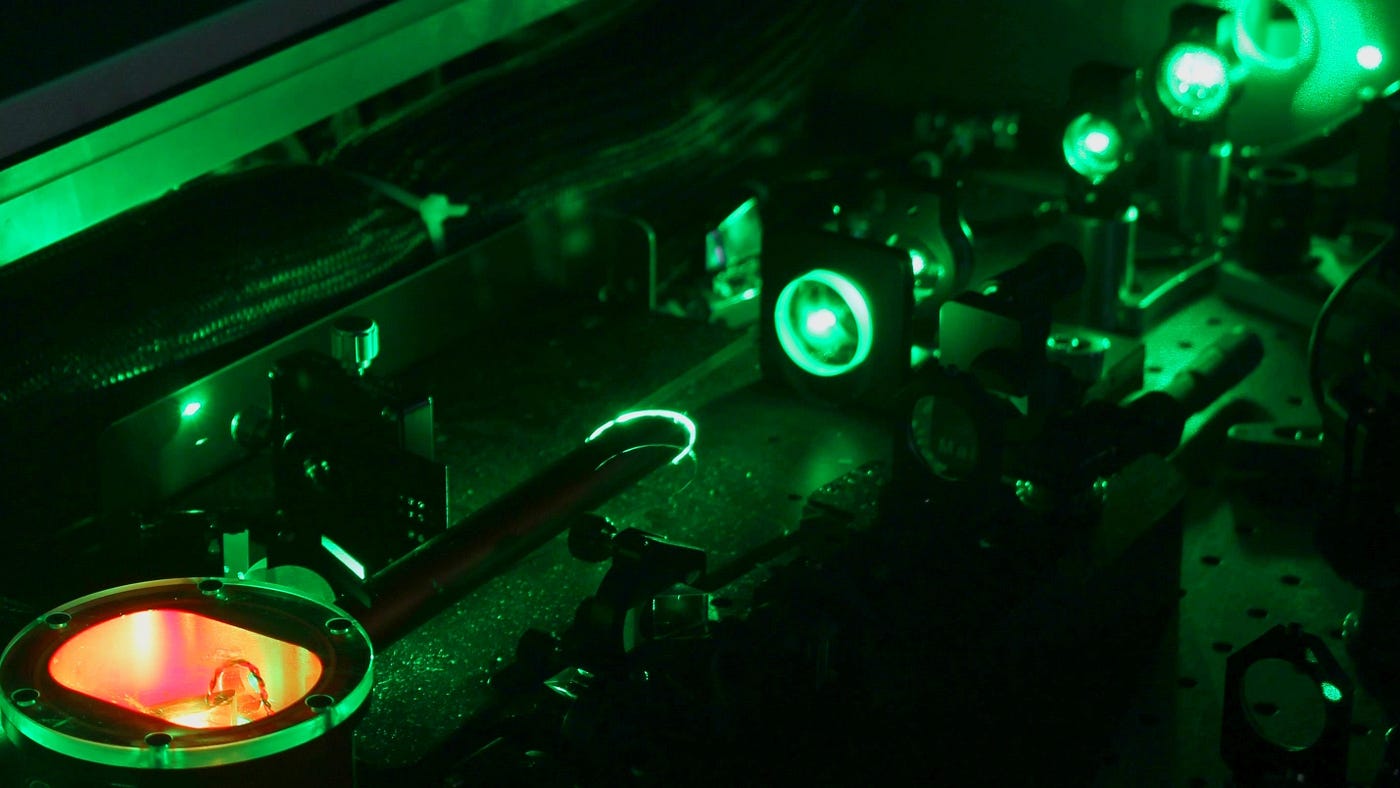
Quantum Mechanics Unveiled: A Journey into the Heart of Reality.
I’ve loved physics ever since my school days. It’s a subject that lets you explore and understand the real world around us. This article is…
Quantum Mechanics Unveiled: A Journey into the Heart of Reality.

source: https://www.cantorsparadise.com
I’ve loved physics ever since my school days. It’s a subject that lets you explore and understand the real world around us. This article is my attempt to explain Quantum Mechanics, one of my favorite topics. As we move forward, we’ll dive deeper into it, but for now, let’s start with the basics.
World of quantum mechanics, a realm where the usual rules of the large-scale world don’t always apply. It’s a place that challenges our understanding of reality and has given birth to some of the most groundbreaking technologies today. In this article, we’re going on an intriguing journey to explore the core concepts of quantum mechanics, understand its significance, and discover its profound impact on both science and our daily lives.
Brief Historical Context
The Dawn of a New Era
Quantum mechanics began as a set of revolutionary ideas that turned classical physics on its head. The story starts in the early 20th century when scientists were grappling with unexplained phenomena. Classical physics couldn’t explain certain behaviors at the atomic and subatomic level. This mystery set the stage for a radical shift in thinking.
Pioneers of Quantum Theory

- Max Planck: The journey into quantum mechanics unofficially began with Max Planck. In 1900, he proposed that energy is quantized, introducing the idea that energy could be emitted or absorbed in discrete ‘packets’ or ‘quanta’. This groundbreaking concept was Planck’s attempt to solve the black-body radiation problem, and it inadvertently laid the foundation for quantum theory.
- Albert Einstein: In 1905, Albert Einstein took Planck’s ideas further. He explained the photoelectric effect by proposing that light itself is quantized, consisting of particles called photons. This work challenged the long-held wave theory of light and earned Einstein the Nobel Prize.
- Niels Bohr: Bohr’s model of the atom in 1913 introduced the idea that electrons orbit the nucleus at set distances. His theory explained why atoms emitted light at specific wavelengths, another puzzle classical physics couldn’t solve.
- Werner Heisenberg and Erwin Schrödinger: In the 1920s, Heisenberg’s uncertainty principle and Schrödinger’s wave equation added new layers to quantum mechanics, further challenging our understanding of the microscopic world.
Key Concepts in Quantum Mechanics
Wave-Particle Duality
A Dual Nature Imagine tossing a pebble into a pond and watching the ripples spread out — that’s wave behavior. Now, picture that same pebble as a single, solid object — that’s particle behavior. In the quantum world, things like electrons and photons (light particles) behave as both waves and particles. This dual nature is one of the most mind-bending concepts in quantum mechanics.
de Broglie’s Insight and Heisenberg’s Uncertainty
- de Broglie Wavelength: Louis de Broglie proposed that particles have wave-like characteristics, leading to the formula for the de Broglie wavelength: λ=h/p where, λ is the wavelength, h is Planck’s constant, and p is the momentum of the particle. This equation bridges the gap between the wave and particle views of matter.
- Heisenberg’s Uncertainty Principle: Werner Heisenberg introduced a principle that challenges our intuition: Δx⋅Δp ≥ h/2 where Δx is the uncertainty in position, Δp is the uncertainty in momentum, and ℏ (h-bar) is the reduced Planck’s constant. This principle states that the more precisely you know the position of a particle, the less precisely you can know its momentum, and vice versa.
Quantum Superposition

Multiple States at Once
Quantum superposition is the principle that a particle can exist in multiple states simultaneously, a concept that is core to quantum mechanics.
- Superposition Principle: Mathematically, the state of a quantum system can be described as a sum of all possible states: ∣ψ⟩=c1∣ψ1⟩+c2∣ψ2⟩+…+cn∣ψn⟩ Here, ∣ψ⟩ represents the superposition state, and ∣ψ1⟩,∣ψ2⟩,…,∣ψn⟩ are the possible states with coefficients c1,c2,…,cn indicating the probability of each state.
- Schrödinger’s Cat: This thought experiment illustrates superposition through a paradoxical scenario involving a cat that is simultaneously alive and dead until an observation is made, emphasizing the abstract nature of quantum states.
Quantum Entanglement and Quantization
Quantum Entanglement
Spooky Action at a Distance
Quantum entanglement is a phenomenon where particles become so deeply connected that the state of one instantly influences the state of another, regardless of the distance separating them. This was famously referred to by Einstein as “spooky action at a distance.”
- Entanglement Principle: When two particles are entangled, the quantum state of each particle cannot be described independently of the state of the others, even when the particles are separated by large distances. The state of the whole system is described by a single wave function.
- EPR Paradox: Einstein, Podolsky, and Rosen proposed a thought experiment to challenge quantum mechanics, highlighting the peculiar nature of entanglement. It questions how information about the state of one particle seems to be instantly known by the other.
Quantization
Discrete Energy Levels
Quantization in quantum mechanics refers to the fact that certain properties, like energy, exist only in discrete values rather than a continuous range. This concept is fundamental to understanding the behavior of particles at quantum scales.
- Planck’s Quantum Theory: Max Planck’s theory that energy is quantized can be expressed as: E=n⋅h⋅ν where E is the energy of a photon, n is an integer (quantum number), h is Planck’s constant, and ν (nu) is the frequency of radiation. This equation marked the beginning of quantum theory, explaining phenomena like the black-body radiation spectrum.
The Role of the Observer
Measurement Affects Reality
One of the most intriguing aspects of quantum mechanics is the role of the observer. The act of measuring or observing a quantum system can affect the system itself.
- Copenhagen Interpretation: This interpretation, primarily associated with Niels Bohr and Werner Heisenberg, posits that a quantum system remains in superposition until it’s observed, at which point it ‘collapses’ to a definite state.
- Many-Worlds Interpretation: An alternative to the Copenhagen interpretation, proposed by Hugh Everett, suggests that all possible outcomes of quantum measurements are physically realized in some ‘world’ or universe.
Applications and Challenges in Quantum Mechanics
Applications of Quantum Mechanics
From Theory to Technology
Quantum mechanics isn’t just a fascinating theoretical framework; it has led to significant practical applications that have transformed our world.
- Semiconductors: The principles of quantum mechanics are essential in understanding and developing semiconductors, the building blocks of most modern electronics, including computers and smartphones.
- Lasers: The operation of lasers is based on quantum principles, particularly the stimulated emission of photons. Lasers have wide-ranging applications from medical equipment to telecommunications.
- MRI Scanners: Magnetic Resonance Imaging (MRI) employs quantum mechanics to visualize the structure and function of the body, revolutionizing medical diagnostics.
- Quantum Computers: Quantum computing utilizes quantum bits or qubits, which can be in superpositions of states, offering unprecedented computational speed and power for certain tasks.
Challenges and Open Questions
The Frontier of Knowledge
While quantum mechanics has been immensely successful, it still poses some of the greatest puzzles in science.
- Quantum Gravity and Unification: One of the most significant challenges in modern physics is reconciling quantum mechanics with general relativity. Quantum mechanics beautifully describes the behavior of particles on the smallest scales, while general relativity explains the force of gravity on the largest scales, such as in the universe or near massive objects like black holes. The quest for a theory of quantum gravity seeks to merge these two theories into a single, coherent framework. This theory would describe gravity using the principles of quantum mechanics, helping us better understand the fundamental nature of space, time, and gravity itself.
- Measurement Problem: The measurement problem is a longstanding enigma within quantum mechanics. It revolves around the way a quantum system transitions from a superposition of multiple possible states to a single observed state when measured or observed by an external system. This phenomenon challenges our understanding of reality, as it raises questions about whether the act of measurement or observation plays a fundamental role in determining the outcome of quantum events. The measurement problem has led to various interpretations and debates within the field, with no consensus on its resolution.
Conclusion
Reflecting on the Quantum Realm
Quantum mechanics has transformed our understanding of the microscopic world and has led to remarkable technological advancements. As we continue to unravel its mysteries, the potential for future applications and answers to fundamental questions about our universe remains vast and exciting. The journey into the heart of reality is far from over, and quantum mechanics will undoubtedly continue to be at the forefront of scientific discovery.
If you found this article helpful, please don’t forget to hit the Follow 👉 and Clap 👏 buttons to help me write more articles like this.
Thank You 🖤
Thank you for Reading!! 🙌🏻😁📃, see you in the next blog. 🤘
About the Author:
Name: Gurpreet Singh Job Role: Senior SRE Mail: gurpreet. singh_89[@]outlook.com 🚀GitHub: https://github.com/supersaiyane 🚀Linked-in: https://www.linkedin.com/in/gurpreetsinghpal/ 🚀Medium: https://medium.com/@gurpreet.singh_89 🚀Subscribe me @: https://medium.com/@gurpreet.singh_89/subscribe 🚀Tech-Blog: https://www.linkedin.com/company/techbulletin 🚀Usage-License: https://creativecommons.org/licenses/by-sa/4.0/
The end ✌🏻
메타데이터
- post_id
- 8da0dbf27734
- slug
- quantum-mechanics-unveiled-a-journey-into-the-heart-of-reality-8da0dbf27734
- url
- https://medium.com/@gurpreet.singh_89/quantum-mechanics-unveiled-a-journey-into-the-heart-of-reality-8da0dbf27734
- canonical_url
- https://medium.com/@gurpreet.singh_89/quantum-mechanics-unveiled-a-journey-into-the-heart-of-reality-8da0dbf27734
- author_url
- https://medium.com/@gurpreet.singh_89
- status
- ok
- fetched_at
- 2026-08-20 08:20:53