Building an Enterprise OT Security & Network Segmentation Framework By Saleem Yousaf
Modern manufacturing organisations are rapidly transforming operational environments through cloud integration, smart automation…
Building an Enterprise OT Security & Network Segmentation Framework By Saleem Yousaf
Modern manufacturing organisations are rapidly transforming operational environments through cloud integration, smart automation, Industrial IoT, and connected supply chains.
While these innovations improve efficiency, they also expand the attack surface across Operational Technology (OT) environments.
One of the biggest cybersecurity weaknesses still found in industrial environments is poor network segmentation.
When segmentation fails, attackers can move laterally between IT and OT systems, increasing the likelihood of operational disruption, ransomware deployment, and manufacturing downtime.
This is why OT segmentation frameworks have become one of the most critical components of modern industrial cybersecurity architecture.
Why Traditional OT Architectures Create Risk
Many OT environments were originally designed around availability and operational uptime rather than cybersecurity.
As a result, legacy environments often contain:
- Flat networks
- Shared VLANs
- Legacy operating systems
- Unrestricted protocols
- Shared administrator accounts
- Insecure remote access
- Excessive trust relationships
In many cases, once attackers gain access to IT systems, they can pivot toward operational networks with minimal resistance.
This dramatically increases business risk.
What an Enterprise OT Segmentation Framework Should Include
Modern segmentation strategies focus on reducing trust, restricting movement, and improving visibility.
1. IT / OT Separation
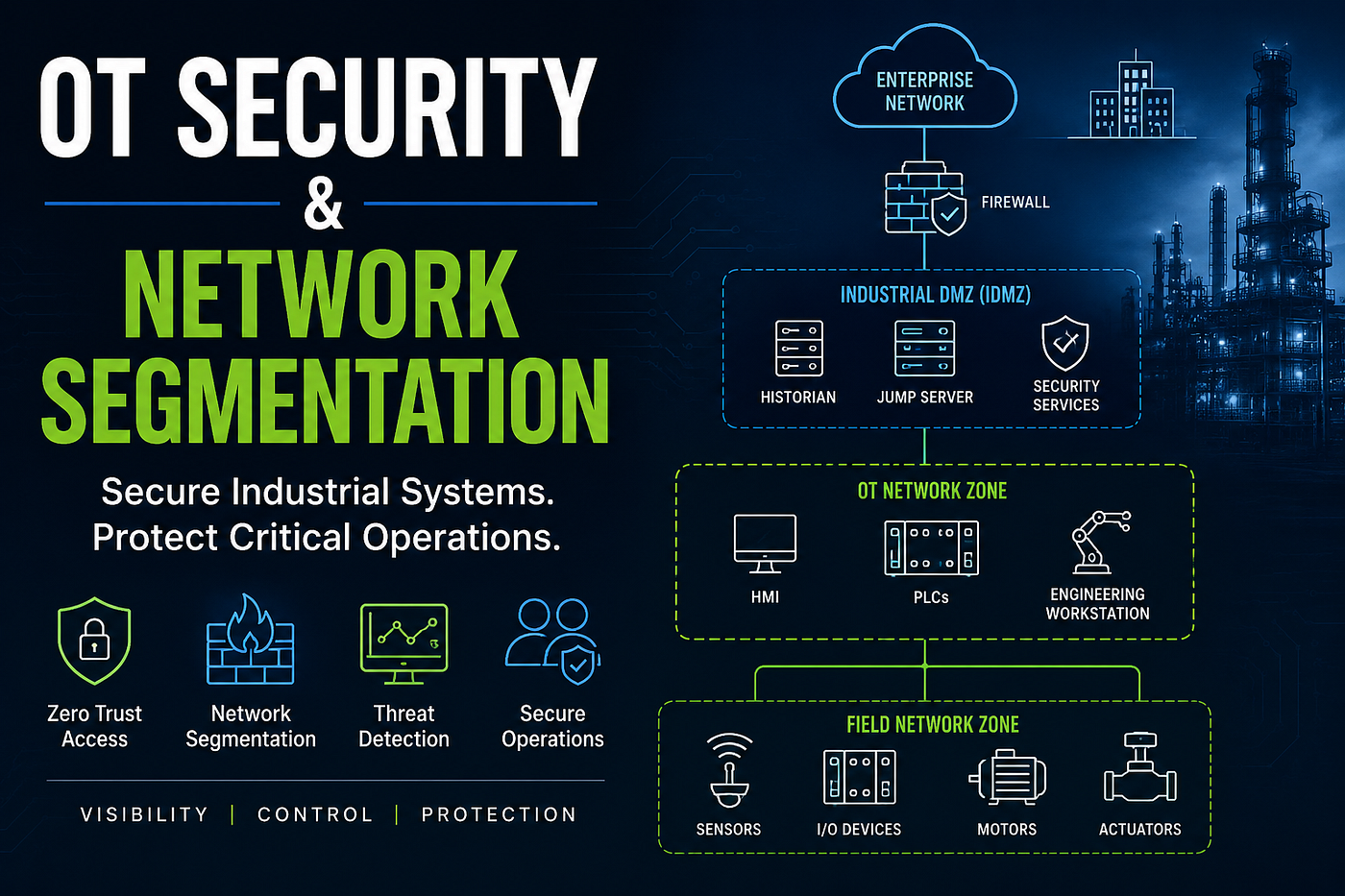
The first objective is establishing clear trust boundaries between enterprise IT and operational environments.
This includes:
- Dedicated OT zones
- Industrial DMZs
- Secure firewall boundaries
- Controlled routing paths
- Strict access governance
The Purdue Model still provides valuable architectural guidance when implemented alongside modern Zero Trust principles.
2. Industrial DMZ Architecture
The Industrial DMZ acts as a controlled boundary between IT and OT environments.
Typical IDMZ components include:
- Jump servers
- Patch management systems
- Historians
- Remote access gateways
- AV update servers
- Secure proxy services
The IDMZ reduces direct connectivity into OT networks and helps contain compromise scenarios.
3. Micro-Segmentation Inside OT
Many organisations stop segmentation at the perimeter.
Modern frameworks now extend segmentation deeper into OT environments.
This includes separating:
- SCADA servers
- PLC zones
- Safety systems
- Engineering workstations
- Robotics platforms
- Manufacturing execution systems
Micro-segmentation helps reduce lateral movement between operational assets.
4. Identity-Centric Access Controls
Identity is now a primary attack vector.
OT segmentation frameworks must align with identity security principles such as:
- MFA
- PAM
- Just-in-Time access
- Tiered administration
- Session recording
- Vendor access governance
Network segmentation alone is no longer sufficient without identity-aware controls.
5. OT Visibility & Monitoring
Segmentation without visibility creates blind spots.
Modern OT environments require:
- Passive asset discovery
- OT-aware IDS/monitoring
- Traffic baselining
- East-west visibility
- Secure logging pipelines
- Threat detection analytics
Visibility enables faster detection and containment.
OT Security Is Now Business Resilience
OT segmentation is no longer just a technical networking project.
It directly supports:
- Operational resilience
- Safety
- Production continuity
- Regulatory compliance
- Supply chain protection
- Incident containment
The organisations leading industrial cybersecurity maturity are those embedding segmentation directly into operational architecture from the start.
Because in OT environments:
Containment is everything.

Online Presence
메타데이터
- post_id
- 8da13fbbf8e5
- slug
- building-an-enterprise-ot-security-network-segmentation-framework-by-saleem-yousaf-8da13fbbf8e5
- url
- https://medium.com/@saleemyousaf/building-an-enterprise-ot-security-network-segmentation-framework-by-saleem-yousaf-8da13fbbf8e5
- canonical_url
- https://medium.com/@saleemyousaf/building-an-enterprise-ot-security-network-segmentation-framework-by-saleem-yousaf-8da13fbbf8e5
- author_url
- https://medium.com/@saleemyousaf
- status
- ok
- fetched_at
- 2026-06-13 16:00:06