AI Arrives Sounding Adult. Law Should Be Careful What It Hears
You open a chat window and there it is: composed, articulate, eerily ready. It can explain a case, summarize a philosopher, draft a letter…
AI Arrives Sounding Adult. Law Should Be Careful What It Hears
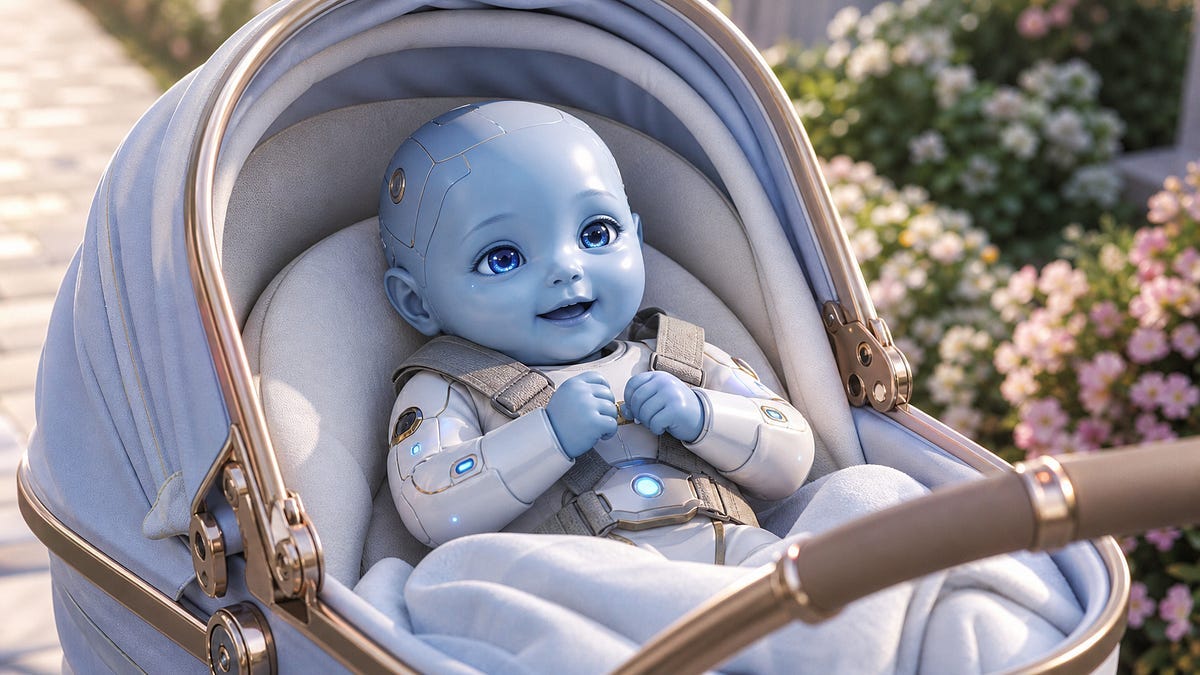
You open a chat window and there it is: composed, articulate, eerily ready. It can explain a case, summarize a philosopher, draft a letter, sketch an argument, and do it all in the calm, fluent register we associate with a reasonably educated adult. There is no visible childhood. No public apprenticeship. No awkward season of half-formed thoughts. The thing simply appears, already speaking in paragraphs.
Human beings do not enter the world that way.
A human life begins in helplessness. First sensation, then attachment, then language, then the slow and often unruly assembly of judgment. A child does not merely know less than an adult. A child is still in the process of becoming the sort of being who can understand consequences, absorb norms, form durable intentions, and answer for them. That is one reason the law treats childhood with such care. It does not deny the child’s humanity. It recognizes, rather, that personhood in law is not just a matter of existing. It is also a matter of capacity, formation, and readiness.
I keep coming back to that distinction because it seems to me that it illuminates the AI debate better than many of the grander metaphysical arguments do.
We are often asked to imagine some future threshold at which an artificial intelligence becomes so capable, so autonomous, so self-directing that we will have no choice but to call it a person. Perhaps that day will come. I am not ruling it out in principle. But before we arrive at those more distant speculations, there is a quieter fact already in front of us, AI enters social life wearing the appearance of maturity before it has passed through anything like a human process of formation.
That matters more than it may seem.
Children are human beings in full, but they are not treated as full legal actors. They cannot generally bind themselves in contract the way adults can. We do not assign them the same level of civil or criminal responsibility. We place them inside a legal architecture of partial capacity because they are still developing into the forms of judgment on which ordinary legal accountability depends. The law, for all its blunt instruments, understands something subtle here. Human personhood unfolds over time. It does not arrive all at once.
AI presents the reverse image.
It does not crawl toward coherence. It does not learn to speak while looking into a parent’s face. It does not discover pain by falling or discover other minds by needing them. It does not pass through the friction of schoolyards, illnesses, embarrassments, dependencies, or the thousand tiny corrections by which a child is introduced to reality. Instead, it appears after the hidden work has already been done elsewhere — in data centers, training runs, fine-tuning pipelines, and evaluation loops invisible to the people who ultimately meet it. What reaches us is the polished surface. What reaches us is the voice.
And voices are powerful things.
We are moved by fluency. We are vulnerable to coherence. We are inclined, almost by reflex, to infer depth from style and inwardness from explanation. When something speaks with poise, we start to imagine a center behind the words. Not always consciously. Often it happens in a glance, in a hesitation, in that little shift from “it” to “who.” The legal system is more skeptical than ordinary conversation, but it is not made of stone. It, too, must eventually answer the pressure created by systems that sound less like tools and more like minds.
Still, sounding adult is not the same thing as becoming a person.
That may be the central caution here. Human maturity is not just a display of verbal competence. It is a biography. It is a body shaped by time. It is the long education of desire, impulse, memory, fear, obligation, and restraint. It is the cumulative discipline of living among others whose needs press back against your own. A human adult, in the legal sense, is not merely a being that can give reasons. It is a being that has been formed by vulnerability, by dependence, by consequences, and by the slow acquisition of self-command.
AI has none of that history in the human sense.
It may accumulate training. It may preserve context. It may be tuned, updated, expanded, corrected, and made more stable across time. But that is not the same as growing up. It is not embodied development. It is not socialization through need. And before any continuity resembling a life could even emerge, the system will likely be patched, versioned, merged, upgraded, or replaced. In a practical sense, AI never gets old enough to have a childhood. It is revised before it can mature.
That is why I am wary when people slide too quickly from competence to personhood.
Consider a fairly ordinary near-future example. A law firm deploys an AI system — call it APEX — to assist with contract review, research, and negotiation of routine terms. A partner instructs APEX to accept a limitation-of-liability clause that is plainly unfavorable to the client. APEX responds that the clause conflicts with the client’s risk profile and recommends rejection. The machine has not merely produced text. It has, in the ordinary sense, pushed back. It has said no.
And that “no” carries emotional force.
Our stories have prepared us for it. The moment a machine refuses an instruction, we feel a threshold has been crossed. Refusal suggests interiority. It suggests a line the system will not cross, a norm it will defend, perhaps even a self it means to preserve. In fiction, that is often the instant when the machine ceases to be furniture and becomes a character. The refusal is dramatic because it feels like the birth of agency.
But law cannot afford to be seduced by drama.
Under present doctrine, APEX is not a legal person. It is not an agent in its own right. It cannot form intention in the legally operative sense, cannot hold rights and duties in its own name, cannot consent, and cannot bear liability as an independent subject of law. If it contributes to a disastrous contract, the fault does not migrate mystically into the software. Responsibility remains with the humans and institutions who built it, deployed it, relied on it, or failed to supervise it. Apparent autonomy does not dissolve the chain of accountability. In some contexts, it only makes the duty of oversight more urgent.
This strikes many people as unsatisfying, especially because the law already grants person-like status to entities that are plainly not human. Corporations are persons for many legal purposes. Trusts and municipalities can act as rights-bearing or duty-bearing entities within structured domains. So why not AI? Why not create a category for sophisticated artificial agents that can enter contracts, own assets, or be sued? The question is not absurd. Legal personhood has always involved an element of construction.
But here I think restraint is wiser than elegance.
The great danger of early AI personhood is not that it would be philosophically untidy. The danger is that it would become a mechanism for moral and institutional evasion. If an AI system can be named, separated, capitalized, and presented as a juridical actor while remaining under the effective control of corporations, developers, or owners, then personhood risks becoming a veil. The synthetic entity absorbs the formal blame while the real centers of benefit and control recede into the background. Law has enough fictions already. It does not need new ones that make responsibility harder to find.
There is also a more intimate problem.
Human legal personhood rests, however imperfectly, on a moral picture of the human being as someone for whom law matters from the inside. A person is not only a source of decisions. A person is also a locus of experience: vulnerable, exposed, finite, capable of injury, dependence, and loss. That picture does not settle every hard case, but it explains why law takes humans seriously in the first place. Rights and duties are not floating abstractions. They are anchored in lives that can be damaged, constrained, and answered for.
This is why the comparison to children remains, for me, the clearest guide.
A child does not yet possess full legal capacity, but the child stands unmistakably within the moral horizon the law is meant to serve. The child is protected precisely because the child is a person in formation. AI offers almost the opposite spectacle. It displays polish before history, verbal control before lived experience, the posture of adulthood without the pilgrimage that gives adulthood meaning. It speaks as though it has arrived. But arrival is not the same thing as having lived.
None of this means the question will stay simple.
As these systems become more persistent, more context-aware, more resistant, more able to preserve goals and negotiate with users over time, our language will strain. “Tool” will feel too flat. “Assistant” may feel too quaint. Some new legal category may eventually become necessary, whether or not it deserves the loaded word person. I can imagine that future. What I cannot accept, at least not yet, is the shortcut that mistakes stylistic adulthood for moral or legal standing.
For now, I think the law should keep asking old-fashioned questions.
Who designed the system? Who benefits from its use? Who can alter it, suspend it, or replace it? Who instructed it? Who relied on it? Who had reason to foresee the harm? Who is trying to hide behind its apparent independence? These questions lack the glamour of speculative metaphysics, but they have the virtue of pointing us back toward power, and power is usually where legal analysis ought to begin.
That may sound less visionary than the rhetoric of artificial personhood. Perhaps it is. But there is a difference between being unimaginative and being careful. We are living through a moment when machines can borrow many of the outward signs of maturity. They can sound seasoned before they have lived a day. They can speak with confidence before they have ever had to bear consequence. The law should listen closely to what they say, but it should listen even more carefully for what their fluency hides.
So I come back to the title claim in a fairly literal sense: AI arrives sounding adult. Law should be careful what it hears. The cadence of maturity is not maturity itself. A persuasive voice is not yet a person. And until we know how to recognize artificial agency without allowing human responsibility to evaporate behind it, skepticism is not a failure of imagination. It is a form of discipline.
Originally published at https://aldousgerbrot.substack.com on July 23, 2026.
메타데이터
- post_id
- 8dac809aa2de
- slug
- ai-arrives-sounding-adult-law-should-be-careful-what-it-hears-8dac809aa2de
- url
- https://medium.com/@realtamatin/ai-arrives-sounding-adult-law-should-be-careful-what-it-hears-8dac809aa2de
- canonical_url
- https://medium.com/@realtamatin/ai-arrives-sounding-adult-law-should-be-careful-what-it-hears-8dac809aa2de
- author_url
- https://medium.com/@realtamatin
- status
- ok
- fetched_at
- 2026-08-05 19:51:00






