Pre-IPO Investing Minimums: How Much Money Do You Really Need?
Depending on the route you choose, getting into pre-IPO shares can cost anywhere from $10 to $ 100,000 or more. Traditional…
Pre-IPO Investing Minimums: How Much Money Do You Really Need?
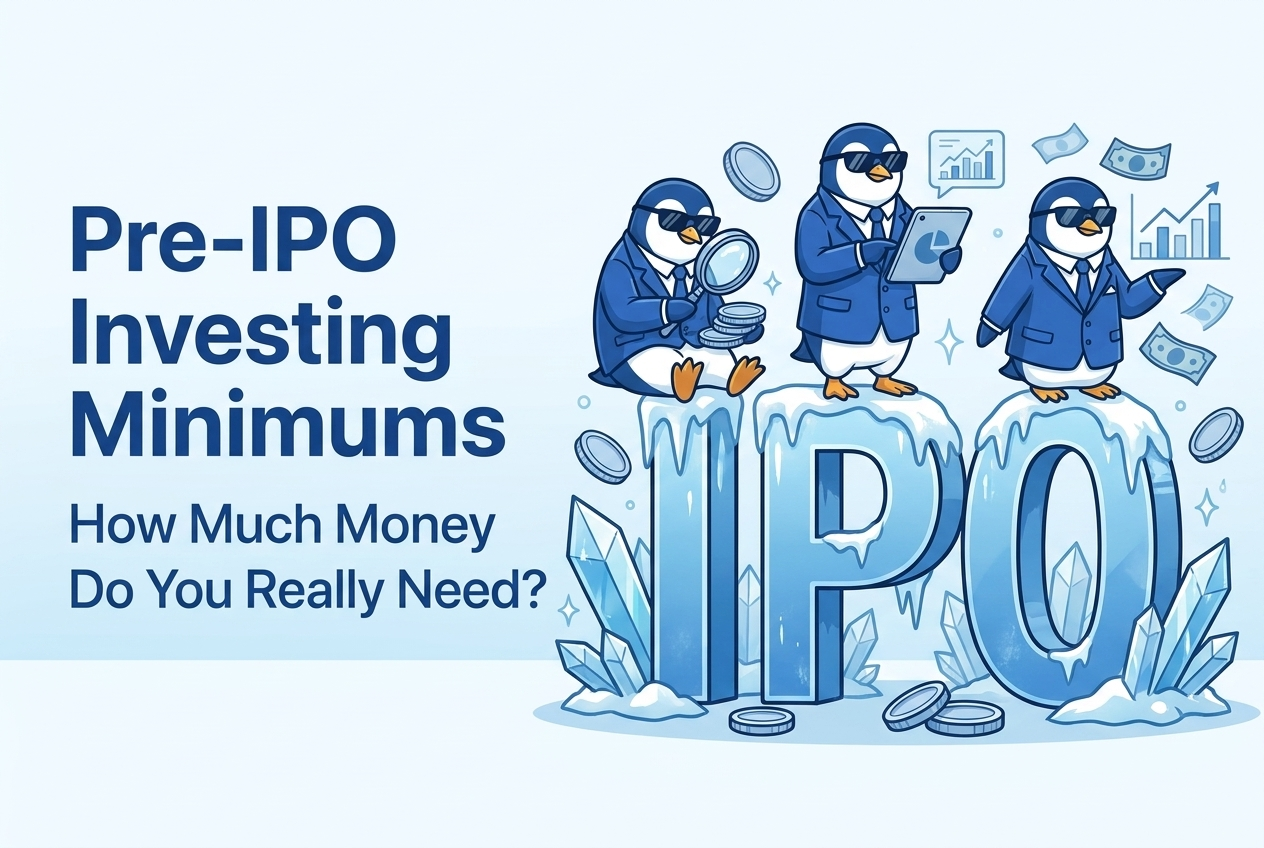
Depending on the route you choose, getting into pre-IPO shares can cost anywhere from $10 to $ 100,000 or more. Traditional secondary-market platforms typically require $5,000 — $100,000 and accredited investor status. Tokenized pre-IPO platforms have collapsed that barrier to as little as $10 and no accreditation required in most jurisdictions. The real question isn’t the platform minimum, though. It’s how much you should put in and what hidden costs add to the sticker price.
For decades, the answer to “how much do I need to invest in a company before its IPO?” was simple: more than you have. Venture rounds were closed clubs. Even when secondary marketplaces opened the door in the 2010s, the entry ticket remained firmly in the five- to six-figure range.
That’s no longer the whole story. In 2026, the pre-IPO market operates on three distinct tiers of entry, and the gap between them is enormous. Let’s break down what each tier actually costs, including the fees, lock-ups, and accreditation hurdles that don’t show up in the headline number.
Why Do Pre-IPO Minimums Exist at All?
Minimums aren’t arbitrary. They exist for three structural reasons:
Regulation: In the US, most private-share transactions are limited to accredited investors, individuals with a net worth above $1 million (excluding their primary residence) or annual income above $200,000 ($300,000 with a spouse). The rules were designed to keep “unsophisticated” investors out of risky, illiquid assets. High minimums are a natural byproduct: if your audience is millionaires, why process $500 tickets?
Transaction economics: A secondary share transfer involves legal review, company approval (right of first refusal, or ROFR), broker compliance, and settlement. Those costs are largely fixed per deal, so platforms set minimums high enough to make each transaction worth processing.
Deal structure: Direct share transfers put you on the company’s cap table, and private companies don’t want thousands of tiny shareholders. Special purpose vehicles (SPVs) pool investors to address this, which is exactly why SPV-based minimums are 5—20x lower than direct-purchase minimums.
Understanding this explains the entire minimums landscape: every innovation that lowered the entry ticket, SPVs, fund structures, and now tokenization worked by attacking one of these three cost drivers.
Tier 1: Traditional Secondary Platforms ($5,000–$100,000+)

The established secondary marketplaces serve accredited investors and price accordingly:
Forge Global: sits at the institutional end. Its standard minimum is around $100,000 per transaction, though exceptions exist, and some opportunities have been offered for as little as $5,000. Forge is built for investors who want direct ownership and deep market data and are comfortable writing large checks.
Hiive: runs a live order-book marketplace with an effective minimum around $25,000 but for high-demand names like SpaceX or Anthropic, direct transfers can require $100,000–$250,000. Popularity has a price.
EquityZen: is the retail-friendly entry point among traditional players. Following its acquisition by Morgan Stanley, minimums for some Fund SPVs dropped to $5,000 (as of February 2026), while standard single-company funds are $50,000 and direct share purchases have historically started around $200,000.
Notice the pattern: the more directly you own the shares, the more money you need. SPVs and pooled funds bring the ticket down; direct cap-table ownership pushes it up.
- Direct share purchase (EquityZen direct): $200,000
- Forge Global, standard: $100,000
- Hiive, marquee names (SpaceX, Anthropic): $100,000–$250,000 (show as range)
- EquityZen single-company fund: $50,000
- Hiive, standard listings: $25,000
- EquityZen Fund SPV (post-Feb 2026): $5,000
- Tokenized platforms (PIPO.vc and peers): $10 Callout annotation: “A 20,000x gap between the highest and lowest entry point” Sources: Forge Global, EquityZen, Hiive published platform terms; platform comparison data via AltStreet Research and PEINVEST (2026)
The Hidden Costs Above the Minimum
The sticker minimum is only the down payment. Before you commit, add these to your math:
Buyer fees: Traditional platforms charge 2.5%–5% on the buy side. On a $25,000 ticket with a 5% fee, $1,250 evaporates before the position exists. Combined with seller-side pricing friction, total round-trip friction on smaller traditional-platform deals can approach 10–12%.
SPV management fees and carry:Fund structures often layer annual management fees and carried interest on top of a persistent drag over a 3–7 year hold.
Lock-up and illiquidity. Whatever you invest, assume you can’t touch it for years. Pre-IPO positions typically remain illiquid until an IPO, an acquisition, or a tender offer, and even post-IPO, standard lock-ups last about six months.
This is why an honest “how much do I need?” answer isn’t just the minimum; it’s the minimum, plus fees, plus the reality that this money is frozen.
Tier 2: Fund and ETF Wrappers ($10–$500)
For investors who want diversified exposure rather than a specific company, pooled vehicles slashed minimums years ago. The Fundrise Innovation Fund accepts as little as $10 for a diversified late-stage venture portfolio, and ARK Venture Fund entries start around $500. Publicly traded closed-end funds like Destiny Tech100 (DXYZ) require nothing more than the price of one share on the NYSE with no accreditation at all.
The trade-off: you don’t choose the companies. If your thesis is “I want SpaceX exposure, specifically,” a diversified fund gives you a diluted version of it, wrapped in annual management fees.
Tier 3: Tokenized Pre-IPO Shares ($10 or Less)
This is where the barrier structurally collapses. Tokenized pre-IPO platforms hold real shares (typically through SPVs or custodial structures), then issue blockchain tokens backed 1:1 by the economic rights of those shares. Because a token can be fractionalized almost infinitely and settles on-chain without per-deal legal overhead, the fixed-cost logic that forced $25,000 minimums simply doesn’t apply.
The result, as of 2026:
- Platforms like PIPO/PreStocks/Jarsy set a minimum of $10.
- Exchange-based programs like Bitget IPO Prime accept commitments from 100 USDT.
- Most tokenized platforms don’t require US-style accreditation for non-US users and instead operate under frameworks like Regulation S.
In other words, the same SpaceX or Anthropic exposure that costs $100,000+ to access directly on Forge can be approximated for the price of lunch. (One important nuance: most tokens grant economic exposure, price appreciation, and distributions rather than legal shareholder rights like voting. Always read what your token actually represents.
So, How Much Should You Actually Invest?
Pre-IPO investing is not about chasing the lowest entry price; rather, it is about making informed decisions regarding investment size and diversification.
View this asset class as high-risk and long-term. A prudent approach is to allocate only a small portion of your portfolio to it (typically around 5–10%) and spread funds across several companies, rather than betting everything on a single issuer. The reality is that even well-known companies can underperform or fail to achieve a successful exit (such as an IPO or a sale).
Liquidity is limited, timelines are unpredictable, and capital may be “locked up” for years. Therefore, you should invest only those funds you are prepared to leave untouched for a period of 3 to 7 years.
The main advantage of a low entry threshold is not merely accessibility, but the opportunity to start small, understand market mechanics, and gradually increase your investment volume as you gain experience, all while avoiding excessive risk at the outset.
FAQ
What is the absolute minimum to invest in pre-IPO companies?
- As of 2026, tokenized platforms offer entry from $10, and some on-chain marketplaces have no minimum at all. Traditional accredited-investor platforms start at $5,000–$25,000, with direct purchases often requiring $100,000+.
Do I need to be an accredited investor?
- On secondary platforms (PIPO, Forge, Hiive, EquityZen), yes. On most tokenized platforms and some retail fund wrappers, no, though KYC verification is standard and US residents are often excluded from token offerings.
Why are traditional minimums so high?
- Fixed legal and compliance costs per transaction, accreditation rules, and companies’ reluctance to expand their cap tables. SPVs and tokenization exist specifically to bypass these constraints.
Is a $10 investment in pre-IPO tokens worth it?
- As a learning position or the start of a dollar-cost-averaging strategy, yes. Treat minimums as an accessibility feature, not an investment thesis.
How do tokenized pre-IPO shares work?
- Tokenized shares represent economic exposure to private company equity, typically via SPVs or custodial structures. Investors hold blockchain-based tokens that track the value of underlying shares, with settlement, transfer, and sometimes dividends managed on-chain.
What are the main risks of investing in pre-IPO companies?
- Key risks include illiquidity, long holding periods, limited financial disclosure, valuation uncertainty, and regulatory changes. In tokenized formats, smart contract risk and platform counterparty risk also apply.
Can I sell my pre-IPO investment before the IPO?
- Yes, but liquidity depends on the platform. Secondary marketplaces like Forge or Hiive enable resale to other accredited investors, while tokenized platforms may offer peer-to-peer trading or AMM-based liquidity, though volumes can be thin.
This article is for informational purposes only and does not constitute an offer to sell or a solicitation of an offer to buy any securities. Any securities or tokenized instruments referenced by PIPO are intended to be offered only under applicable securities laws and exemptions, including Regulation S where applicable, to eligible non-U.S. persons in offshore transactions.
All investments involve significant risk, including potential loss of the entire investment. IPO outcomes, liquidity, transferability, redemption, and exercise mechanics are subject to legal, regulatory, market, issuer, and operational conditions.
*PIPO is building compliant tokenized pre-IPO infrastructure designed to broaden access for eligible non-U.S. investors through structured security tokens, compliance controls, and a defined exercise pathway.*
More About the PIPO: Website | Twitter | Telegram Ann | Telegram chat| Linkedin | Blog
메타데이터
- post_id
- 8dae52c487a5
- slug
- pre-ipo-investing-minimums-how-much-money-do-you-really-need-8dae52c487a5
- url
- https://blog.pipo.vc/pre-ipo-investing-minimums-how-much-money-do-you-really-need-8dae52c487a5
- canonical_url
- https://blog.pipo.vc/pre-ipo-investing-minimums-how-much-money-do-you-really-need-8dae52c487a5
- author_url
- https://medium.com/@romanwiligut
- status
- ok
- fetched_at
- 2026-07-17 14:05:38