The Iran War and America’s Debt: Two Crises on a Collision Course
Uncover how conflict abroad and financial strain at home are converging into a global shock.
The Iran War and America’s Debt: Two Crises on a Collision Course
Uncover how conflict abroad and financial strain at home are converging into a global shock.
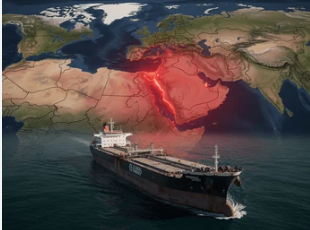
Image used from shutterstock
I’ll be straight with you from the top I’ve been watching two separate storms build for a while now. One is America’s debt, which has been getting worse every year for over two decades. The other is the Iran war and what it’s done to the global energy market. Individually, each one is a serious problem.
But together? The way they’re feeding into each other right now is something I don’t think most people have fully worked out yet. So let me try to lay it out clearly.
This isn’t doom-scrolling for its own sake. The numbers here are real, the mechanisms are real, and understanding them matters if you want to make sense of what’s happening to gas prices, mortgage rates, and frankly the cost of just about everything in your life right now.
America’s debt has crossed a line it hasn’t crossed since World War II
Let’s start with the debt, because people have been warned about it for so long that most have stopped listening. Back in the early 2000s, economists were already ringing alarm bells about America’s borrowing. Politicians gave speeches about it. Think tanks published reports. And yet, for two decades, the world kept lending the US money, bond yields stayed manageable, and the whole thing just kept rolling forward.
So it’s understandable if your eyes glaze over when you hear “US debt is at 100% of GDP.” But here’s why this particular moment is different from all the previous warnings.
The US is currently sitting on about $39 trillion in debt. That number alone is hard to picture it’s so large it basically stops meaning anything. But the timing of how that debt is structured matters enormously right now. Nearly $9 to $10 trillion of it matures this year.
That means it comes due, and the US has to refinance it take out new loans to pay off the old ones. The problem is that a lot of that debt was borrowed a decade ago, when interest rates were near zero. Rolling it over now means locking in rates that are dramatically higher, on an enormous pile of borrowing, for at least another decade.
Total US national debt
$39T
As of mid-2026
Debt maturing in 2026
~$9–10T
Must be refinanced this year
Extra annual interest cost
$180B
From just +0.5% yield spike
Debt as share of GDP
100%
First time since WWII
Even a half-percentage-point rise in bond yields which sounds tiny translates to roughly $180 billion in extra annual interest payments when you spread it across the full national debt. To give you a sense of scale, that’s enough to fund NASA’s entire budget four times over. Every single year. Just from that half-point move.
The Strait of Hormuz closure the greatest energy security challenge in history
Now let’s talk about the Iran war, and specifically about a 33-kilometre-wide stretch of water that most people couldn’t find on a map until recently.
The Strait of Hormuz is the throat through which roughly one-fifth of all the world’s petroleum consumption flows every day. Around 20 million barrels of crude oil and petroleum products pass through it daily. Qatar’s entire liquefied natural gas export capacity with no pipeline alternative moves through it. When Iran closed the Strait in early March 2026, the head of the International Energy Agency described it as the greatest energy security challenge in history. That’s not hyperbole. It was.
Some 13 million barrels per day of Gulf exports were immediately stranded. Saudi Arabia and the UAE managed to redirect about seven million barrels per day through alternative pipelines, but that still left a massive shortfall the largest supply disruption ever recorded in the global oil market. Iraq, Kuwait, Qatar, and Bahrain had no escape route at all. Their energy exports, normally their primary source of national income, were simply trapped.
The result was what analysts are calling the “Hormuz paradox.” Brent crude surged past $100 per barrel in late April and reached $110 by mid-May. But here’s the twist that makes this oil shock unlike any previous one: the countries generating the price spike couldn’t actually sell their oil.
They were being hurt twice losing export revenues at the exact moment their import costs rose and their physical infrastructure was being bombed. Under the most likely scenario, Iran alone could lose around 15% of its GDP. Qatar faces losses of around 9%. Across the Gulf group as a whole, the projected GDP loss is around 6.2%.
The Hormuz paradox
In every previous oil shock, rising prices at least meant a windfall for producers. Not this time. The countries generating the price spike could not export their product. They were being hit twice over: cut off from revenues at the very moment their import costs rose.
Here’s what happens when the oil crisis hits America’s debt
This is where the two stories start to collide, and it’s worth slowing down to walk through the mechanics carefully.
When the Iran war began, foreign governments needed dollars urgently because oil is priced in dollars, and if you want to stock up on reserves before the shortage hits, you need to get your hands on a lot of greenbacks fast. The fastest way to do that? Sell some of the US Treasury bonds you’ve been accumulating for decades.
Now imagine it’s not just China doing this, but Germany, Japan, the UK, France pretty much every major international holder of US debt, all selling at roughly the same time. Within two months of the war starting, foreign central bank holdings of US debt fell by over $100 billion. That’s the steepest drop since the pandemic.
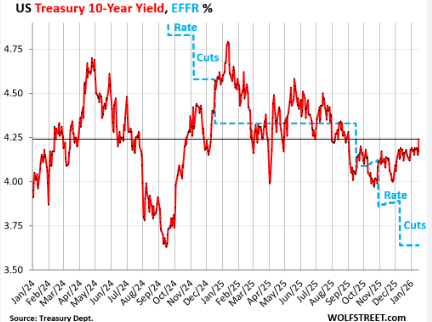
Image used from wolfstreet
The problem this creates is straightforward: America is still spending roughly a trillion dollars more per year than it earns in tax revenue, and it still has to borrow money to keep the lights on. So when demand for its bonds collapses, it has to offer higher interest rates to attract buyers back.
And higher rates on new debt, combined with the mass refinancing of the old debt, means the government ends up paying significantly more interest for years even decades to come.
At this point, the 0.5 percentage point spike in bond yields that’s already happened will cost the US government around $180 billion a year in extra interest. And that’s just from what’s occurred so far. If yields climb further during the refinancing window, the bill grows larger.
Why countries are selling bonds
· Need dollars to buy oil internationally
· Fear that inflation will erode bond returns
· Broader concerns about US fiscal trajectory
· Seven of the top 10 US debt holders have cut positions
The knock-on effects for Americans
· 30-year mortgage rates track ~2% above Treasury yields
· Business loan costs rise with bond yields
· Credit card rates move higher
· Cost of borrowing rises across the entire economy
And this doesn’t just hit the government’s balance sheet. The 30-year mortgage rate has historically tracked about two percentage points above the 10-year Treasury yield. When Treasury yields go up, that increase flows through into your mortgage, your car loan, your credit card.
The cost of borrowing rises across the whole economy. This is why the Iran war’s financial consequences are landing in places far removed from the Middle East.
Scenario modelling the Iran conflict
The 2026 Global Peace Index modelled the economic impact of this conflict under three scenarios, and the spread between them tells you everything about what’s at stake in the next few months.
Scenario 1 the war ending immediately has already passed. We’re now living in the aftermath. Scenario 2, the most likely near-term outcome, assumes an extended ceasefire or stalemate. The Strait of Hormuz is partially reopened, but Iranian naval harassment continues and shipping risk premiums remain elevated. Under this scenario, global GDP losses in 2026 are estimated at around $1.3 trillion roughly 0.6% of world output.
The dollar value of diplomacy
The gap between Scenario 2 and Scenario 3 amounts to approximately US$2.2 trillion. That figure the difference between a contained stalemate and a resumed war is what the GPI calls “the dollar value of diplomacy.” It’s a striking way to frame the stakes.
Scenario 3 the most severe envisions the war resuming, the Strait closed for six or more months, and regional actors drawn further in. Under that outcome, global GDP losses would climb to roughly $3.5 trillion, exceeding the economic shock from the Russia-Ukraine war in its first year.
Scenario 2 global GDP loss
$1.3T
Ceasefire / stalemate, 2026
Scenario 3 global GDP loss
$3.5T
War resumes, 6+ month closure
Iran GDP loss (Scenario 2)
~15%
Lost oil export revenue
Gulf states GDP loss (Scenario 2)
~6.2%
Combined group estimate
The ripple effects nobody is talking about
The most underreported part of this story isn’t the oil price or even the bond market. It’s the way this conflict is transmitting costs to countries and communities that have nothing to do with it directly.
Ships rerouting around southern Africa to avoid the Gulf add roughly two weeks to delivery times. Freight rates and war-risk insurance premiums have risen sharply in some cases more than tenfold. Supply chains that were already fragile from the pandemic years are being stretched again. And for developing countries, every additional week of disruption produces income losses that simply cannot be recovered later.
There’s also a remittance channel that’s causing real pain in some of the world’s most fragile economies. Workers in Gulf states send around $88 billion home each year, with Egypt, Pakistan, Jordan, and India among the largest recipients. Egypt alone received $41.5 billion in Gulf remittances in 2025 roughly 10% of its entire GDP. Within weeks of the conflict beginning, foreign investors withdrew around $6 billion from Egyptian markets, the pound fell more than 8% against the dollar, and the full compression of remittances was still feeding through. That’s a genuine economic emergency for a country that had nothing to do with starting the war.
Then there are the hidden supply dependencies most people have never heard of. The Gulf region supplies approximately 45% of global sulphur and 50% of global urea exports both critical inputs to fertiliser production. Qatar produces around 40% of the world’s helium, an essential material in semiconductor manufacturing. All of it stranded. The food price implications alone, given fertiliser’s role in agriculture, are going to ripple through grocery stores in countries far removed from the Middle East for months to come.
Hidden supply dependencies now stranded
Gulf states supply ~45% of global sulphur and ~50% of global urea (fertiliser inputs). Qatar produces ~40% of global helium (semiconductor manufacturing). None of this is flowing. The downstream effects on food prices and chip production are still working their way through the global economy.
The Fed, Kevin Warsh, and the impossible position
In normal times, this is precisely the kind of situation the Federal Reserve exists to manage. But the Fed is not in a normal position right now.
Kevin Warsh, who replaced Jerome Powell as Fed Chair earlier this year, has signalled that he believes an AI-driven productivity boom is on the horizon and that the Fed should be cutting rates to let businesses borrow and invest more. In a stable environment, that argument has some logic to it. But cutting rates now when oil prices are already pushing inflation above 4% would pour fuel on an already burning fire.
“Even if the inflation caused by the oil shock eventually passes, the cost in terms of government debt wouldn’t reset so cleanly. The $9 trillion being refinanced right now will carry higher interest rates for the next decade.”
Here’s the part that I think gets lost in the political noise around the Fed: even if the war ended tomorrow and oil prices came back down, the damage to America’s debt position doesn’t undo itself. The refinancing window is happening now. The bonds being issued now carry the current higher rates. That cost is locked in for ten years, regardless of what happens to inflation next month.
There is a real possibility and I want to be clear this isn’t certainty, but it’s a serious risk that within the next 12 months, interest payments quietly become the single largest line item on the US federal budget and stay that way for decades. The military budget, Social Security, Medicaid — all of it potentially overtaken by the cost of servicing a debt load that was already at the edge of sustainability when the oil shock arrived.
Look, I’m not here to tell you the sky is falling. America has faced enormous debt challenges before and found ways through. The system has more resilience than the doom-and-gloom crowd sometimes acknowledges.
But I do think there’s something genuinely different about this moment two slow-moving disasters arriving at the same time, amplifying each other in ways that most coverage is not joining up.
The oil shock is real. The debt refinancing crunch is real. The bond yield spike is real. And the way they interact through inflation, through foreign selling of US debt, through higher borrowing costs flowing into every corner of the economy is a story worth understanding properly. Because unlike most financial crises, this one isn’t going to arrive with a single dramatic headline. It’s going to arrive in your gas bill, your mortgage renewal, and your grocery receipt, month by month, until the full weight of it lands.
Reference
메타데이터
- post_id
- 8dbd2be2dea7
- slug
- the-iran-war-and-americas-debt-two-crises-on-a-collision-course-8dbd2be2dea7
- url
- https://medium.com/geopolitics-beyond/the-iran-war-and-americas-debt-two-crises-on-a-collision-course-8dbd2be2dea7
- canonical_url
- https://medium.com/geopolitics-beyond/the-iran-war-and-americas-debt-two-crises-on-a-collision-course-8dbd2be2dea7
- author_url
- https://medium.com/@nairsahil08
- status
- ok
- fetched_at
- 2026-06-29 22:44:20