Soft Goods Prototype Process Log
Design
Soft Goods Prototype Process Log
Design
To be honest, this was my first time learning sewing, and I felt both nervous and excited. At the beginning, I planned to make a simple decorative object, such as a small bag accessory. However, I later thought about making something more meaningful and useful. My mom really likes canvas tote bags, so I decided to design and create a simple canvas tote bag for her.
In terms of design decisions, I focused on simplicity and usability. Since I was a beginner, I intentionally chose a relatively simple structure to reduce technical difficulty while still meeting functional needs. At the same time, I wanted the bag to be practical for daily use, so I considered elements like handles, storage space, and closure.
Sketches
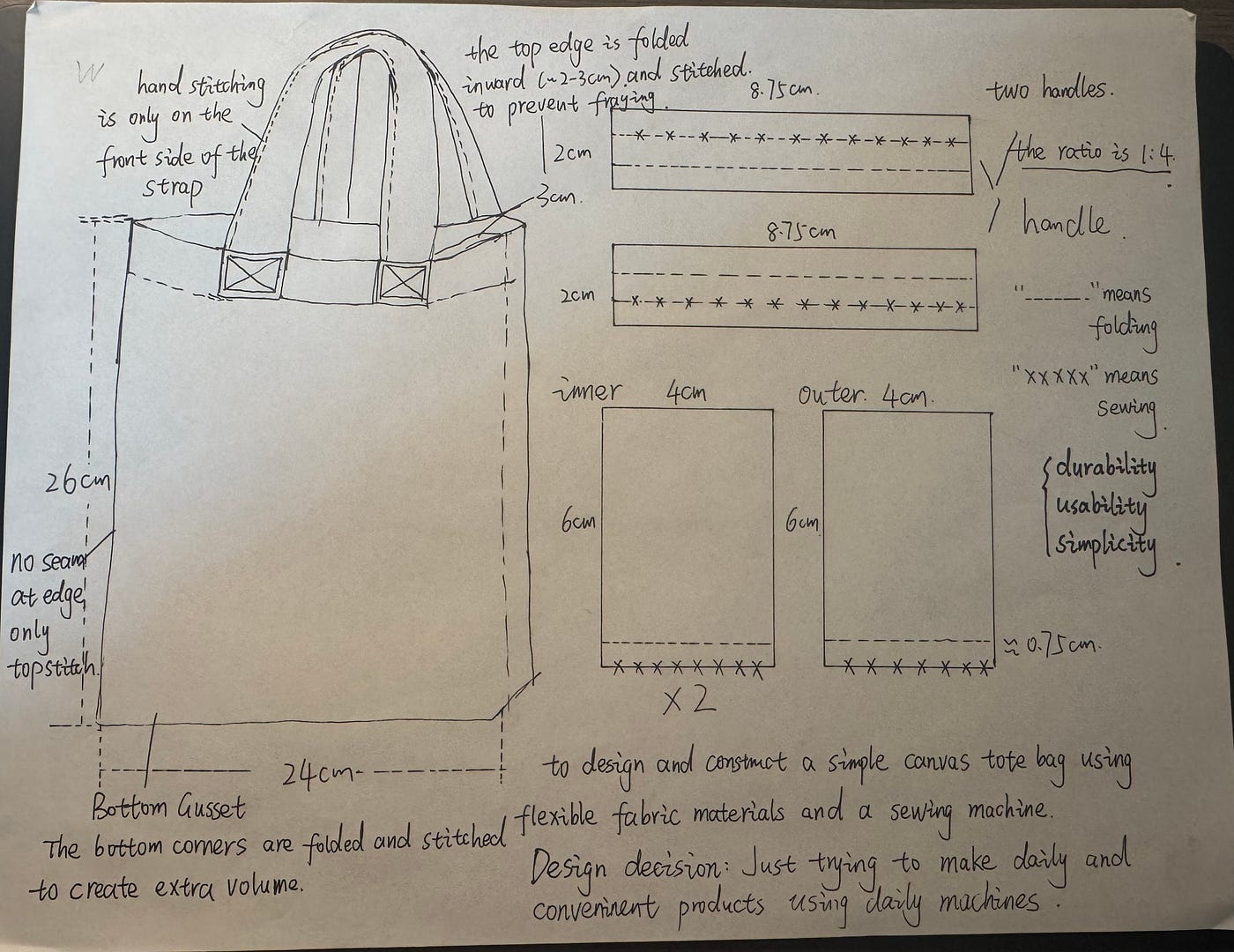
I started with hand-drawn sketches to explore the structure of the bag. In my sketches, I tried to represent each component (body, handles, pocket) at a real scale. This helped me better understand how the parts would fit together.
Prototype
Iteration 1
In the first prototype, I followed my sketches to cut and assemble the fabric components. The overall process from sketch to prototype went smoothly. Drawing components at actual scale made fabric cutting much easier and more accurate.
However, I did not mark exact folding and sewing positions (e.g., how many centimeters to fold or stitch), which caused alignment errors during sewing.
During construction:
- My sewing skills were still very basic, resulting in rough and uneven stitching
- The side corners of the bag were not symmetrical
- Both handles were sewn directly onto the outside, leaving messy threads exposed
Overall, the first prototype had a simple structure but lacked refinement and visual quality.

Iteration 2
For the second prototype, I improved my process based on the issues from iteration 1.
- I updated my sketches with precise measurements, clearly marking fold lines and sewing positions
- This made the sewing process more efficient and accurate
- The body of the bag became more symmetrical, and the folds were cleaner
For the handles:
- I first attached them to the outside
- Then folded them inward and added a second layer of stitching
- This resulted in a cleaner appearance with no exposed threads
I also added new functional features:
- A button and string closure system, allowing the bag to be opened and closed like a zipper
- A small black outer pocket for items like keys or cards

Analysis
What worked and what didn’t
The first prototype worked well in terms of overall structure and concept. Creating sketches at real scale was especially helpful and made fabrication easier. However, the lack of detailed planning (such as marking fold and stitch positions) led to misalignment and uneven construction. My limited experience with the sewing machine also affected the quality of stitching.
In contrast, the second prototype showed clear improvement. Planning more precisely before sewing significantly improved accuracy and efficiency. The bag became more symmetrical, and the handle construction looked cleaner and more professional. The added features also improved usability.
Feedback
In-class critique:
- Suggested adding an inner and outer layer (nested structure) to improve durability
- Commented that the button closure design was creative and interesting
External feedback (my mom):
- She really liked the bag overall
- Suggested moving the black pocket to the inside for better security, so items like keys and cards would not fall out
Next Steps
If I continue improving this design, I would:
- Use higher-quality and colored fabric to enhance the visual appearance
- Apply a double-layer (nested) construction to make the bag stronger and more durable
- Move the pocket to the interior based on feedback for better functionality
These changes would improve both the durability and usability of the design while making it more suitable for everyday use.
Note: All work is done by myself; ChatGPT was used to check grammar and completeness of sentences.
Yuyao Sun
메타데이터
- post_id
- 8dc29f15ea2c
- slug
- soft-goods-prototype-process-log-8dc29f15ea2c
- url
- https://medium.com/@syy01/soft-goods-prototype-process-log-8dc29f15ea2c
- canonical_url
- https://medium.com/@syy01/soft-goods-prototype-process-log-8dc29f15ea2c
- author_url
- https://medium.com/@syy01
- status
- ok
- fetched_at
- 2026-06-09 15:37:30