The Naira Is Leaking, Everybody Is Talking But Who Is Doing Something About It?
Just one dollar jump will leave you explaining and explaining and explaining with no evidence, and somehow that’s just normal.
The Naira Is Leaking, Everybody Is Talking But Who Is Doing Something About It?
Just one dollar jump will leave you explaining and explaining and explaining with no evidence, and somehow that’s just normal.
Seven months
That’s how long I spent saving to get a new laptop
Now, this wasn’t a flex laptop, but a work laptop. Because the one I used started to hang every time NEPA takes light. It would work fine when it’s connected to external power, it will be smooth and responsive, no issue.
But the moment the light goes off, and it switches to battery power, it will decide to freeze. Especially in the middle of an edit, with a client deadline approaching (The moment I needed it the most).
I will be honest with you, there are two things I can’t tolerate at all when I am working, a slow internet and a slow laptop. Because I am the kind of person who is easily distracted, and once my flow breaks, I might never get that creative energy flowing as it was again.
So getting a new laptop was very important to me.
I asked around. ₦500,000 for a clean, new one with the capacity I needed as a graphic designer and video editor. Mind you, this was early 2023, and my salary wasn’t there yet, so I started saving. Cut some expenses for seven good months. Then I begged my elder sister to support me, which she did because she understood how hard I had worked and saved for it.
I walked into Computer Village with ₦540,000, extra for a laptop bag and Shawarma to reward myself on the way home.
The laptop I wanted was now ₦930,000.
The dollar had jumped from around ₦450 to almost ₦800. The same trader I confirmed the price from seven months back just stood there and said: “Dollar don rise.” Like that was supposed to make sense to me.
I stood there in front of him doing the maths in my head, trying to figure out which smaller laptop I could manage with.
No more shawarma for me.
That day, something my university lecturer used to say finally made sense to me: “Money is what money can buy.”
₦1,500 used to buy a quality Chicken Republic Refuel meal, Jollof rice and Chicken with Coke. Now, that same ₦1,500 buys small rice and egg from the Mama Put, which is filled with area boys near my bus stop.
The value of money is determined by what it can purchase. And as Nigerians, we have what is called:
The Naira Problem.
In 2021, one dollar cost ₦390, but by the end of 2024, that same dollar cost ₦1,535.

That is a 284% devaluation in three years. As of December 2024, Nigeria’s inflation peaked at 34.80%. That’s the highest it has been in 28 years.

These numbers aren’t just statistics. They show up in our daily lives, from the increase in the cost of transportation to the cost of purchasing everyday groceries and other expenses
Prices rise when the dollar rises, and when the Naira gains a little back, prices don’t come down.
And for those trying to build something in this country, it goes even deeper.

And at best, salaries don’t adjust, and interest on savings doesn’t adjust. Only the market and the cost of everything you need to survive.
Back to my story.
After the Computer Village experience, I started searching for jobs that pay in Dollars. It was simple, if I could get a job paying in dollars, I wouldn’t have to worry about the Naira problem anymore.
But then I found out that having the money and accessing the money are two completely different things in Nigeria.
Let me tell you what happened when I got 96 dollars’ worth of coins from a Telegram tap-to-earn game (Tapcoin)
I moved it to Binance so I could convert from Tapcoin to USDT and possibly to Naira, but Binance had been banned in Nigeria at that point. You could use the app, but you couldn’t withdraw naira. So I converted to USDT and started what I term:
The App Marathon
I moved the USDT to Yellow Card. And Yellow Card gave me a serious headache.
Tried to withdraw. Had to convert USDT to naira first, fees and spread took their own share. Then, I tried to withdraw the naira and hit another wall. Converted back to dollars to try another platform. Googled “how to withdraw USDT in Nigeria” and saw different apps in every single result.
A friend mentioned another crypto platform, Bybit. The reviews on Twitter (now X) were scary. I genuinely didn’t know if I’d send my money there and never see it again.
I went to a guy I knew on Telegram who does exchanges. He said he doesn’t do anything less than $100, and I didn’t have up $100.
Went back to my Bybit friend. Told him to help me withdraw since he knew the platform better than I did. By the time everything settled after fees and converting back and forth on different platforms, I could only send him $84 of the original $96.
Twelve dollars gone just like that. Just to the friction of trying to access money I had earned.
Now, just weeks ago, people were ranting on X about another platform’s fees. One user shared a screenshot of $12.33 charged just to convert $1,358 worth of USDC to naira. Just to swap. Another user replied that his previous transaction cost $47.75. The one before that? $114.

Underneath all of this is one bigger problem
The FX and Cross-Border Problem
Getting dollars in Nigeria is hard. Converting stablecoins to naira costs you on every side, the spread, the fee, and the rate that is constantly moving while you wait. And sending money across borders is worse.
Nigerians record the highest remittance fees on the continent

Traditional services charge as high as 8.45% on average. Send $1,000 home, and $84.50 disappears before your family sees a kobo.
The CBN Governor said it publicly at an international conference that cross-border payments remain “too slow, too costly, and too fragmented, especially for developing economies.”

That’s the central bank admitting the system is broken.
For freelancers earning in dollars, remote workers receiving salaries in stablecoins, small businesses trading across borders, diaspora sending money home, every single naira conversion is a tax nobody agreed on.
So you have three problems stacked on top of each other.
- Naira that leaks value while you sleep.
- Apps that charge you just to access your own money.
- And a cross-border system that was never designed to work in your favour.
But here is something different
Finna
A stablecoin-native financial platform built for Nigerians with a mission make stablecoins work like cash.
Not something you trade or convert before you can use it.
Because right now, there is a wall between the global digital economy and your everyday life. A freelancer earning USDC still has to dance through different apps just to pay Lagos rent. A small business owner receiving payment from abroad still loses days and dollars just to access their own money.
And the infrastructure Finna chose to leverage is Solana.
Morgan Housel wrote in The Psychology of Money:
“Money’s greatest intrinsic value, and this can’t be overstated, is its ability to give you control over your time.”
That line stopped me when I read it. Because the naira problem, the app marathon problem, and the FX problem are all the same problem underneath, they take control away from you.
Control over your savings, over your time, over when and how you access what you earned.
A few weeks ago, I won a USDT giveaway on an X Space. They asked participants to drop their Finna username and picked five people at random. I was one of them.
The USDT landed in my Finna wallet almost immediately, and that same week, my younger brother called from school. He needed money urgently.
I opened Finna. Converted 5 USDT to naira for free with zero swap fees. Added his bank account to my profile and sent the naira directly to his account.
He received it in under a minute, and I was charged just ₦100.
Why I am Doubling Down on Finna (the Product)
Receive
Finna gives you an account number in your name to add naira directly. When I tested it, funds appeared in under 10 seconds. Fee: ₦100.

You can also receive stablecoins (USDT or USDC) across five chains: Solana, Ethereum, Tron, BNB Smart Chain, and Base. Your crypto doesn’t need to be on a specific chain before Finna can work with it. It meets you where your money already is.
Swap
Convert stablecoins to naira instantly. For free, no hidden fees. The same conversion that costs $12 on some platforms costs nothing here.

Send
Send stablecoins to other Finna users via username or email. You don’t need to send via long wallet addresses to avoid errors. But for external wallets and non-Finna users, you can send via wallet address across all five supported chains.
Withdraw
Naira to your local bank account. I tested this. Funds arrived in under 10 seconds. Fee: ₦100 flat, regardless of the amount.

Finna Lend
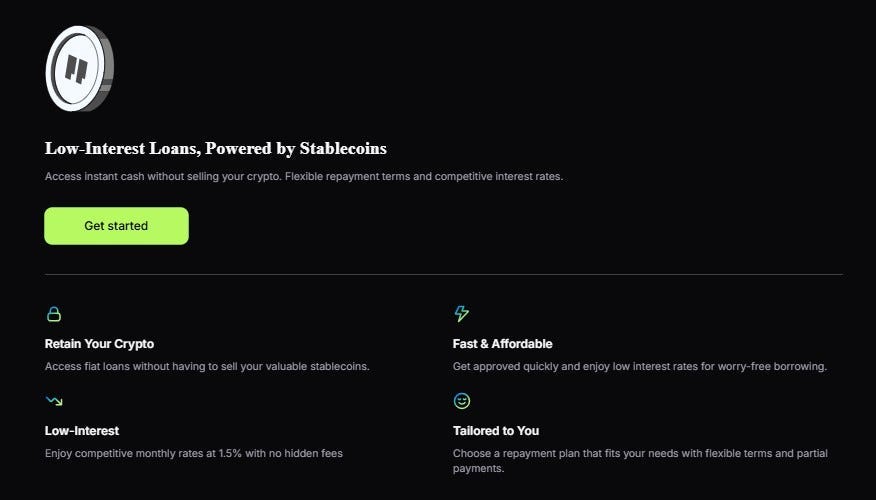
You know that feeling when you need naira urgently but don’t want to sell your USDT at a bad rate? That specific frustration of needing cash but not wanting to lose the value of your stablecoins? Finna Lend is built for that exact moment.
You deposit your stablecoins as collateral. Finna lends you naira against them — up to 90% of the collateral value. Your stablecoins stay locked, but they stay yours. When you repay, they’re released immediately.
Minimum loan: ₦40,950. You need at least 110% of the loan amount in stablecoin collateral.
Loan terms: 7, 30, 60, or 90 days. You can repay partially or in full anytime. Monthly interest rate: 1.5%. No hidden fees.
Compare that to loan apps in Nigeria charging up to 30% per month and harvesting your contact list. With Finna Lend, your stablecoin is your collateral. Your credit history is irrelevant. The process takes minutes.
Finna Tags
Your username is your financial identity on Finna. Anyone on Finna can send you naira or stablecoins using only your tag. That was also how I received my USDT giveaway; someone typed my username, and it arrived.
Why All of This Works: Solana’s Role in Finna’s Architecture
Everything I just described, the under-10-second deposits, the under-10-second withdrawals, the ₦100 flat fees, the instant transfers…
It’s not magic.
Finna uses Solana to power its entire stablecoin infrastructure. And that choice is the reason the product works the way it does for a Nigerian user.
Here is how Solana powers what you experience on Finna:
When you swap stablecoins to naira on Finna, that transaction is processed on the Solana blockchain. When you send USDT to another Finna user, it moves on Solana rails. When you receive stablecoins, Solana is the settlement layer confirming and recording that transaction. The speed, the cost, the reliability, all of it comes from Solana’s architecture operating underneath Finna’s clean interface.
Solana processes up to 65,000 transactions per second. Confirmation time is around 0.4 seconds, essentially instant. The average transaction fee on Solana is $0.0005. At today’s exchange rate, that is less than ₦1 per transaction.
Compare that to other chains where fees regularly run between $1 and $50, depending on network congestion. That is ₦1,364 to ₦68,200 per transaction with confirmation times of up to 10 minutes.
And Solana’s scalability means it doesn’t slow down under pressure. The network is designed for high-volume, high-frequency transactions, which is exactly what a financial platform serving millions of Nigerians needs.
When more users join Finna and when more transactions happen, Solana’s architecture handles the load without fees spiking the way they do on other chains during busy periods.
Reliability matters too. Solana has significantly improved its network stability, making it one of the most dependable high-performance blockchains available today, which is non-negotiable for a platform people trust with their money.
Now connect these numbers back to the three problems:
Naira volatility: Because Finna uses Solana to power its stablecoin infrastructure, you can hold stablecoins at near-zero cost and convert to naira only when you choose to. You are no longer forced to sell at a bad rate because you need cash urgently. Finna Lend, powered by Solana’s instant settlement, gives you naira without touching your stablecoins.
FX access: The spread and fee problem exists because moving money through traditional FX channels involves multiple middlemen, each taking their own share of your money. On Solana, the transaction moves directly, confirmed in 0.4 seconds, at a cost of less than ₦1. Finna passes that efficiency to you as ₦100 flat fees and zero swap costs.
Cross-border payments: Sending money across borders on Solana costs the same whether you’re sending to someone in Lagos or London. In under 0.4 seconds, without having to wait for the 3-day settlement windows or the 8.45% remittance fees. Finna puts that infrastructure in your pocket.
Think of it this way.
Finna is the vehicle, and Solana is the road.
You know you can have the best vehicle in the world, but if the road is not vehicle-worthy…
That is, it’s full of potholes, go-slows, one-way wahala, everything slows down and costs more. Solana gives Finna a smooth, fast, almost-free road. And that smoothness is what you feel every time a transaction completes in under 10 seconds.
The speed is why your brother gets the money in under a minute.
The low cost is why you pay ₦100 instead of $12 or $114
The reliability is why the transaction doesn’t hang halfway and leave you wondering if your money has landed in the hands of scammers.
But What Does This All Mean
According to CNBC Africa, 95% of Nigerians said they prefer receiving payments in stablecoins over naira. Nigeria processed nearly $22 billion in stablecoin transactions between July 2023 and June 2024, the largest volume in Sub-Saharan Africa.
Nigerians figured out that stablecoins were better, and they went all in.
So the problem was never the stablecoin but the infrastructure.
And Finna, using Solana to power its stablecoin infrastructure, solves that problem
The naira has been leaking, and everybody kept talking, but Finna actually did something about it.
That being said,

Get started here: Finnahq.com
I’m on** X at @emekalutm and [LinkedIn](https://www.linkedin.com/in/emekalutm)**
메타데이터
- post_id
- 8e2175a71c8b
- slug
- the-naira-is-leaking-everybody-is-talking-but-who-is-doing-something-about-it-8e2175a71c8b
- url
- https://medium.com/@emekalutm/the-naira-is-leaking-everybody-is-talking-but-who-is-doing-something-about-it-8e2175a71c8b
- canonical_url
- https://medium.com/@emekalutm/the-naira-is-leaking-everybody-is-talking-but-who-is-doing-something-about-it-8e2175a71c8b
- author_url
- https://medium.com/@emekalutm
- status
- ok
- fetched_at
- 2026-07-13 06:23:13




