Internal Committee vs Local Committee Under POSH: Key Differences Explained
The Internal Committee (IC) and the Local Committee (LC) are two grievance redressal bodies established under the Sexual Harassment of…
Internal Committee vs Local Committee Under POSH: Key Differences Explained
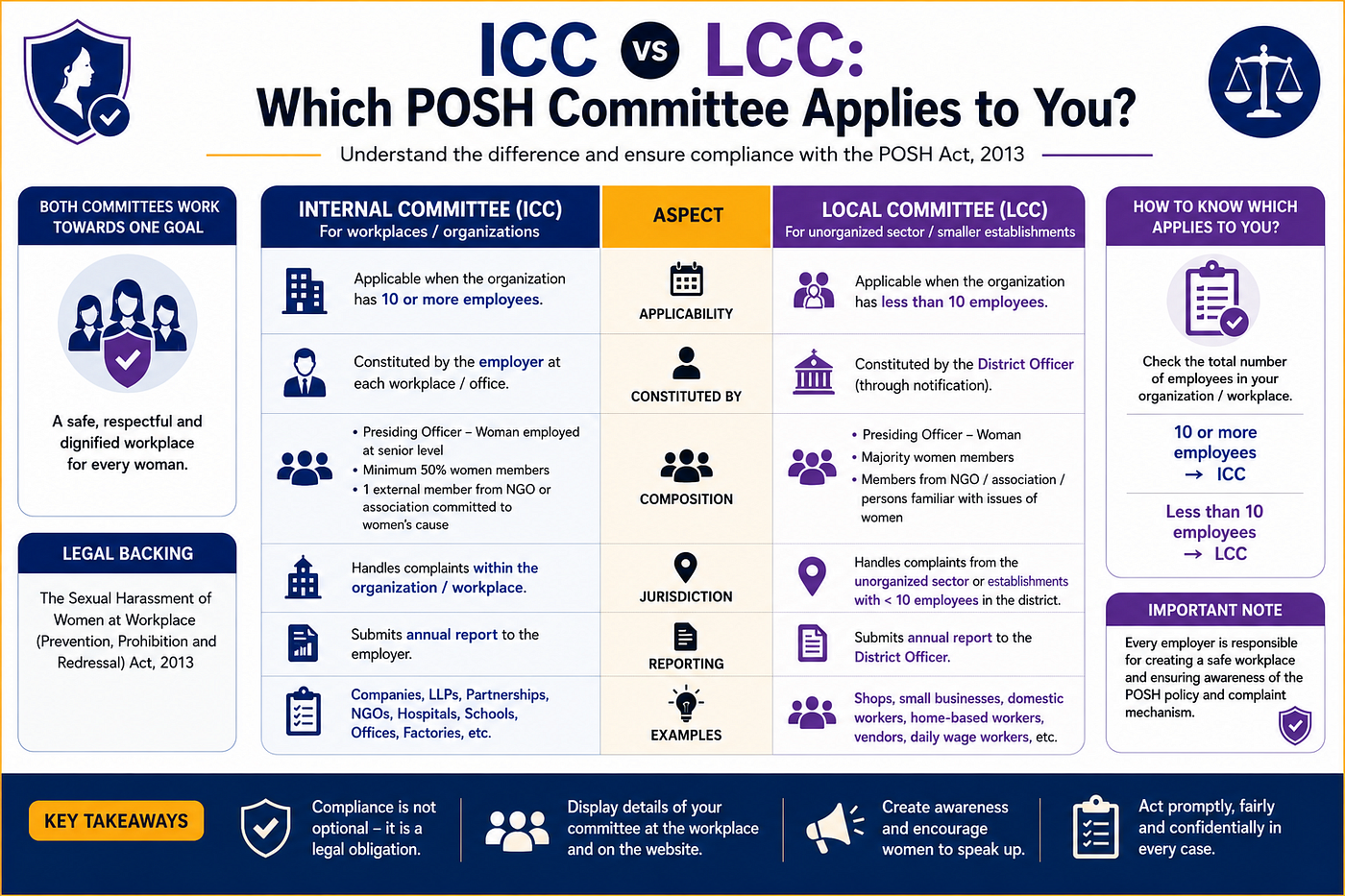
The Internal Committee (IC) and the Local Committee (LC) are two grievance redressal bodies established under the Sexual Harassment of Women at Workplace (Prevention, Prohibition and Redressal) Act, 2013.
The Internal Committee is formed by employers with 10 or more employees, while the Local Committee is established by the district administration to handle complaints from workplaces that do not have an Internal Committee or where specific circumstances require its involvement.
Many employers confuse these two committees, leading to compliance mistakes. Understanding which committee applies to your organisation is essential for meeting POSH obligations and handling workplace complaints correctly.
This guide explains the differences between the IC and LC, when each applies, and what employers should know in 2026.
What Is an Internal Committee (IC)?
An Internal Committee is a workplace committee constituted by an employer to receive and investigate complaints of sexual harassment.
Under the POSH Act, every organisation with 10 or more employees must establish an Internal Committee.
The committee is responsible for:
- Receiving complaints
- Conducting inquiries
- Maintaining confidentiality
- Submitting recommendations to the employer
For example, a manufacturing company in Pune employing 80 workers must constitute an Internal Committee.
What Is a Local Committee (LC)?
A Local Committee is established by the District Officer under the POSH Act. It primarily handles complaints when:
- A workplace has fewer than 10 employees.
- An employer has not constituted an Internal Committee where required.
- The complaint is against the employer.
- Other situations specified under the Act require the Local Committee’s involvement.
For example, a beauty salon in Ahmedabad with seven employees can approach the Local Committee because it is not required to constitute an Internal Committee.
When Does an Internal Committee Apply?
An Internal Committee is mandatory when a workplace has 10 or more employees. Examples include:
- Retail stores
- Hospitals
- Restaurants
- Manufacturing units
- IT companies
- Educational institutions
For example, a logistics company in Chennai employing 35 workers must establish an Internal Committee.
Failure to do so may lead to compliance issues under the POSH Act.
When Does a Local Committee Apply?
The Local Committee becomes relevant when:
- A workplace has fewer than 10 employees.
- The complaint is against the employer.
- No Internal Committee exists where legally required.
- Domestic workers file complaints.
For example, a pharmacy in Surat with eight employees does not need an Internal Committee but should inform employees about the Local Committee mechanism.
This ensures employees still have access to a formal complaint process.
Employer Responsibilities
Employers required to form an Internal Committee should also:
- Adopt a written POSH policy.
- Conduct employee awareness programmes.
- Display POSH information at the workplace.
- Support fair and confidential investigations.
- Maintain complaint records.
Businesses relying on the Local Committee should still maintain a POSH policy and inform employees about the complaint process.
Compliance extends beyond committee formation.
Common Employer Mistakes
Many SMEs create compliance gaps by:
- Assuming every business needs an Internal Committee.
- Not informing employees about the Local Committee.
- Using outdated committee structures.
- Not appointing an external member.
- Failing to conduct awareness programmes.
For example, a startup in Bengaluru with 12 employees may create an Internal Committee but overlook the requirement to appoint an external member.
Small omissions can affect compliance.
Practical Example
A dental clinic in Jaipur employed nine staff members. initially, the owner believed an Internal Committee was mandatory.
After reviewing the POSH Act, the clinic learned that complaints could be referred to the Local Committee because the employee count was below 10.
The clinic documented its POSH policy, informed employees about the Local Committee, and conducted a workplace awareness session.
This helped improve compliance without creating an unnecessary committee.
How HR Systems Help
As businesses grow, managing compliance manually becomes more difficult. Many employers use HR systems to:
- Maintain employee records.
- Store POSH policies.
- Track workforce strength.
- Organise compliance documentation.
Solutions like Petpooja Payroll help businesses maintain structured employee records and HR processes, making it easier to identify when an Internal Committee becomes mandatory as the workforce grows.
Final Thoughts
The Internal Committee and Local Committee play different but equally important roles under the POSH Act. Organisations with 10 or more employees are generally required to establish an Internal Committee, while smaller workplaces and certain specific cases rely on the Local Committee.
Understanding which committee applies to your business helps maintain compliance, protect employees, and create a safer workplace. As your organisation grows, reviewing POSH obligations regularly can help ensure that your compliance processes keep pace with your workforce.
메타데이터
- post_id
- 8e3f9e58e2df
- slug
- internal-committee-vs-local-committee-under-posh-key-differences-explained-8e3f9e58e2df
- url
- https://medium.com/@vidhi.petpooja13/internal-committee-vs-local-committee-under-posh-key-differences-explained-8e3f9e58e2df
- canonical_url
- https://medium.com/@vidhi.petpooja13/internal-committee-vs-local-committee-under-posh-key-differences-explained-8e3f9e58e2df
- author_url
- https://medium.com/@vidhi.petpooja13
- status
- ok
- fetched_at
- 2026-06-28 10:39:35