ETIAS for UK Travellers 2026: Everything You Need to Know Before You Fly
Burgundy passport in hand, no visa, no fuss — that’s how Britons have crossed into Europe for decades, Brexit notwithstanding. That’s about…
ETIAS for UK Travellers 2026: Everything You Need to Know Before You Fly
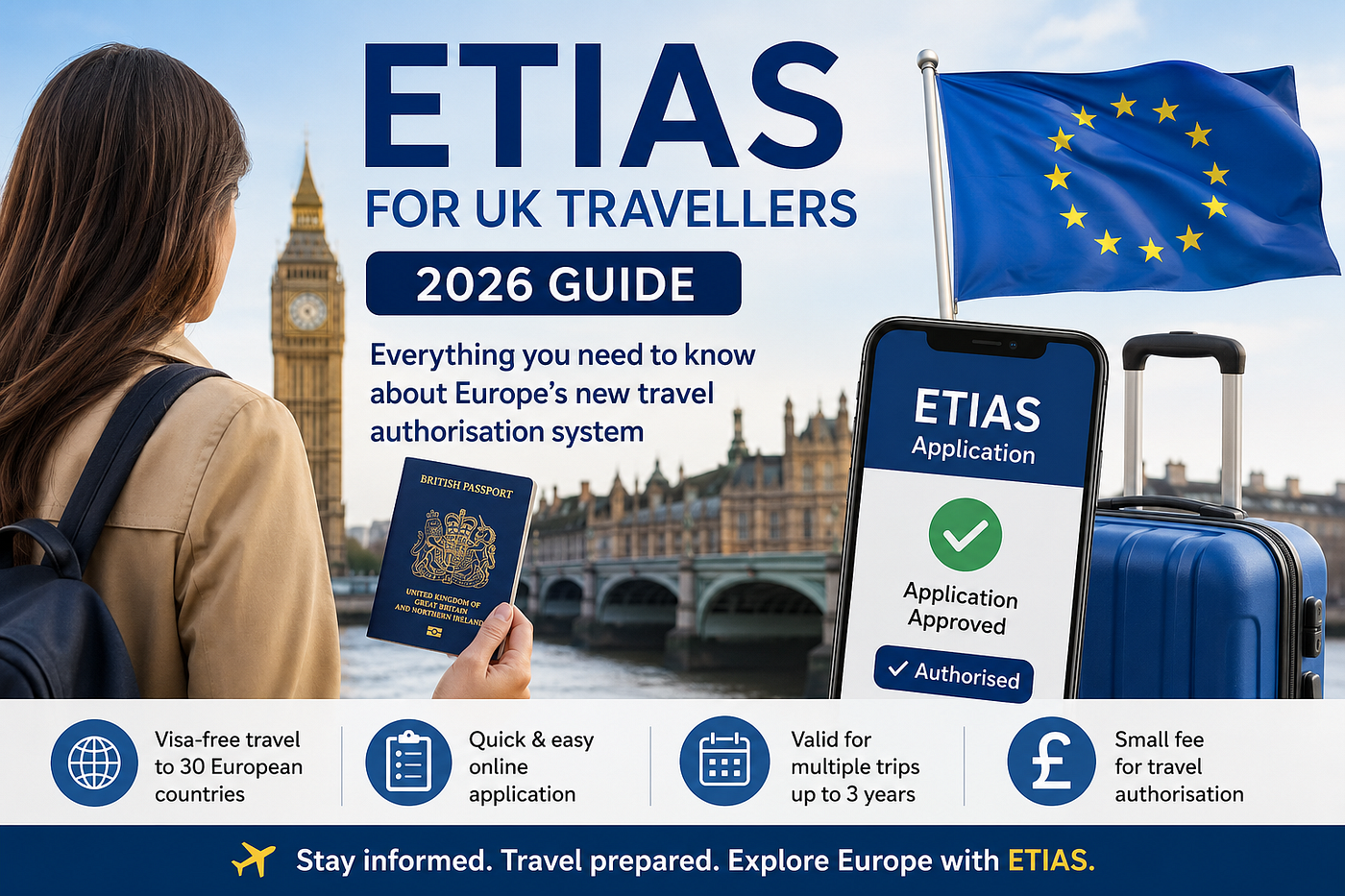
ETIAS 2026: What UK travellers need to know before visiting Europe.
Burgundy passport in hand, no visa, no fuss — that’s how Britons have crossed into Europe for decades, Brexit notwithstanding. That’s about to change, just not in the way half the headlines suggest.
From late 2026, anyone travelling from the UK to most of Europe will need to complete a short online form before departure. It’s not a visa. It won’t stop you going on holiday. But it is a new step, and getting it wrong — or ignoring it altogether — could mean an awkward conversation at check-in or, worse, being turned away at the border.
This guide walks through exactly what ETIAS is, who it affects, what it costs, and how to actually apply, without the scaremongering or stale information floating around elsewhere online.
What Is ETIAS, Exactly?
ETIAS stands for the European Travel Information and Authorisation System. Think of it as Europe’s answer to the American ESTA, or indeed the UK’s own ETA scheme that now applies to European visitors coming here.
It’s a pre-travel screening system, not a visa. British citizens will remain visa-free for short trips to Europe — that fundamental right hasn’t changed. What’s changing is the process leading up to the trip. Before you board a flight, ferry, or Eurostar, you’ll need to register your details online, pay a small fee, and receive electronic authorisation linked to your passport.
The system exists to help European border agencies screen travellers against security and immigration databases before they arrive, rather than sorting problems out at passport control. It’s part of a broader shift in European border rules for UK citizens that also includes the Entry/Exit System, which we’ll get to shortly.
Who Actually Needs ETIAS?
If you hold a British passport and you’re travelling to any of the 30 participating European countries for tourism, business, family visits, or transit, you’ll need ETIAS once the system is live.
This applies to:
- Solo travellers and families alike, including children
- Business travellers attending meetings or conferences
- Anyone transiting through a Schengen airport and passing through border control
- Frequent travellers, regardless of how many times they’ve visited before
There’s no exemption for seasoned Europe travellers. Even if you’ve holidayed in Portugal every summer for twenty years, you’ll still need authorisation under the new system.
Who Doesn’t Need ETIAS?
Not everyone is affected. You won’t need ETIAS if:
- You hold an EU passport or dual nationality with an EU country, provided you travel on that passport
- You already hold a valid long-stay visa or residence permit for a European country
- You hold a current Schengen visa, for the duration that visa remains valid
- You’re only passing through the international transit zone at an airport without going through border control
That last point catches people out. If your connecting flight requires you to clear passport control in, say, Amsterdam or Frankfurt, ETIAS applies. If you stay airside the whole time, it doesn’t.
Dual British-Irish citizens travelling on their Irish passport are also exempt, since Ireland’s relationship with the Common Travel Area and EU membership puts them outside ETIAS entirely.
Which Countries Require ETIAS?
ETIAS covers 30 European countries: the 29 Schengen Area members plus Cyprus, which is preparing to join the scheme despite not yet being part of Schengen proper.
That includes major UK holiday destinations such as:
- Spain, France, Italy, Portugal and Greece
- Germany, Austria and the Netherlands
- Croatia, Malta and Iceland
- Switzerland and Norway (both non-EU but Schengen members)
Notably, Ireland is not part of ETIAS, since it isn’t in the Schengen Area. Neither is it required for domestic travel within the UK, obviously — ETIAS only applies once you’re heading to mainland Europe.
ETIAS Cost and Validity
The fee has been a moving target in early reporting, with some sources still citing an outdated €7 figure. The confirmed cost is €20 per applicant, roughly £17 at current exchange rates.
A few cost-related points worth knowing:
- Applicants under 18 or over 70 are exempt from the fee entirely
- Payment is made online during the application, typically by card
- Once approved, ETIAS is valid for three years or until your passport expires, whichever comes first
- You can use a single ETIAS authorisation for multiple trips within that validity window
So this isn’t a per-trip cost. Apply once, and you’re covered for years of travel, provided your passport doesn’t expire first — which is worth double-checking, since a new passport means a new ETIAS application.
How to Apply for ETIAS
The application process is designed to be quick, and for most people it will be. Here’s what it involves:
Complete the online form. You’ll provide passport details, personal information, travel history, and answer a handful of security and health-related questions.
Pay the fee. €20, paid by card during the application.
Wait for approval. Most applications are processed within minutes. Some take longer if additional checks are triggered.
Receive confirmation by email. Your ETIAS is then electronically linked to your passport — there’s no physical document or sticker to carry.
It genuinely is meant to be a light-touch process. The EU has been explicit that this shouldn’t feel like applying for a visa, and for the vast majority of applicants, it won’t.
Documents You’ll Need
Before starting the application, have these ready:
- A valid British passport with at least three months’ validity beyond your planned departure date
- A valid email address for confirmation and correspondence
- A debit or credit card for the application fee
- Details of your intended travel, though you don’t need fixed bookings to apply
- Basic background information, including any relevant criminal history or previous visa refusals
Having a criminal record doesn’t automatically disqualify you from receiving ETIAS, but you’ll need to declare it accurately. Manual review may take longer in these cases.
Processing Time: How Long Does It Take?
Most applications are approved within minutes of submission, sometimes instantly. However, the EU has built in room for delays:
- A small percentage of applications require manual review, which can take up to 72 hours
- In rare cases involving additional documentation requests, this can stretch to 30 days
The safe advice, echoed across every reputable source covering ETIAS for UK travellers, is to apply well before your trip rather than the night before. Ninety-six hours is often cited as a comfortable minimum, but earlier is always better, particularly during peak summer travel periods when volumes are higher.
If you want a single, thorough breakdown that pulls together the launch timeline, costs, and application steps in one place, this guide to ETIAS for UK Travellers is worth bookmarking before you start.
ETIAS vs EES: What’s the Difference?
This is where a lot of confusion creeps in, understandably, because both systems are new and both affect UK travellers heading to Europe.
EES, the Entry/Exit System, is already operational. It became fully active at external EU borders from 10 April 2026, following a phased rollout. EES is a digital border-checking system that records your entry and exit each time you cross into or out of the Schengen Area, replacing manual passport stamping with facial images and fingerprints for non-EU nationals, including Brits.
ETIAS is different. It’s a pre-travel authorisation you apply for online before you even leave home, similar in spirit to the UK’s own ETA scheme.
Put simply: EES checks you at the border, each and every crossing. ETIAS clears you before you travel, once every three years. The two systems work together but serve different purposes, and you’ll likely encounter both — EES already, ETIAS once it launches.
Common Mistakes UK Travellers Make
A few recurring errors are worth flagging, partly because misinformation about ETIAS has spread faster than accurate information.
Assuming ETIAS is live already. It isn’t, at the time of writing. The system is targeting a Q4 2026 launch, with a transitional grace period expected to run into early 2027 before enforcement becomes strict. Anyone claiming to process ETIAS applications right now is not legitimate — the official portal has not opened.
Confusing ETIAS with a visa. It’s an authorisation, not a visa, and the application process reflects that. Treating it like a full visa application, with excessive documentation, isn’t necessary.
Leaving it to the last minute. Even once live, processing can take days in some cases. Booking flights for the following week and assuming same-day approval is a risky bet.
Forgetting passport expiry rules. ETIAS is tied to your passport. A passport renewal means reapplying, even if your original authorisation hadn’t expired.
Ignoring the three-month validity rule. Separate from ETIAS, most European countries still require your passport to have at least three months’ validity remaining beyond your travel dates. This catches out even seasoned travellers.
Latest Updates on the ETIAS Timeline
The launch date has shifted multiple times since ETIAS was first announced, which has understandably bred scepticism. As things stand, the European Commission has confirmed a target of Q4 2026 for operational launch, meaning sometime between October and December.
Following launch, a transitional period of roughly six months is expected, during which enforcement won’t be strictly mandatory. That pushes full mandatory compliance toward spring 2027.
Practically speaking, this means UK travellers heading to Europe through the rest of 2026 can continue as normal, without ETIAS. But anyone planning trips into 2027 should factor the new authorisation into their pre-travel checklist.
Frequently Asked Questions
Do I need ETIAS if I already have a Schengen visa? No. If your Schengen visa remains valid, you’re exempt from ETIAS for the duration of that visa.
Is ETIAS the same as a visa? No. It’s a lighter-touch travel authorisation, closer to the US ESTA than a traditional visa application.
How much does ETIAS cost? €20 per adult applicant, around £17. Under-18s and over-70s are exempt.
How long is ETIAS valid? Three years, or until your passport expires, whichever happens first.
Can children travel without ETIAS? No, children need their own ETIAS authorisation, though the fee is waived for those under 18.
What happens if my ETIAS application is refused? You’ll be notified of the reason and have the right to appeal, or you may need to apply for a full Schengen visa instead.
Does ETIAS apply to Ireland? No. Ireland isn’t part of the Schengen Area and isn’t included in ETIAS.
Practical Tips for UK Travellers Heading to Europe
A little preparation goes a long way once ETIAS becomes mandatory:
- Apply as soon as you have confirmed travel dates, rather than waiting until the last week
- Double-check your passport’s expiry date well before booking, ideally allowing more than the minimum three-month buffer
- Keep a copy of your ETIAS confirmation email accessible on your phone, even though it’s electronically linked to your passport
- Watch out for unofficial websites charging inflated fees to “process” applications before the system is even live
- If travelling with children, apply for their authorisation separately and don’t assume they’re covered under a parent’s application
Final Thoughts
None of this changes the fundamental fact that British holidaymakers remain warmly welcome across Europe, visa-free, for short stays. What’s changing is procedural: a short form, a small fee, and a bit of forward planning.
The travellers who’ll sail through this transition are the ones who treat ETIAS the way they already treat passport renewals and travel insurance — as a routine box to tick well ahead of departure, not a last-minute scramble at the airport. Once the portal opens later in 2026, that’s exactly the approach worth taking.
메타데이터
- post_id
- 8e6b7db259fe
- slug
- etias-for-uk-travellers-2026-everything-you-need-to-know-before-you-fly-8e6b7db259fe
- url
- https://medium.com/@tripbuffergsc/etias-for-uk-travellers-2026-everything-you-need-to-know-before-you-fly-8e6b7db259fe
- canonical_url
- https://medium.com/@tripbuffergsc/etias-for-uk-travellers-2026-everything-you-need-to-know-before-you-fly-8e6b7db259fe
- author_url
- https://medium.com/@tripbuffergsc
- status
- ok
- fetched_at
- 2026-08-04 23:50:29