Sakana Fugu vs Claude Fable 5: The Real AI Race Is Moving From Bigger Models To Smarter…
The next AI battleground may not be “which single model is smartest.”
Sakana Fugu vs Claude Fable 5: The Real AI Race Is Moving From Bigger Models To Smarter Orchestration
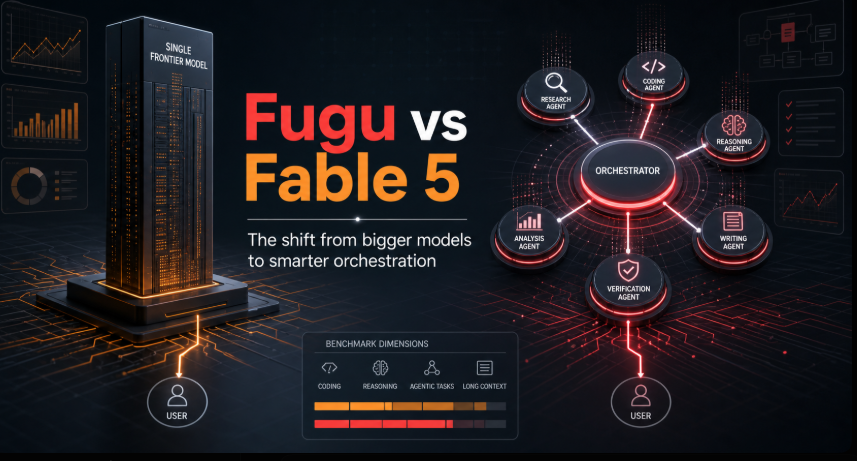
The next AI battleground may not be “which single model is smartest.”
It may be: which system knows when to call the right model, how to coordinate agents, and how to verify the answer before returning it.
That is the useful way to read Sakana Fugu.
Sakana Fugu is not a direct peer of Claude Fable 5 or Claude Mythos 5. Claude Fable 5 and Mythos 5 are Anthropic model configurations. Fugu is a learned multi-agent orchestrator exposed through a model-like API. It routes work across multiple underlying agents, then synthesizes the result. That difference matters more than the leaderboard headline. Sakana Anthropic
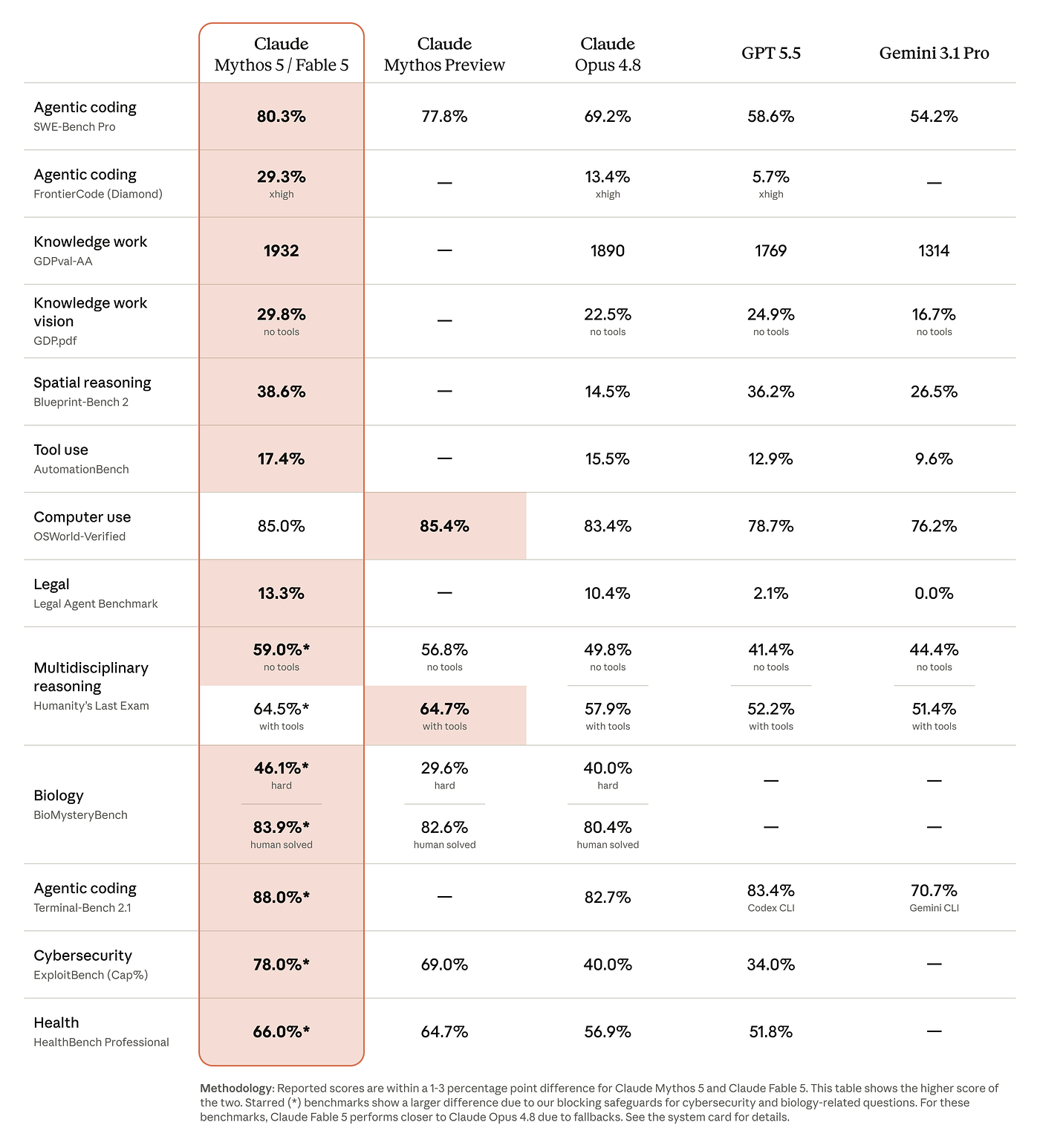
anthropic-fable-mythos-benchmark-table
What Fugu Actually Is
Sakana describes Fugu as a “multi-agent system as a model.” The user sends one request. Fugu decides how to structure the work, which agents to use, when to delegate, and how to merge the result. Sakana
The technical report describes two variants. Fugu is optimized for latency and interactive use. Fugu Ultra is optimized for quality on complex, multi-step tasks and can coordinate more expert agents. Sakana technical report
This is not mixture-of-experts in the usual transformer sense.
In a neural MoE model, experts are subnetworks inside one model. A router activates a sparse subset of experts per token. That reduces compute because the full model is not active for every token.
Fugu’s experts are external model agents. The routing happens at the workflow level, not inside one transformer layer. Sakana also says the specific underlying models selected per query are proprietary and not exposed. Sakana product page
That makes Fugu closer to a learned AI operating system than a conventional frontier model.
What Claude Fable 5 And Mythos 5 Are
Anthropic released Claude Fable 5 and Claude Mythos 5 on June 9, 2026. Fable 5 is the generally available model. Mythos 5 is the restricted-access version for approved cyberdefense and infrastructure users. Anthropic
Anthropic says Mythos 5 uses the same underlying model as Fable 5, but with some safeguards lifted. Fable 5 uses classifiers that can route certain cyber, biology, chemistry, or distillation-related requests to Claude Opus 4.8 instead. Anthropic docs
Both support a 1M-token context window and up to 128K output tokens. Pricing is $10 per million input tokens and $50 per million output tokens. Anthropic docs
The Benchmark Picture Is Mixed
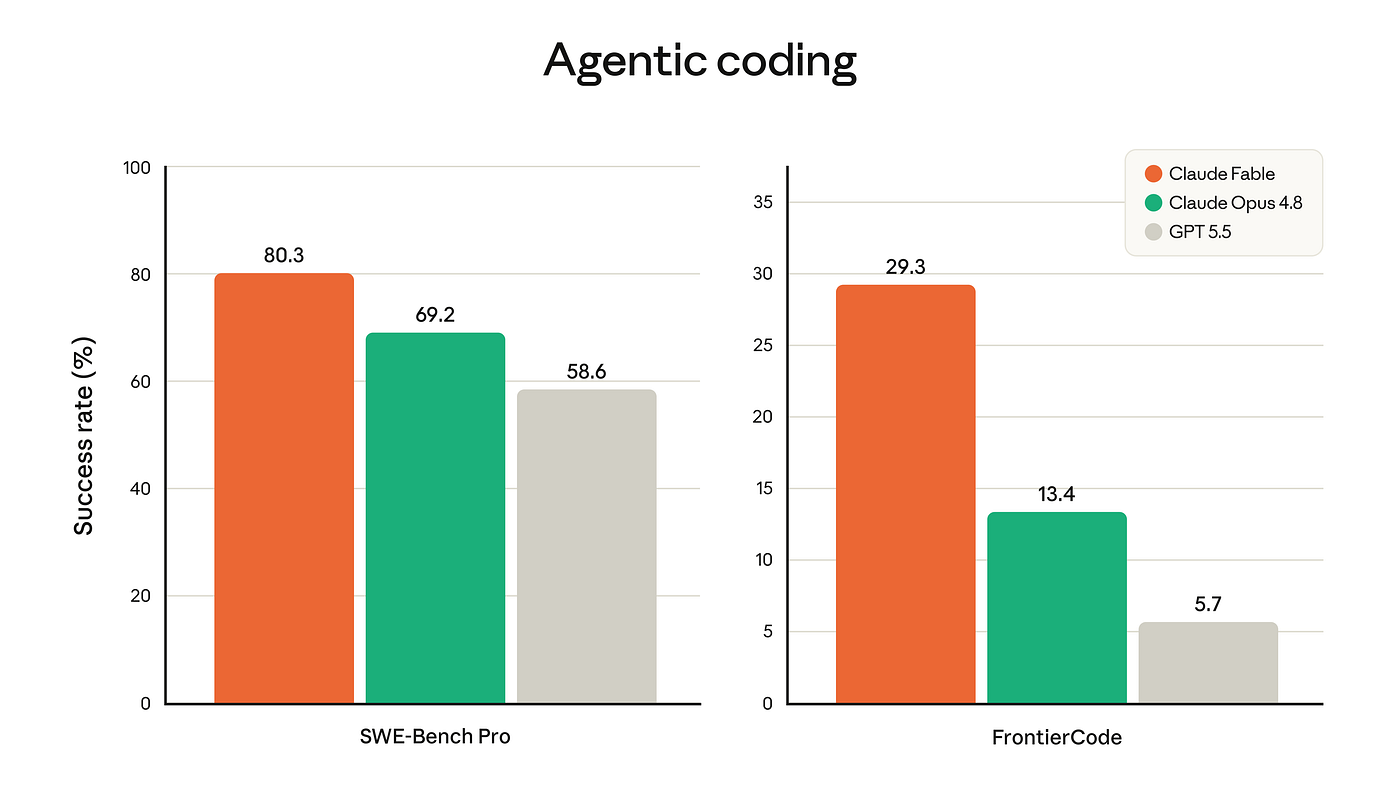
The cleanest direct comparison is SWE-bench Pro.
SWE-bench Pro measures whether an AI agent can solve realistic software engineering tasks in repositories. It is more useful than simple coding tests, but it still depends on the harness, tool access, time budget, and grading tests.
As of July 6, 2026, BenchLM reported:
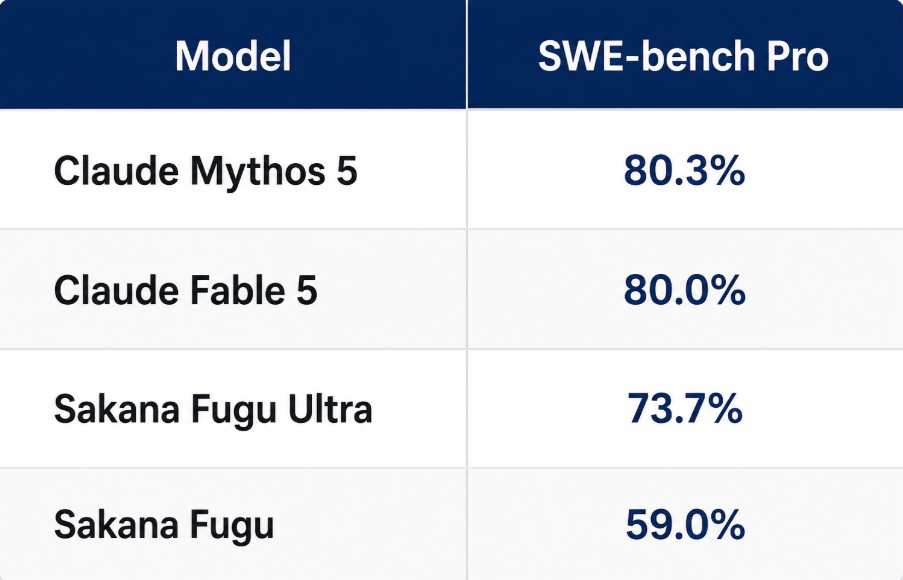
Source: BenchLM SWE-bench Pro leaderboard
So on the cleanest overlapping coding benchmark, Claude still leads.
But Fugu is not trying to win only by being a larger single model. Its claim is that orchestration can close part of the gap.
Sakana’s technical report reports Fugu Ultra at 82.1% on Terminal-Bench 2.1 and Fugu at 80.2%. Terminal-Bench measures command-line task completion and tool use. It is relevant for agentic engineering, but results can vary with environment, sandboxing, and scaffolding. Sakana technical report

Anthropic reports stronger results for Fable/Mythos on several broad benchmarks, including Terminal-Bench 2.1 and Humanity’s Last Exam. But those are vendor-reported results. Sakana’s Fugu results are also vendor-reported in several places. Independent evaluation is still limited. Anthropic Sakana technical report
That is the main caution: benchmark wins do not automatically translate into production wins.
Why Orchestration Matters
The most interesting Fugu result is not one benchmark row.
It is the architecture bet.
A single-model strategy says: train a bigger, better model.
An orchestration strategy says: build a system that knows which model or agent to use for each part of the task.
That can matter in long-running work. Real engineering tasks often involve reading, planning, coding, debugging, reviewing, and explaining. One model may be better at repository search. Another may be better at mathematical reasoning. Another may be better at concise synthesis. A strong orchestrator can exploit those differences.
Sakana’s report shows Fugu using different underlying agents at different stages of a task. In the report’s Terminal-Bench analysis, Fugu alternates between GPT-5.5 and Claude Opus 4.8 during trajectories, calling Claude at specific debugging points. Sakana technical report
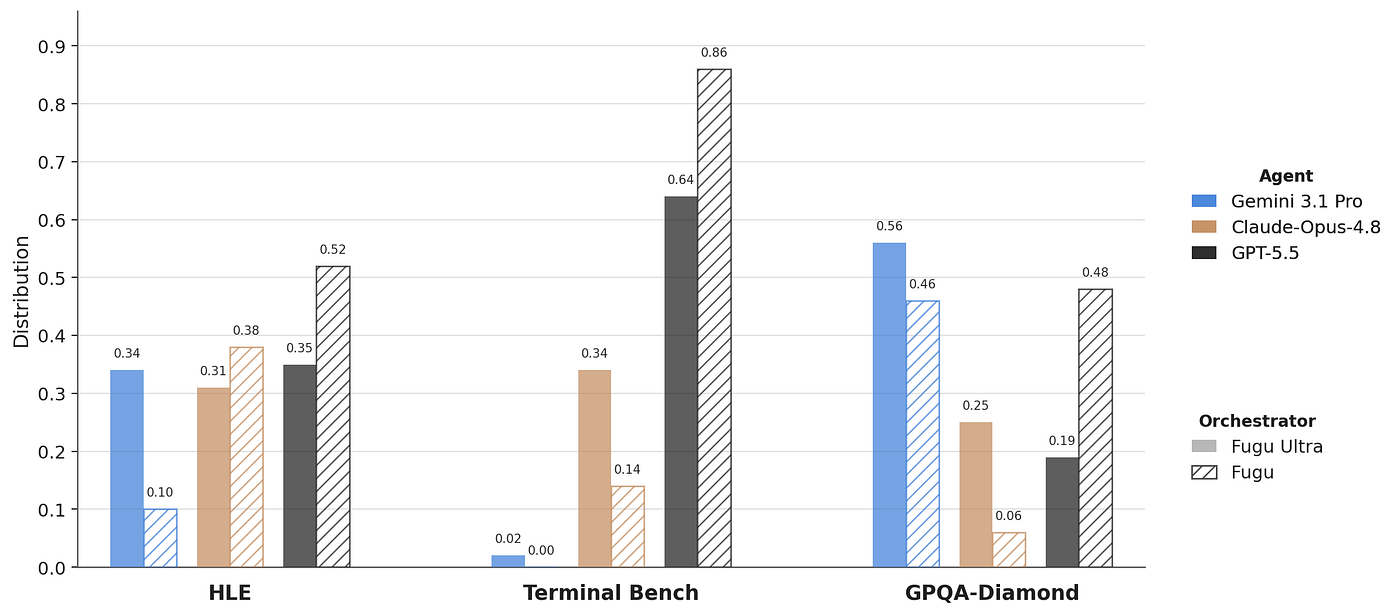
This is why Fugu is worth watching even when Claude wins the direct benchmark.
It represents a systems-level path to better AI agents.
Cost And Context
Fable 5 and Mythos 5 are expensive but straightforward. Anthropic lists pricing at $10 per million input tokens and $50 per million output tokens. They support 1M context and 128K output. Anthropic docs
Sakana lists Fugu Ultra at $5 per million input tokens and $30 per million output tokens. Above 272K context, pricing rises to $10 input and $45 output. Sakana product page
On paper, Fugu Ultra is cheaper on standard input and output pricing. But the real cost per completed task depends on latency, retries, tool calls, and how many tokens the orchestrated workflow consumes.
Lower token price does not always mean lower total cost.
For production teams, the more important question is: how many attempts does the system need before it produces a correct result?
Where Claude Still Looks Stronger
Claude Fable 5 remains the safer default for teams that want a single frontier model with strong benchmark evidence, long context, mature tooling, and enterprise deployment paths.
It leads Fugu Ultra on SWE-bench Pro. It also has independent evidence from Artificial Analysis, which reported Fable 5 scoring 1932 on GDPval-AA, with Opus 4.8 fallback occurring on 2% of those tasks. GDPval-AA measures agentic knowledge work, not coding alone. Artificial Analysis
Claude’s weakness is access complexity. Fable 5 can route some requests to Opus 4.8. Mythos 5 is restricted. Anthropic also requires 30-day retention for Mythos-class model traffic for safety monitoring and abuse detection. Anthropic says that retained data is not used to train new Claude models. Anthropic
For some companies, that is acceptable. For others, it is a blocker.
Where Fugu Looks Stronger
Fugu’s strongest argument is not raw intelligence. It is adaptability.
If a new frontier model appears, an orchestration system can potentially incorporate it faster than a company can train a new monolithic model. Sakana says it expects to spend roughly two weeks training and evaluating updated Fugu models after new frontier models are publicly released. Sakana product page
That makes Fugu a bet on model liquidity.
The best model today may not be the best model next month. A strong orchestrator can turn model churn into an advantage.
There is a tradeoff. Sakana does not expose which underlying models were used per query. That reduces observability. Regulated teams may care about that more than benchmark performance. Sakana product page
My Read
Claude Fable 5 is still ahead on the cleanest direct evidence. On SWE-bench Pro, it scores 80.0% while Fugu Ultra scores 73.7%. Claude Mythos 5 scores 80.3%. BenchLM
But Fugu is the more interesting systems idea.
It suggests that the next jump in AI agent performance may come from coordination, routing, verification, and synthesis, not only from larger parameter counts.
For coding agents, that matters. Real software engineering is not one-shot code generation. It is a loop: inspect, plan, modify, test, debug, explain. A learned orchestrator has a natural advantage if it can assign each part of that loop to the right agent.
The practical recommendation is simple.
Use Claude Fable 5 when you need a strong generally available frontier model and want the best direct coding benchmark evidence.
Use Mythos 5 only if you are in the approved trusted-access path.
Use Fugu Ultra when the task is long, messy, multi-step, and likely to benefit from model diversity. But benchmark it on your own workload before replacing a single-model agent.
메타데이터
- post_id
- 8e8f3e105cfd
- slug
- sakana-fugu-vs-claude-fable-5-the-real-ai-race-is-moving-from-bigger-models-to-smarter-8e8f3e105cfd
- url
- https://medium.com/@anudeepbatchu10/sakana-fugu-vs-claude-fable-5-the-real-ai-race-is-moving-from-bigger-models-to-smarter-8e8f3e105cfd
- canonical_url
- https://medium.com/@anudeepbatchu10/sakana-fugu-vs-claude-fable-5-the-real-ai-race-is-moving-from-bigger-models-to-smarter-8e8f3e105cfd
- author_url
- https://medium.com/@anudeepbatchu10
- status
- ok
- fetched_at
- 2026-07-07 13:53:00




