Ryan Reynolds Used a Photographer to Promote His Company, Aviation Gin, for Six Years — and…
Marilyn Starkloff’s Lawsuit Shows a Talented and Trusting Young Artist Who Was Repeatedly Exploited to Help Boost Aviation Gin’s Valuation…
Ryan Reynolds Used a Photographer to Promote His Company, Aviation Gin, for Six Years — and Allegedly Paid Her Nothing
Marilyn Starkloff’s Lawsuit Shows a Talented and Trusting Young Artist Who Was Repeatedly Exploited to Help Boost Aviation Gin’s Valuation Prior To and After Its Sale for $610 Million
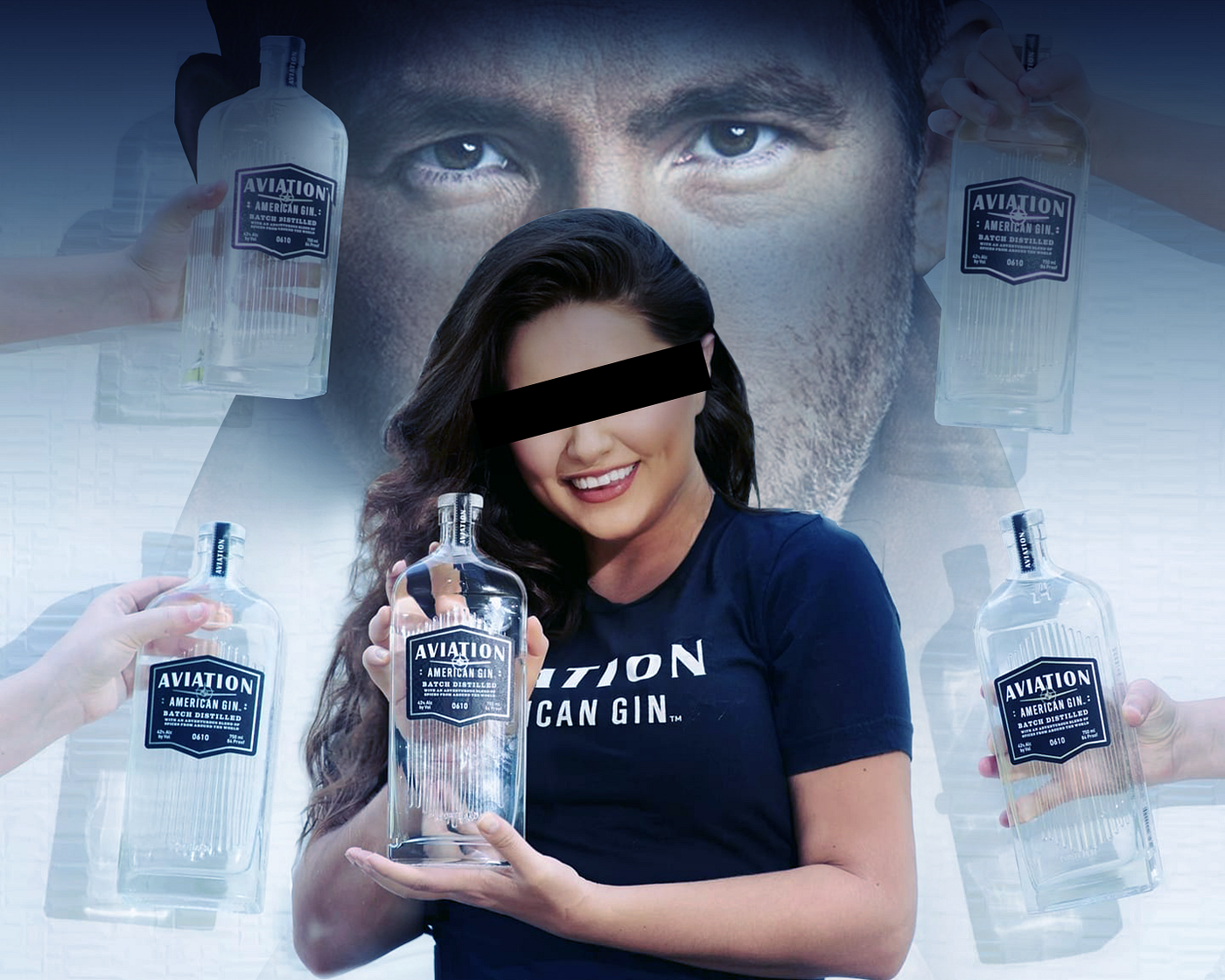
Ryan Reynolds, celebrity co-owner of Aviation Gin, and photographer Marilyn Starkloff (self-portrait of Starkloff with bottles of Aviation Gin by Marilyn Starkloff, October 10, 2020)
For years, Ryan Reynolds has enjoyed the protection of an impenetrable suit of PR armor. Frequently described by legacy media outlets as “funny,” “self-deprecating,” “charming,” “handsome,” and even a “marketing genius,” the Hollywood actor turned celebrity influencer and advertiser has never truly faced meaningful scrutiny. Even when there are grumblings from the public about the incessant auditory onslaught of his Mint Mobile ads — delivered in a slithering, sardonic hiss coming somewhere from within his sinuses that is as grating as it is inescapable — his public image is still overwhelmingly positive.
That all changed when his wife, Blake Lively, published an article in the New York Times accusing director and co-star Justin Baldoni and three other men — Jamey Heath, Steve Sarowitz, and Adam Mondschein — of sexual harassment during the production of the film It Ends with Us. After Baldoni, Heath, and Sarowitz’s production company, Wayfarer, sued NYT for defamation, Lively filed a lawsuit against Baldoni and Wayfarer. Wayfarer countersued for defamation and civil extortion against Lively and Reynolds.
At first, Reynolds managed to evade scrutiny and criticism, as most of it was directed at either his wife or Baldoni. But as the lawsuit stretched on and the discovery process kicked into high gear, Reynolds started playing his hand hard. Too hard. Hard enough for his culpability to no longer be swept under the rug of carefully crafted PR spin in bought-and-paid-for entertainment media outlets.
Three things soon became evident: One, that Lively’s sexual harassment claims were false; two, that they were likely made to conceal Lively and Reynolds’ hostile takeover of the film that resulted in a coerced and unearned PGA credit for Lively; and three, that the true crux of the legal conflict was thanks to the couple’s ego, unable to handle the outpouring of public criticism for their botched promotional tour of the film in August 2024.
But it is Reynolds’ tight-gripped fingerprints that are starting to leave a stronger impression on the case than Lively’s. It was his marketing company, Maximum Effort, that was responsible for the widely panned decision to hawk Lively’s Betty Buzz booze brand during the IEWU promotional tour. As we will later see, this fits with a long and well-established pattern with Reynolds’ other marketing decisions.
Moreover, despite being dismissed from Baldoni’s countersuit in June 2025, Reynolds’ name was included on the subpoenas Lively sent to 107 content creators a month later in July. These subpoenas — which requested highly invasive data and were sent improperly in bulk batches via social media rather than to individuals — were intended to financially burden, harass, and intimidate online commentators from speaking critically about Lively’s lawsuit, Lively, or Reynolds.
Finally, when online sleuths discovered the entity that Lively and Reynolds used to illegally subpoena Justin Baldoni’s publicist’s phone — a delinquent shell company of theirs called Vanzan, Inc — Reynolds updated the company to name himself as CEO, and filed its first biennial statement to resolve its delinquent status. This would put it back into legal standing, allowing it to sue and issue subpoenas.
If Reynolds thought that asserting an obsessive degree of control over the lawsuit would help mask his involvement, it only achieved the opposite. The public had questions, far more than the ones raised in August 2024.
Now, they knew where to start looking.
Looking for Leads, Stumbling on a Surprise Settlement
U.S.-based lawyer and TikTok user NotActuallyGolden (abbreviated to NAG), is one of the many content creators following the Lively v. Wayfarer Studios case and providing commentary on it. She often explains the more complex or obscure legal concepts that lay viewers want to understand, but lack the expertise to do so.
In February of this year, NAG was the first to uncover crucial information about Ryan Reynolds’ legal past — partly by accident. “So, randomly this morning, I’m on PACER, looking up something else, and I decided to check and see if Ryan Reynolds has ever been sued for discrimination,” she begins in her video. (PACER is a government database for federal court records that are available to the public.) “So I did a search on PACER for Ryan Reynolds’ name, and I never got to the discrimination, because I stopped at something else.”
That something else was a little-known lawsuit called Starkloff v. Aviation Gin, LLC. It was initiated by Florida-based photographer, Marilyn Starkloff, against Reynolds and his alcohol company, Aviation American Gin, on November 1, 2024.
“This thing was filed, served, and settled in six days,” NAG continues. “Literally the entire docket is complaint, summons, notice of settlement, closed. Reynolds and Aviation didn’t even have a lawyer appear for them. I think they got the complaint, picked up the phone and called her and said, how much does the check need to be for?”
NAG’s main takeaway from the complaint — aside from the speed with which it was settled — was Starkloff’s claim that Reynolds and Aviation engaged in evidence spoliation, i.e. the destruction of evidence in a lawsuit, or the failure to preserve it.
Since this was in line with the pattern of behavior that was emerging about Lively and Reynolds in their case against Baldoni and Wayfarer — wherein Lively allegedly asked pop superstar and former best friend, Taylor Swift, to delete text messages between them relating to her case against Baldoni — no one thought to delve deeper, even though NAG encouraged people to look if they wanted to. It also probably didn’t help that Starkloff’s complaint is only available on PACER, which charges fees for searches and retrieved documents, and not on CourtListener, which is free and where the majority of the Lively v. Wayfarer Studios court filings are available.
As it turns out, a few payments to PACER are more than worth it to find out how much more there is to the story.
A Recap of Ryan Reynolds’ Rapid Rise to Riches and Relevance
To understand the events in Starkloff’s case, it’s first necessary to establish the context and period in which her interactions with Reynolds and Aviation Gin began.
Reynolds wasn’t always the ever-present power player he is now. In fact, he was a frequent box-office flop. No, it wasn’t only Green Lantern that flopped. Reynolds has several notable flops under his belt; he simply chooses not to draw attention to those. The 2016 Deadpool movie was a massive boon for Reynolds, dragging him out of his unpredictable hit-or-flop pattern and permanently smoothing the trajectory of his career into a steady, sharply upwards line.
For years, Reynolds denied outright responsibility for intentionally leaking the Deadpool footage online to pressure 20th Century Fox to greenlight the project, but finally admitted to the obvious last month. “Yes, I cheated a little, but I think I was onto something that people would be interested in,” he said at the 2025 Toronto International Film Festival. “And I’m like, ‘Dude, what have you done? This could be punishable by law!’ But the internet forced the studio to say, ‘We’re gonna make this movie,’ and 24 hours later, that movie had a green light.”
This pattern of acting first, asking for permission later — particularly with regard to using coercive tactics and skirting the boundaries of the law — is one we see again and again with Reynolds. It’s a pattern that Hollywood and marketers have praised as innovative, daring, and financially lucrative, while ignoring the dark and destructive underbelly of its consequences.
Leaking the footage was only one part of his Deadpool guerilla marketing campaign to pressure both the studio and audiences to support it. Reynolds said the movie got made using “pretty unorthodox methods.” He doesn’t specify what additional methods were used, but whatever they were, they paid off handsomely. The film’s budget was a meager $58 million, yet raked in $782.8 million at the box office. Reynolds purportedly earned a $2 million base salary, with significantly more in undisclosed back-end deals, around $20–22 million.
“I’ve never taken ownership like this before,” Reynolds said in 2016 after the success of the movie. “I can channel this guy [Deadpool] in a way I just can’t seem to channel anything else.”
It’s a taste of ownership that he seems to have grown quite accustomed to.
The director, Tim Miller, who worked closely with Reynolds to bring Deadpool to screen, only made $225k for his director’s salary despite two years of work. He was later forced out of the franchise during the sequel due to Reynolds’ desire for total creative control, in what is indisputably an acrimonious split.
Yet Reynolds boasts that he personally took a pay cut to have his two co-writers, Rhett Reese and Paul Wernick, on set with him so he could form a writer’s room on Deadpool. Rather than the touching story that legacy media wants the public to believe this is, it’s yet another clue towards Reynolds’ intense need for uncontested authority, underhanded and manipulative financial tactics that are presented as altruism, and a penchant for inserting himself into roles, resources, and opportunities that aren’t his.
Regardless of ethics or legality, the creative heist worked. The Deadpool franchise was his.
If Deadpool transformed Reynolds from a middling actor with a flip-of-a-coin success rate to a bona fide comic-book antihero superstar, his company, Maximum Effort, transformed him from yet another run-of-the-mill celebrity influencer to advertising heavyweight in the marketing world.
Founded in 2018 with co-founder Geroge Dewey, the sole purpose of Maximum Effort was to promote *Deadpool. But its purpose expanded quickly. “Me and George Dewey, my cofounder at Maximum Effort, started marketing with the [Deadpool] suit and having fun with it without giving away pieces of the film, and it turned out to be really successful,” Reynolds said. “I then used some of that sweet Deadpool *money to buy Aviation Gin and I needed to market that, so we inadvertently became a marketing company.”
This finally brings us back to the company at the center of Starkloff’s lawsuit: Aviation American Gin.
Although the ubiquitousness of Reynolds’ face on Aviation Gin ads over the years has led the public to generally believe he either founded Aviation himself, or purchased the company outright, neither belief is true.
The brand was founded in 2006, in a collaboration between bartender Ryan Magarian and Christian Krogstad, co-founder of Portland-based House Spirits Distillery. The brand was first acquired by the spirits conglomerate Davos Brands in 2016. Reynolds expressed interest in the brand that same year, and formally got involved two years later, when he purchased an ownership stake in February 2018.
His official backstory for acquiring the company — while hard to believe as factual given his propensity for pursuing marketability over candor in his PR narratives — is at least consistent: that during the filming of Deadpool, he visited local Vancouver bars after shooting wrapped each day, and kept coming back to a certain gin-based cocktail that contained the brand.
The name of that cocktail? Well, for a man who got married on a slave plantation next to slave cabins on Slave Street, named one of his shell companies after said plantation, and who secretly helped his wife write for her antebellum-themed lifestyle company, Preserve, Ryan Reynolds managed to select the most linguistically unfortunate drink as the reason for his interest in Aviation Gin: the Negroni.
Named after Count Negroni of either Italy or France (the origin is contested), Reynolds credits the gin cocktail as the hook that spurred his desire to get involved with Aviation Gin. “About a year ago, I tried Aviation for the first time. Since that day, I’ve spent my time finding some way to infiltrate the company,” said Reynolds. He became a “significant owner,” although we’ll never know how significant, as his representative declined to disclose the sale price or Reynolds’ percentage of ownership.
Either way, what might be more important is that Reynolds also became a creative director for Aviation Gin. When he came onboard, the company had already spent a decade selling and managing the brand. As such, Reynolds didn’t wipe the slate clean, but instead seems to have inherited some of the staff who already had expertise in marketing Aviation. This included Senior Brand Manager, Adrian Molina.
Molina is a prominent figure in Starkloff’s lawsuit, and we will soon see why.
The Deep Dive Begins: Starkloff v. Aviation Gin, LLC
The following information is compiled from Starkloff’s complaint available on PACER, publicly available information on Facebook, Instagram, and X, formerly known as Twitter (which will be referred to as such due to the timing of events), and relevant interviews and media coverage that relates to the individuals involved in the lawsuit. Together, these three areas of sources paint a vivid picture that provides insight into Reynolds and Aviation Gin’s speedy settlement that would otherwise remain mysterious and inchoate to the public.
Marilyn Starkloff’s story with Aviation Gin begins in December 2018, ten months after Reynolds acquired ownership in the company.
At the time, Starkloff was not a professional photographer, but a hobbyist in her twenties who liked taking photos for her own enjoyment. On December 20, she uploaded a photo from her Christmas-themed photoshoot where she staged a bottle of Aviation Gin next to a cocktail glass with a candy cane in it. According to Starkloff, the official Aviation Gin Instagram reposted her photo the next day. They credited her in the caption, but didn’t ask permission to post it on their page.
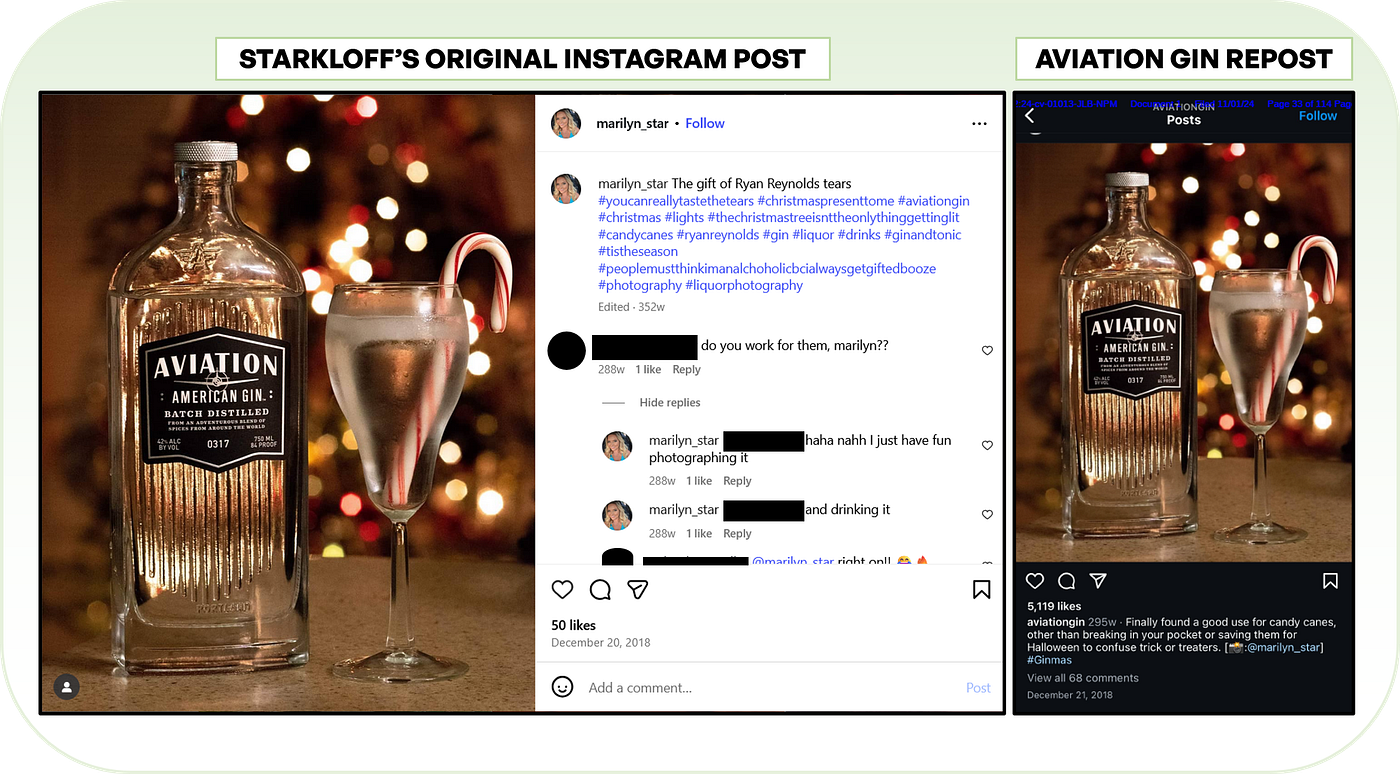
The official Aviation Gin Instagram account reposted Starkloff’s Christmas-themed photo of Aviation Gin with a candy cane without asking her for permission
To non-artists, this may not seem like a problem, but it’s actually a significant one. Prior to Elon Musk renaming Twitter’s “retweet” function, a “repost” was well understood to mean a kind of social media theft that involves lifting content from a person’s post and uploading it in a separate post, typically without proper attribution to the original poster.
Even with proper credit, the act of reposting — rather than sharing the original post — denies visibility, engagement, and potential income to the original poster by directing it all to the reposter instead. This is particularly harmful to small, independent artists, who rely on heavily on social media engagement to build an audience and pay their bills.
To underscore this harm, Aviation Gin’s repost got 5,119 likes, whereas Starkloff’s original post only got 50 likes. Worse, Aviation’s caption, which read in part, “finally found a good use for candy canes,” implied that the photo was Aviation’s idea.
While Starkloff states in her lawsuit that this was the start of a pattern of Aviation Gin harming her by taking her work and using it for free, at the time, she instead chose to focus on the positive aspect: that she got the brand’s attention.
For better or worse, this is a common reaction for up-and-coming artists. This was especially true during the golden age of Twitter and other social media platforms, where there was a prevailing belief that getting noticed by celebrities or large corporations would lead to much bigger opportunities down the line, even if they flat-out stole content from you first. The rags-to-riches mythos of artists like Lil Nas X only helped endorse a modern-day social media fairytale: make a splash online first, worry about money later.
Starkloff next took a New Year’s-themed Aviation Gin photo about a week later, with a festive hat, bottle of Aviation Gin, and a lit sparkler leaning inside of a martini glass. This time, Aviation Gin’s Senior Brand Manager, Adrian Molina, reached out to her via the official Aviation Gin Instagram account and asked for permission to repost it. Starkloff agreed.
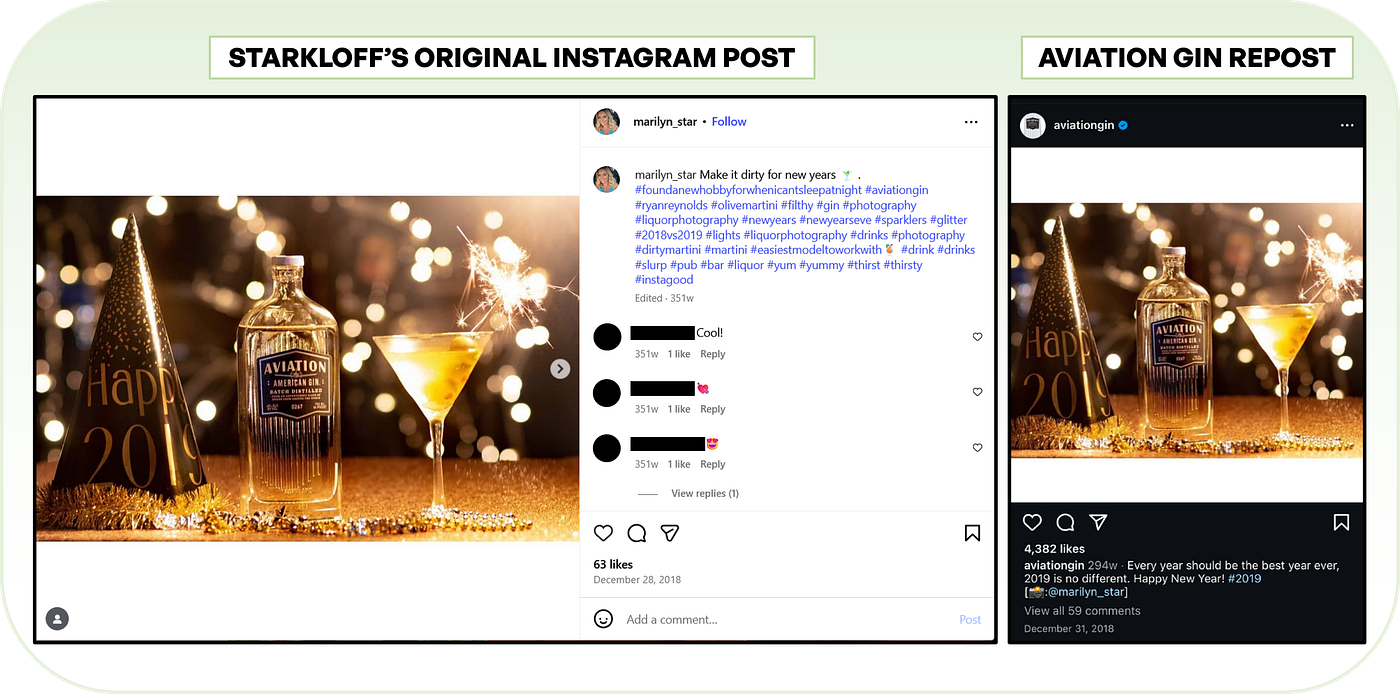
Aviation Gin’s Senior Brand Manager, Adrian Molina, reached out to Starkloff and asked for permission before reposting her New Year’s-themed Aviation Gin photo
Interestingly, in his recounting of these two events, Molina combines them into one. In a 2020 podcast interview, he confirms that Aviation Gin’s first interaction with Starkloff was when she uploaded the candy cane photo. However, in his version of events, he says he asked for permission to share it.
As we will see, interviews like this will be crucial in understanding Aviation Gin’s view on Starkloff, the value of her work, and the nature of the relationship they wanted from her. The insights Molina inadvertently share in them dovetail with the details included in Starkloff’s legal complaint, which features numerous written conversations between Molina and her over the years.
It’s immediately obvious in reading the messages that Aviation Gin knew they had hit the jackpot with Starkloff. She was eager, incredibly talented, responsive and timely, and staunchly loyal to the brand. Perhaps most important to Aviation Gin, however, was her business experience as a freelance photographer:
She was palpably naïve.
A Starry-Eyed Photographer in a Sea of Sharks
A few weeks after the New Year’s photo repost, Molina reached out to Starkloff again. Between January 15 and 19, 2019, Molina messaged Starkloff to praise her work, offer her bottles of Aviation Gin, and even stated that he “would love to give you a bigger platform on AAG.” (AAG meaning Aviation American Gin.)
A month later, on February 15, Molina told her that he would “dig in the calendar and get you on some paid projects; you have a talent for sure.” He also offered to help with her portfolio and act as a reference.
“It just makes me excited enough being featured,” Starkloff exclaims in one message. “I’m just trying to learn. And I never realized how fun product photography would be. So used to people!”
Here, we see that whatever misgivings Starkloff may have had about having her work reposted, it was superseded by her excitement at being recognized by the brand she cared so much about — especially because Molina had explicitly dangled the possibility of paid work in the future.
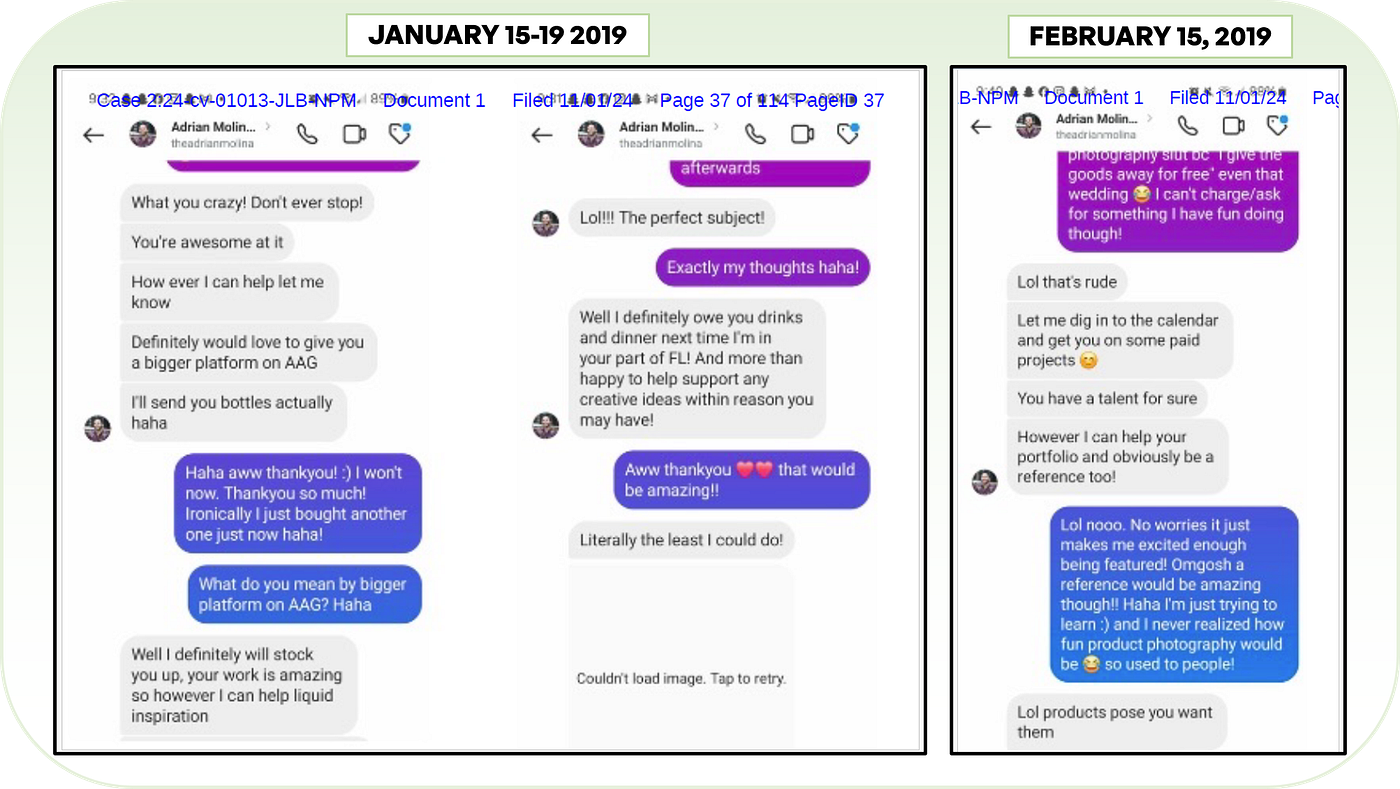
Molina praises Starkloff and tells her he will get her on paid projects
Molina’s next request from Starkloff was indeed a gig. But according to her, it wasn’t a paid one at all.
Starting on March 1, Molina made several requests for Starkloff to do photoshoots for Aviation Gin merchandise, specifically apparel. At the time of his first request, Molina stated that he didn’t yet know what kind of content he wanted in the shoot. A month later in April, Molina told Starkloff he knew that she bought a bomber jacket. It’s unclear how he knows this — whether through monitoring her social media, or through monitoring her purchases through the official website. Either way, this could be what gave Molina the idea to focus on this article of clothing in the upcoming shoot.
Meanwhile, Starkloff seems apologetic in telling him that organizing a photoshoot with models is much harder than she anticipated due to scheduling conflicts. It’s an observation that a veteran photographer would already know, and why they would never agree to such a photoshoot without pay. But Starkloff didn’t have that business experience. Molina was insistent, repeating the request not once, but twice. Starkloff finally completed the shoot in September and delivered the desired photos — for free.
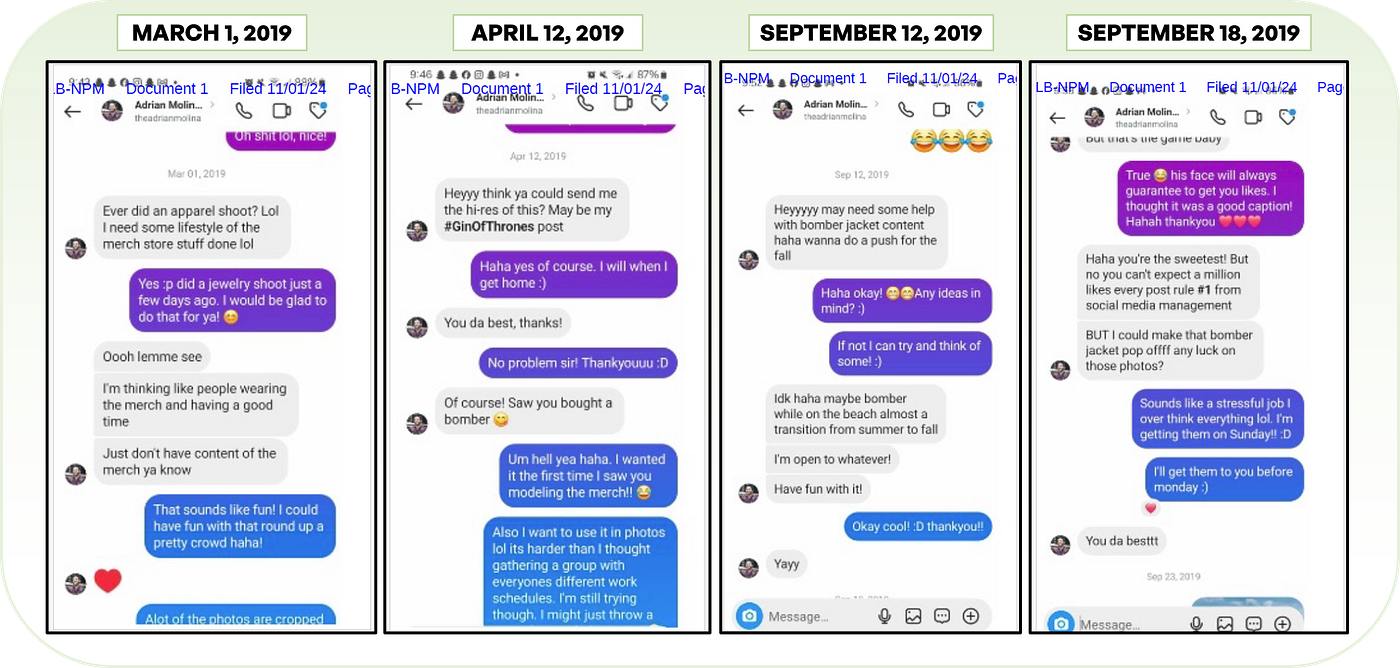
Molina repeatedly makes requests to Starkloff to perform a photoshoot involving models and Aviation Gin apparel
While Starkloff’s complaint doesn’t explicitly address it, the caption on Aviation Gin’s Instagram post is telling. “The Aviation Gin Social Media team were supposed to shoot ‘Fall cocktails’ for the #firstdayofautumn but it turned into a ‘Fall fashion shoot’,” it says.
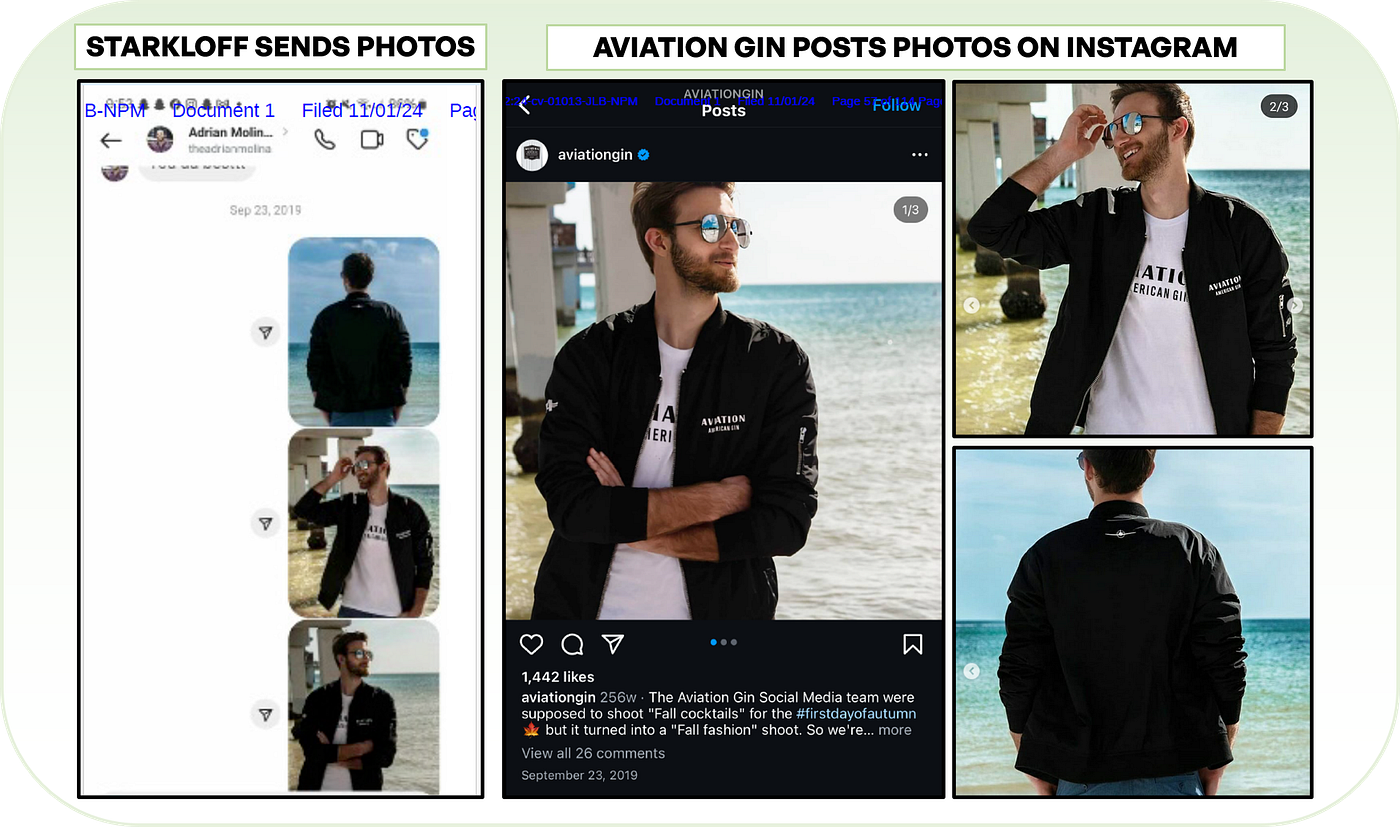
Starkloff sends the photos she took of a model showcasing an Aviation Gin bomber jacket, and Molina refers to “the Aviation Gin Social Media team” when he uploads the photos to the official Instagram account
This in line with Starkloff’s allegations that Aviation Gin repeatedly led her to believe that they would one day compensate or hire her. Any reasonable person reading that caption would believe that Starkloff was already part of Aviation Gin’s social media team based on those words.
According to her lawsuit, she wasn’t.
Molina’s requests for more apparel photoshoots — also unpaid — continued.
In February, Molina asked for a Valentine’s Day-themed ring proposal photo with a mini bottle of Aviation Gin. Starkloff obliged, allegedly purchasing a ring case and completing the shoot the same day.
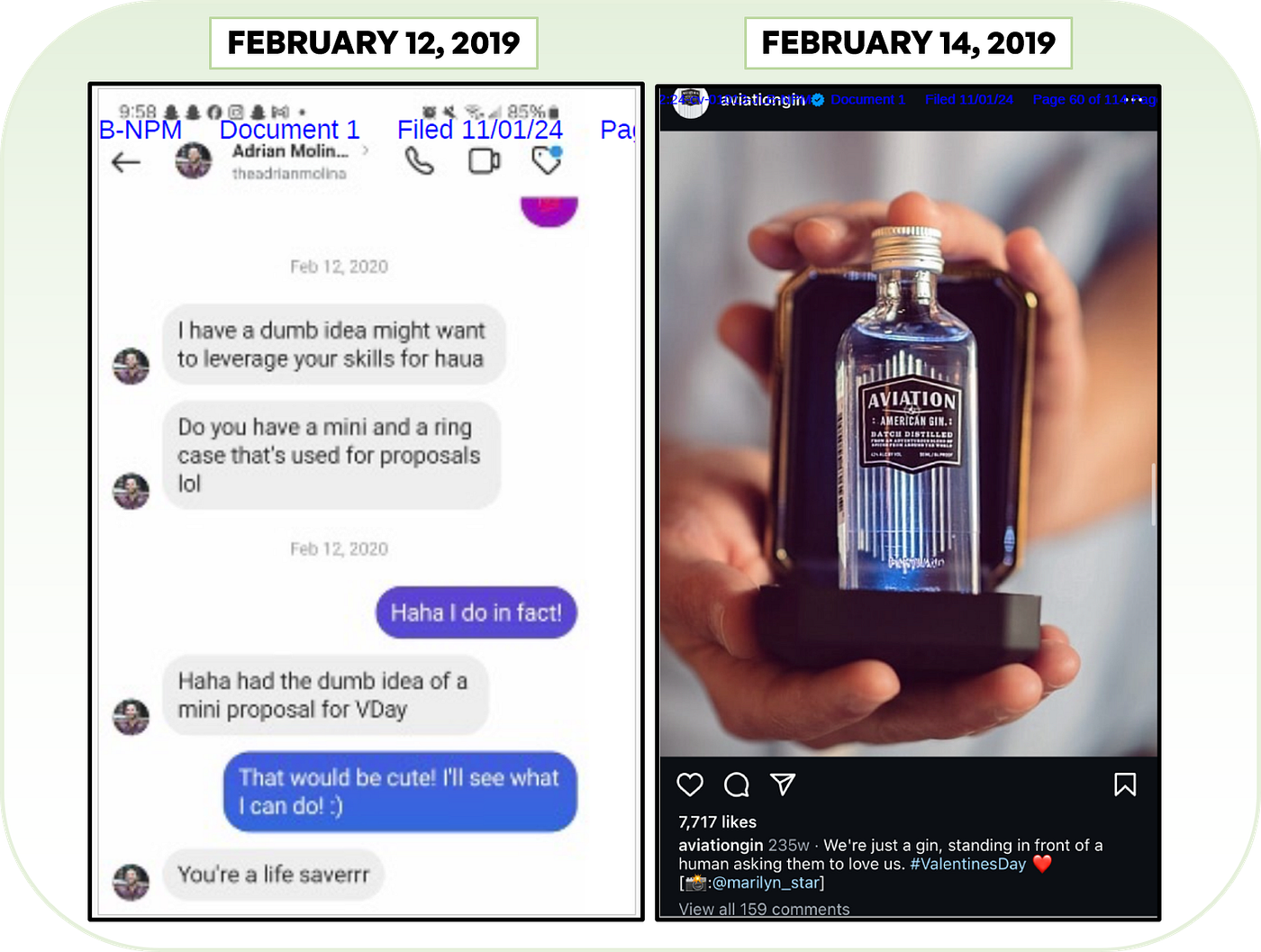
Molina requests a photoshoot involving a wedding ring proposal with a mini bottle of Aviation Gin and Starkloff delivers the photo within a day, which Molina uploads on Valentine’s Day
Molina then asked for a photoshoot with Aviation Gin socks.
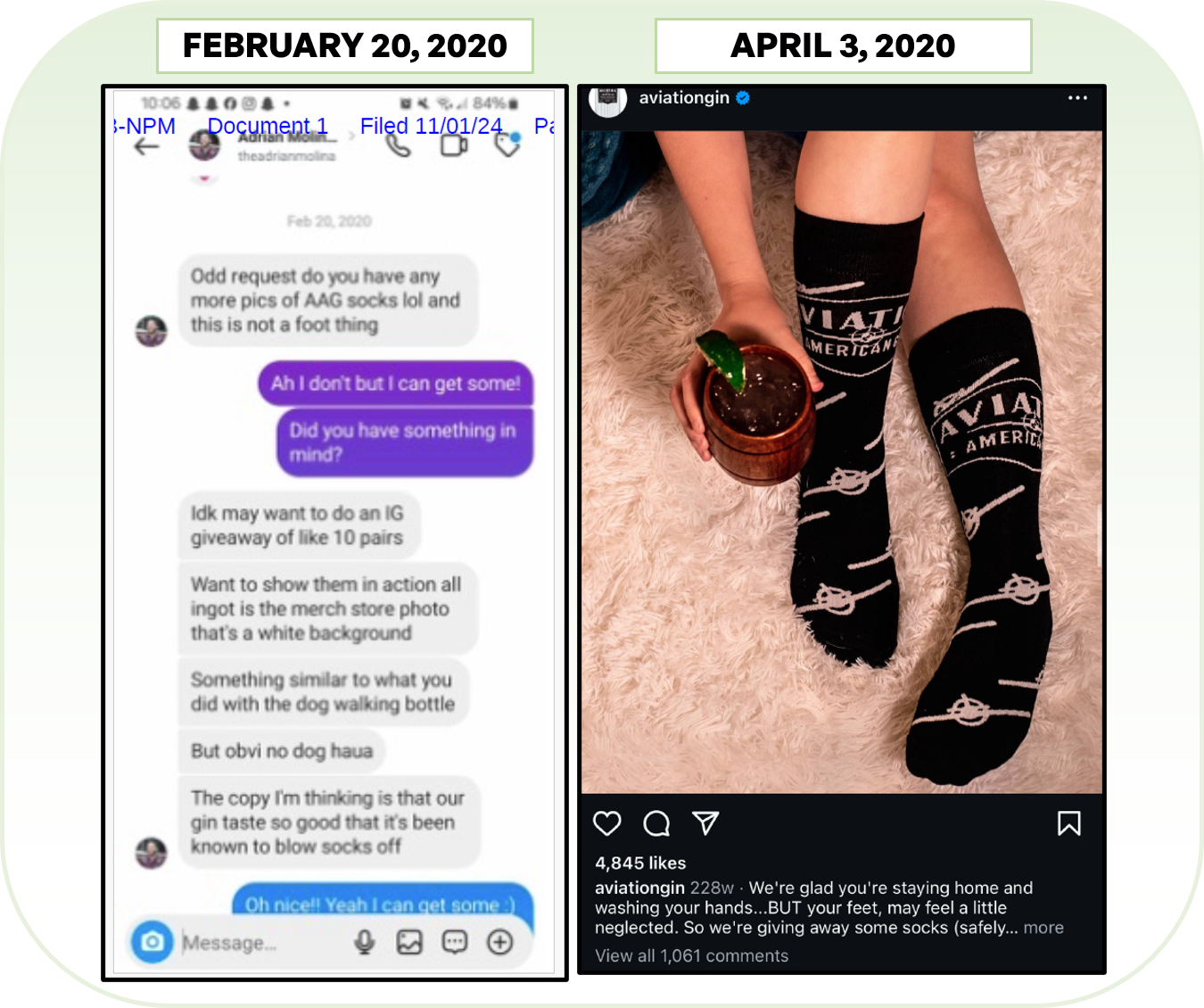
Molina requests a photoshoot involving Aviation Gin socks, and Starkloff completes the shoot a month and a half later
Molina’s repeated requests for photoshoots were not the only work that Starkloff performed. In fact, most of the work she did for Aviation Gin was self-initiated, spurred by the joy for her craft and desire to get their attention.
In 2019 alone, she performed nearly 30 photoshoots, each separate and distinct. Her work not only showcased bottles of Aviation Gin itself, but branded merchandise as well. Spanning the entire calendar year, her photos marked every Western holiday and changing of the seasons: New Year’s, Valentine’s Day, first day of spring, St. Patrick’s Day, Easter, summer vacation, Halloween, Thanksgiving, Christmas. She did both product and model photography.
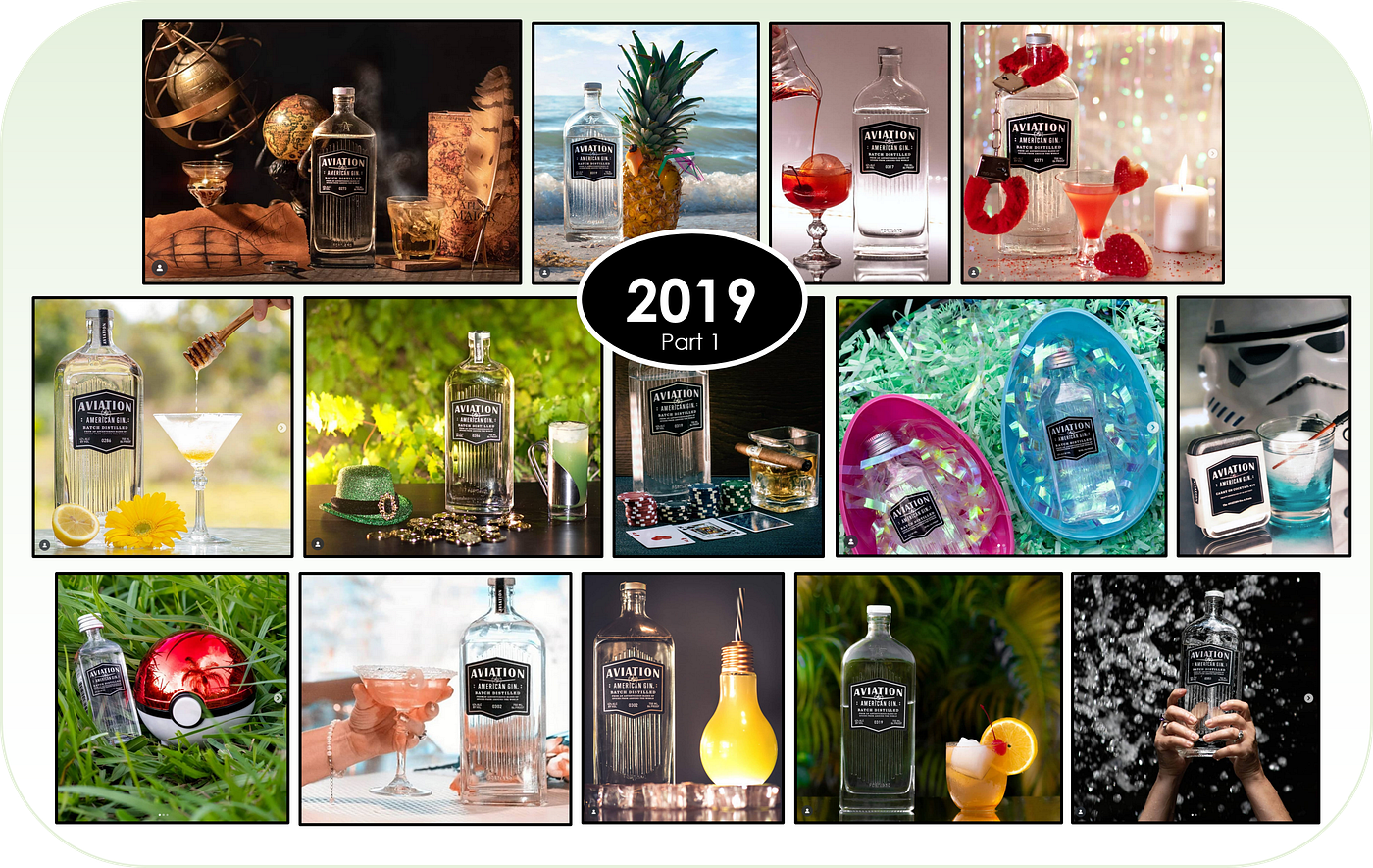
A compilation of the first half of Starkloff’s photography work during 2019 to promote Aviation Gin
She even took photos that were relevant to Ryan Reynolds’ current Hollywood projects to help promote those films and Reynolds as an actor, such as staging a Poké Ball next to a bottle of Aviation Gin during the promotion of Detective Pikachu in November 2019.
Many of these photos were reposted on Aviation Gin’s official social media pages, where they enjoyed thousands more likes than what Starkloff received on her own pages.
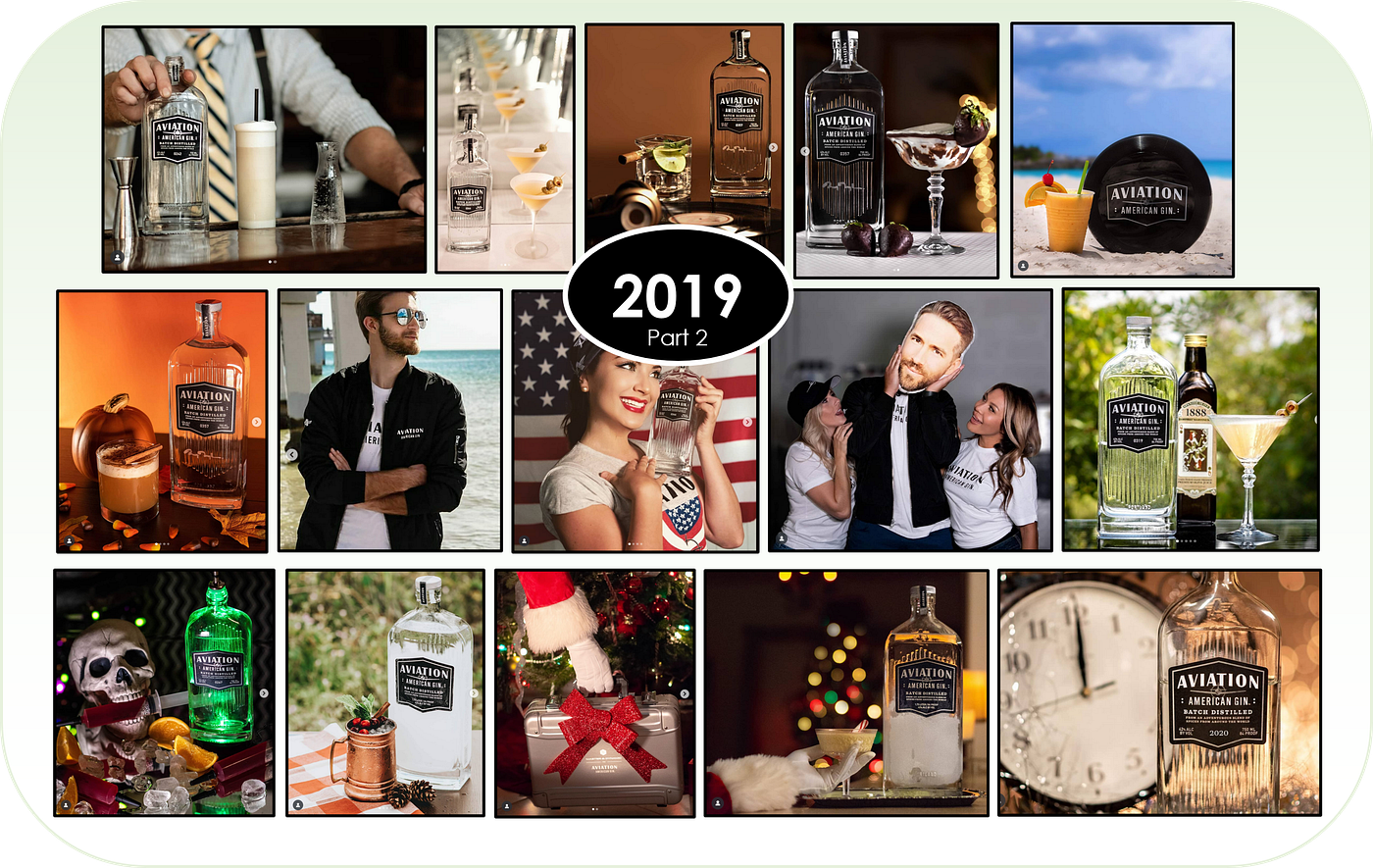
A compilation of the second half of Starkloff’s photography work during 2019 to promote Aviation Gin
Starkloff’s talent is strikingly apparent. While her experience as a small business entrepreneur is probably best described as amateur, her photography work is nothing of the sort. Her portfolio is bursting with an impressive diversity of shots that demonstrate a masterful understanding of composition, lighting, color, and focus.
Even better for Aviation Gin, there is a deep, intimate familiarity with the brand and its needs. Although not shown here, Starkloff often included witty captions with her photos, capturing the same style of playful, sarcastic wit that Reynolds prides himself on. She understood Aviation Gin’s brand — along with Ryan Reynolds’ personal brand — inside and out.
These compilations don’t cover the full breadth of her work for Aviation Gin, either. To begin with, not all her final proof photos are shown here, just the main ones per shoot that she posted. Some photos, which were only shared on Aviation Gin’s official page and have since been deleted, survived only if Starkloff took a screenshot of their post. In addition to her formal and polished work, Starkloff also posted memes, selfies, and casual photos that she took with family and friends, many of which either reference Aviation Gin or featured Aviation Gin merchandise, such as t-shirts and headgear. The brand inspired her in many areas of life.
Reynolds, Molina, and Aviation Gin were undoubtedly aware of her worth, and how effectively she was augmenting theirs.
Starkloff was aware of neither.
The Big Break: Not for Starkloff, but for Reynolds
On December 3, 2019, an ad for Peloton exercise bikes aired on televisions and drew immense backlash. It shows a husband gifting his wife a Peloton bike for Christmas, who then documents her exercise journey on video over time with a terror-stricken smile, as if forced into it.
Even though the ad had been uploaded online the previous month, it didn’t attract mainstream attention until it was plastered across television sets for a holiday promotion. The criticism was sharp, immediate, and nearly unanimous: the ad was sexist. The flames of consumer fury dominated headlines, and resulted in Peloton’s stock dropping 10%.
Reynolds lunged at the opportunity to insert himself. Within four days, he and his company, Maximum Effort, booked the “Peloton Wife” from the original ad, Monica Ruiz, and used her to pump out a piggyback ad on December 6. The ad carefully avoids mentioning what transpired in the original Peloton ad, and instead focuses on Ruiz needing alcohol and support from female friends for reasons that are deliberately up to interpretation.
Widely called “the Peloton ad” in mainstream publications, the nickname for Reynolds’ ad is a misnomer, which obscures the fact that it’s an Aviation Gin ad. There is no mention or visual inclusion of Peloton anywhere. The ad relies on recency bias, and the viewer’s recognition of Monica Ruiz as she returns to the screen — not on Peloton.
While piggybacking off another company’s advertising misfires — appropriately called ambush marketing — is a tried-and-true marketing method that Reynolds did not invent, he was showered in accolades nonetheless. This was most likely because, as a celebrity influencer, it was the first time he made a move in the advertising world that went beyond mere influencing. After all, the Aviation Gin ad was a full commercial spot — scripted, cast, filmed, and blasted across major television networks like the ad that preceded it — within a handful of days. It helped double sales for Aviation Gin.
It was the crown jewel in Reynolds’ new venture as an advertiser. He was on top of the world. And things were only going to get better for him.
Shaken, Not Stirred: The Quarantini
The year is 2020. It’s the beginning of the SARS-CoV-2 pandemic that, despite people’s willful denial and insistence to the contrary, continues to disable and kill to this day. At the time, however, it was new and impossible to handwave away as inconsequential, with lockdowns and quarantine forcing even the worst of deniers to have to take to it seriously.
Starkloff snaps one of her more casual shots, staging an orange-filled martini glass, a mini bottle of Aviation Gin, and a packet of cold medicine brand, Emergen-C. She captions it, “Made myself a quarantini.” She uploads it to Facebook, Twitter, and Instagram on March 12, 2020.
In a moment that no one could have predicted, it went massively viral — on all three platforms.
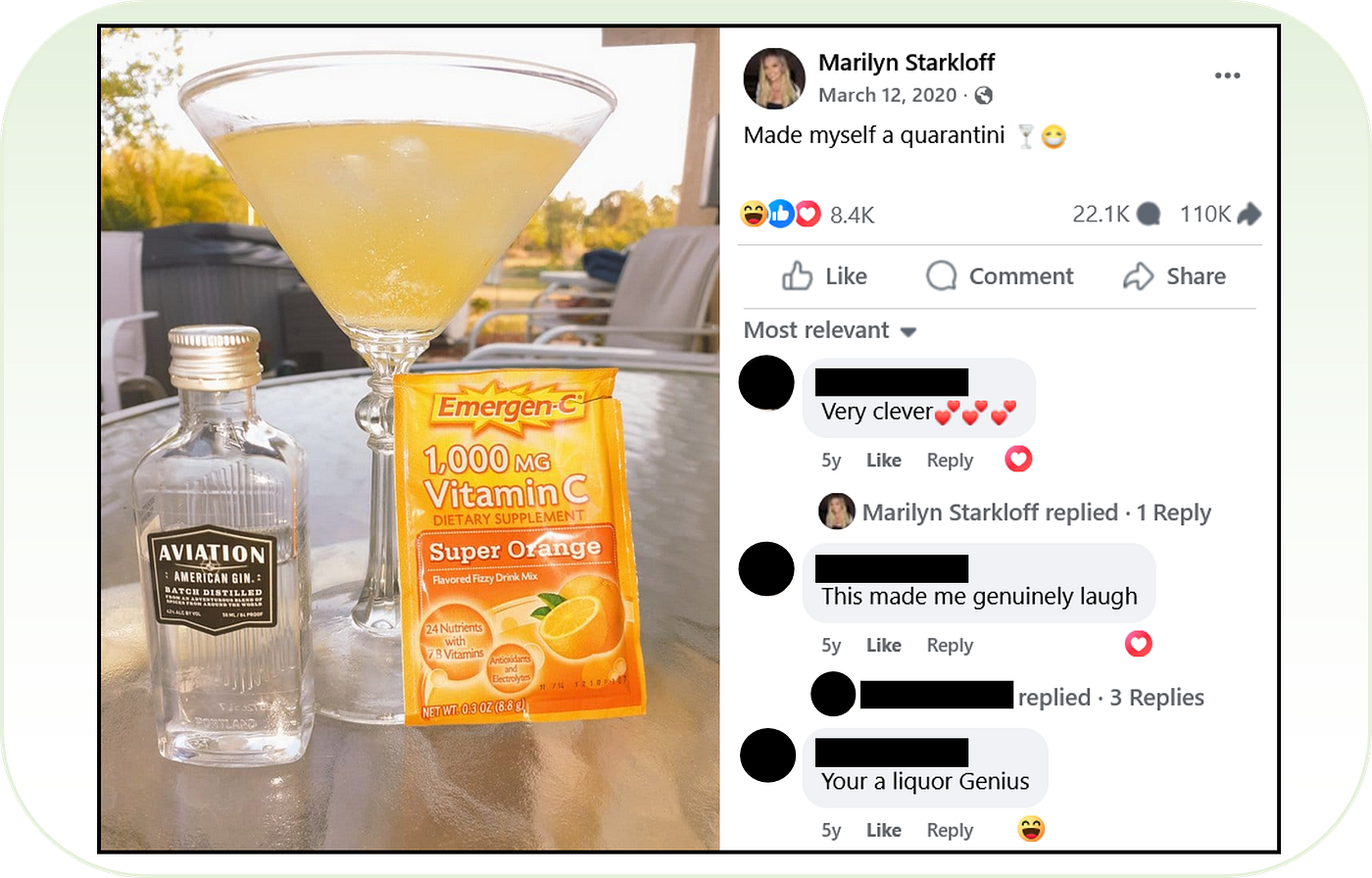
The right kind of viral: Starkloff’s creative “quarantini” combo of Aviation Gin and an orange-flavored Emergen-C packet rapidly spreads across the internet on several major social media platforms
The post was shared over 110,000 times on Facebook alone. The official Emergen-C social media account weighed in. So did Aviation Gin. So did Ryan Reynolds. In fact, he updated his “out-of-office” email auto-reply to refer to Starkloff’s post.
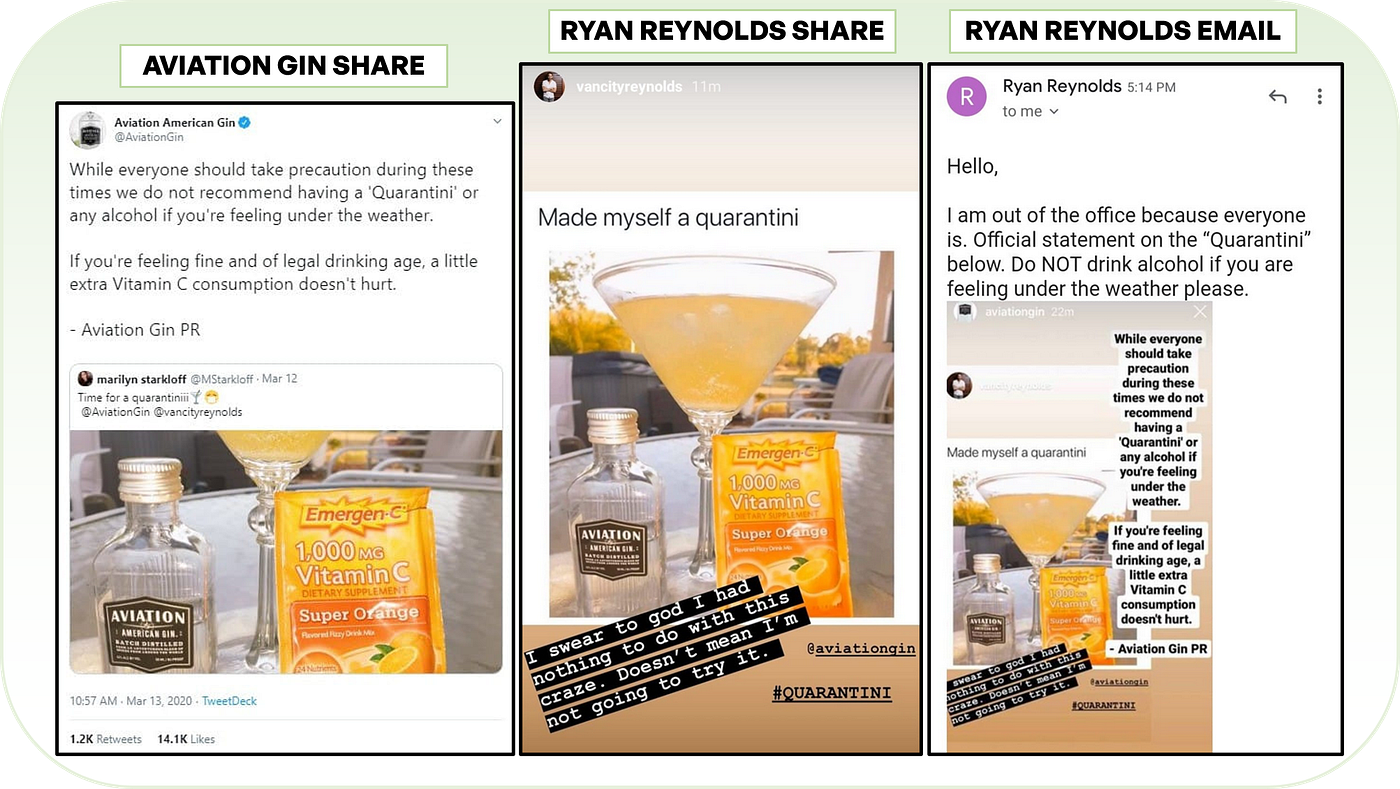
Starkloff’s quarantini post was not only shared by the official accounts for Aviation Gin and Ryan Reynolds, but was also featured in Ryan Reynolds “out-of-office” email at Aviation Gin
Starkloff’s post did far more than go viral online; it transcended social media. The word “quarantini” was immediately adopted into mainstream vernacular, as if it’d been there all along. The concept was so popular that it inspired recipes and multiple cookbooks using the name, the filing of trademarks revolving specifically around beverages and flavored health powders, and — in a stroke of incredible luck and fortune for Reynolds — encouraged bars and restaurants to stock Aviation Gin to sell the unique cocktail.
(Fortunately for Starkloff and unfortunately for Reynolds, Starkloff kept a record of these moments. She simply wanted to share these events on her Facebook page in real-time to celebrate the moment, but likely had no idea that it would serve as legal evidence later.)
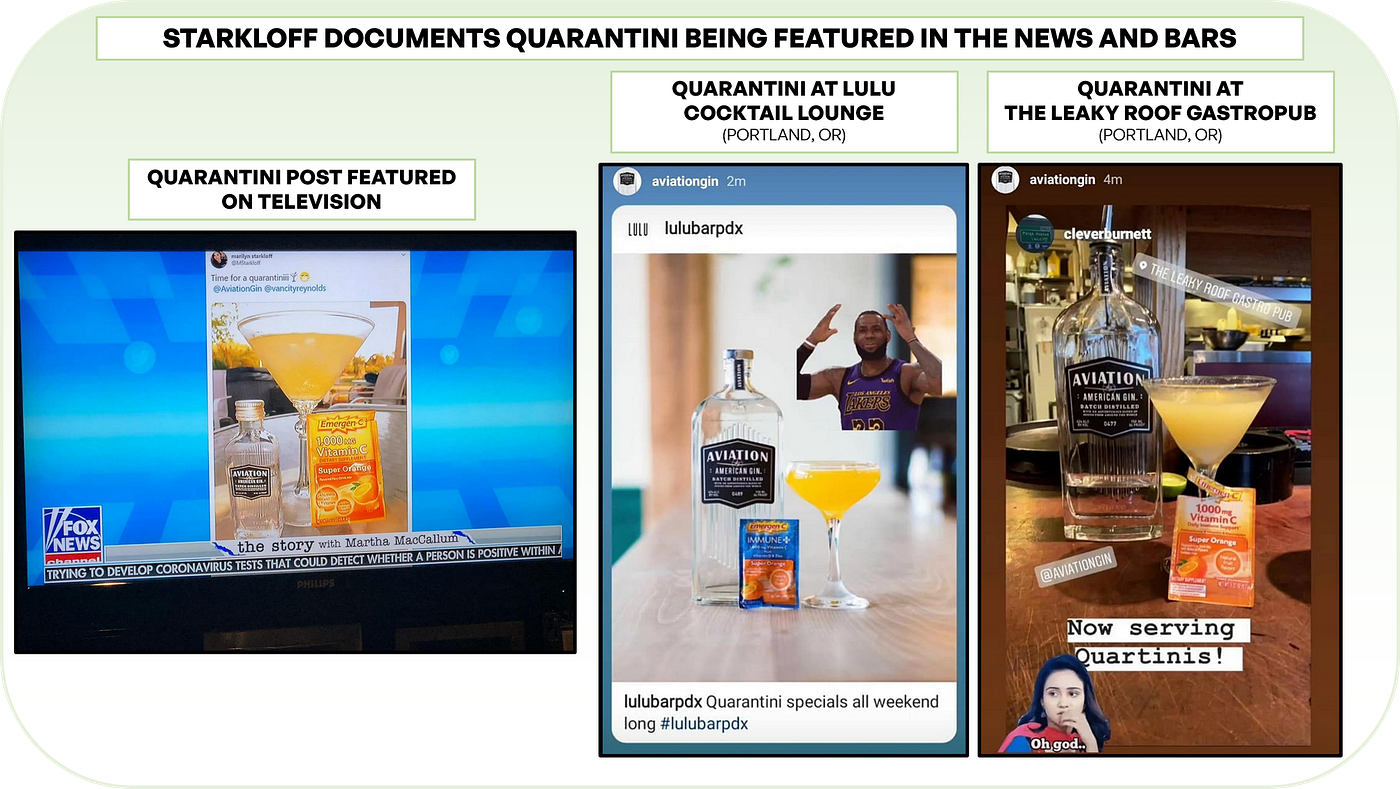
Starkloff documented her viral quarantini post being featured in the news and when her cocktail invention was sold in bars
In all of the hype and excitement, not everyone gave credit to Starkloff. In fact, the recipe mentioned above from Jessica Segarra a.k.a. The Novice Chef, goes out of its way to pretend that Segarra invented it. Not only does she call it “The Original Quarantini Drink,” but she dedicates several paragraphs to suggesting that she came up with the term.
“The initial thought behind a Quarantini,” Segarra writes, “was that it’s a martini that you drink alone in your house when under lockdown. Then my husband and I joked about adding toilet paper (which is worth more than gold in our current economy) and emergency Vitamin C packs. Next thing I know, it’s taken the internet by storm and the famous Quarantini was born and now has a huge following on the #Quarantini hashtag on instagram.”
While some articles correctly linked the term back to Starkloff and viral sensation it created, others credited Segarra instead of Starkloff, ironically respecting the idea that Segarra might have a recipe copyright. Many others followed Segarra’s footsteps and falsely claimed credit for themselves. Most didn’t mention the origin at all, and simply threw around the word like well-worn slang. The viral moment was a free-for-all for opportunists, grifters, and thieves looking to capitalize on it.
Unfortunately for Starkloff, that’s not where the erasure and theft would end.
Reynolds, already on a high from his Aviation Gin commercial with Monica Ruiz three months earlier, was ready to take advantage of the moment and leverage it to the max. He appeared on the The Late Show with Colbert Show on April 2, a mere weeks after Starkloff’s viral posts. The interview, which is barely an interview, but more of a well-disguised Aviation Gin advertisement made to look like an interview, was punctuated by several premeditated interruptions of Colbert pulling out a bottle of the clear liquor and making himself a cocktail in-between questions about — you guessed it — Reynolds owning and managing the brand.
“That’s the quarantini you’ve made there, I see,” says Reynolds in their planned bit.
The YouTube comments lauded Reynolds for his cleverness. It wasn’t until a week later that Reynolds corrected the record, after a fan tweeted at him about the interview. “The Quarantini, a beautiful cocktail idea from @VancityReynolds (Ryan Reynolds) and @colberlateshow (Stephen Colbert),” the tweet reads.
“I wish I could take credit for the ‘quarantini,’” says Reynolds. “That credit goes to @MStarkloff (Marilyn Starkloff).” Aviation Gin’s official twitter page, run by Molina, agrees with “Facts, @MStarkloff is the ‘Quarantini Queen.’”
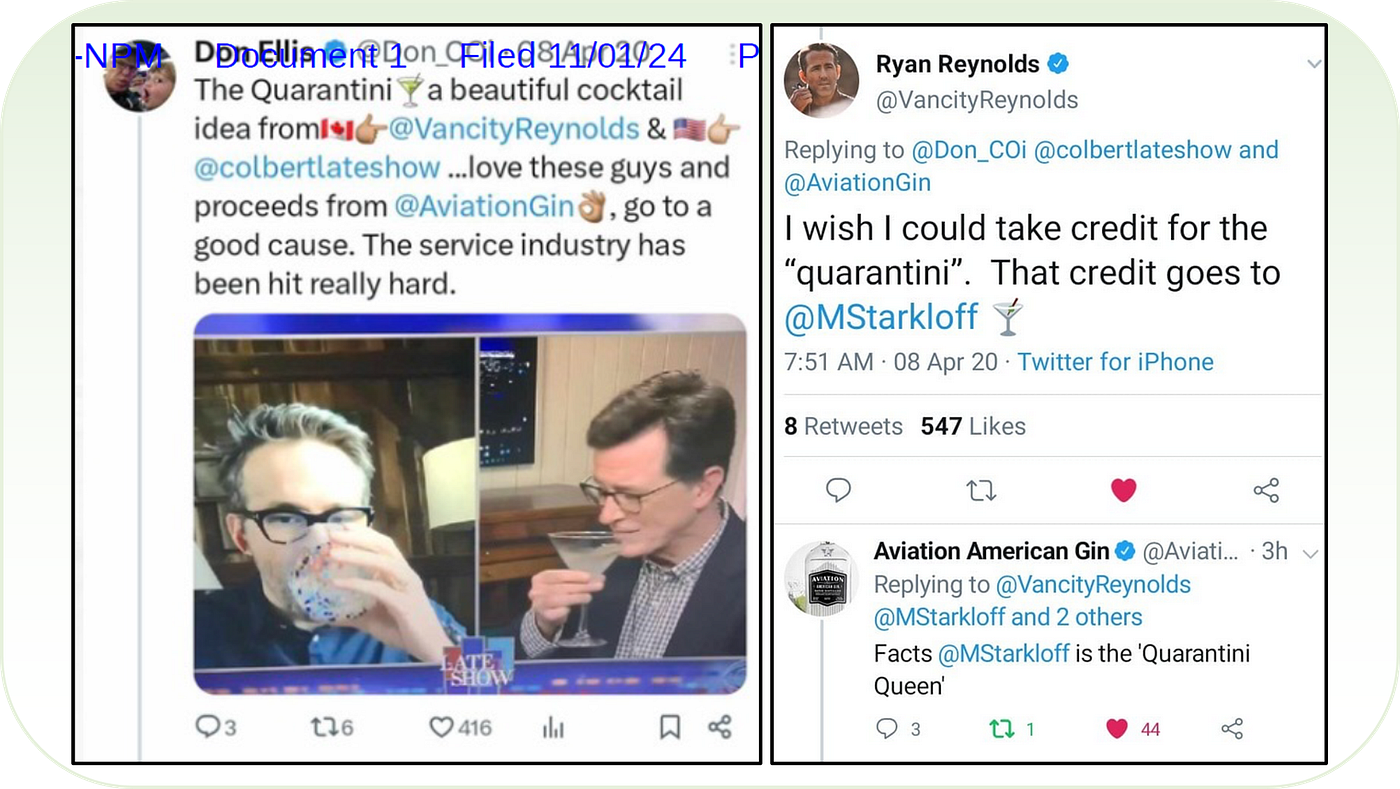
Ryan Reynolds misleads viewers of The Late Show with Colbert into thinking Reynolds invented the word “quarantini,” and only corrects the record later when a fan tweets about it
But it’s a little too late. Reynolds’ after-the-fact correction, given only when a fan credited him in writing, is buried in a Twitter reply that only got a couple hundred likes. In contrast, Colbert’s television viewership at the time was around 3.3 to 3.6 million viewers per week. The YouTube upload of Reynolds’ interview has 2.6 million views.
For Reynolds, paying a proverbial penny’s worth of lip service in a barely-there Twitter reply is nothing to compared to what he gained in taking ownership of the term on the grand stage of legacy media. Another convenient outcome of his act first, ask for permission later policy.
Meanwhile, Starkloff never stopped taking photos on her own throughout 2020. She pumped out another impressive year of beautiful and diverse shots, promoting Aviation Gin without employment or pay.
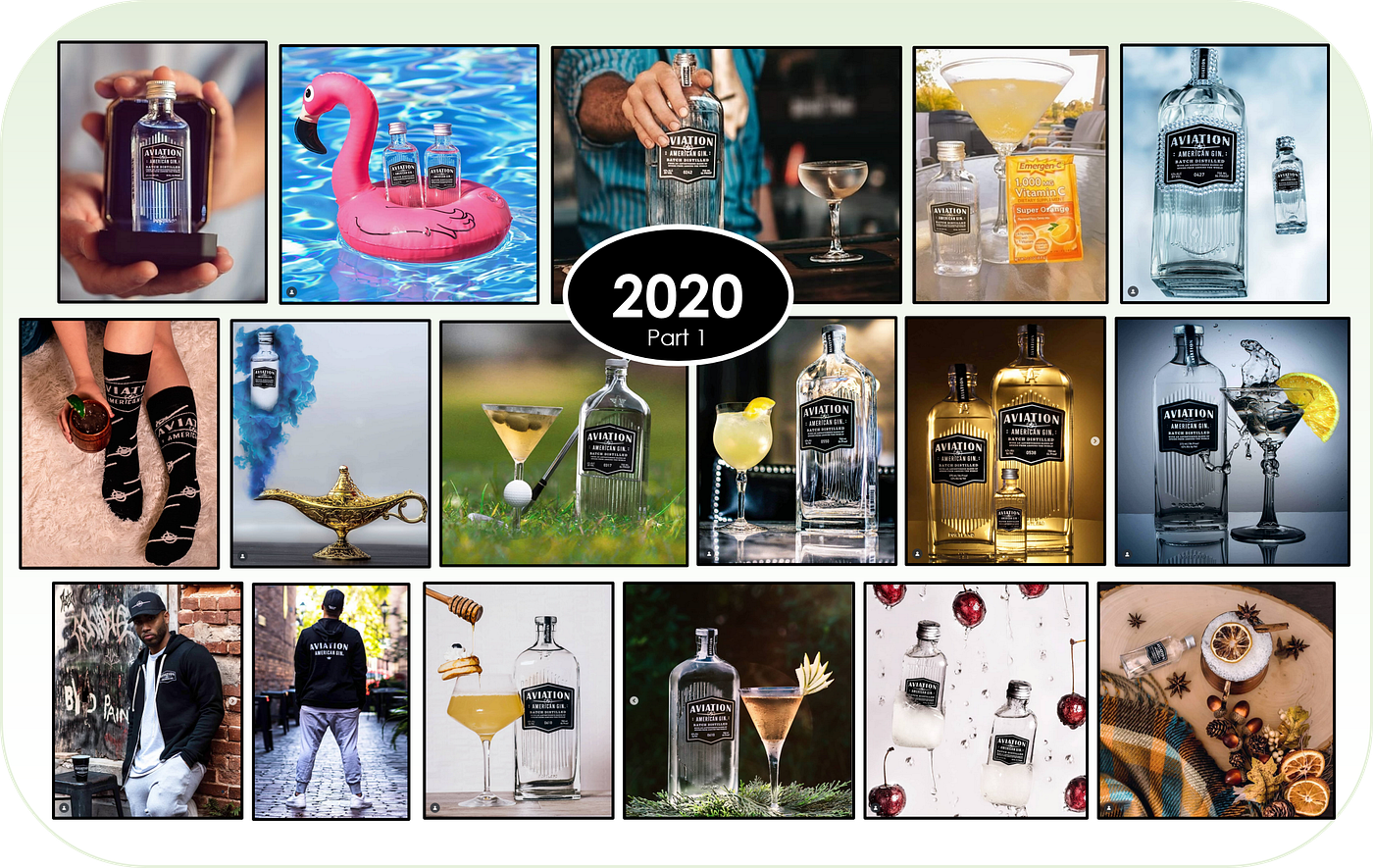
A compilation of the first half of Starkloff’s photography work during 2020 to promote Aviation Ginn
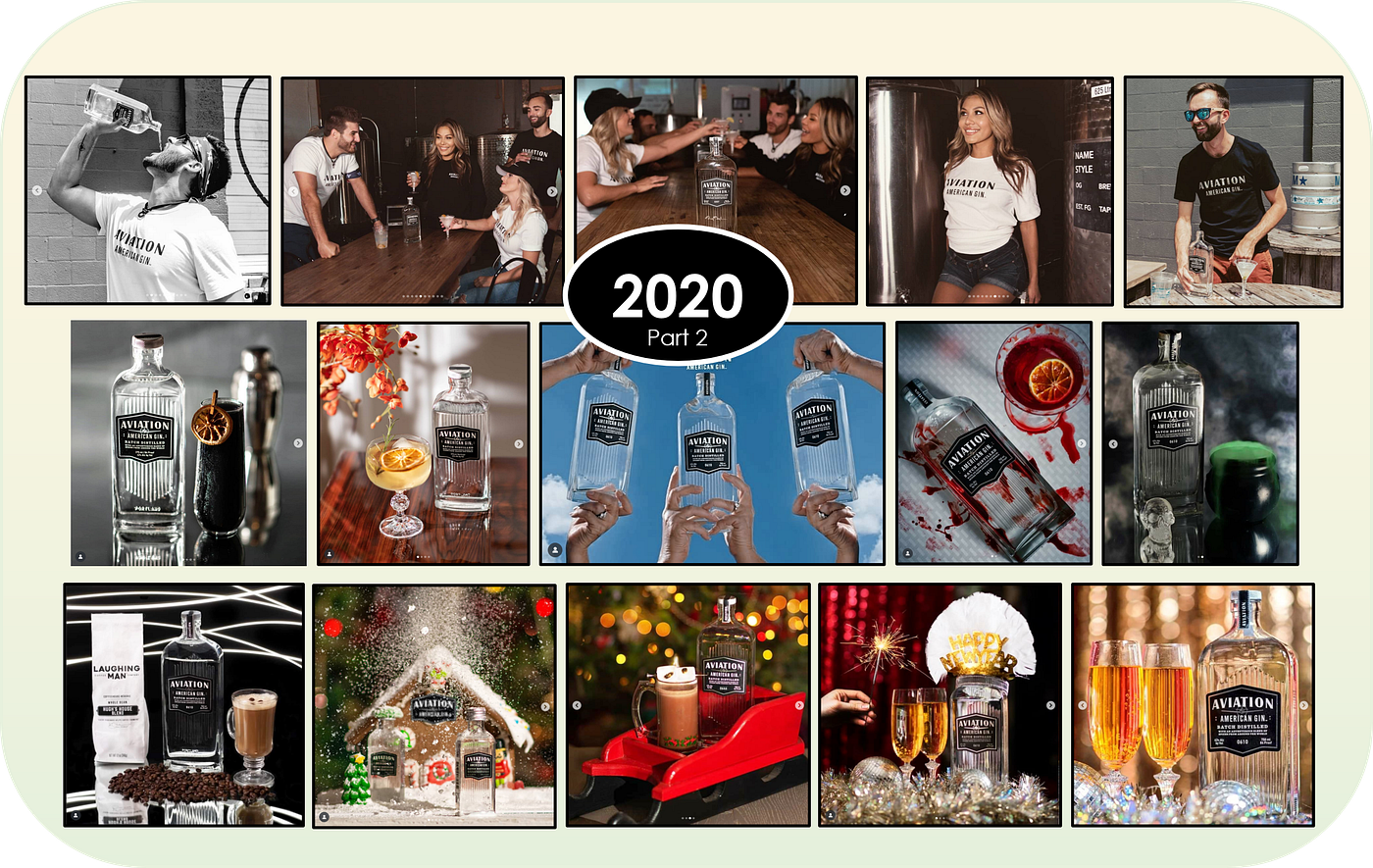
A compilation of the second half of Starkloff’s photography work during 2020 to promote Aviation Gin
It’s important to note that Aviation Gin did more than repeatedly repost Starkloff’s photography on their social media throughout 2019 and 2020. They also used her apparel photoshoots involving models on their official Aviation Gin merchandise website.
The photos have since been scrubbed in the aftermath of Starkloff’s lawsuit. While there aren’t screenshots of the bomber jacket photos being featured on the website — which she alleges was there until she filed her complaint — Starkloff did keep screenshots of her 2020 photoshoot involving a group of four models who took photos at a brewery with a variety of poses, camera angles, and group interactions.
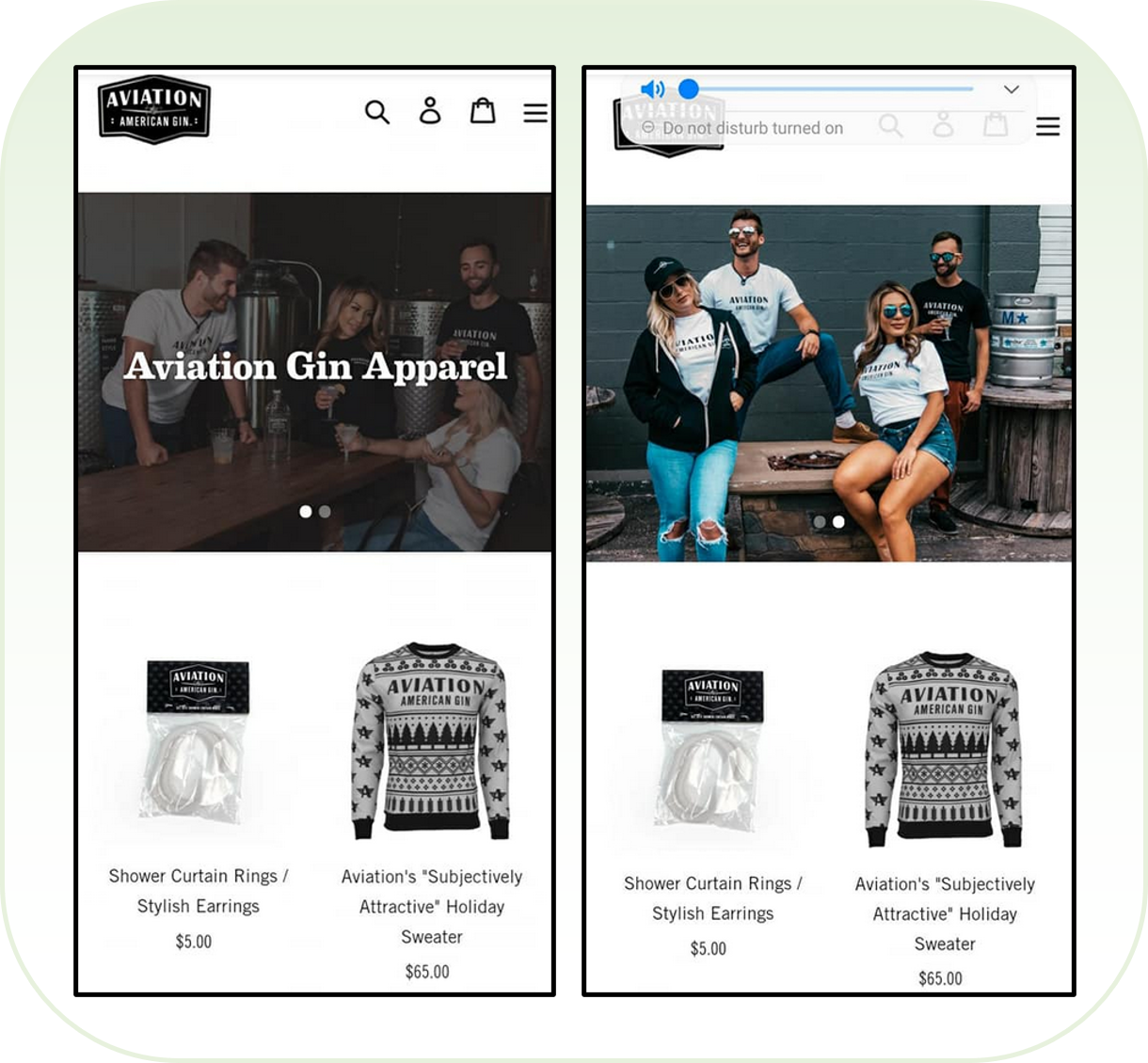
The final proofs from Starkloff’s photoshoots involving models were used on Aviation Gin’s merchandise to sell apparel
This model-based photoshoot took place five months after Starkloff’s viral quarantini moment. One would think, at this point, Aviation Gin would have recognized that it was beyond time to officially hire her, or at least pay her per photo or gig, if for no other reason than to protect themselves from legal liability.
But according to Starkloff’s complaint, they were only sending her swag — i.e. Aviation Gin merchandise like apparel, frisbees, etc. with the brand logo on them — and inconsistently at that. She alleges that Molina made multiple promises to send her merch, and only followed through occasionally. Worse, she alleges that much of the apparel she did receive ended up going to the models for their participation in her photoshoots, meaning Starkloff didn’t even keep a lot of what she was sent.
So, Aviation Gin was doggedly avoiding compensating Starkloff for her labor and photography work, using occasional swag as a cheap consolation prize instead. How were they able to justify this?
We turn to Aviation Gin’s Senior Brand Manager, Adrian Molina, to find out.
Aviation Gin’s Marketing Model: Molina, Manipulation, and a Girl Named Marilyn
Earlier in this article, we mentioned the importance of establishing a timeline of Reynolds’ rise in both Hollywood and the marketing world, and the relevance of interviews that Molina did. Now, we will combine these two elements to uncover the missing piece in Starkloff’s case: what Molina — and ultimately, Ryan Reynolds — were thinking at the time.
Following the Aviation Gin piggyback ad with Monica Ruiz in December 2019, Reynolds and Molina were treated like gold medalists of the advertising and marketing world.
The two of them were basking in media attention, adulation, and accolades. Molina was named one of AdWeek’s 2020 Young Influentials, i.e., a rising star in marketing. He went on a media tour blitz, appearing on several marketing podcast interviews throughout 2020: *Making the Brand on March 13, [Thrive: People, Policies, & Profits](https://paychexbusiness.podbean.com/e/s2-ep4-adrian-molina/) on September 8, AdWeek’s [Social Confidential](https://www.adweek.com/brand-marketing/social-confidential-how-aviation-gin-leverages-real-time-pop-culture/) on October 8, and [Brandsplaining](https://brandsplaining.libsyn.com/light-as-a-feather-stiff-as-a-drink-with-adrian-molina-of-aviation-gin)* on November 3. (Each of these interviews were uploaded separately to YouTube as well: 1, 2, 3, 4)
Marketing professionals and even marketing professors wanted to know: what was Aviation Gin’s secret formula that was making the brand so successful online? Across these four interviews, Molina provided the answers.
The first question was how Aviation Gin’s marketing team was run. This was of particular interest not only because of Reynolds’ celebrity status, but because of his unusually high hands-on involvement compared to most Hollywood influencers.
Molina happily obliged in revealing their team structure, repeating the same story in every interview: Ryan Reynolds, his creative partner, George Dewey, and Molina were the essential marketing trio for Aviation Gin. They worked closely with each other on both big budget commercials like the piggyback television commercial, along with Molina’s daily social media strategy online.
Molina mentions that there is a VP of Marketing above him and an Associate Brand Manager below him, but neither played a significant role in shaping strategy or implementing it, instead merely serving as support to either Molina or the two partners. Reading between the lines, Molina implies that the VP was an old-school, traditional advertising professional who didn’t understand online platforms or how to tap into the cultural zeitgeist, and mostly rubberstamped whatever the trio were doing. Molina also indicated that the purpose of the Associate Brand Manager was to perform the type of logistical work that Molina didn’t want to do himself. That freed him up to focus mainly on the creative aspect with Reynolds and Dewey.
“The marketing minds behind Aviation, it’s really Ryan and his creative partner, George Dewey, who is the president of Maximum Effort Productions,” says Molina. “So, there’s really no science to it, and we’re a very small team. So, an idea like Peloton or the Fyre Festival, we’ll start off with a text chain between Ryan and George. I’ll get a script from George, and then I’ll kind of add my two cents to it, because obviously we want to get as much branding as possible. Working with Ryan and George in the past two years, they’re more ingrained in the brand so they know what points we want to hit. So then from there it’s, ‘do we have the budget to do this?’ Then it’s off to the races. My VP of Marketing doesn’t get those scripts, I do.”
Interestingly, in another interview, Molina adds, “There’s been a lot of times that ideas have came about from Ryan and George’s world, and me from brand side, and knowing the spirits industry as a whole, it’s like, ‘we can’t do that, it’s illegal.’”
The second question was about Aviation Gin’s robust online engagement. To this, Molina coins his strategy “social listening.” He talks about having “every Boolean search” saved (i.e. using keyword combinations to refine search results), so he can monitor what’s being said about Ryan Reynolds, Aviation Gin, and everything in-between in real-time on social media. Then, he responds to people using the brand’s official social media accounts to help keep the conversation going, boost engagement, convert fans into loyalists, and ultimately drive up sales. “I live or die by TweetDeck,” he says, referencing an online tracking tool that helps manage things like Boolean search terms. “That’s why I’m very responsive. My usual work setup is three monitors, TweetDeck on one of them.”
He then goes into detail about his favorite platforms, Twitter and Instagram, and his least favorite, Facebook, which he says is too pay-to-play compared to the others. He notes that the copy on a post (i.e., marketing term for text-based advertising; in this context, it refers to a tweet or image caption) performs better on Twitter, whereas images are more impactful on Instagram. He even mentions “dipping into Reddit” to measure traction on Aviation Gin’s ads, and take the temperature on consumer sentiment, which tends to be more honest and conversational there. “You’re the eyes and ears for the brand,” he says. “The world is your focus group.”
The third question was, listening to whom? When Making the Brand asks Molina about Aviation Gin’s interactions with customers and how it influences Aviation Gin’s content, he answers:
“I think our fanbase is amazing. They’re insanely engaged. They’re also creative themselves, which I feel is kind of inspiring, seeing like a lot of, people just taking dope photography. So, one of our followers, Marilyn Starloff [sic], she started off taking a picture of Aviation Gin bottle [and a] candy cane. And obviously, doing social listening, I was like, this is a sick photo and it’s Christmas, wow, I want to use this. So, I asked her and obviously tagged her, and she gained followers. It’s obviously, like, people who are creating content just for fun and that are using our brand, why not amplify that platform a little bit better?”
Thus far, none of this strategy would be problematic — if it weren’t for the truth of Starkloff’s situation behind the scenes.
First, it’s worth pointing out that the interviewer explicitly asked about customers, and it was Molina who chose not to use that word and use “fanbase” instead. Second, he brought up Starkloff unprompted as a prime example of the brand’s success with online engagement, implying that they viewed her as a particularly special feather in their cap. Finally, let’s review how much Aviation Gin had relied on Starkloff’s work up to this date.
Although the interview was uploaded March 13 (and uploaded to YouTube much later, on July 26), the interviewer notes at the end of the interview that they coincidentally recorded on the very same day Starkloff’s quarantini posts went viral, which is the day before. Taking Molina’s cue, the interviewer describes Starkloff as “one of Aviation Gin’s fans.”
Yet at that point in time, Starkloff had performed at least 31 separate photoshoots, uploaded more than 52 final proofs to her Instagram, received three requests from Molina for photoshoots involving models showcasing Aviation Gin merchandise, and completed two of them — the ones with the bomber jacket and ring proposal.
Fast forward several months. Molina repeats his description of Starkloff as a “fan” again in the Brandsplaining podcast on November 3.
“What I love about our fanbase is that they’re very vocal and very creative,” he says. “We have tons of fanart. Everything from paintings to spoof commercials to dope photography, and stuff like that. So that absolutely makes me wake up in the morning with a little smile. Just seeing how we’re having fun being creative, being self-aware, and if that inspires them to do something with our brand that they might not have ever done, that’s totally cool.
“There’s this girl, her name is Marilyn Starkloff. She lives in Florida. She took the dopest picture of Aviation Gin with a candy cane garnish and tagged the brand. It’s the dopest picture. So I DMed her as the brand, I’m like, hey, is it okay if I re-share this? And she’s like, Oh my god, yeah, that’s awesome. So we shared it, re-did the copy on it (I thought I did), and she was super thankful because she was thinking about quitting doing photography.
“So now she’s going all-out. I use her for gigs here and then for the brand. And she went viral on her own this summer, because she posted a picture on her Facebook [of] Emergen-C, [an] Aviation Gin mini, and put ‘quarantini time.’ This was while the pandemic was happening, and it made news everywhere. And we’re getting tagged into it, and she’s like, that’s not even my best photo, there’s been so much better. So, seeing that inspiration come to fruition, we’re more than happy to reward it and acknowledge it.”
Except, according to Starkloff, that “reward” was nothing more than social media reposts and occasional swag.
Moreover, at the time of this interview, Starkloff had performed another 17 separate photoshoots, uploaded an additional 35 final proofs to her Instagram, and completed three more apparel photoshoots with models — the ones with the socks, another with a jacket, and the group photoshoot at the brewery. That brings the to-date tally to 48 separate photoshoots, 87 final proofs, and five apparel photoshoots with models. All unpaid.
Meanwhile, in their private conversations during this same time period, Molina was praising Starkloff and telling her she deserved paid opportunities for her work.
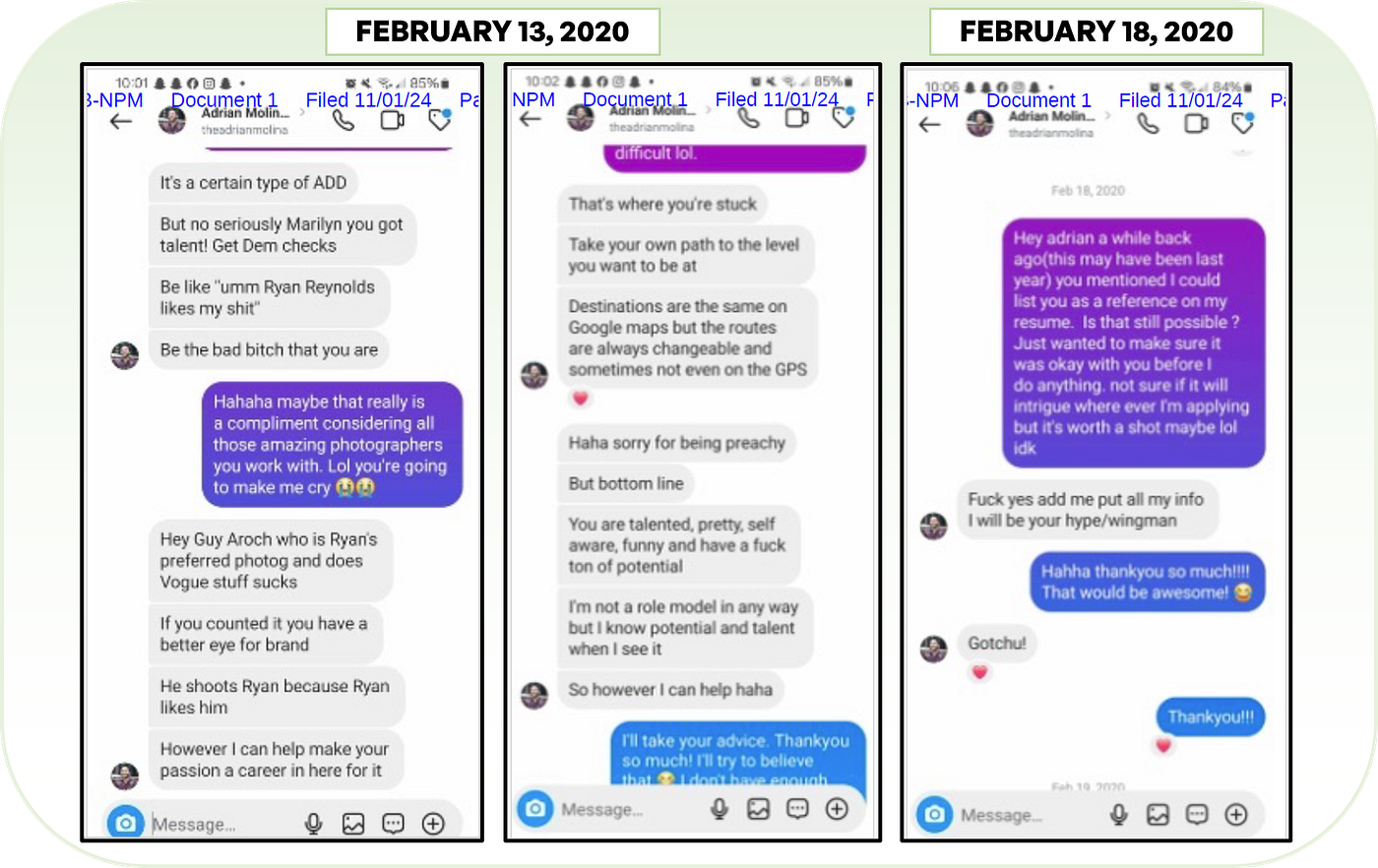
Molina repeatedly praises Starkloff’s talent, tells her she deserves to get paid for her work, and offers to serve a reference
“But no seriously Marilyn, you got talent! Get dem checks,” Molina tells her on February 13, 2020. “Be like ‘umm Ryan Reynolds likes my shit.’ Be the bad bitch you are.”
“Hahaha, maybe that really is a compliment considering all those amazing photographers you work with,” Starkloff replies. “You’re going to make me cry.”
“Hey, Guy Aroch, who is Ryan’s preferred photog and does Vogue stuff, sucks,” says Molina. “If you counted it, you have a better eye for brand. He shoots Ryan because Ryan likes him. However, I can help make your passion a career in here for it.”
Molina continues with his praise, telling Starkloff, “You are talented, pretty, self aware, funny, and have a fuck ton of potential. I’m not a role model in any way, but I know potential and talent when I see it. So however I can help.”
A few days later, Starkloff requests Molina’s help in acting as a reference for jobs. “Fuck yes, add me, put all my info, I will be your hype/wingman,” Molina responds.
But the praise and promises don’t stop there.
The day after Starkloff’s viral quarantini post, Molina tells her, “If we were hiring, I would for real.” He goes on to say he’ll act as a reference instead, and mentions how he had to kill his budget.
A few weeks later on March 30, Molina tells Starkloff, “Quit your job, you have a resume and I will be your reference, and I’m sure Ryan can.”
“That would be amazing, I need references for sure,” Starkloff replies. “They would hire me just to talk to Ryan Reynolds, lmao.”
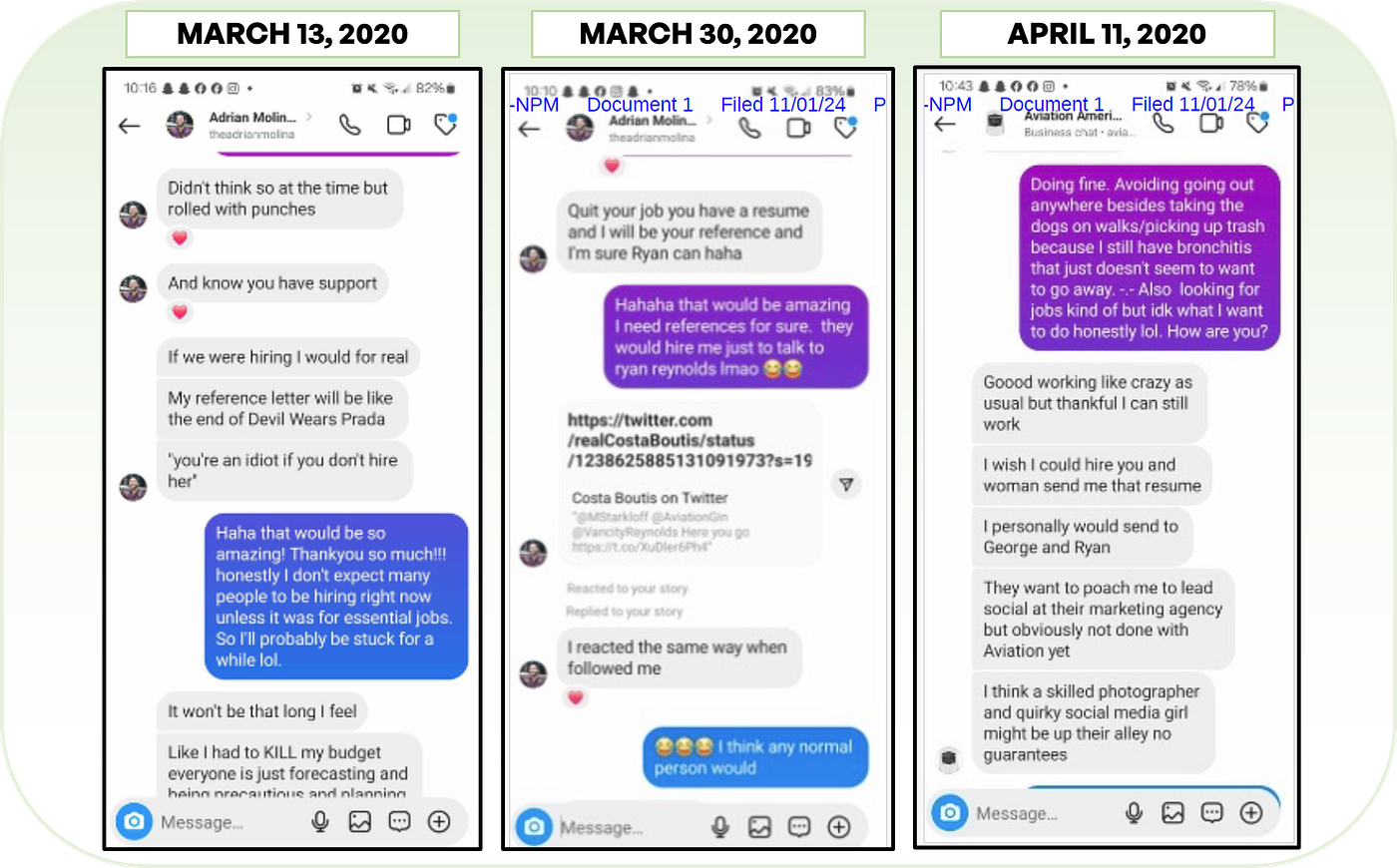
Molina tells Starkloff to quit her job, again offers to act as a reference, and says he will personally send her resume to Reynolds and Dewey
The next month, on April 11, Molina reiterates his wish that he could employ Starkloff. “I wish I could hire you,” he tells her. “And woman, send me that resume. I personally would send to George and Ryan. They want to poach me to lead social at their marketing agency, but obviously not done with Aviation yet. I think a skilled photographer and quirky social media girl might be up their alley. No guarantees.”
Based on Molina’s consistent praise and promises to help Starkloff find employment and paid opportunities, is it any wonder that she felt those opportunities were forthcoming? Not only was she compared to the likes of Guy Aroch, a well-known photographer of celebrities, she was told that her work was better. More importantly, she was told that Molina would personally send her resume to Reynolds and Dewey to help her get a job — specifically at their company.
But “fanart.” Sure.
At this point, readers can make an educated guess as to why Molina resolutely relegates Starkloff’s contributions to Aviation Gin as something far less than they are. The company is well-aware that she’s producing high-quality work, yet doesn’t want to pay Starkloff for what she’s worth. But is there proof of those suspicions? Molina’s interviews continue to illuminate.
“We’re such a small brand, like obviously the marketing team is very, very limited,” says Molina on Making the Brand. It’s a sentiment he repeats multiple times. “I love just seeking out user-generated content. Because hey, small team, don’t have the biggest content budget for ongoing, evergreen stuff, besides the Peloton things of the world and Arlene’s of the world.”
This is in reference to the piggyback television commercial with Monica Ruiz, and another Aviation Gin commercial with Arlene Manko, a real-life 84-year-old woman born on leap day who celebrates her “first legal drink” with Aviation Gin as Reynolds narrates in a voiceover.
In other words, Molina reveals that Aviation Gin purposely preserves its spending budget for big television spots, leaving little to nothing for its social media advertising. A revelation that at this point should come as no surprise.
“We didn’t spend a dime on digital paid last year,” Molina boasts, referring to paying for advertising in online spaces. “Kind of built that up. When I tell my friends at [advertising] agencies that, they’re like wait, you didn’t spend a dollar on digital, but you were the number three trending video on YouTube? I’m like, it’s all about the content.”
Molina continues. “Actually, I feel one of our most successful platforms was email. Because when Ryan started, the idea came up, he’s actually employed by Aviation Gin, [so] he should have an email address from it. And knowing George and Ryan’s mind, and the tool of an out-of-office message, it almost creates a new form of communication. Yeah, we have like over 55,000 people that emailed it, which is crazy, and spend zero dollars behind it. Which is, again, if your marketing could affect the bottom line and save money, you are the golden child in any company.”
Molina is referring to another marketing gimmick that Reynolds started in August 2018 and continued to use multiple times since then. The public can message Reynolds’ official Aviation Gin email and receive a quippy, automated reply that is not a real out-of-office message, but another Aviation Gin advertisement in disguise. Recall that Reynolds used Starkloff’s quarantini post — for free — in one of these out-of-office advertising messages.
“I feel lack of budget almost creates the necessity to maximize every dollar as much as possible,” says Molina, “And then, when you’re a growing brand like us, you see that dollar — How does that affect sales, how does it affect this? It’s almost like, cool, we got a bunch of impressions, but were sales up? No? Then you’re not thinking 360 in that mindset. I’d rather be a broke boy underdog than sitting high on the mountain and lazy.”
Then, on the Thrive podcast, Molina expands on how online buzz leads to actual product sales. “So, on the alcohol industry side, it’s a little regulated. […] You’re not going to get the data overnight. It’s gut feelings, and knowing and seeing the results months later,” he explains. “I’m not selling bottles directly to people online, we can’t do that. So it’s definitely a little delayed, but there is a correlation between high traffics months on the website and high volumes in terms of sales.”
And there it is. The connection between all of this constant online social media engagement, and the company’s bottom line: selling bottles of gin. So where does Starkloff factor into all of this?
In a podcast interview with Adweek’s Social Confidential, Molina laid out Aviation Gin’s entire roadmap to success in a sequence of five telling images.
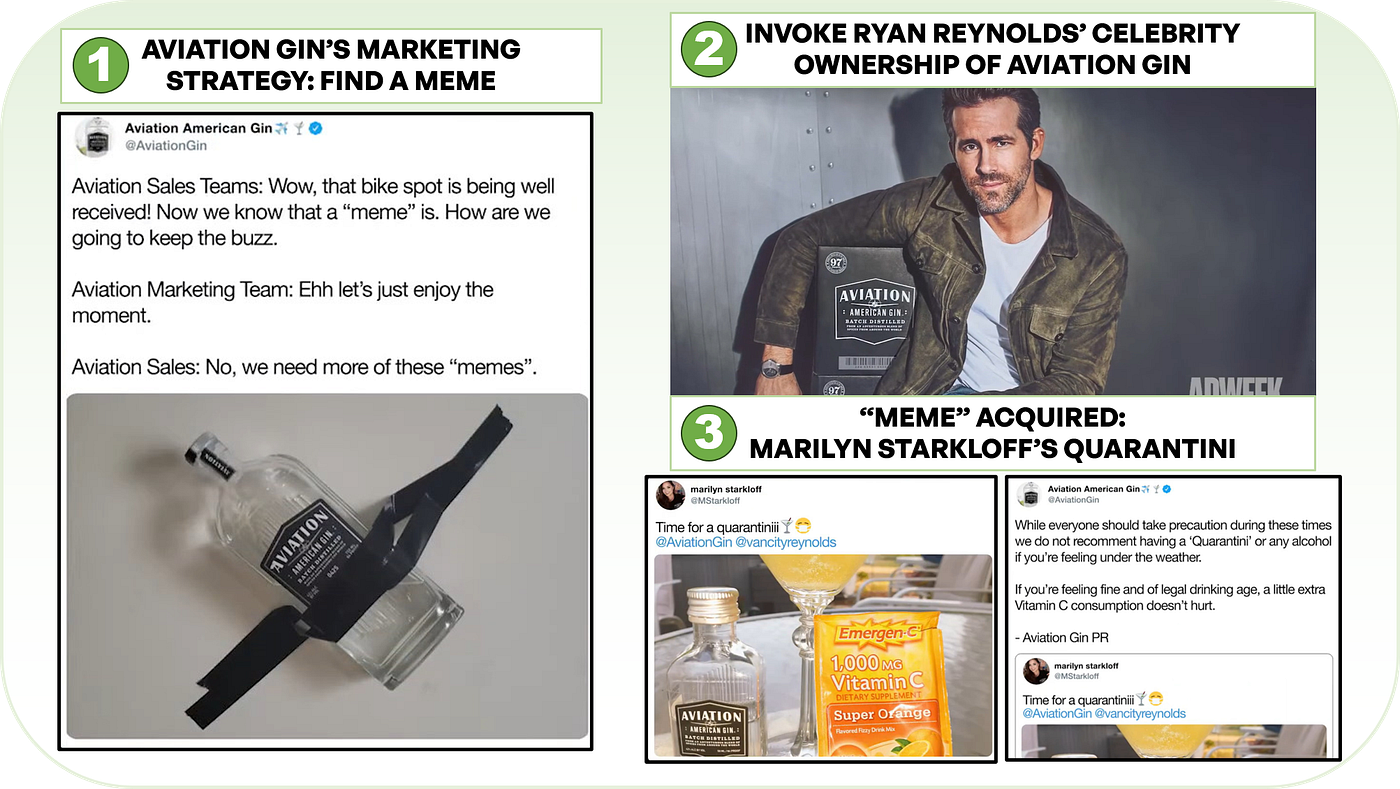
Aviation Gin’s roadmap to success in images: 1. Find a meme, 2. Invoke Reynolds’ celebrity, 3. Starkloff inadvertently delivers the desired “meme” with her quarantini post
Aviation Gin’s tweet, formatted like a conversation, reads, “Aviation Sales Team: Wow, that bike spot is being well received! Now we know that [sic] a ‘meme’ is. How are we going to keep the buzz / Aviation Marketing Team: Ehh, let’s just enjoy the moment. / Aviation Sales: No, we need more of these ‘memes’.”
The image in the tweet, which is of an Aviation Gin bottle taped to a wall, is a spoof of a viral and controversial story about a work of art that is nothing more than a banana duct-taped to a wall, which sold for $120,000.
This tweet, dated December 8, 2019, is mere days after Aviation Gin’s piggyback ad with Monica Ruiz. Although the tweet is presented as a joke, it’s more revealing than it seems to be at first glance. Molina seems to be pushing back against the sales department, correct in believing that he understood online spaces better than them. He knew that forcing a meme would backfire. Sure enough, although Molina says the tweet did well, it wasn’t as well-received in the advertising world, which thought it was band-wagoning in a cringy way.
Still, the goal revealed here is clear: the sales division wanted the same type of success in the digital sector that they just had in the television sector, and knew that some kind of viral content would achieve that. But how?
The third image in the sequence shows Ryan Reynolds, invoking his star power and association with the brand. Then comes Starkloff’s quarantini post heard around the world, along with Aviation Gin’s response to it. Finally, two tweets pop up the screen.
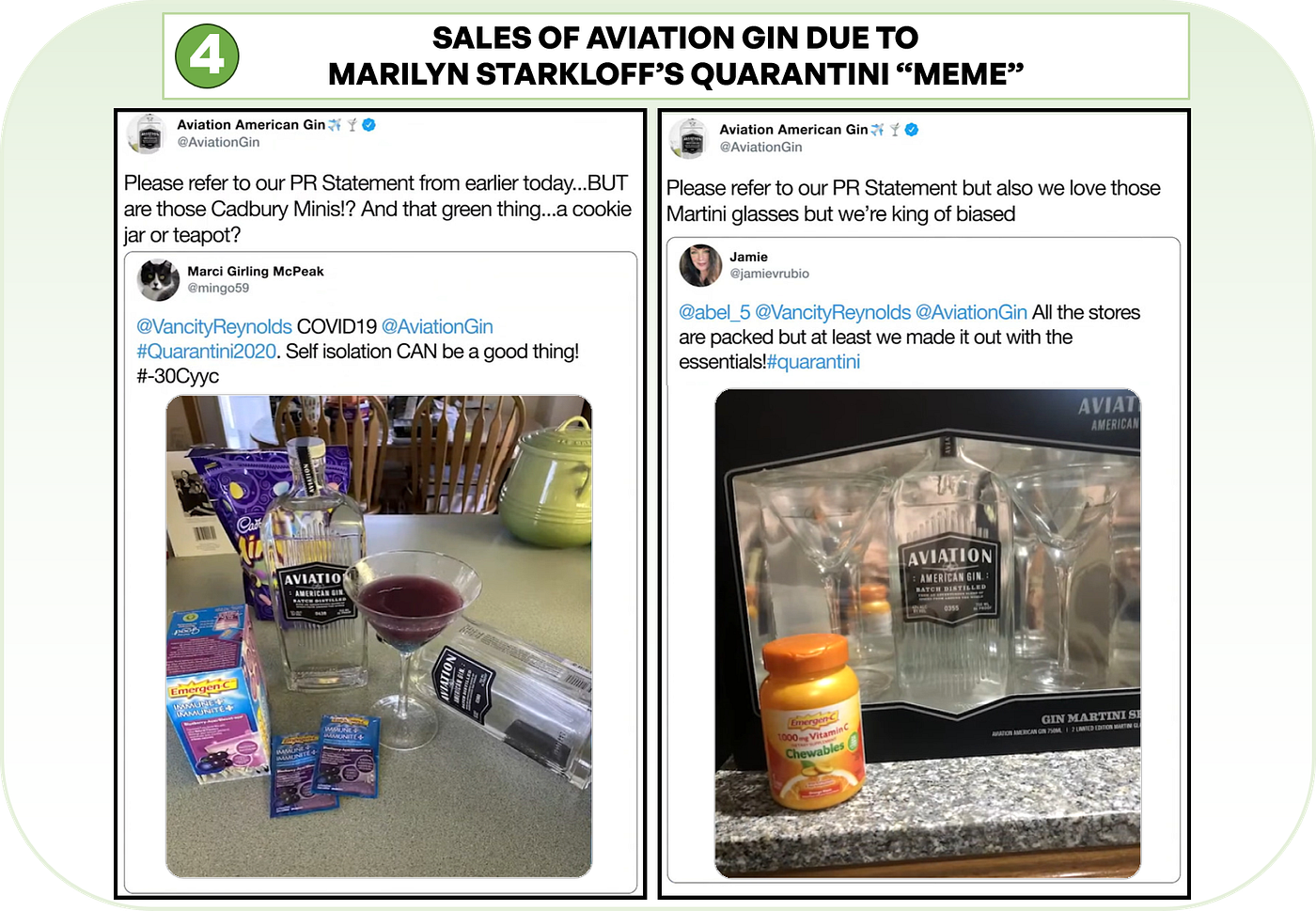
Random Twitter users upload photos of their purchases of Aviation Gin and Emergen-C, hashtag it #quarantini, and tag the accounts of Reynolds and Aviation Gin
Lo and behold, it’s two random Twitter users, tagging Reynolds and Aviation Gin to share images of their purchases of Starkloff’s Aviation Gin and Emergen-C combo, hashtagged #quarantini.
That’s right, purchases. Bona fide sales. Money exchanged for Aviation Gin’s product. The “meme” the sales department wanted? Starkloff delivered it. Tenfold.
“People that are not on social media are sharing your meme on emails,” Molina tells Starkloff as the two of them watch her posts explode with virality in real-time. (Here, he’s referring to Aviation Gin’s VP of Sales and the company’s distributor, who are both implied to be out-of-touch with the online zeitgeist the way his VP of Marketing is.) “These people are old.”
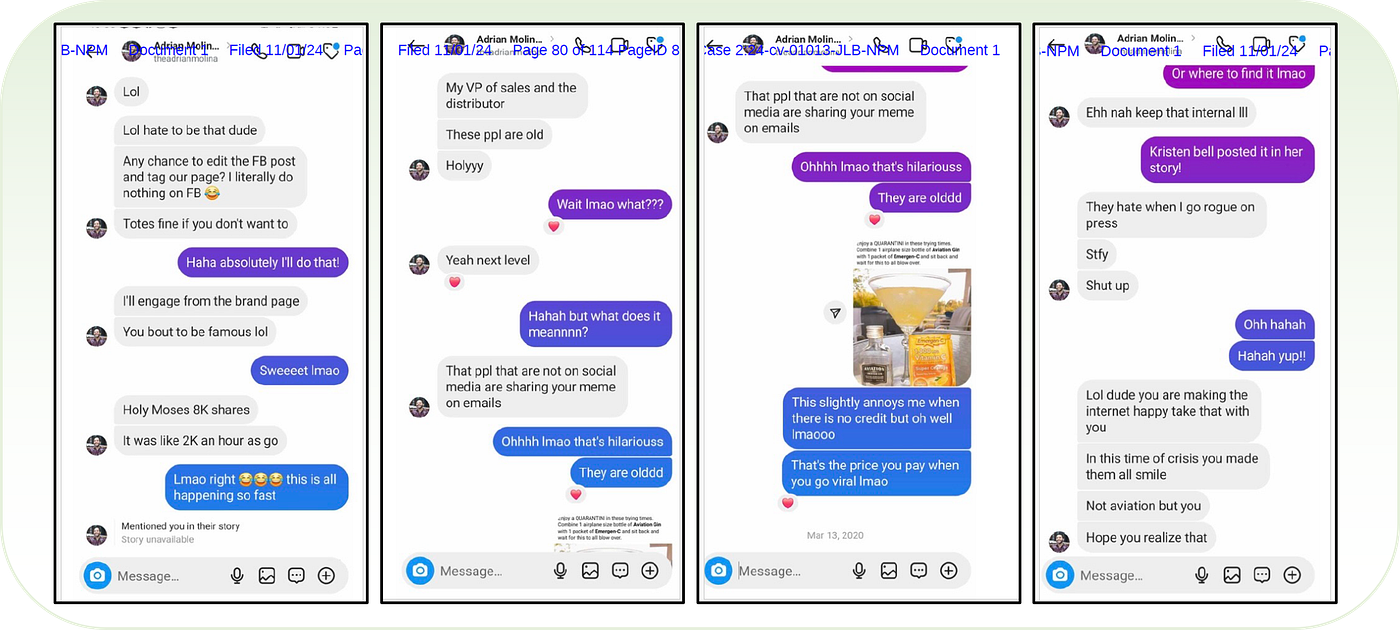
Molina observes that the success of Starkloff’s quarantini post has gone beyond social media, and Starkloff expresses annoyance at not being credited
“You are making the internet happy, take that with you,” Molina continues as they bask in the unexpected success of her posts. “In this time of crisis, you made them all smile. Not Aviation, but you. Hope you realize that.”
Meanwhile, Starkloff expresses her frustration that she’s not getting credit, but resigns herself to it, as it had already happened many times before.
“That’s the price you pay when you go viral lmao,” she says.
How Responsible is Ryan Reynolds in This, Really?
As of now, the exploitation of Marilyn Starkloff seems to fall squarely on the shoulders of Adrian Molina, Aviation Gin’s Senior Brand Manager, who was so successful in his role that he was promoted to Brand Manager in October 2021. Yet that’s only because proof of Reynolds’ involvement isn’t featured much in Starkloff’s lawsuit — it’s much more prominent on her social media pages.
In going through Starkloff’s online digital records, it’s hard not to come away with the impression that she was perpetually starstruck by the actor, even up to the very end. But her screenshots — meant to celebrate Reynolds’ interactions with her — show a sad, twisted pattern of Reynolds and Aviation Gin continuously leveraging her interest in Reynolds, and dangling the promise of his attention and praise towards her in order to keep her creating work for his company for free.
But before we get into their interactions, let’s first hear Reynolds’ own words about his marketing ethos, absent the specific context with Starkloff.
Molina wasn’t the only one doing a victory lap in the media during this era of post-Peloton piggyback ad glow. Reynolds, too, was snapping up honors, awards, and interview opportunities in the marketing world — and revealing that much of Molina’s strategy came directly from him.
In a 2021 interview with Talking to Ourselves, a podcast focused on marketing industry leaders, Reynolds, along with creative partner, George Dewey, was asked about the success of Deadpool and how it informed his marketing approach.
“Necessity is the mother of invention,” Reynolds answered. “That the studio constantly took money away from us, as opposed to, giving, putting money into the project. […] We were always having to replace spectacle — which costs a lot of money — with character. That created very valuable lessons. We found that the project got better and better the more we did that. And then, we extended that same idea to the marketing, where we were really avoiding paid ads and working on earned media in a much greater capacity to acquaint the audience with the character without having to use our assets from the movie.”
Just like Molina, Reynolds openly and comfortably confesses to their strategy: Don’t spend money to advertise. They sought unpaid earned media instead, i.e. word-of-mouth media, like social media buzz. It was a strategy that worked extremely well during the guerilla marketing for Deadpool.
“Comic book fans really, I would say, are the authors of [Deadpool’s] success, they helped get it made. They spoke up on the internet, and Fox listened, when the test footage leaked onto the internet,” said Reynolds. “I wanted to release as few materials as possible, and save the surprises for the movie theater and that opening weekend, when Twitter has finally reached full strength in terms of word-of-mouth and that kind of stuff. We really wanted to use and hijack some of that for the opening of the movie. So that’s where we got this earned media blitz, as opposed to a paid media blitz, and just started playing around.”
(Savvy readers may recognize this language as something that Blake Lively said at Book Bonanza to promote It Ends with Us in 2024. “These are the people who authored the success of the book,” said Lively in reference to Colleen Hoover’s book fans, right after admitting to stealing unauthorized footage of the unfinished film. Unlike Reynolds, however, this phrasing was a much more awkward choice, as Hoover, the actual author, was on-stage with her when she said it.)
The problem is that, even if Reynolds is telling the truth about budget constraints for Deadpool — and given that he considers a $2 million base salary a pay cut, it may not be the truth — Reynolds was far beyond those scrappy, underdog days of pitching Deadpool to unconvinced studio executives. It’s hard to argue he didn’t have money to pay for advertising — or any other service or labor that is owed compensation, for that matter — after he’d already earned approximately $20 million on the backend from the film. Not only that, but he had many more Hollywood project payouts prior to Deadpool that led to a net worth of $71.5 million in 2020. His pocketbook was more than heavy enough to comfortably invest in business ventures like Aviation Gin in 2018 and Mint Mobile in 2019. Unlike Starkloff — who used to work a retail job at Target — a starving artist he was not.
Yet Reynolds reiterated his miserly money mantra later in the interview. “Everything that we do is incredibly prudent in terms of cost and time. We don’t spend money unless we have to. It all kind of originates from Deadpool, […] where we had to make one dollar feel like ten. And that has served us better than almost any other edict across the board could ever serve us. It’s just been delightful, because everything is down and dirty. Fundamentally, it has a lack of red tape.”
A down and dirty lack of red tape, indeed.
As suspected, the pressure on Molina to stay within budget, and, more specifically, to not spend money at all, comes directly his boss, Ryan Reynolds. But what about online spaces? Is Molina’s strategy his own, or does that also come from Reynolds?
“Mostly, it’s listening,” Reynolds says when asked about the reason for his team’s success. He advises other marketing professionals to “tune into the ‘digital water cooler’ that is social media to hear the cultural conversations going on around you, and extrapolate from them.”
In echoing Molina’s “social listening” moniker, Reynolds’ response corroborates that Molina’s methods were a reflection of Reynolds’ marching orders for him, and not the actions of a rogue agent.
It’s a strategy that has been wildly lucrative, with few consequences and high financial payoff. According to Adweek, Reynolds’ “extrapolation” of online sentiment and content for Aviation Gin garnered 13 billion media impressions in 2019, over ten million video views on Twitter, over six million views on Aviation’s YouTube channel, and “unquantifiable amounts of earned media coverage.”
Now, let’s see what that “extrapolation” looks like when applied to Marilyn Starkloff.
Ryan Reynolds: Celebrity Crush, Future Boss, or Master Manipulator?
According to Starkloff’s screenshots, Reynolds began following her social media accounts after her viral quarantini moment. Up to that point, Starkloff’s interactions were mostly with Adrian Molina and the official Aviation Gin pages he was responsible for running. From this point on, however, Reynolds would interact with her — directly.
We know for a fact that it’s Reynolds because, in the interviews discussed earlier, Molina confirms that Reynolds “runs his own socials,” and “sees these things, and loves it.” (By “these things,” he was referring to Starkloff’s quarantini post.) Over time, one can track a progression of Reynolds’ increasing closeness to Starkloff, exemplified by the following three tweet exchanges that Starkloff documented.
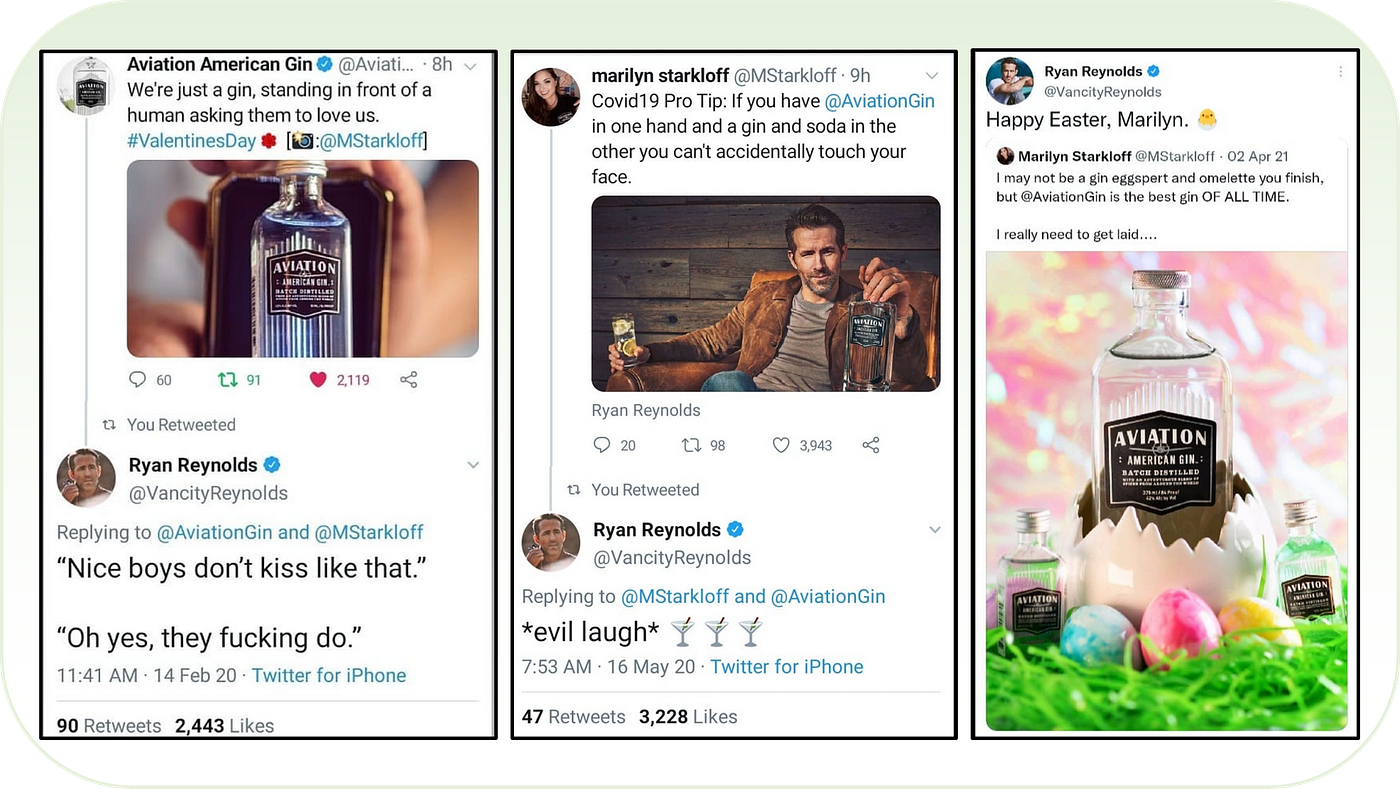
Starkloff’s screenshots of her tweet interactions with Reynolds shows a progression from distant to familiar and personalized
At first, there was a barrier between Reynolds and Starkloff. He didn’t interact with her; instead, he responds to an Aviation Gin tweet of Starkloff’s ring proposal photo — posted by Molina — in which Starkloff is only tagged as credit for the photo.
But the next time, the barrier between them lowers, when Starkloff makes a post on her own personal Twitter account. “Covid-19 Pro Tip,” she tweeted alongside one of the official Aviation Gin promotional photos of Reynolds posing with a bottle of the alcohol, “If you have @AviationGin in one hand and a gin and soda in the other, you can’t accidentally touch your face.” It goes decently viral with nearly 4,000 likes, and Reynolds responds to the tweet with an “evil laugh.”
Next, Starkloff posted an Easter-themed photo she took, with a bottle of Aviation Gin inside of a half-cracked ceramic egg. Her caption reads, “I may not be a gin eggspert and omelette you finish, but @AviationGin is the best gin OF ALL TIME. I really need to get laid.” Reynolds goes one step further than last time and quote-tweets her with a personalized message: “Happy Easter, Marilyn.”
The effect of Reynolds’ interactions on Starkloff is profound.
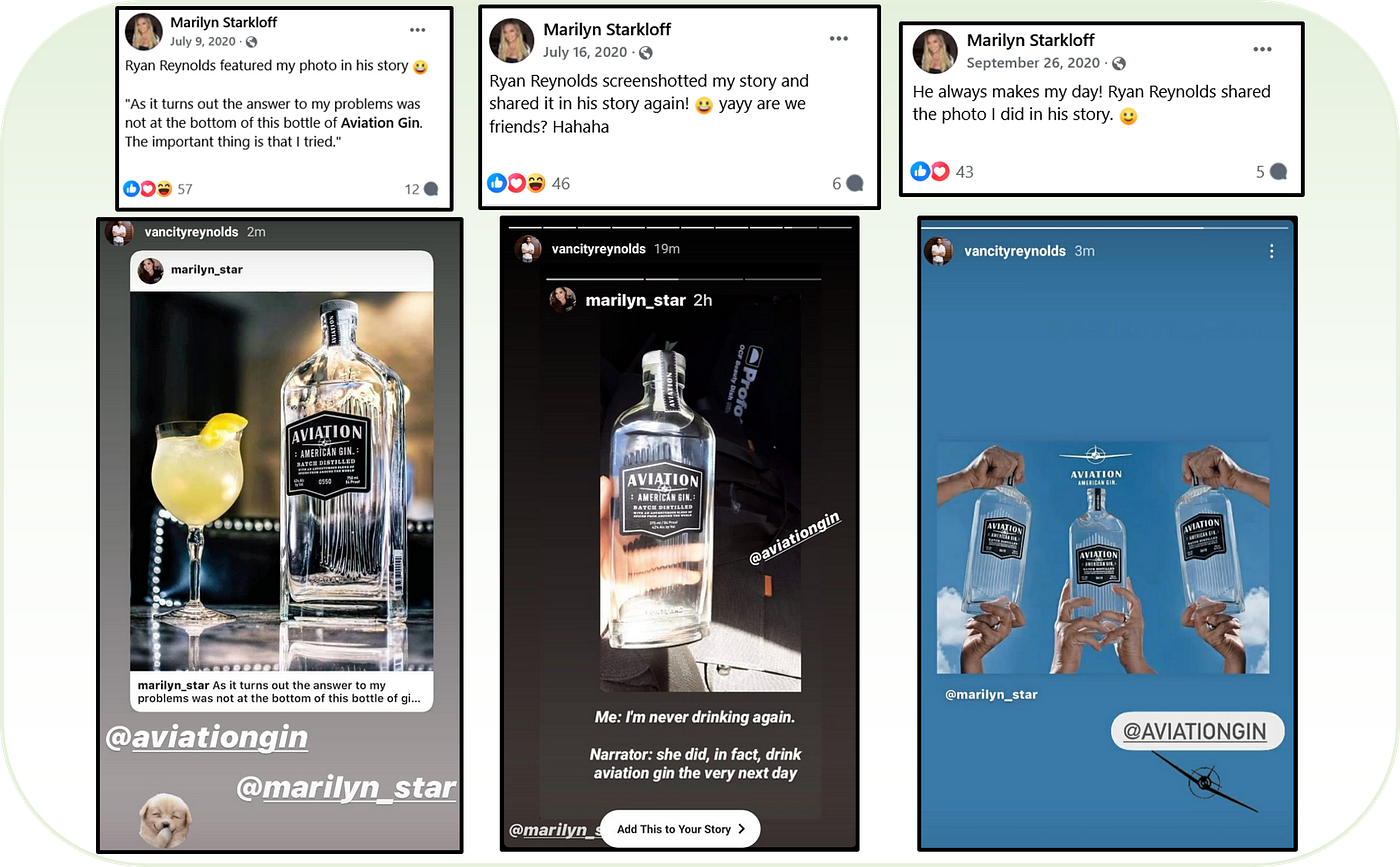
Reynolds repeatedly shares Starkloff’s photography work on his social media accounts, and Starkloff is thrilled every time
“Ryan Reynolds featured me in his [Instagram] story,” she gushes in July 2020, a few months after her quarantini posts. “Ryan Reynolds screenshotted my story and shared it in his story again! Yay are we friends? Hahaha,” she says a few days later as Reynolds once again interacts with her on Instagram. Then, a third time: “He always makes my day! Ryan Reynolds shared the photo I did in his story.”
“Ryan Reynolds reacts more to my stories than my friends do lol,” Starkloff observes in a caption showing a screenshot of Reynolds reacting to her Instagram story with a laugh emoji. “I just want to be on a first name basis.”
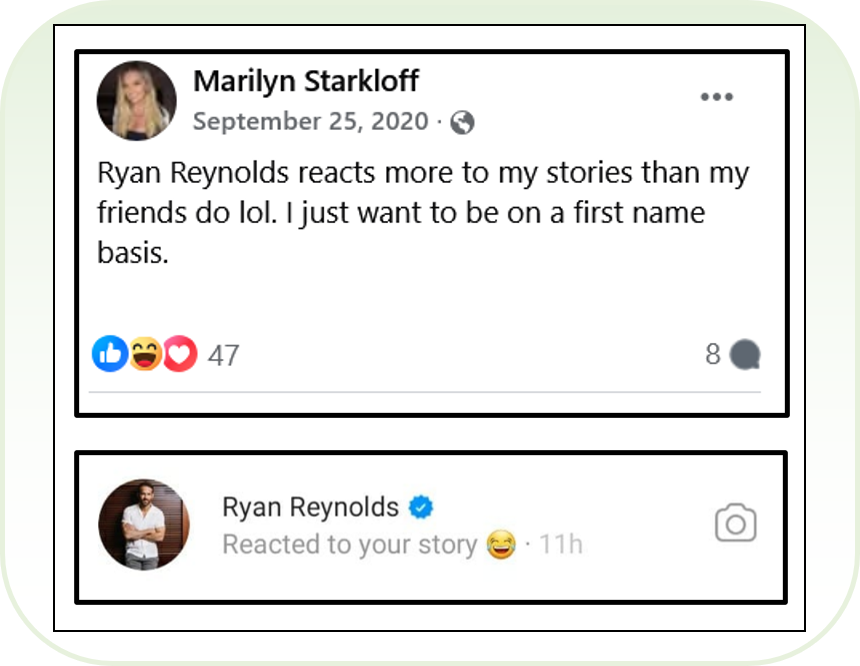
Starkloff observes that Reynolds interacts with her online posts more than her friends do
It bears repeating the Starkloff didn’t only provide Aviation Gin with beautiful, polished photography — she made casual posts and memes, too, with an understanding of the online cultural zeitgeist and how the company was trying to position itself within it.
Starkloff makes one such meme, careful to place the Aviation Gin logo on the image to maximize the promotional impact of it. “I’m having a vasectomy,” the Star Wars-themed meme begins. “The Aviation Gin cocktail, right?”
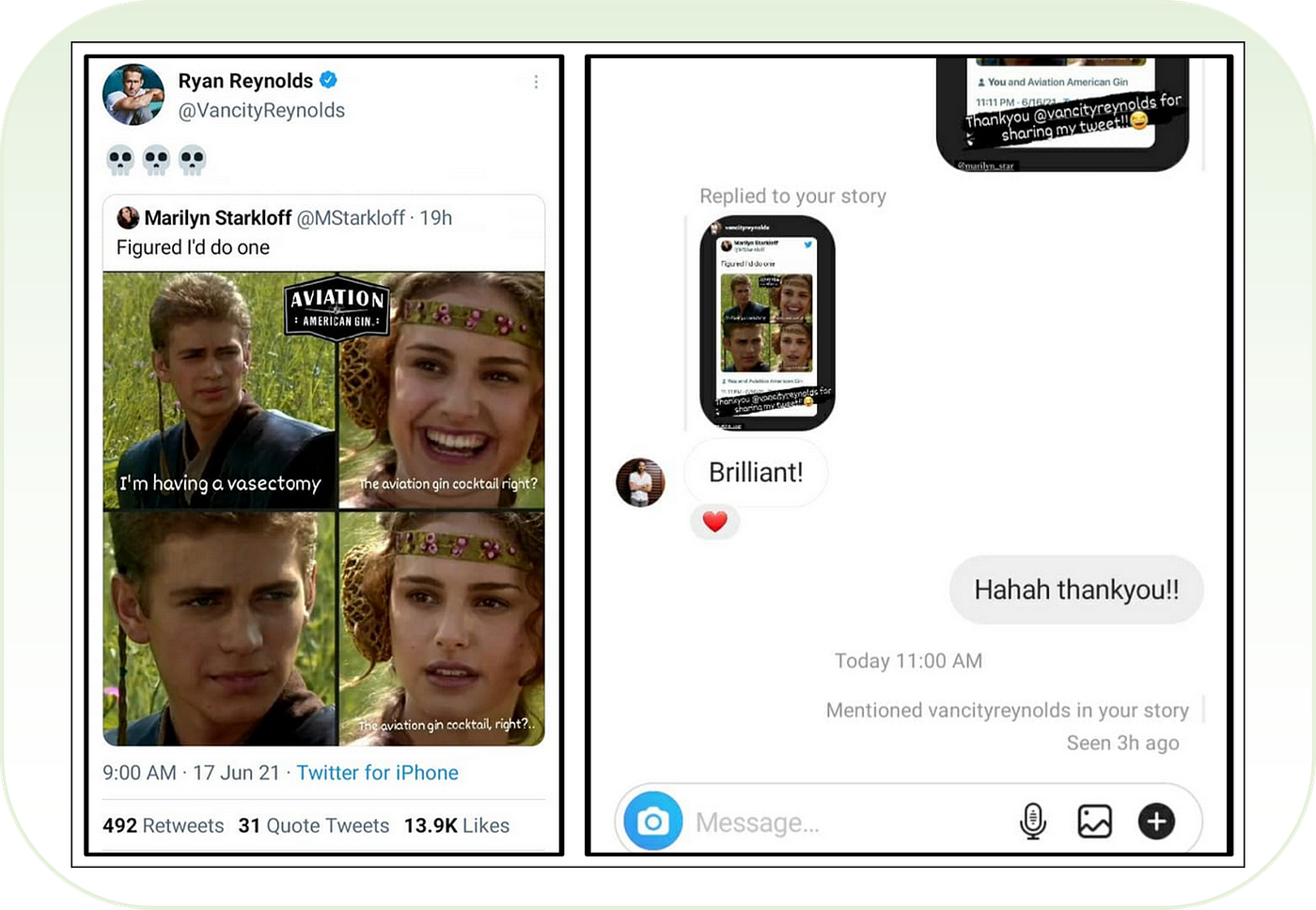
When Starkloff uses a Star Wars-themed meme to promote Aviation Gin and it goes viral, Reynolds direct messages her (DMs) to tell her it’s brilliant
This is in reference to another Aviation Gin advertising campaign, where Reynolds named a cocktail The Vasectomy in honor of Father’s Day. (Reynolds would recycle this joke in 2025, adding commentary about how he thinks his two-year-old son, Olin, has only “violence, breasts, and engines” on his mind, and that’s why Reynolds would have gotten a “punching vasectomy” had Olin been born before his sisters.)
Reynolds quote-tweets Starkloff’s meme, and it goes viral with around 14,000 likes. Then, one of Starkloff’s dreams comes true: Reynolds sends a direct message (DM) to her to tell her the meme is “brilliant.”
But none of this raises eyebrows as much as what happens when Starkloff talks about her personal dating life. It’s hard to read the small text in the screenshot, but it appears to be a message with a man Starkloff met online via a dating app, who tells her he’s “not a fan of Aviation Gin.” When she posts a poll on Instagram asking if she should unmatch him, Reynolds not only weighs in with a vote, but tells her yes.
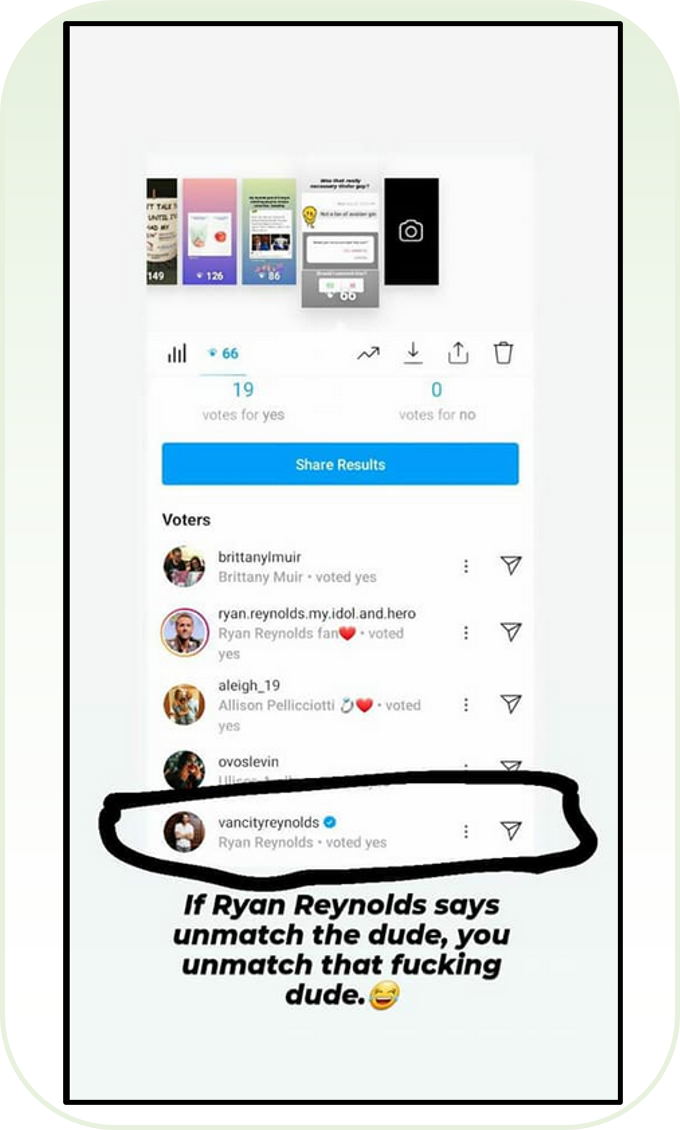
When Starkloff posted a poll about her personal dating life, Reynolds weighed in and agreed that she should unmatch the man who messaged her
“If Ryan Reynolds says unmatch the dude, you unmatch that fucking dude 😂,” Starkloff captions the screenshot.
Starkloff was in her twenties during this time. Regardless of the post’s reference to Aviation Gin, Reynolds was in his forties, married, and with children, providing his input on Starkloff’s personal dating life in a poll in which only 18 other people voted.
Meanwhile, Starkloff’s Facebook friends were watching all these interactions unfold with excitement.
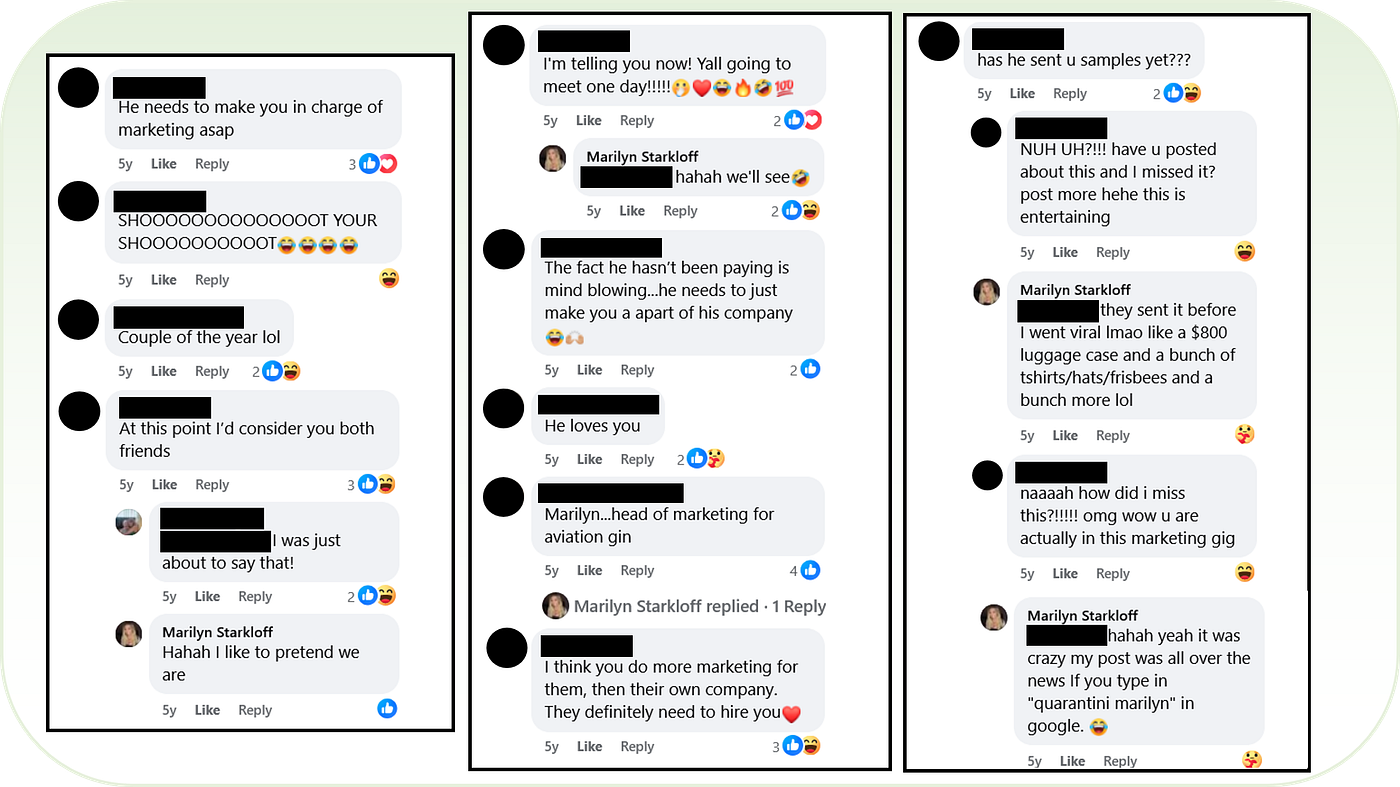
Starkloff’s friends’ reactions provide insight into how Reynolds’ repeated interactions with her were perceived
“Shoot your shot!” exclaims one in reaction to the COVID-19 tweet. “Couple of the year lol,” says another. “That fact that he hasn’t been paying you is mind blowing,” says another. “He needs to just make you a part of his company.” Another affirms this thought, saying “I think you do more marketing for them than their own company. They definitely need to hire you.”
Reynolds was so responsive to Starkloff that, for some of her friends, the excitement eventually dimmed and they became unimpressed. “T-Minus 10 til Ole Vancity makes a comment,” one friend says drolly — referring to Reynolds’ online username — when Starkloff posted a photo featuring Aviation Gin and Hugh Jackman’s Laughing Man Coffee brand.
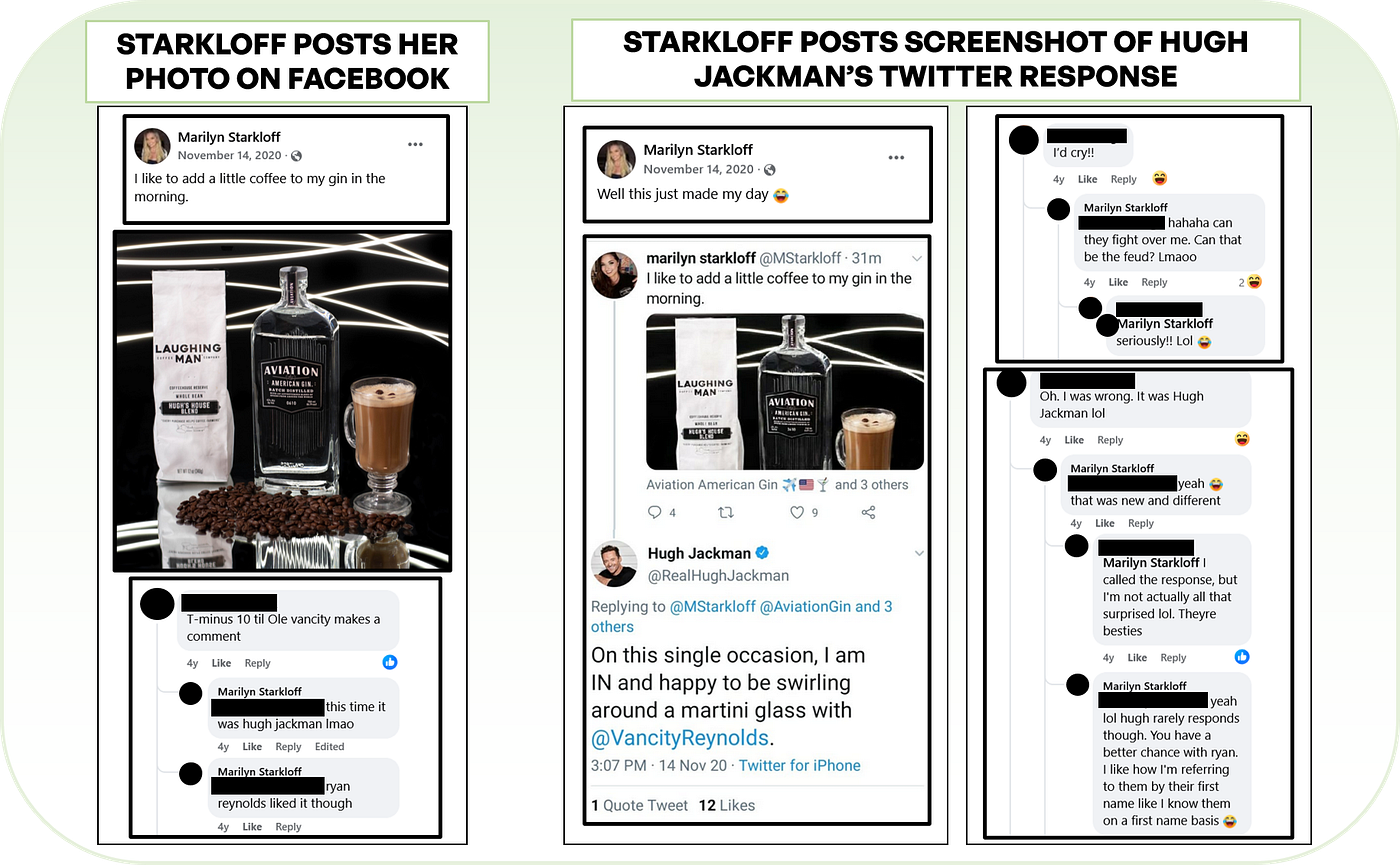
Reynolds was so responsive to Starkloff’s online posts that some of her friends became unimpressed and were surprised when Hugh Jackman responded instead
“This time it was Hugh Jackman lmao,” Starkloff responds before later adding, “Yeah, Hugh rarely responds though. You have a better chance with Ryan. I like how I’m referring to them by their first names like I know them on a first name basis 😂”
Indeed, it’s worth noting that Jackman responded to Starkloff’s tweet within thirty minutes of her posting it, when it only had nine likes — suggesting that he may have been tipped off about the existence of her post, rather than finding it organically. It’s another clue about the inner workings of Aviation Gin, and how much of the interactions with Starkloff were likely coordinated behind the scenes.
As much as Starkloff’s celebrity worship of Reynolds may have blinded her to how she was being exploited at the time, it wouldn’t be fair to judge her — or her friends — harshly for those reactions. Ironically, a disproportionate reverence for Reynolds would not be a deterrent to him hiring her, as it would fit right into his company culture. Once again, Molina provides insight.
“Thank you to whoever was my Secret Santa for the Marketing Twitter Gift exchange for somehow reaffirming my morning routine,” Molina tweeted during this same time period. The tweet shows a picture of a mug that says “To Do List: 1. Wake up, 2. Drink coffee, 3. Admire Ryan Reynolds, and 4. Get shit done.”
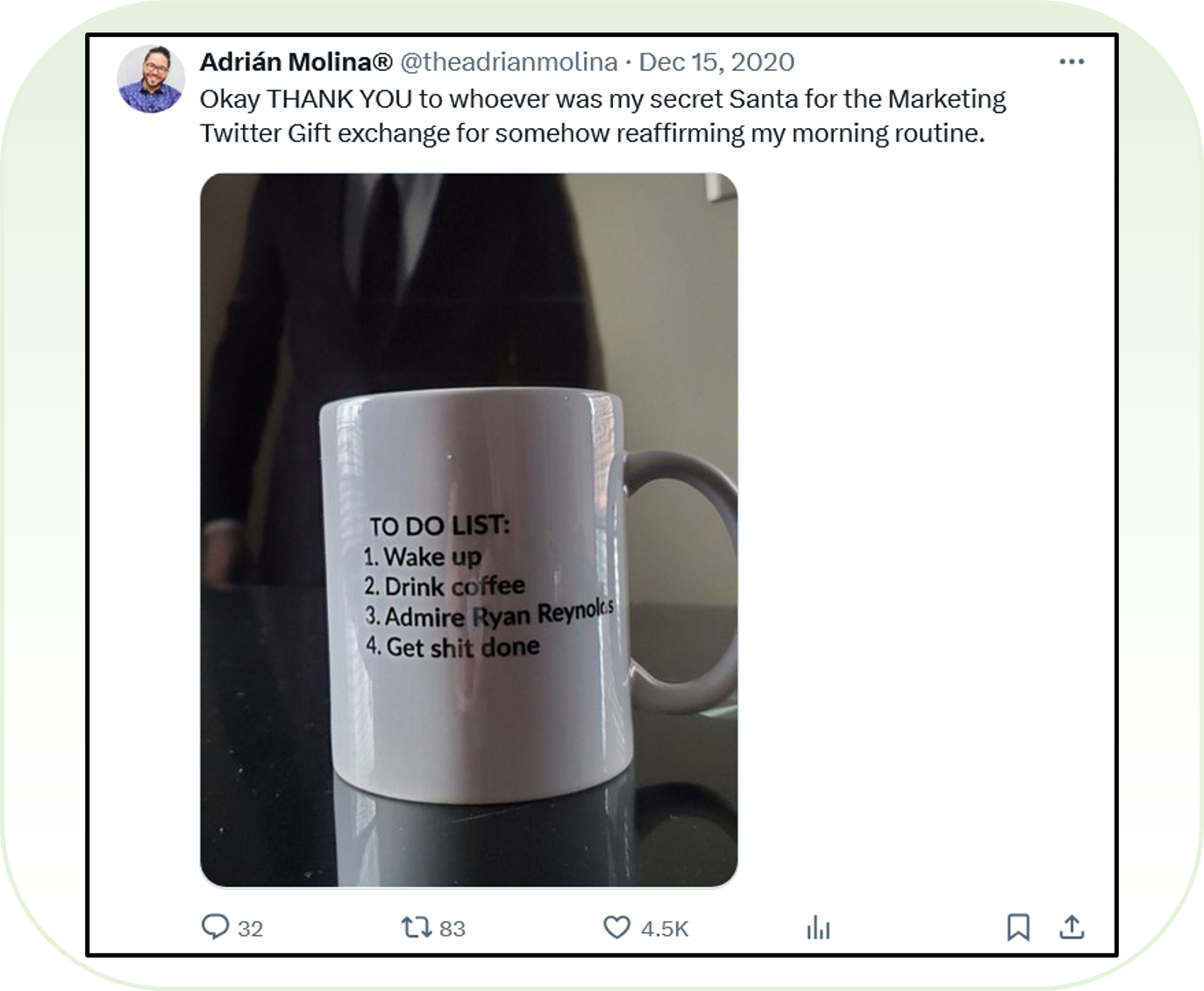
Starkloff’s admiration of Reynolds was neither strange nor discouraged, as Reynolds’ paid employees like Molina put him on a similar pedestal
Indeed, it’s hard to dispute that Starkloff admired Reynolds.
That Reynolds was completely unaware of her admiration — and the boost of motivation his interactions gave her to create free content for his company — doesn’t seem likely.
How much did he end up benefiting from that admiration?
A Detour of Due Diligence into George Dewey
Readers may have noticed that a certain name keeps popping up, but glazed over it as unimportant: George Dewey.
He matters in this story, but we’ll first need to do some background on him to understand why. As mentioned earlier in this article, he is Ryan Reynolds’ creative partner, co-founder, and president of Maximum Effort. Dewey originally came from the traditional advertising world, with a long stint at global advertising agency, McCann, and a job as Head of Digital Marketing at 20th Century Fox before he joined forces with Reynolds on Deadpool.
Thanks to Molina’s interviews, we now also know that Dewey served as Molina’s true supervisor in Aviation Gin’s chain of command, acting as Molina’s liaison for “day-to-day” marketing operations. Yet Starkloff didn’t include Dewey in her lawsuit. Didn’t sue him, didn’t even mention him. Why is that? Doesn’t he have a vital position at Aviation Gin, one that helped shape Starkloff’s negative experiences with the company?
Except he doesn’t.
Despite acting as Molina’s immediate supervisor at Aviation Gin, Dewey is not employed by Aviation Gin, and never was. He is employed only by Maximum Effort.
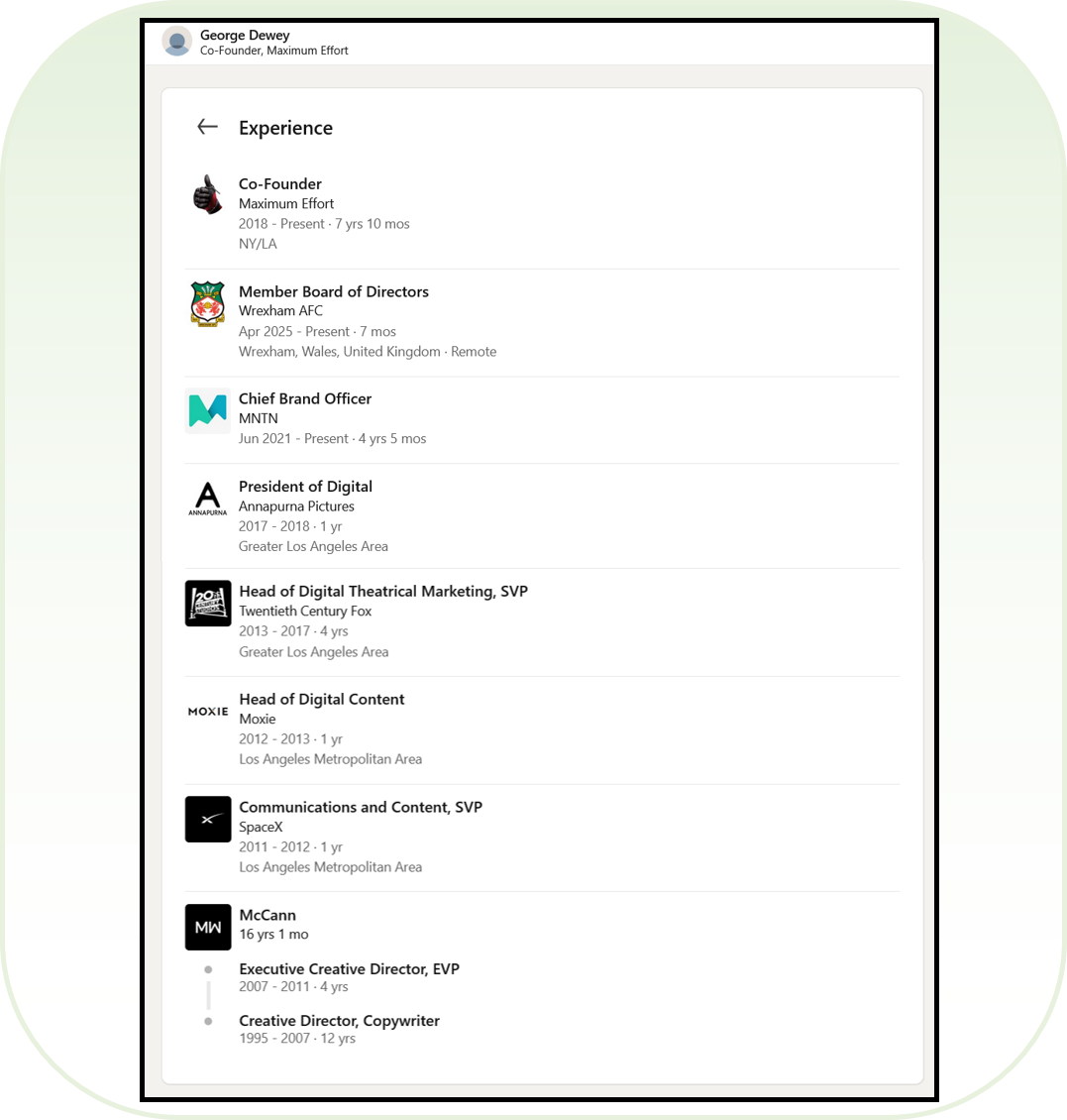
George Dewey’s LinkedIn resume shows that, despite working on behalf of Aviation Gin on a daily basis, he was never employed by the company
If Starkloff was unaware of Dewey’s presence and impact on her dealings with Aviation Gin, that’s most likely by design. The company Maximum Effort is a masterclass on how not to provide business transparency.
Their website only features two links: an About page, which features a pithy two-sentence description about how the company exists to personally amuse Ryan Reynolds, and a Projects page, which shows that the company really is just a self-promotional tool for Reynolds, as all of the projects revolve around him or businesses in which he is either an owner or stakeholder.
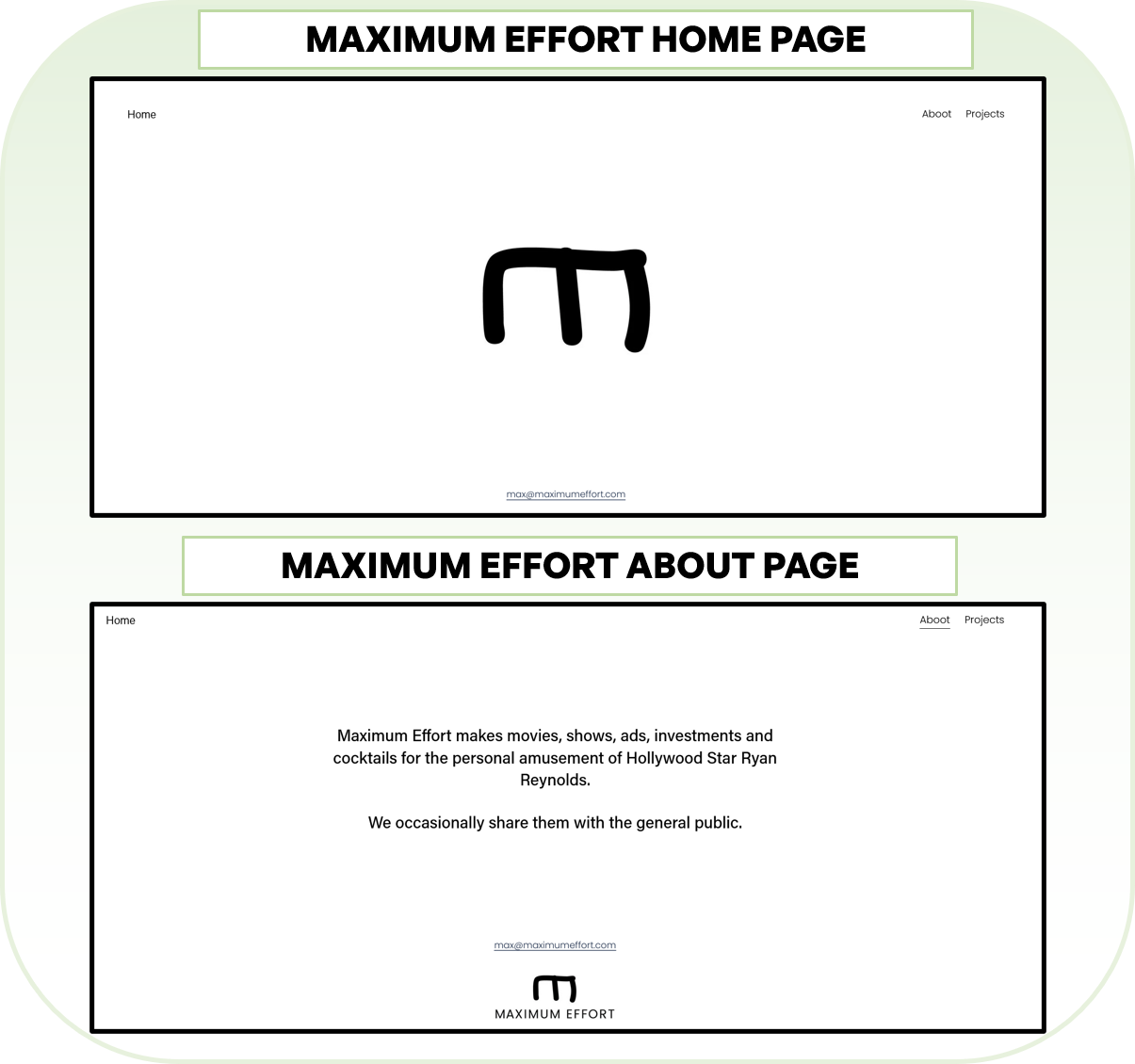
For a company with “maximum” in its name, its official website is stunningly bare
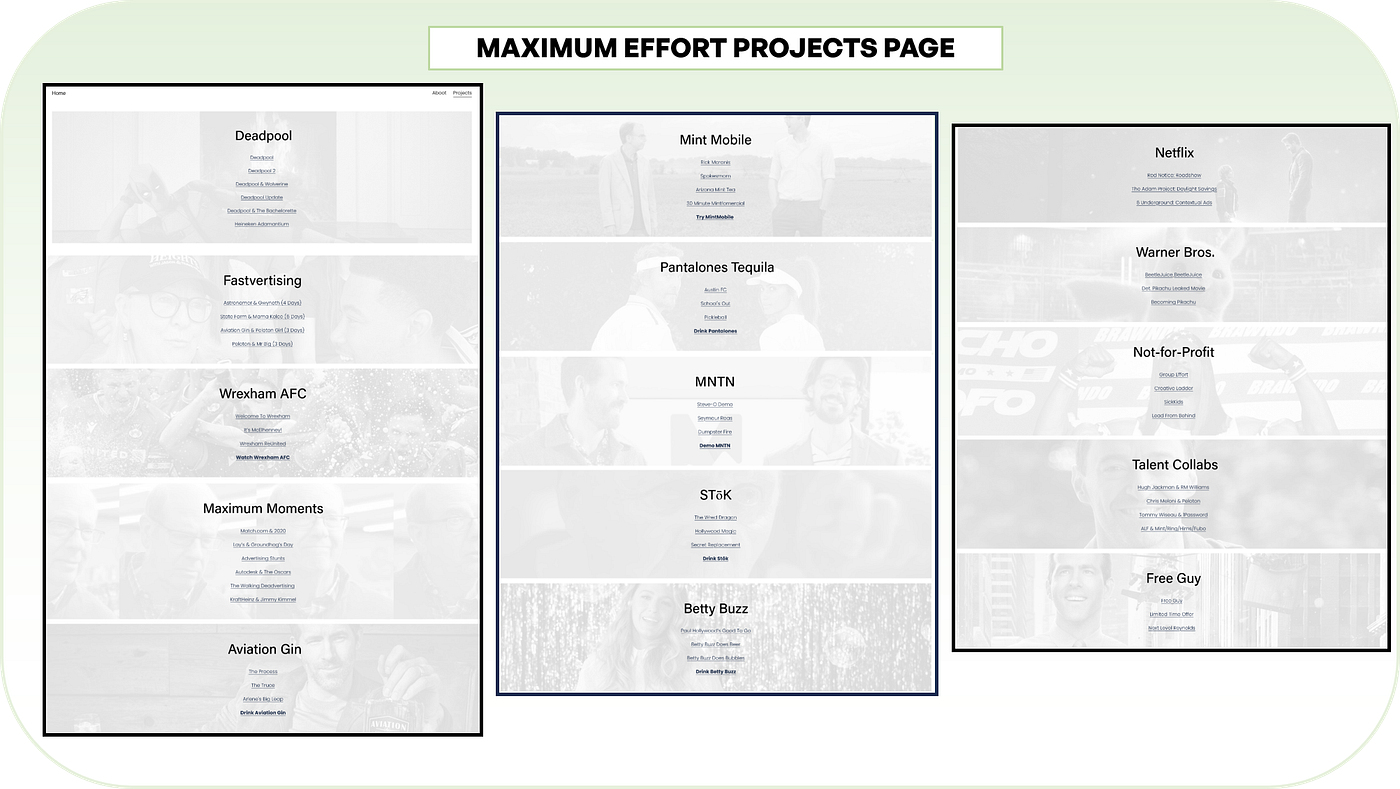
All of Maximum Effort’s advertising campaigns revolve around Reynolds and his business investments
Even a seemingly unrelated product circles back to Reynolds’ wallet. Brewed coffee brand, STōK? The official stadium sponsor of Welsh football club Wrexham AFC, in which Reynolds has ownership. Match.com’s 2020 commercial with Satan? Reynolds sits on the Match board of directors.
Indeed, an examination of Reynolds’ Maximum Effort resume shows a hollow imitation of an advertising innovator. All the crowing about Reynolds’ marketing “genius” seems to ignore that Ryan Reynolds is his own client. He can approve his advertising projects quickly because every product he’s hawking belongs to him in some way.
(It’s worth noting that when he does need secondary approval, there’s a pattern of Reynolds using relentless, repetitive pressure to get his ideas greenlit. He only got the Match commercial approved after bombarding Match employees with emails saying “Hail, Satan.” Which is similar to how he pressured TIME magazine to photograph the back of his head for the cover image. Which is similar to how he called Monica Ruiz “five or six times” to convince her to do the piggyback ad, and how she “dropped out five times within the space of three hours” before eventually relenting.)
What’s just as important as what’s on the Maximum Effort website is what is not on it. There is no mention of the fact that Maximum Effort is, in fact, three separate companies.
The first is Maximum Effort Productions, the studio arm that produces movies like Deadpool, and films commercials for Reynolds’ investments like Mint Mobile and Aviation Gin. The second is Maximum Effort Marketing, a digital marketing agency that has bounced back and forth in ownership between Maximum Effort Productions and MNTN, Inc, a TV tech advertising company that Reynolds also has a stake in as its Chief Creative Officer. The third company is Maximum Effort Investments, LLC — owned by Reynolds and Dewey, along with James Toney, and real estate and private equity firm CEO, Harshal Dave — which is the company that recently started building a 1.2 million-square-foot television studio near Toronto.
In fact, if you search online for “Maximum Effort Productions” or “Maximum Effort Marketing,” there aren’t two separate websites for each company — there’s only the one. This writer only discovered the distinction thanks to business news articles that were about the sale of Maximum Effort Marketing to MNTN — which it held onto for four years before selling it back to Maximum Effort Productions right as MNTN went public with an IPO. (The questionable timing of this corporate re-shuffling didn’t go unnoticed by business analysts.)
If you try searching “Maximum Effort Investments,” good luck. Public mention of its members seems limited to articles about the entity’s recent purchases, like ownership in Formula 1 team Alpine and sports apparel brand HOMAGE, Inc, which has been linked to American football player and Taylor Swift’s current fiancé, Travis Kelce.
In a similar vein, the second major set of data missing from the Maximum Effort website is any information on its leadership. This is why Starkloff most likely had no idea who George Dewey is, and how much of a hand he had in guiding Molina without her ever knowing.
Yet lack of transparency seems to be a theme for Reynolds and Dewey. Speaking of MNTN — where Reynolds currently serves as Chief Creative Officer and George Dewey as Chief Brand Officer — the company was recently sued by Intent IQ for patent infringement, just two days after MNTN went public with an IPO on May 21.
Intent IQ has already filed numerous similar lawsuits against giants like Amazon and Meta, and won. Amazon was forced to pay $122 million for patent infringement, while Meta and other companies like Microsoft, Roku, and Samsung agreed to acquire a license to the patent as an alternative to suffering the same fate as Amazon.
The lawsuit against MNTN is looking to be yet another easy win for Intent IQ, and a defeat for MNTN. Yet MNTN has not disclosed this legal liability to their new shareholders in either press releases or required SEC filings. Neither MNTN’s Form 8-K from May or August makes mention of the lawsuit, nor does their August Form 10-Q.
This isn’t the first time MNTN has gotten into legal trouble. Before MNTN was named MNTN, it was called Steelhouse, and was previously sued by a competitor that accused the company of a “counterfeit click fraud scheme” to falsely inflate click counts. Steelhouse countersued, accusations flung between the two rivals, and then both companies dismissed their lawsuits.
All in all, George Dewey has been Reynolds’ other half in nearly every single one of Reynolds’ business dealings: Deadpool, Maximum Effort (times three!), MNTN, and every third-party advertising project they’ve ever worked on. Dewey is Reynolds’ right-hand man, his perpetual lock-step shadow, the discrete corporate doppelganger to Reynolds’ public-facing celebrity. And it’s precisely that lack of celebrity that has allowed Dewey — and Reynolds’ leveraging of him — to fly under the radar.
Readers may now be asking: How does all of this relate to Starkloff’s lawsuit against Aviation Gin? We’ll get there, promise. But first, it’s time to end the detour and get back to where we left Starkloff.
Reynolds Gets His Big Payday, Starkloff is Still Waiting for Hers
On August 17, 2020, Reynolds cashes in on Aviation Gin.
After two and a half years of ownership, Reynolds sells most of his shares to multinational alcohol beverage company, Diageo, in a highly lauded $610 million deal. The spirits giant — which owns brands like Smirnoff and Johnnie Walker, and which previously purchased George Clooney’s tequila brand for $1 billion in 2017 in a similarly structured deal — acquired both Aviation Gin and its parent company, Davos Brands.
“The acquisition of Aviation American Gin and the Davos Brands portfolio is in line with our strategy to acquire high growth brands with attractive margins that support premiumization,” said Diageo in their press release about the sale.
The press release also cited Aviation Gin’s performance metrics based on IWSR, the industry standard for alcoholic beverage market research. According to IWSR’s 2019 report, Aviation Gin’s sales increased by over 100 percent in volume, making it one of the fastest-growing gin brands in the U.S. Not only that, but the brand was responsible for adding the highest number of cases and contributing 40% of super premium gin segment growth, signaling the brand’s potential to increase its worth over time. (Indeed, the brand would experience “significant growth” from 2020 to 2022, with an 38% increase in volume.)
To say that Reynolds’ flipping of his investment in Aviation Gin into a tidy profit would be an understatement. The Diageo sale earned Reynolds another round of media accolades touting his marketing and business acumen.
Meanwhile, Starkloff benefited from neither the sale or the accolades. Instead, her own spirit started to dampen as she realized she’d been left behind.
But she wasn’t completely deterred. She continued to create photography to promote Aviation Gin throughout 2021, albeit at a fraction of the output and frequency from before the Diageo sale.
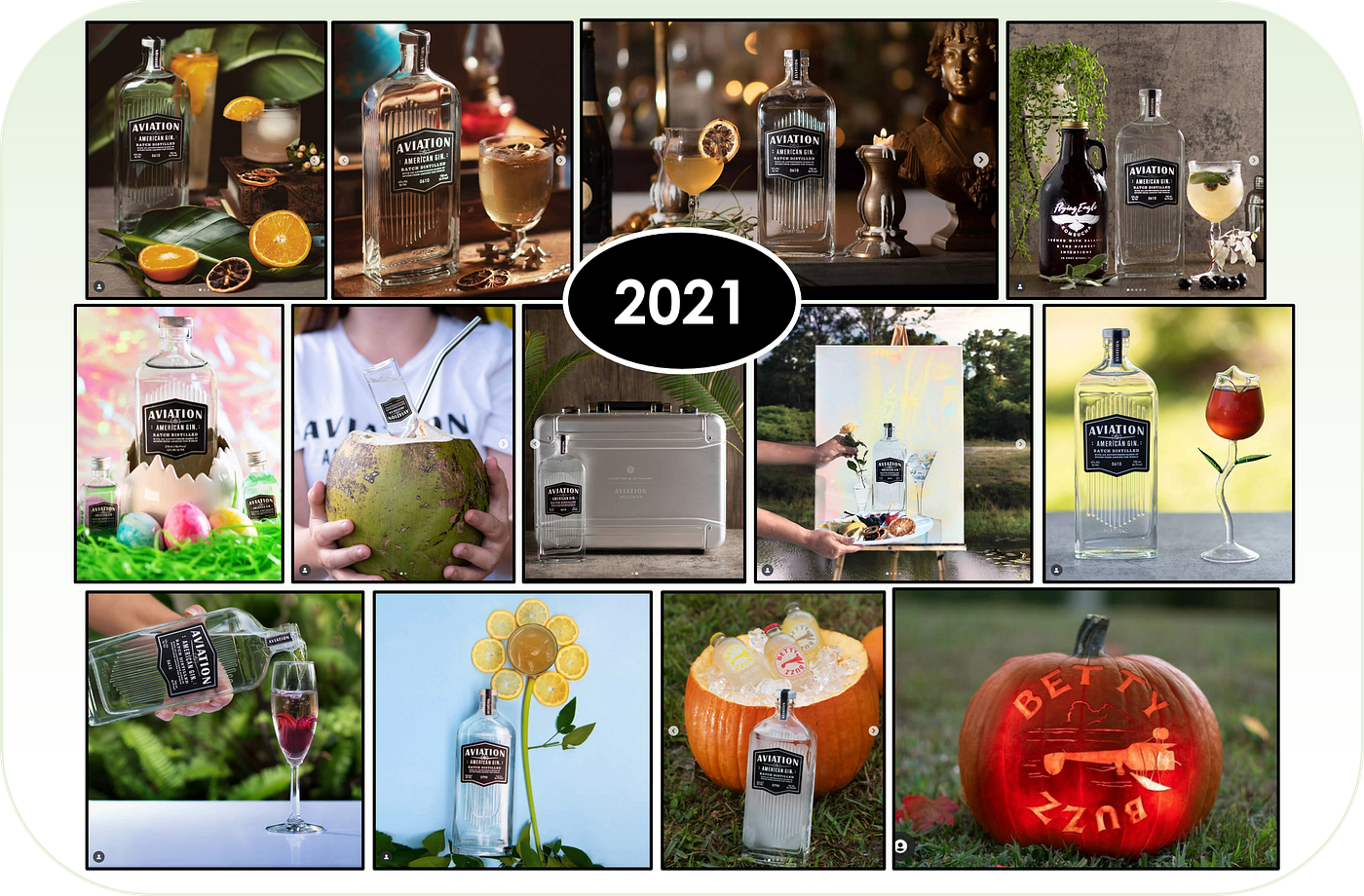
A compilation of Starkloff’s photography work during 2021 to promote Aviation Gin
Towards the end of 2021 — after more than three years of promoting Aviation Gin without employment or compensation — Starkloff finally gets thrown a bone: Maximum Effort offers her a paid gig. Not to promote Aviation Gin, but to promote Reynolds’ wife’s brand, Betty Buzz. Starkloff is thrilled at the opportunity.
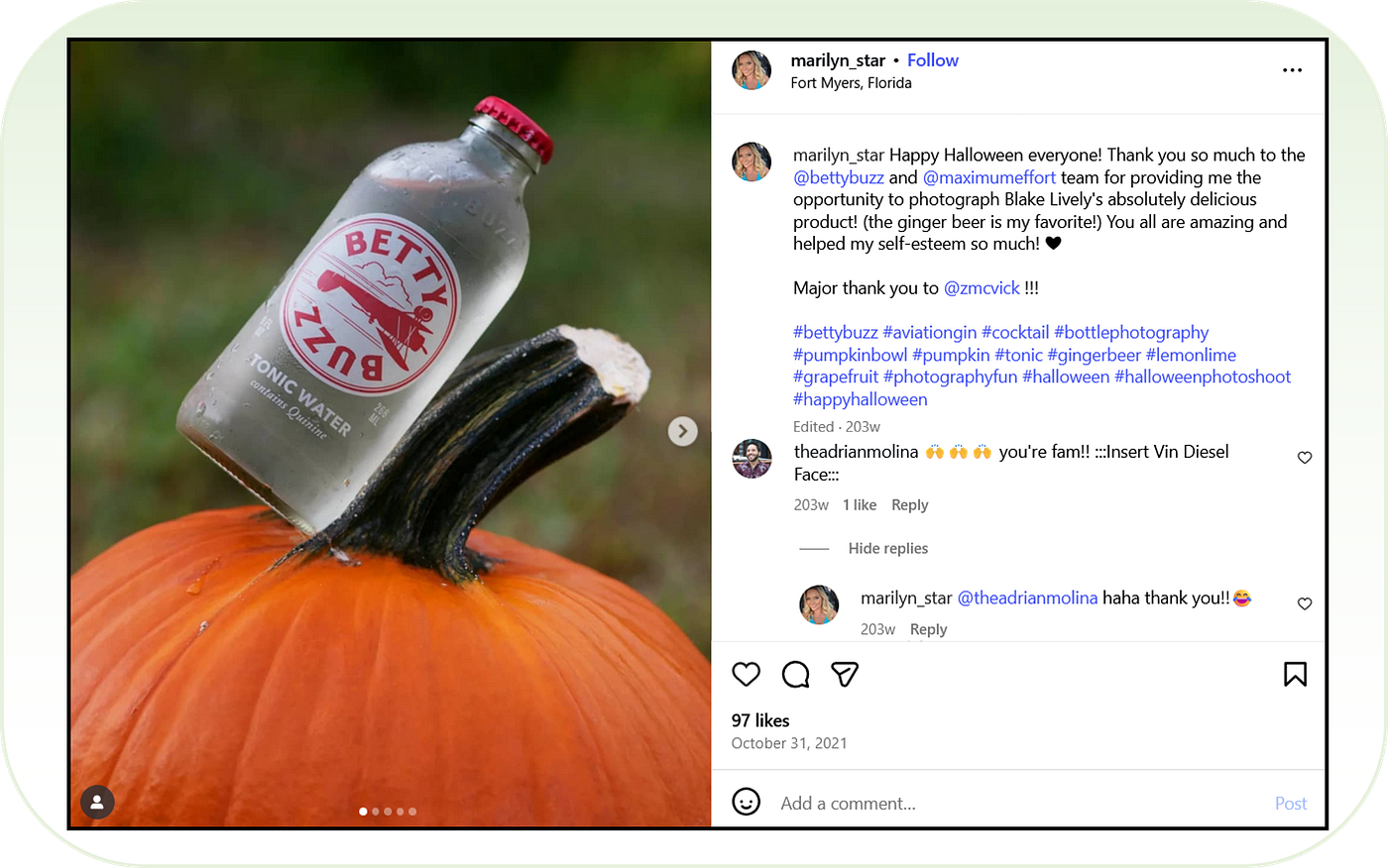
Starkloff’s announces her paid collaboration with Blake Lively’s Betty Buzz brand
“You all are amazing and helped my self-esteem so much,” Starkloff exclaims when she makes the announcement on her Instagram.
“You’re fam,” comments Adrian Molina, including a reference to Vin Diesel’s famous catchphrase in the Fast & Furious franchise. It’s a rare moment of him using his personal account, rather than the official Aviation Gin account.
Starkloff’s new paid gig occupies her whole year, although she still incorporates bottles of Aviation Gin into several of her photoshoots. It’s a sign that, to Starkloff, Betty Buzz may feel like yet another consolation prize, and that her heart’s true wish — to be employed by Aviation Gin, or at least get paid for working with them — remains out of reach.
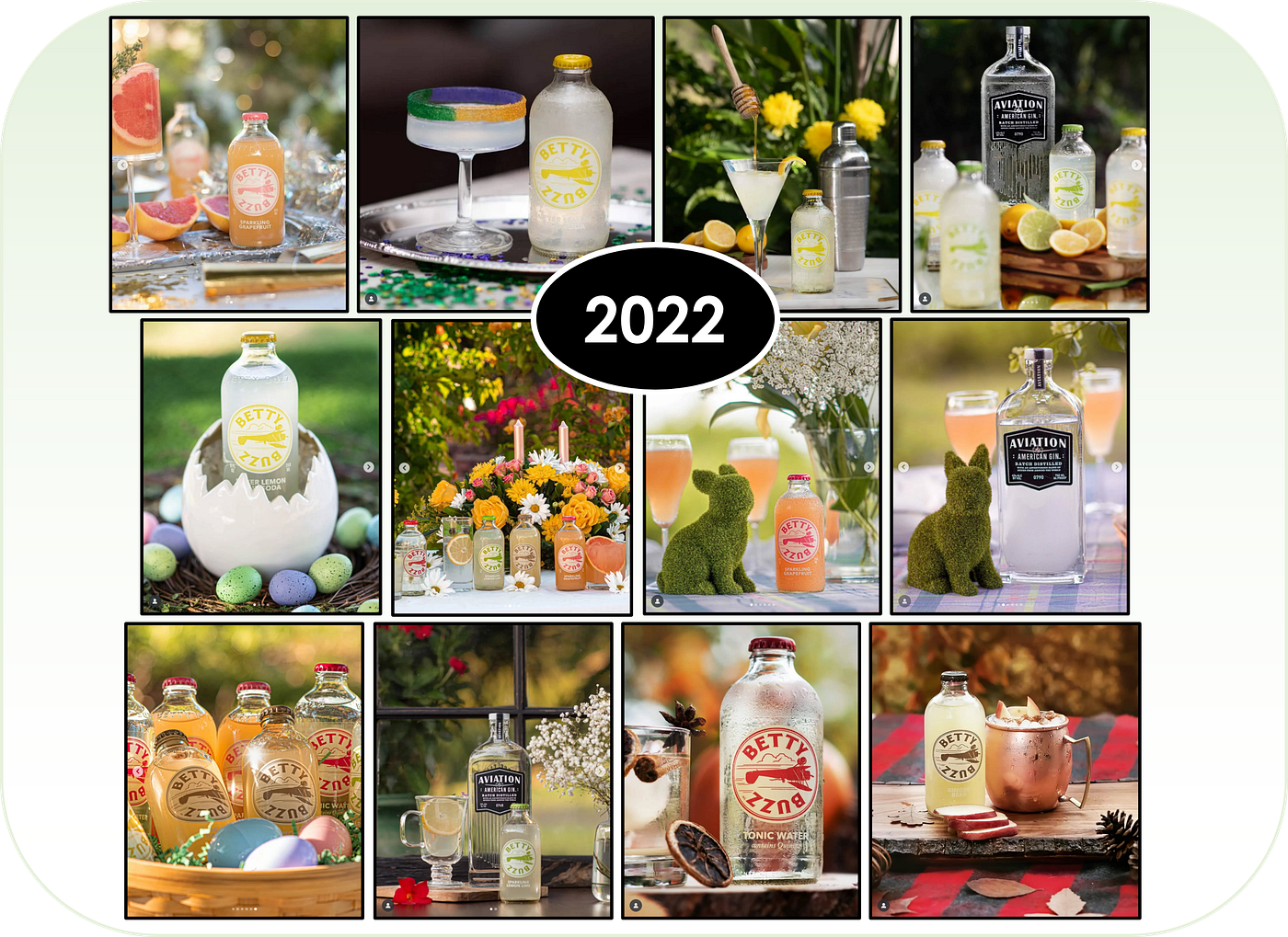
A compilation of Starkloff’s paid photography work during 2022 to promote Betty Buzz, with Aviation Gin bottles being featured as well
Noticing the sustained presence of Aviation Gin in her work, Starkloff’s friends continue to ask her if she’s getting paid to promote the company.
“I hope they pay you to sponsor them. I love Ryan and Blake,” says a friend in response to Reynolds’ personalized quote-tweet of Marilyn’s photo with Aviation Gin in the ceramic Easter egg. “Haha they do for Betty Buzz,” Starkloff responds.
“Hey Marilyn, are you promoting Aviation Gin now?” asks another a month later. “Betty Buzz I do,” she answers.
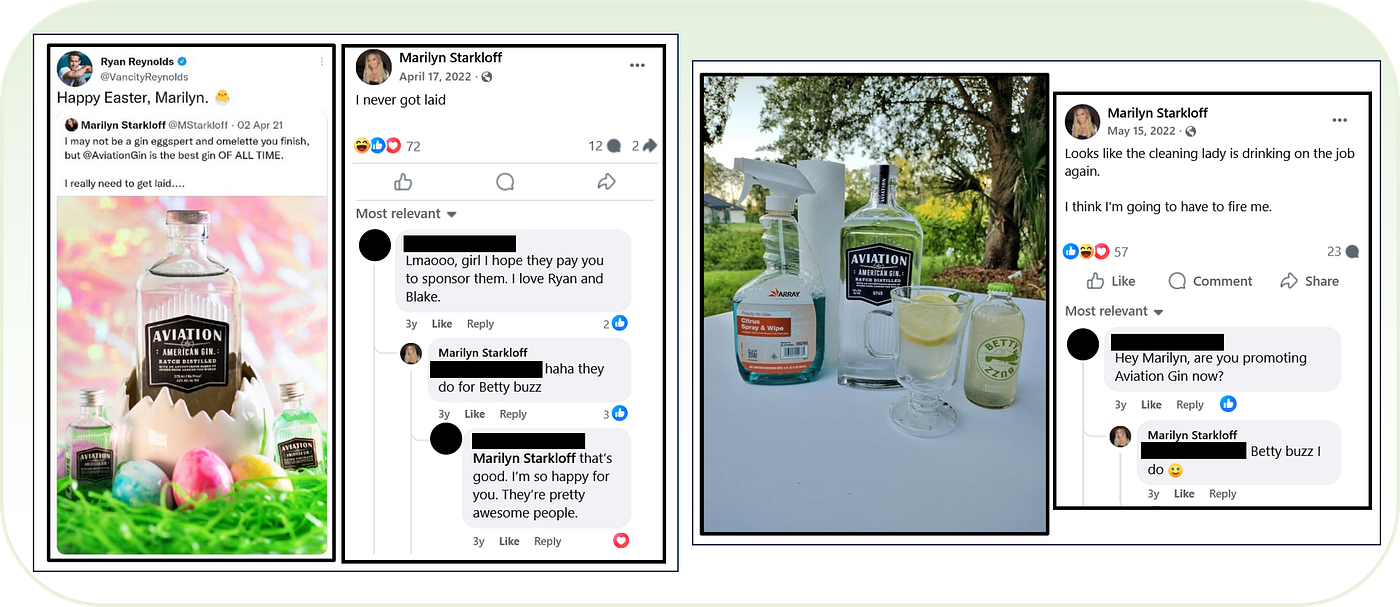
Starkloff’s friends keep asking if and when she will be paid for her work promoting Aviation Gin
A few months later, Starkloff shares a screenshot of Blake Lively liking all of Starkloff’s Instagram posts of the paid work she’s performed for Betty Buzz. (This, along with the fact that Starkloff’s announcement post only tagged the official Maximum Effort and Betty Buzz accounts, suggests that Lively and Starkloff never interacted in the process of hiring Starkloff.)
But Starkloff’s patience with Aviation Gin was wearing thin.
“Are they paying you yet?” asks another friend. “Betty Buzz does,” Starkloff reiterates for the third time.
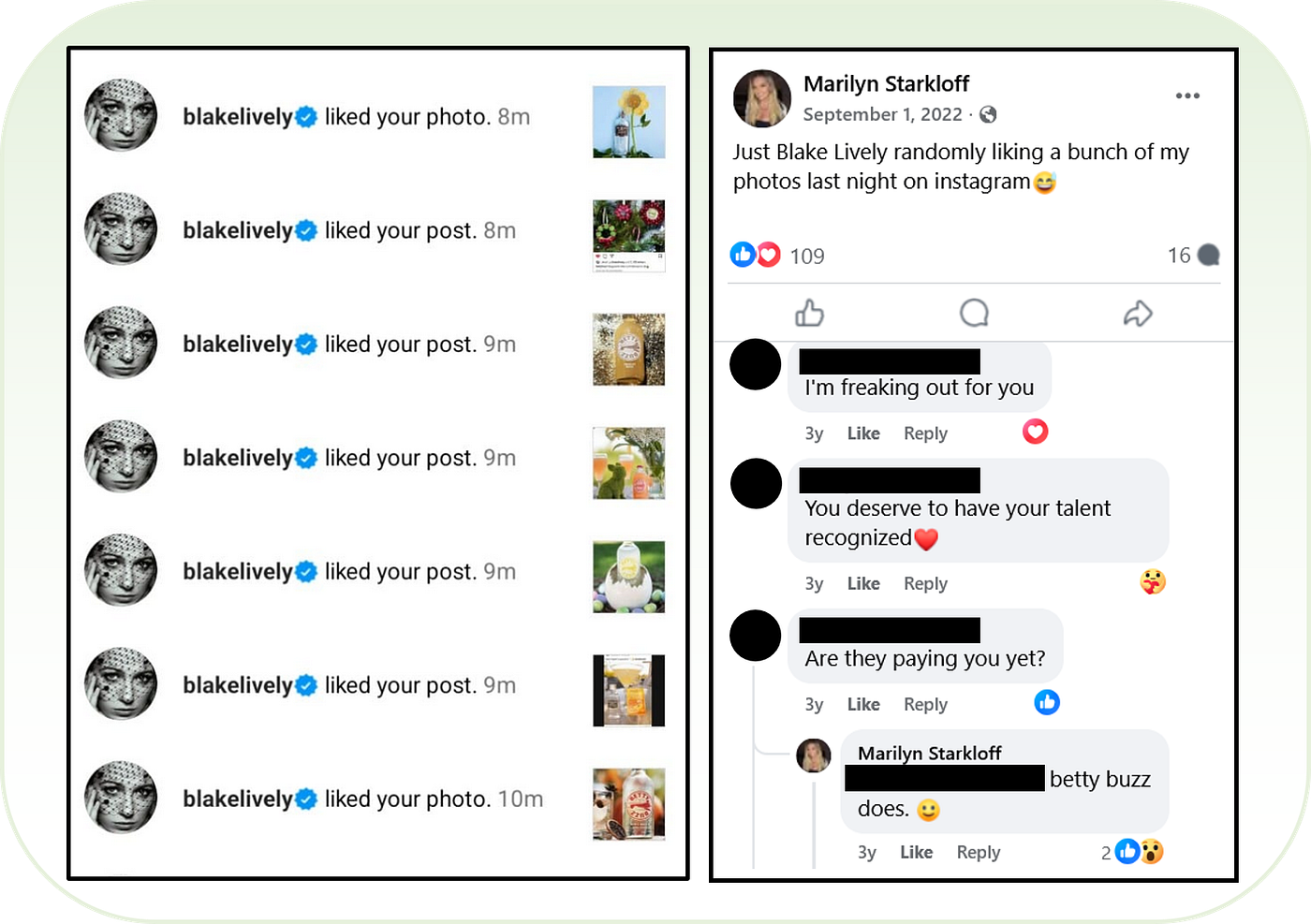
Starkloff repeatedly and pointedly states that only Betty Buzz is paying her for her work, not Aviation Gin
If Starkloff was about to reach her breaking point and leave Aviation Gin behind her forever, the company reeled her back in just enough to keep the sputtering flames of hope flickering. They continued to taunt her with the tantalizing tease of giving her what they clearly knew she wanted: a paid gig for Aviation Gin.
On January 20, 2022, one of Reynolds’ employees, Julian Gamboa, reached out to Starkloff. “Are you shooting for Aviation Gin?” he asks. “No, I shoot for Betty Buzz though,” she responds. “Ahh, but would you be interested in shooting some AAG [Aviation American Gin] content?” To which Starkloff replies with enthusiasm.
Starkloff alleges that despite answering affirmatively, she never received a follow-up response from Gamboa.
Then, again, on September 25 of the same year, a Creative Director for Davos Brands made a similar offer. He told her he would reach out to her soon for “a price quote” because he was “working with a brand that needs some bottle photography.” He told Starkloff he loved her work, and she expressed excitement about finding out which brand.
Just like with Gamboa, Starkloff says she never received a follow-up.
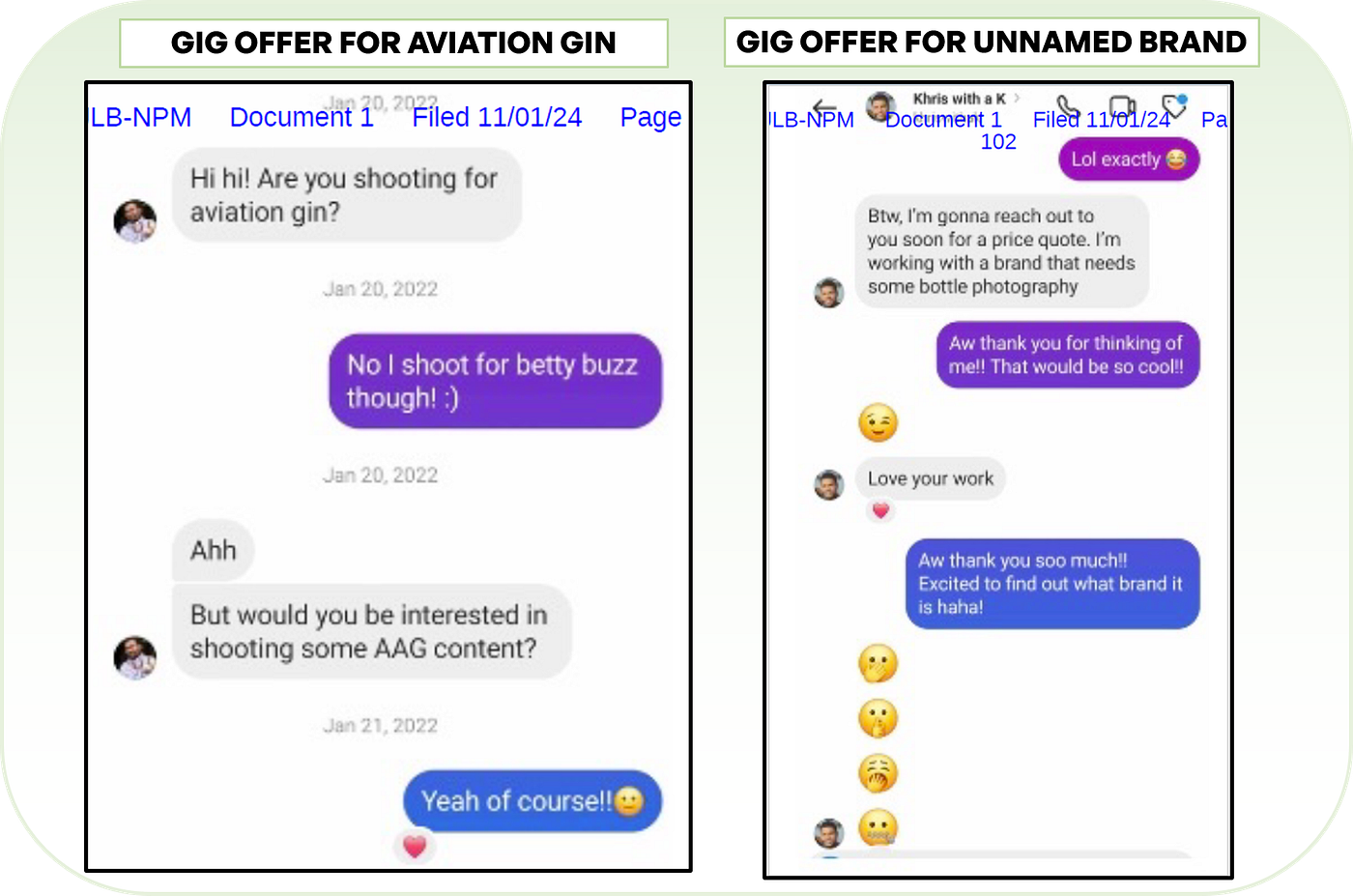
Starkloff received two offers for photography gigs — one of which was for Aviation Gin — and then was ghosted in both instances
If that weren’t enough to keep Starkloff hooked on hollow hope, Reynolds injected a well-timed dose of renewed motivation for Aviation Gin. In February 2023, he shared one of Starkloff’s Aviation Gin photos on his Instagram — like he had done so many times before.
“Haven’t done anything Aviation Gin in a bit with being so busy haha,” says Starkloff. “Nice to see Ryan Reynolds share my photo though!”
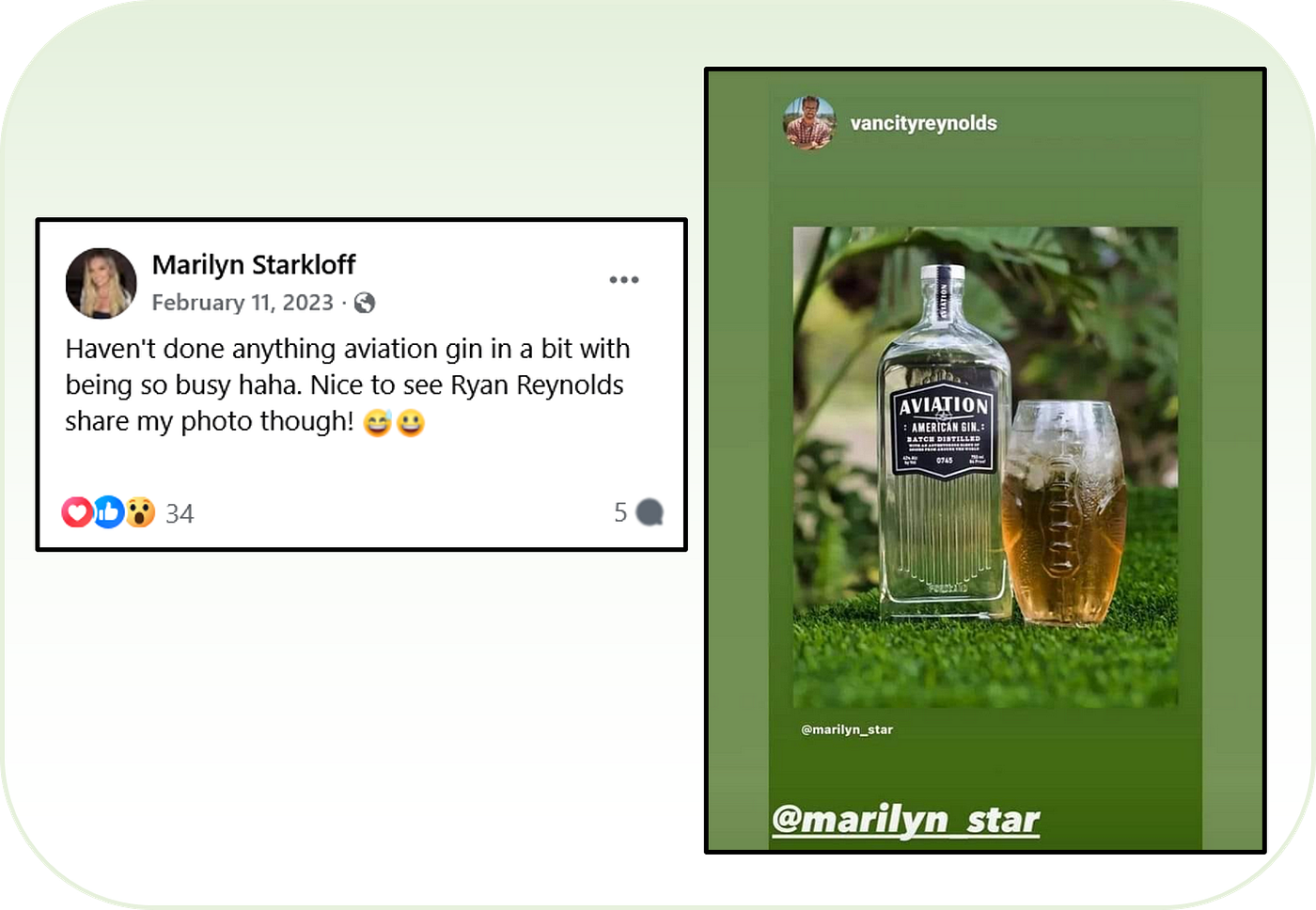
Reynolds returns to share Starkloff’s Aviation Gin photo on his Instagram
It’s unknown when Starkloff’s agreement with Betty Buzz expired. But it’s clear from her 2023 work — in which only one Betty Buzz photoshoot was posted — that it probably ended some time in that year, and she resumed her efforts to pitch her work to Aviation Gin.
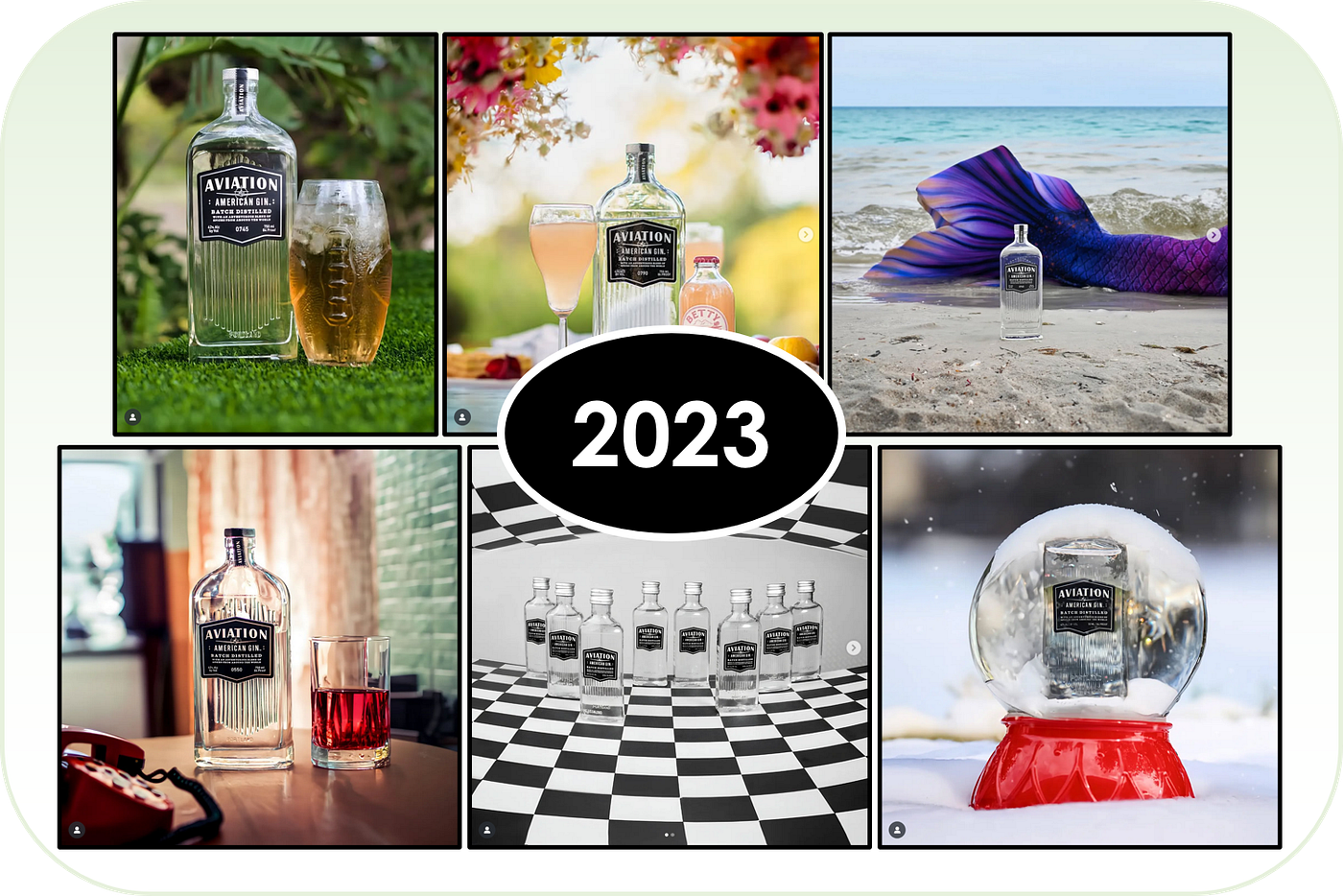
A compilation of Starkloff’s photography work during 2023 to promote Aviation Gin
But the silence and lack of follow-through from Aviation Gin on paid work was deafening. Starkloff had enough.
After five years of having her work taken and exploited for profit and earning insultingly little in return, Starkloff finally advocated for herself.
“I hope this message finds you in good spirits (sorry of the tacky/pun introduction),” she begins in her September 2023 Instagram message to Aviation Gin’s official account. “As a dedicated photographer/content creator, seeing Aviation Gin’s brand flourish and getting to witness the impact of our collaborative work has been nothing short of amazing. I’m very passionate about gin in more ways than one.
“While I have truly enjoyed contributing to Aviation Gin’s success in the past, I must now prioritize sustainable partnerships that align with supporting me as a business.”
(Note: Starkloff launched her own photography business, Stark Creators, in June 2022.)
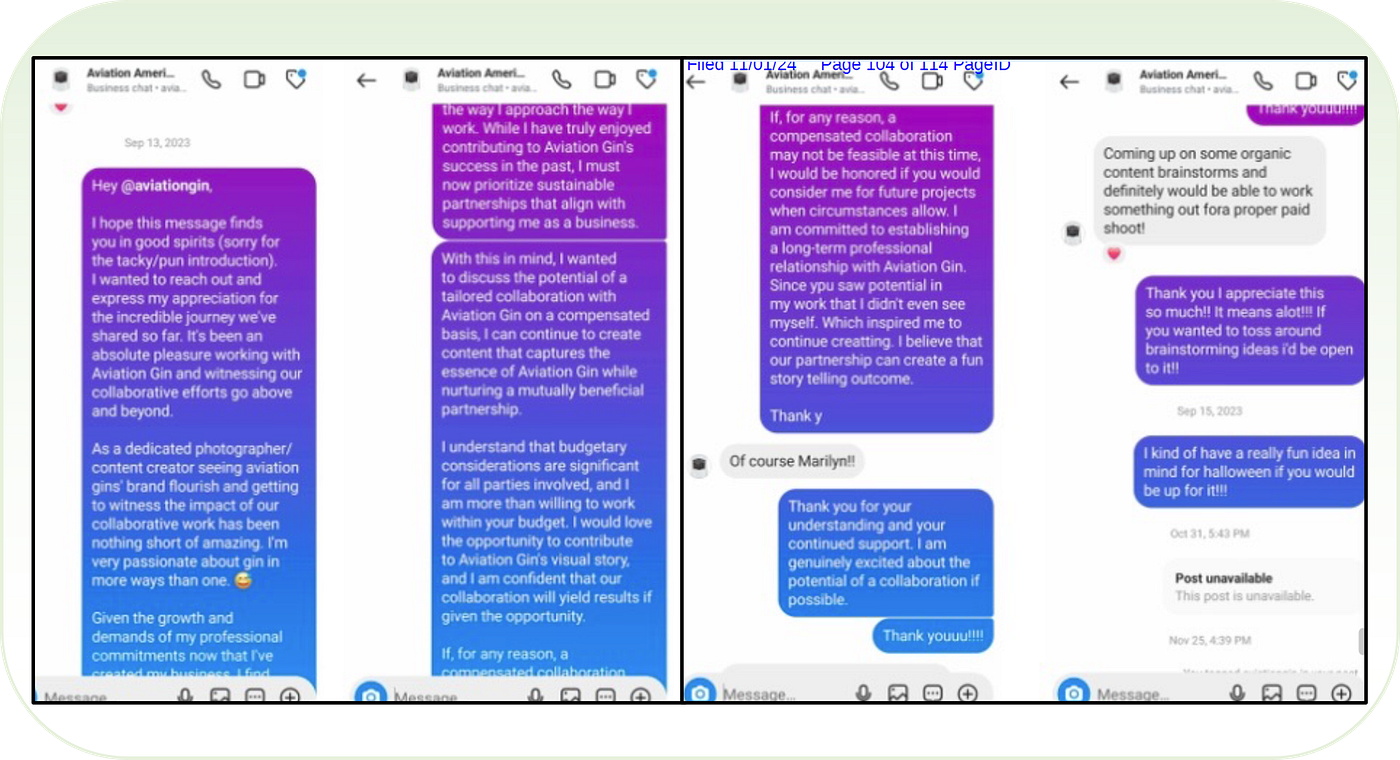
Starkloff messages the official Aviation Gin Instagram account to ask for “collaboration with Aviation Gin on a compensated basis,” to which Aviation responds, “of course!”
“With this in mind, I wanted to discuss the potential of a tailored collaboration with Aviation Gin on a compensated basis,” she continues. “I can continue to create content that captures the essence of Aviation Gin while nurturing a mutually beneficial partnership.
“If, for any reason, a compensated collaboration may not be feasible at this time, I would be honored if you would consider me for future projects when circumstances allow. I am committed to establishing a long-term professional relationship with Aviation Gin. Since you saw potential in my work that I didn’t even see myself. Which inspired me to keep creating. I believe that our partnership can create a fun story telling outcome.”
Aviation Gin responded, saying, “Of course, Marilyn!!” Then, later in their exchange, they added, “Coming up on some organic content brainstorms and definitely would be able to work out for a proper paid shoot!”
Reinvigorated, Starkloff resumed her unpaid work for Aviation Gin — in what would be the final round.
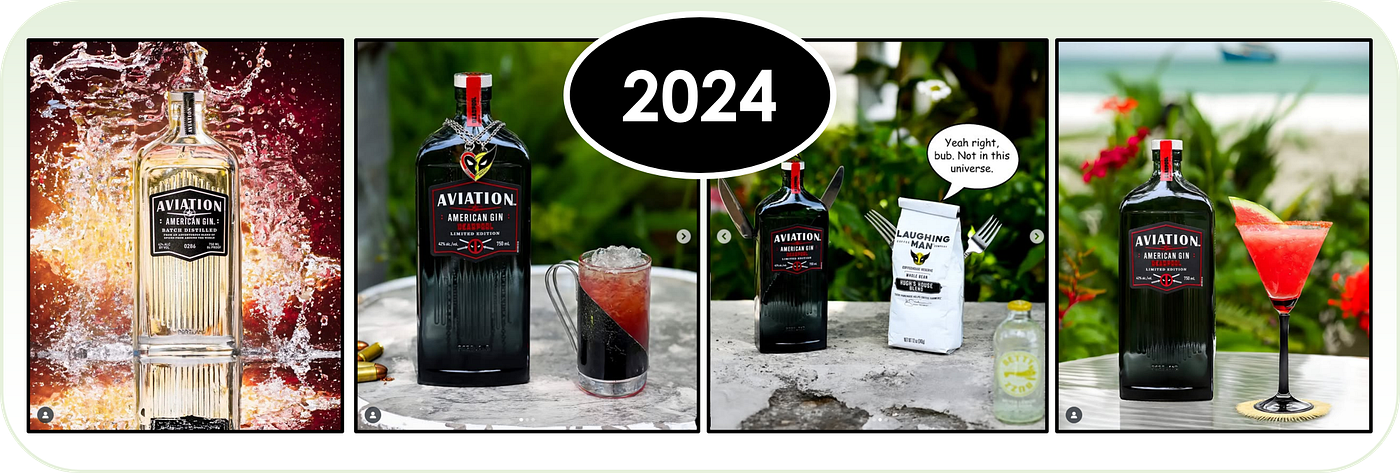
A compilation of Starkloff’s photography work during 2024 to promote Aviation Gin
The Final Straw: Plagiarism
Starkloff barely took any self-initiated Aviation Gin photos in 2024. Of those she did, they revolved around the limited-edition Deadpool-themed bottle sold in honor of and collaboration with the Deadpool & Wolverine movie that would release in July.
One such photo was made in the style of a comic book panel, featuring the limited-edition bottle of Deadpool-themed Aviation Gin with two butter knives attached as arms, a packet of Hugh Jackman’s Laughing Man coffee with forks as arms, and a bottle of Betty Buzz in the foreground.
“There’s something about that Betty Buzz bottle; I can see us making cocktails together — four specifically,” says the Deadpool bottle in a comic book-style speech balloon. “Yeah, right, bub,” says the Wolverine-themed Laughing Man coffee, “Not in this universe.”
According to Starkloff, this was just the start of her “multiverse” idea for promoting Aviation Gin. On June 18, two days after her photo, she tweeted on X that she had “an idea to create comic strip photos of the Deadpool gin universe.” Reynolds shared this tweet in his Instagram story.
Then, on July 22 — almost exactly one month after Starkloff’s multiverse photo, and the same day as Deadpool & Wolverine’s premiere in New York — the official Aviation Gin Instagram account posted a photo that was conspicuously similar. It featured a bottle of the same limited-edition Deadpool-themed Aviation Gin, along with a limited-edition Wolverine-themed Aviation Gin bottle.
“The universe where we turned into super delicious bottles of Aviation Gin I think,” it says next to the bottles.
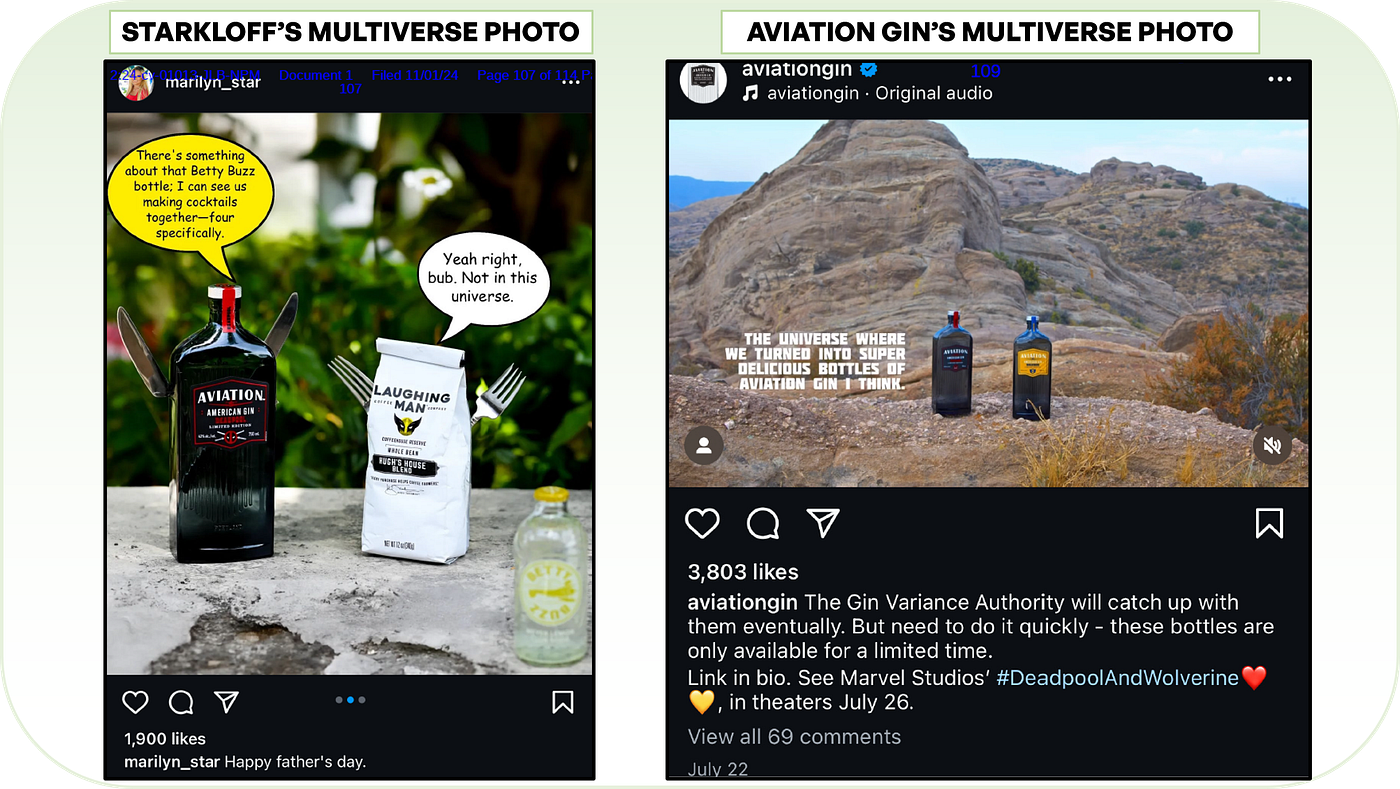
Aviation Gin’s “multiverse” photo that was posted on the premiere day of Deadpool & Wolverine looks suspiciously similar to Starkloff’s “multiverse” photo from a month earlier
Starkloff hit her limit.
On July 26, she sent an email to Bryan Rowland, Director and Editor at Maximum Effort, and Clare Berman, Senior Director of Operations at Maximum Effort. It reads:
“Over the past six years, I’ve dedicated a significant amount of time and effort to creating content for Aviation Gin. Much of this work was done on my own initiative, although there were also direct requests from the company. Despite numerous messages about potential compensation, paid gigs, and messages of merchandise, I have not received payment or so much as a bottle, just some merchandise. Most of the merchandise I received had to be given to models featured in the images used on Aviation Gin’s website, as well in other instances where I was requested for specific content. I did not have the means to pay them. I didn’t expect to work for nothing. Additionally, some of my images were posted without my knowledge or proper credit. I let this slide at the time, simply happy that my work was enjoyed, hoping it would foster a positive and collaborative experience in the future.”
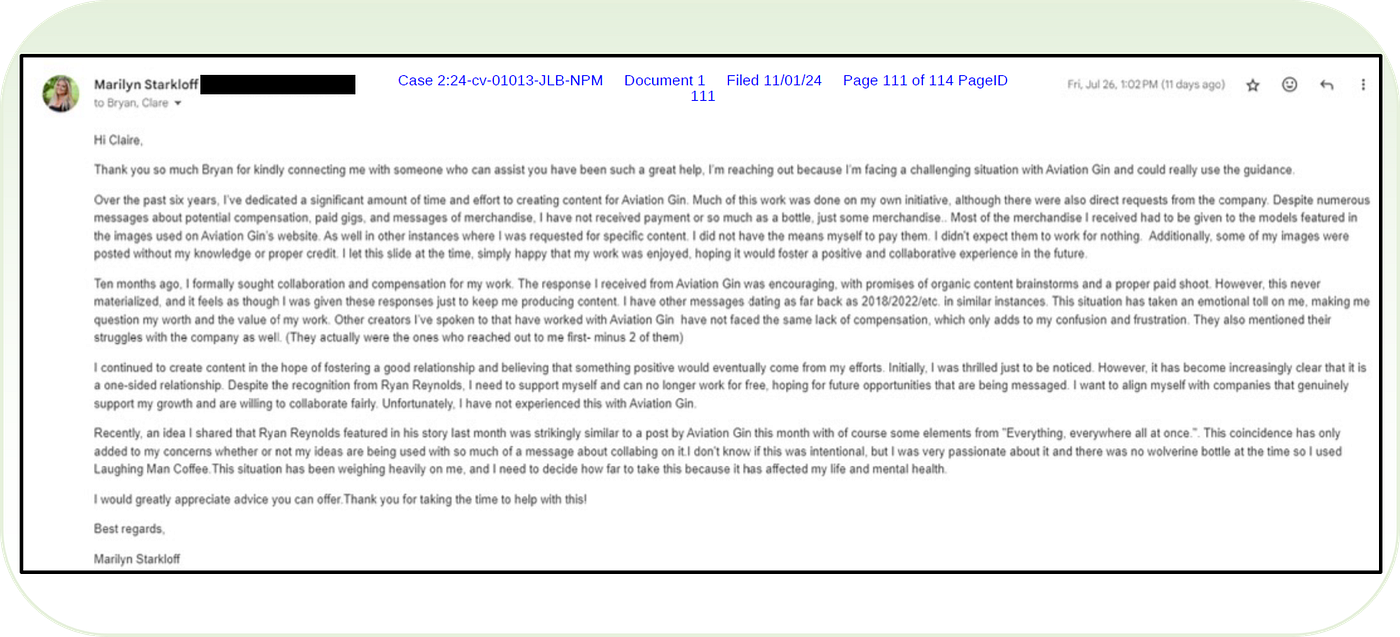
Starkloff’s email to Maximum Effort outlines the mistreatment and exploitation she’s experienced at the hands of Aviation Gin for the past six years
“Ten months ago, I formally sought collaboration and compensation for my work. I response I received from Aviation Gin was encouraging, with promises of organic content brainstorms and a proper paid shoot. However, this never materialized, and it feels as though I was given these responses just to keep me producing content. I have other messages dating as far back s 2018/2022/etc. in similar instances. This situation has taken an emotional toll on me, making me question my worth and the value of my work. Other creators I’ve spoken to that have worked with Aviation Gin have not faced the same lack of compensation, which only adds to my confusion and frustration. They also mentioned their struggles with the company as well. (They actually were the ones who reached out to me first — minus two of them.)
“I continued to create content in the hope of a good relationship and believing that something positive would eventually come from my efforts. Initially, I was thrilled just to be noticed. However, it has become increasingly clear that this is a one-sided relationship. Despite the recognition of Ryan Reynolds, I need to support myself and can no longer work for free, hoping for future opportunities that are being messaged. I want to align myself with companies that genuinely support my growth and are willing to collaborate fairly. Unfortunately, I have not experienced this with Aviation Gin.
“Recently, an idea I shared that Ryan Reynolds featured in his [Instagram] story last month was strikingly similar to a post by Aviation Gin this month with of course some elements from “Everything Everywhere All at Once.” This coincidence has only added to my concerns whether or not my ideas are being used with [sic] so much of a message about collabing on it. I don’t know if this is intentional, but I was very passionate about it and there was no Wolverine bottle at the time, so I used Laughing Man Coffee. This situation has been weighing heavily on me, and I need to decide how far to take this because it has affected my life and mental health.”
Starkloff receives no response. She tries again a few days later, on July 30. Even then, she gives Maximum Effort praise.
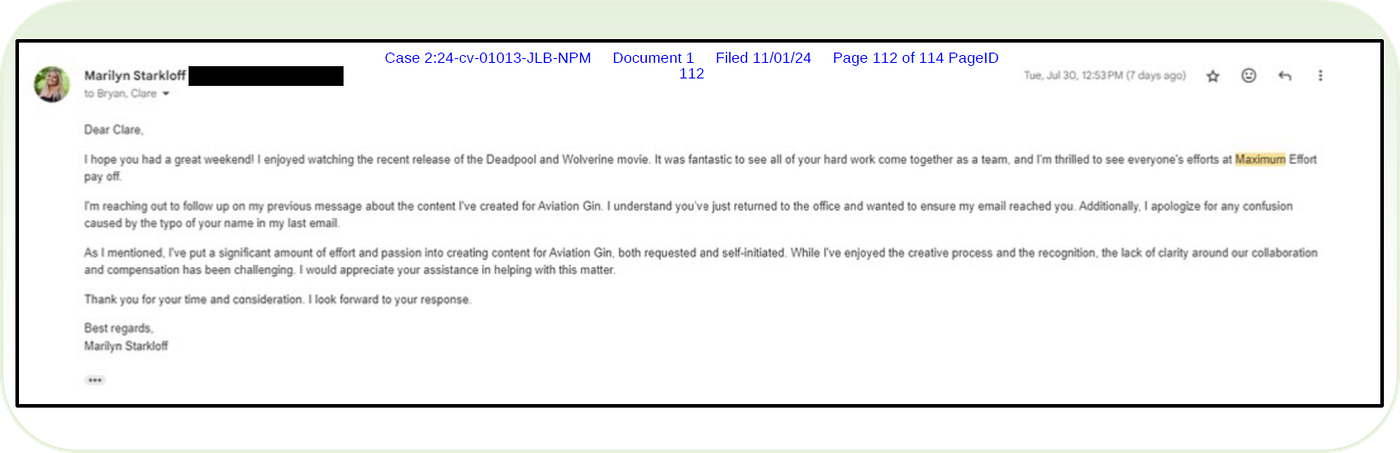
Starkloff remained polite and even complimentary in following up to confirm receipt of her first email
“I enjoyed watching the recent release of the Deadpool and Wolverine movie,” she tells them. “It was fantastic to see all of your hard work come together as a team, and I’m thrilled to see everyone’s efforts at Maximum Effort.”
Starkloff once again receives no response. She makes her third and final attempt on August 5. (Ironically, this is the day before the premiere for It Ends with Us.)
“I have maintained detailed records and screenshots of my communications with your team, which I have been told by a legal professional who specializes in these claims are sufficient evidence,” she writes. “However, my intent is not to escalate matters legally but rather to seek a fair resolution if possible. This situation has significantly impacted my mental health and professional life for years, and I hope we can address it amicably so that I don’t have to raise awareness of these issues publicly.”
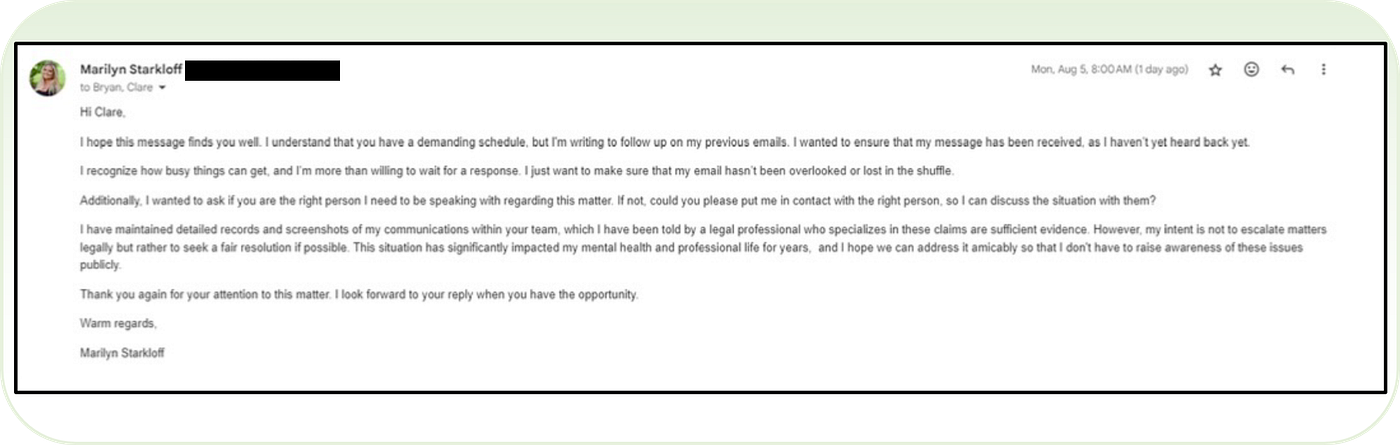
Starkloff’s third and final email warns that she has sought legal counsel
Maximum Effort and Aviation Gin’s response? Well, it wasn’t delivered via email.
Instead, a month after Starkloff’s last email attempt, someone on Reynolds’ team reported one of Starkloff’s Facebook posts to get it removed. The post — which was indeed removed by Facebook and is no longer available — was made the day after Starkloff’s quarantini, and suggests that Aviation Gin had sent her a video then in relation to her viral posts.
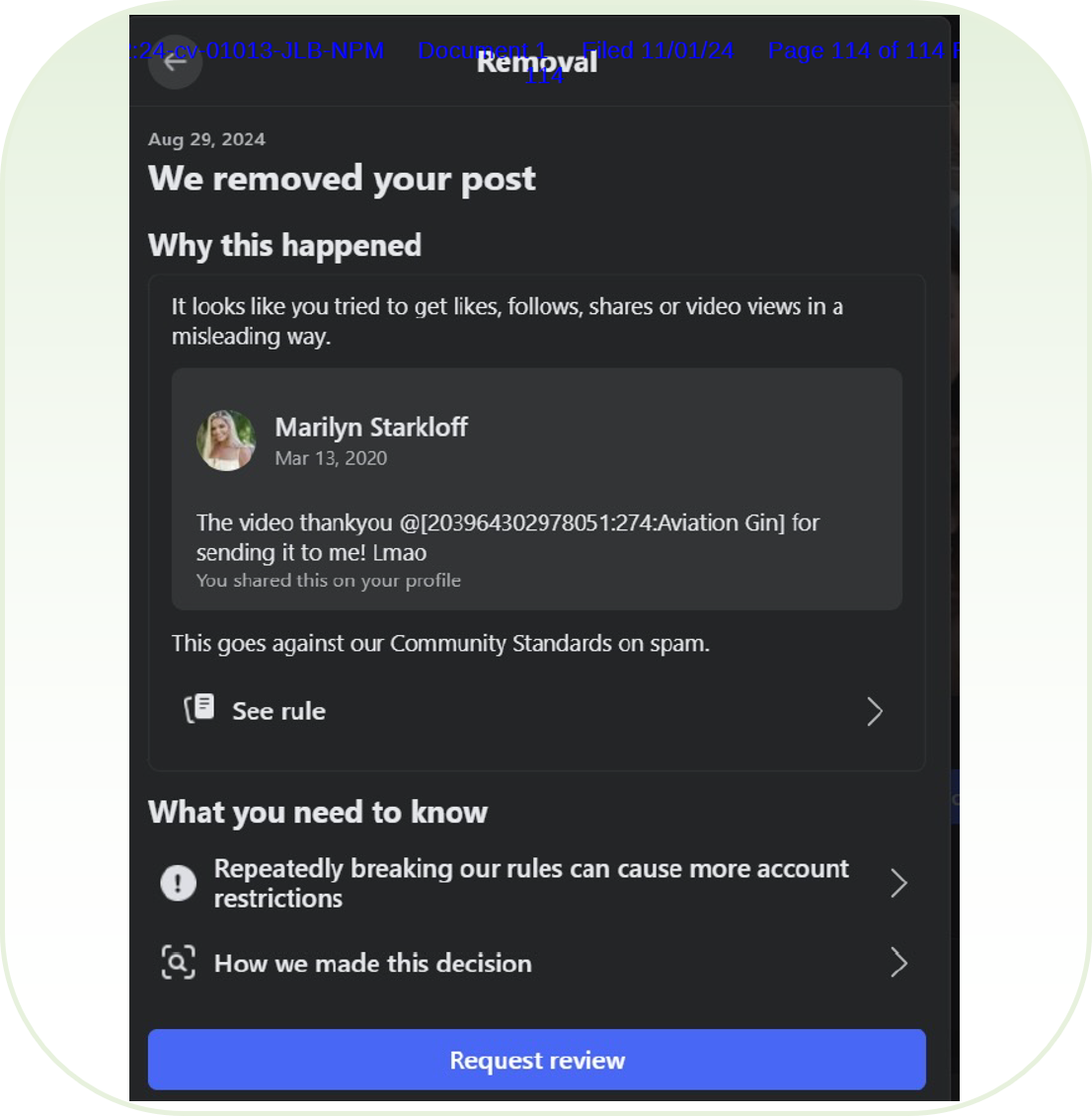
Someone from either Maximum Effort or Aviation Gin reported one of Starkloff’s Facebook quarantini posts to get it removed
Worse, Starkloff’s lawsuit claims that the removal notice was based on a copyright strike. In other words, despite years of Aviation Gin infringing on her copyright by using her photos without compensation and consistent attribution, they were invoking copyright law to delete evidence of their use of those photos.
With that, Starkloff’s rose-colored glasses finally and firmly fell off.
On September 11, 2024, Starkloff filed two copyrights for her photos. (She ends up filing another two later in the month.) Then, on November 1, she filed her lawsuit against Aviation Gin, Diageo, Maximum Effort Productions, Ryan Reynolds, and Adrian Molina.
Starkloff’s Suit and The Single Sentence That Struck Fear
At this point, it should be abundantly apparent why Starkloff’s lawsuit was settled swiftly. But there’s slightly more to it than the culpability of Aviation Gin in exploiting Starkloff as an artist over a six-year period.
First, recall that the sale of Aviation Gin to Diageo was not long after Starkloff’s quarantini creation, and that her viral posts inspired both restaurant and bars and individual customers to purchase Aviation Gin to make the unique cocktail.
“While not the sole reason for the purchase by Diageo, Plaintiff’s Quarantini post clearly led to a heightened valuation of Aviation Gin which it then capitalized on and parlayed the virality and success into the subsequent sale,” her lawsuit reads.
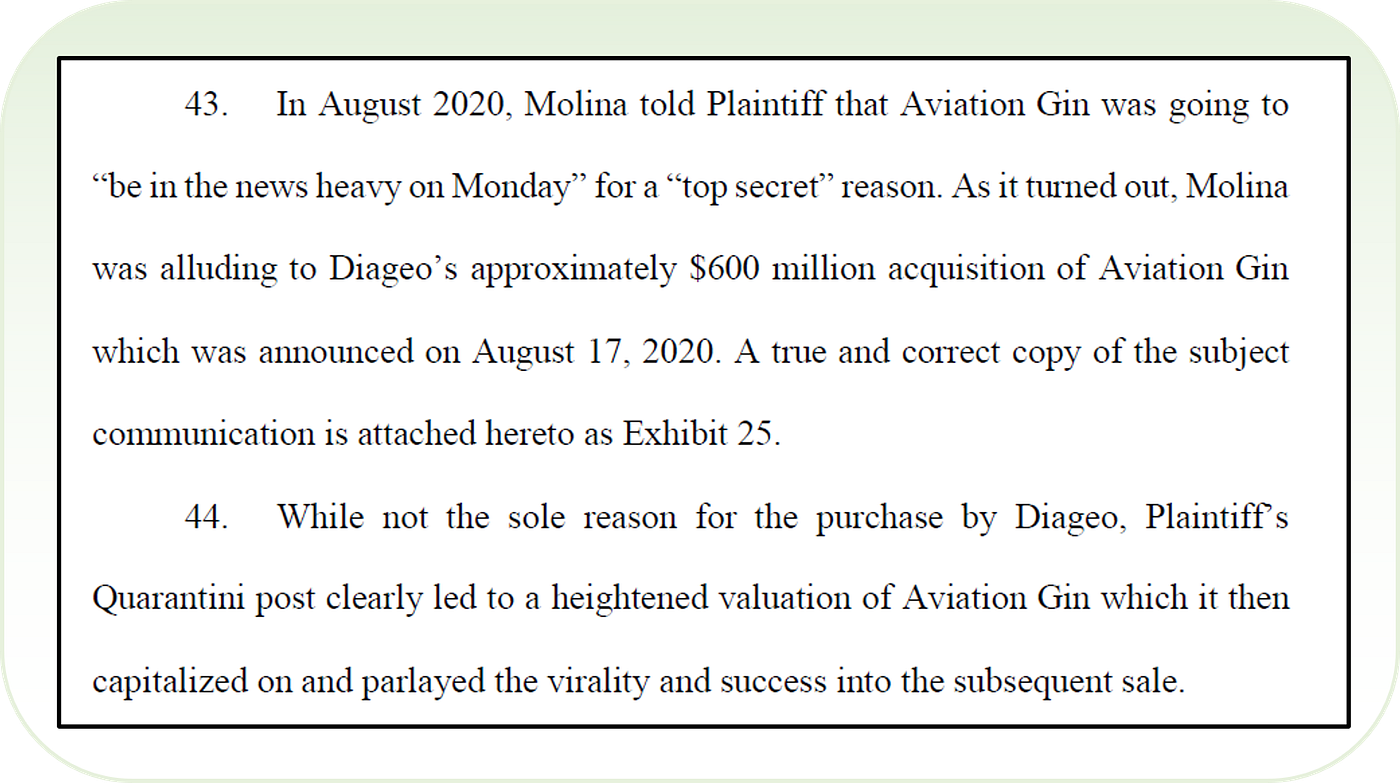
Starkloff’s lawsuit connects her quarantini posts to Diageo’s valuation of Aviation Gin
As for all of the photographs Starkloff had taken — both self-initiated and requested — Starkloff knew she’d been had, but couldn’t easily put a price tag on the exploitation she’d experienced.
Copyright law would have helped here. Indeed, when Blake Lively’s company, Blakel, Inc, was sued for copyright infringement for a single photo by a paparazzi photographer, his lawsuit claimed he was entitled to up to $150,000 of statutory damages for willful infringement based on copyright protection laws.
Unfortunately for Starkloff, the statute of limitations for copyright infringement had passed for many of her photos by the time she filed her lawsuit against Aviation Gin. She states in her complaint that she trusted and relied on Aviation Gin’s September 2023 promises of compensated collaborations with her, and that she would have taken legal action sooner had they not mislead her at such an important juncture.
So, since she couldn’t easily calculate the financial value of what she was owed, she took the logical step and asked for it to be determined via court process.
“As a direct and proximate result of Defendant’s infringing conduct alleged herein, Plaintiff has been harmed and is entitled to damages in amount to be proven at trial,” her lawsuit states.
Yet neither of those sentences were as devastating to Ryan Reynolds as the next.
“Plaintiff is also entitled to recovery of Defendant’s profits attributable to Defendant’s infringing conduct alleged herein, and an accounting of and a constructive trust with respect to such profits.”
Starkloff’s lawsuit requested a full accounting of Aviation Gin’s profits in order to determine the financial harm done to her
Accounting. Financial records. In trying to ascertain the value of her appropriated work, Starkloff’s lawsuit inadvertently activated a type of accountability that Reynolds seems to have long been avoiding: an audit of his companies.
The company Maximum Effort — well, all three of them — is a private company. Unlike a public company, which is held to significantly stricter scrutiny thanks to shareholders and the SEC, Maximum Effort has long enjoyed the benefit of keeping its opaque organizational structure and murky methods concealed from the public eye.
That almost changed when MNTN went public. But then it didn’t, because the company conveniently sloughed off Maximum Effort Marketing before shareholders would have the right to take a look at it. And although business analysts suspected the timing was due to Lively and Reynolds’ lawsuit with Baldoni — the company was sold off in May, a month before Reynolds was dismissed from the lawsuit — there are signs pointing to a different explanation.
Let’s go back to George Dewey. (See, we didn’t forget him.)
Recall that Dewey did not, and has not, ever worked for Aviation Gin. Yet Molina stated on many occasions that Dewey essentially served as his de facto daily supervisor. So, the question is: Has any part of Dewey’s salary been correctly recorded as an operating expense in Aviation Gin’s accounting records?
How about Julian Gamboa?
Gamboa is a blink-and-you-miss-it character in this story, who’s actually shown up twice. He was the interviewer who interviewed Molina in Adweek’s Social Confidential in 2020. He’s also the one who messaged Starkloff asking if she wanted to shoot Aviation Gin content in 2022.
Turns out, Gamboa was working for Adweek in 2020, and was then hired by Maximum Effort, joining the company on November 1, 2021. (Funny how neither Aviation Gin nor Maximum Effort could find a paid role for Starkloff at this time, even though Molina revealed that Aviation Gin has also previously hired interns.) Starkloff named Gamboa in her lawsuit for his role in reaching out to her in 2022, but incorrectly identifies him as “an Aviation Gin employee.”
And there it is. This is why Dewey, Gamboa, and Starkloff’s request for a full accounting of Aviation Gin’s profits matters — a whole lot.
The blurred lines between the two companies aren’t an occasional blip. It’s constant. When researching Aviation Gin and Maximum Effort, it’s frustratingly difficult to determine who works where, and what their roles are. Indeed, when Starkloff wanted to contact Aviation Gin in July 2024 to voice her grievances about the lack of compensation, she was told to contact executive leadership in Maximum Effort — Bryan Rowland and Clare Berman — not Aviation Gin.
This makes it equally difficult to walk away with any other conclusion than that this confusion is deliberate.
Now for the kicker: the sale of Aviation Gin to Diageo was not a one-time, flat fee. The first half of the sale involved an initial, upfront payment of $335 million. But the second half of the deal, for $275 million, was made on a contingent, performance-based basis. In other words, the full payout of $610 million to Aviation Gin — and Reynolds — relies on the brand’s performance for the next ten years following the sale. A period of 2020 to 2030 means there’s still five years left on the clock.
As of now, Diageo’s 2021 financial reports show that Aviation Gin and Davos Brands’ promotional expenses for the year 2020 was £9 million. But we know for a fact that the exploitation of Starkloff resulted in a ton of marketing expenses that should have been paid (to her), but weren’t. Also, she mentions that she wasn’t the only content creator that Aviation Gin relied on — were there others who were similarly exploited for free? Finally, we know that George Dewey and Julian Gamboa were never official employees for Aviation Gin, yet work on the company’s behalf in a way that would suggest they are de facto employees.
If it turns out that Reynolds has fudged his expense accounts — by, say, not paying content creators the compensation they’re owed, and leaving people like Dewey and Gamboa off Aviation Gin’s books — and that was corrected, it would increase his expense sheets, and weaken his performance metrics. (In case you were wondering, yes, omitting expenses or related-party transactions in order to artificially inflate performance metrics is a type of financial statement fraud.) That, in turn, would diminish the yet-to-be paid contingent payout that Diageo owes him and the company.
That Reynolds may be committing financial statement fraud in his companies and advertising business ventures is speculation, of course. Until the day comes that those records become public or are audited, any analysis of them would be incomplete. However, within the context of a decade-long act first, ask permission later policy, a proclivity for coercive tactics, an alarming lack of business transparency, a confusing amount of overlap between entities that should be legally separate, a known pattern of exploiting labor and creative works, a motive to embellish performance metrics, and deleting evidence when caught suggest an ugly, tangled web that will unravel quickly should even one thread be pulled.
Maybe Diageo doesn’t care if promotional costs are artificially lowered, as long as sales targets are met. After all, £9 million is a drop in the bucket compared to a $610 million sale. But they will care if this type of potentially inaccurate and misleading bookkeeping is much more pervasive than just within their own company, and the perceived value of Reynolds’ public-facing involvement takes a sharp hit when his legal liabilities start to build up. (The downward slide of audience opinion of Reynolds may have already begun.)
To wit, Reynolds has invited three lawsuits in the span of a few months, with accusations of trademark infringement regarding MNTN, accusations of civil extortion and hijacking a franchise regarding IEWU, and accusations of copyright infringement regarding Starkloff. All three complaints center around a similar issue: intellectual property theft.
(Perhaps, the story of Reynolds’ 2004 feud with Wesley Snipes on the set of Blade: Trinity needs to be revisited through this lens, as many of Snipes’ complaints revolve around Reynolds not reciting his lines correctly, overstepping Snipes’ executive producer authority, and the production company, New Line Cinema, failing to address racism on set — accusations that formed Snipes’ $5 million lawsuit against the company, who settled.)
Ironically, Reynolds seems to think that legal threats are funny — when he’s the ones issuing them. In 2021, Molina got a tattoo of the Maximum Effort logo to accompany his existing Aviation Gin tattoo. A few months later in 2022, when Molina left his job at Aviation Gin to join Maximum Effort instead (again, there’s that overlap), Dewey tweeted in response to those tattoos with a fake cease and desist letter. The reason for the C&D? Trademark infringement.
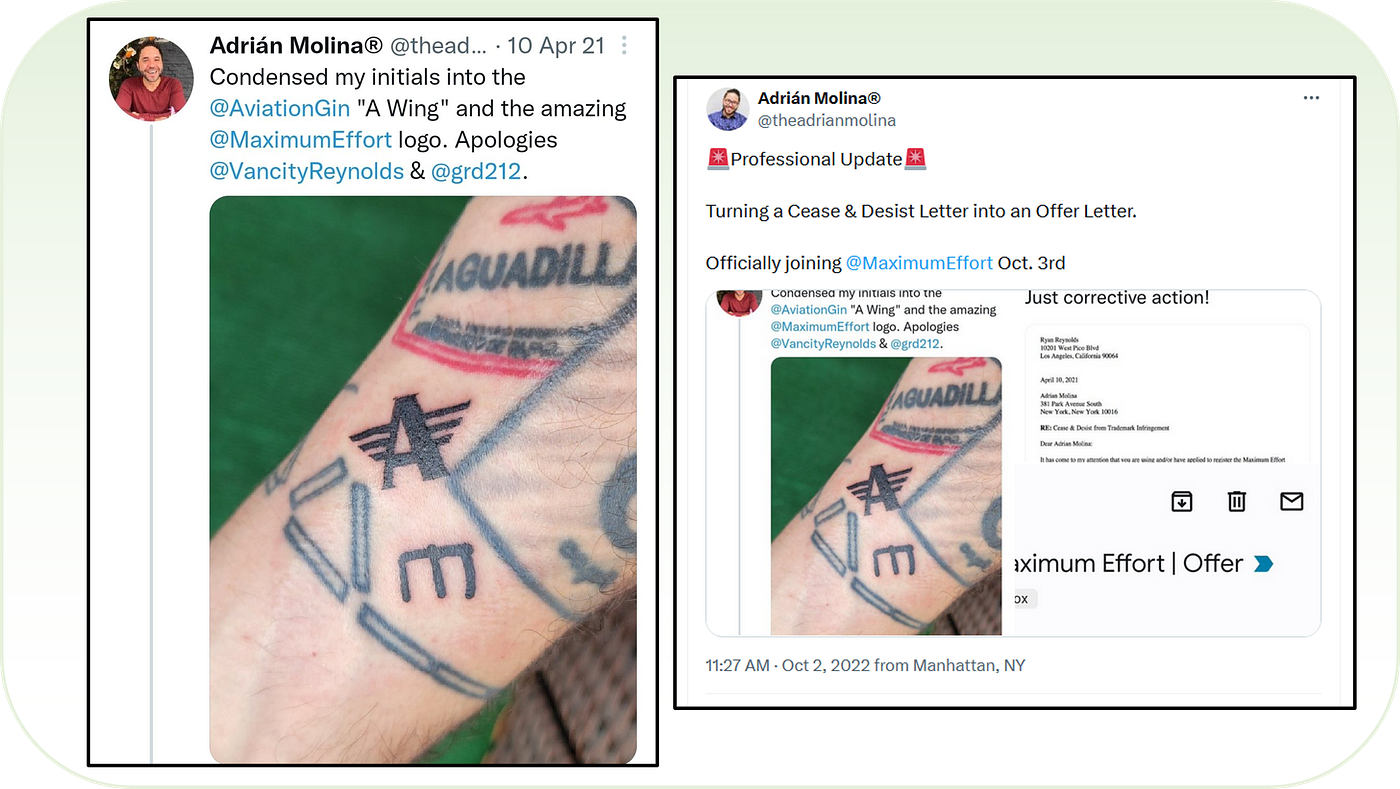
Molina gets a tattoo of the Maximum Effort logo, which later prompts a fake cease and desist letter from Reynolds and Dewey when Molina is officially hired by the company
Reynolds would repeat this joke with Rob McElhenney when a character in the show Ted Lasso made a reference to their ownership of Wrexham by saying he couldn’t “tell if them buying the club is a joke or not.” McElhenney tweeted a fake cease and desist to Apple signed by Reynolds and him for casting “doubt on our commitment to the club.” This is a particularly rich irony given that many have speculated Reynolds’ acquisition of Wrexham was inspired by Lasso, the process of which began one month after the August 14, 2020 premiere of the show.
In both instances, the letters are signed by Reynolds, but he’s not the one posting them.
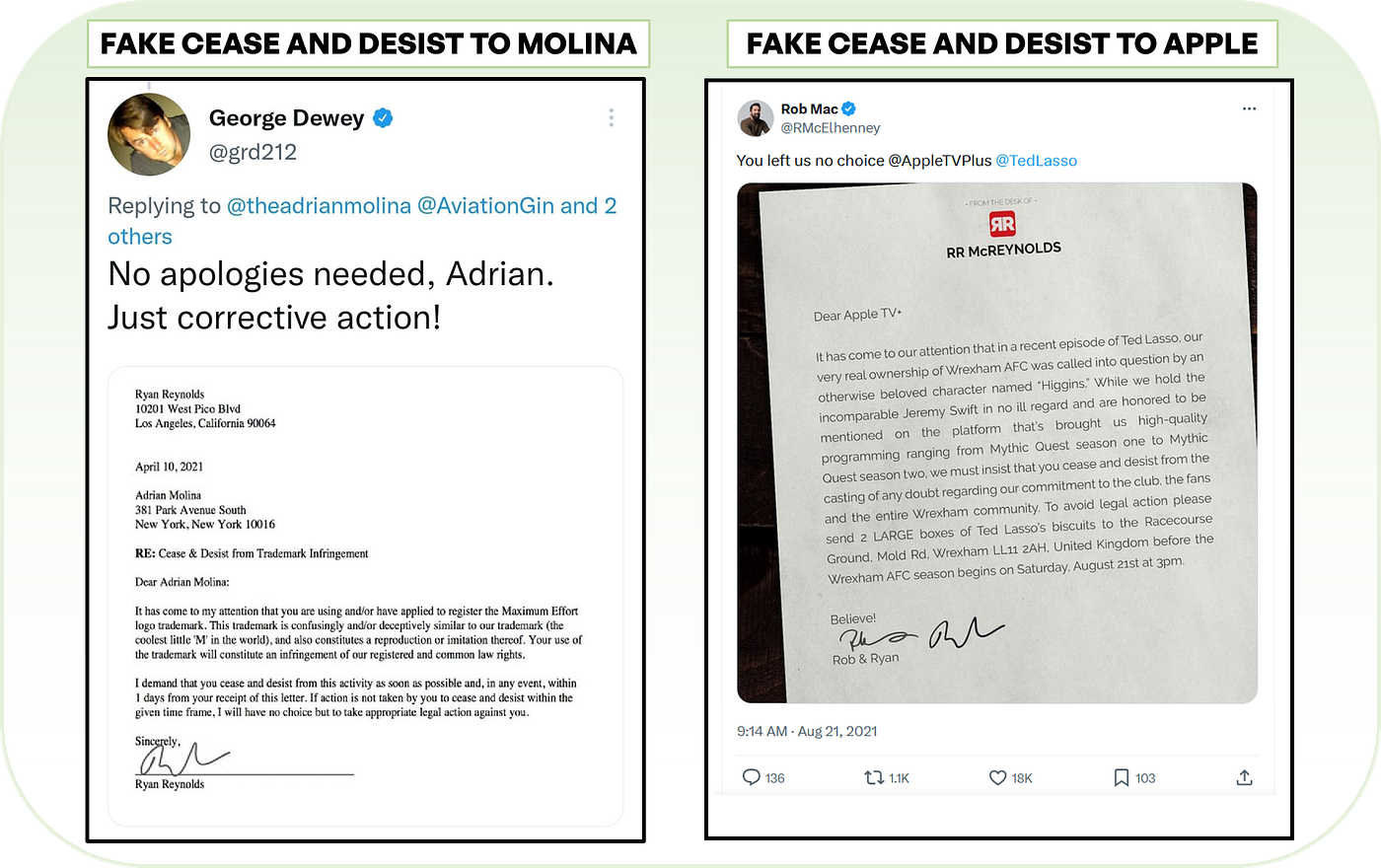
Dewey sends Reynolds’ fake cease and desist letter for trademark infringement against Molina, and McElhenney sends Reynolds’ fake cease and desist letter to Apple against Ted Lasso
Well, it looks like Reynolds doesn’t think it’s as much of a joke when he’s on the receiving end of such legal action.
Starkloff probably had no idea what she was asking with that single sentence about accounting for Aviation Gin’s profits; she just wanted justice in getting the money she is owed for the work she performed. But did Reynolds want to have to cough up years’ worth of full accounting records — in front of a judge and jury in a court of law, no less — to show exactly how much overlap there is between Maximum Effort and Aviation Gin? Probably not.
It seems similar to how, when Black stuntwoman Joi Harris died on the set of *Deadpool 2* and her family sued, the insurer for 20th Century Fox indicated they were going to fight tooth and nail to avoid paying them anything. Then, when Harris’ family lawyer said they would expand the list of defendants to include Marvel, 20th Century Fox, and Maximum Effort, he was suddenly and personally contacted by Fox executives, who did a 180 and helped settle things amicably.
Perhaps, for Ryan Reynolds, it’s much easier to hand over a check than to invite outsiders to look too closely at the companies you use to cut them.
Reynolds and Starkloff: Where Are They Now?
As online sleuths and commentators in the Lively v. Wayfarer Studios case have observed, Reynolds is still engaging in his ignominious habit of plugging alcohol in extremely inappropriate settings like he did with IEWU.
Recently, in his promotional tour as one of the producers for the documentary about late comedian John Candy, John Candy: I Like Me, Reynolds once again forcibly pushed Aviation Gin to the forefront, making a theater showing event about himself and his own brand. The event included cocktails, such as an Aviation Gin and tonic, and an Aviation Gin martini. Candy struggled with substance abuse, including heavy drinking.
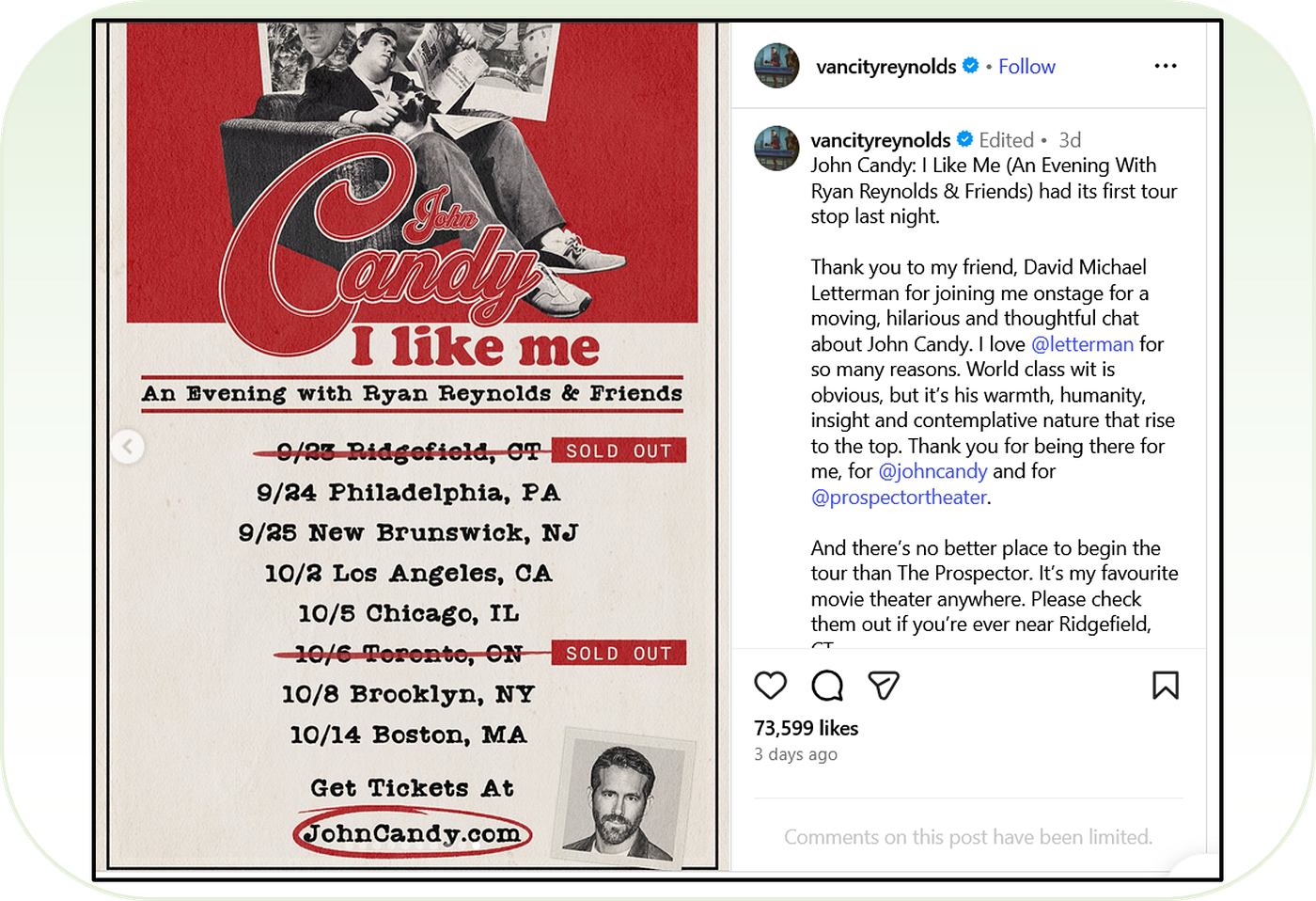
In a since deleted post, Reynolds centered himself in a theater showing event of the John Candy documentary he helped produce
In the same deleted post, Reynolds showed a drink menu featuring alcoholic beverages at the theater showing event for the John Candy documentary
The drink menu includes cocktails like an Aviation Gin & tonic, and an Aviation Gin martini
Interestingly, Reynolds’ post, dated September 28 — one month ago — only received backlash from Wayfarer supporters who are closely following the Lively v. Wayfarer Studios case; the public at large most likely didn’t even notice. Yet the post has since been deleted.
This is not the first time Reynolds has engaged in clean-up duty after online sleuths point out embarrassing or legally concerning information about him. Indeed, if the court of public opinion had filed a lawsuit against Reynolds, one could say he’s been engaging in evidence spoliation on a regular basis in the past year.
Reynolds is also still engaging in his “extrapolation” of his “fanbase” via “social listening.” In trying to insert himself into the upcoming Avengers movie, Reynolds recently reposted the art featured on a fan-made t-shirt with no credit or mention of where he had found it.
Reynolds’ reposted an image to suggest his Deadpool character would be featured in the upcoming Avengers film
A fan recognizes Reynolds’ post as the t-shirts their mother made for them during Deadpool & Wolverine
Meanwhile, Starkloff has shifted into standard freelance photography work: weddings, graduations, real estate listings. It’s reputable and important work, but it’s just not the same as landing her dream job of doing bottle photography for a major celebrity brand she admired and understood so well.
The sting of her experience with Aviation Gin lingers.
“For so long, I was a people-pleaser,” she says in a recent interview. (She does not mention the company or the individuals involved.) “Photography became my voice long before I knew how to use my own. For years, I stayed silent — afraid to take up space, undervaluing myself, and ignoring the red flags in situations where I deserved more. I gave my creativity freely, thinking if I worked hard enough or gave enough of myself, eventually it would come back around.
“I chalked it up to being ‘grateful for the opportunity’ or ‘just happy to be here.’ But deep down, I was playing small to make other people more comfortable.
“I felt undervalued, overlooked, and honestly, taken advantage of. It hurt.”
According to her lawsuit, Starkloff says she created 97 photographs which Aviation Gin used at least 43 times across their social media accounts. But by this writer’s count, the true number is significantly higher than that. Her number likely represents only the photos that are legally actionable.
More than that, Starkloff gave her trust and creative spirit — two things that have no price, and which were obviously wounded by this experience. Her pain is a reminder of just how much passion and skill she brought to Aviation Gin. For every photo that Starkloff made, there were countless hours, resources, and ideas that she poured into them.
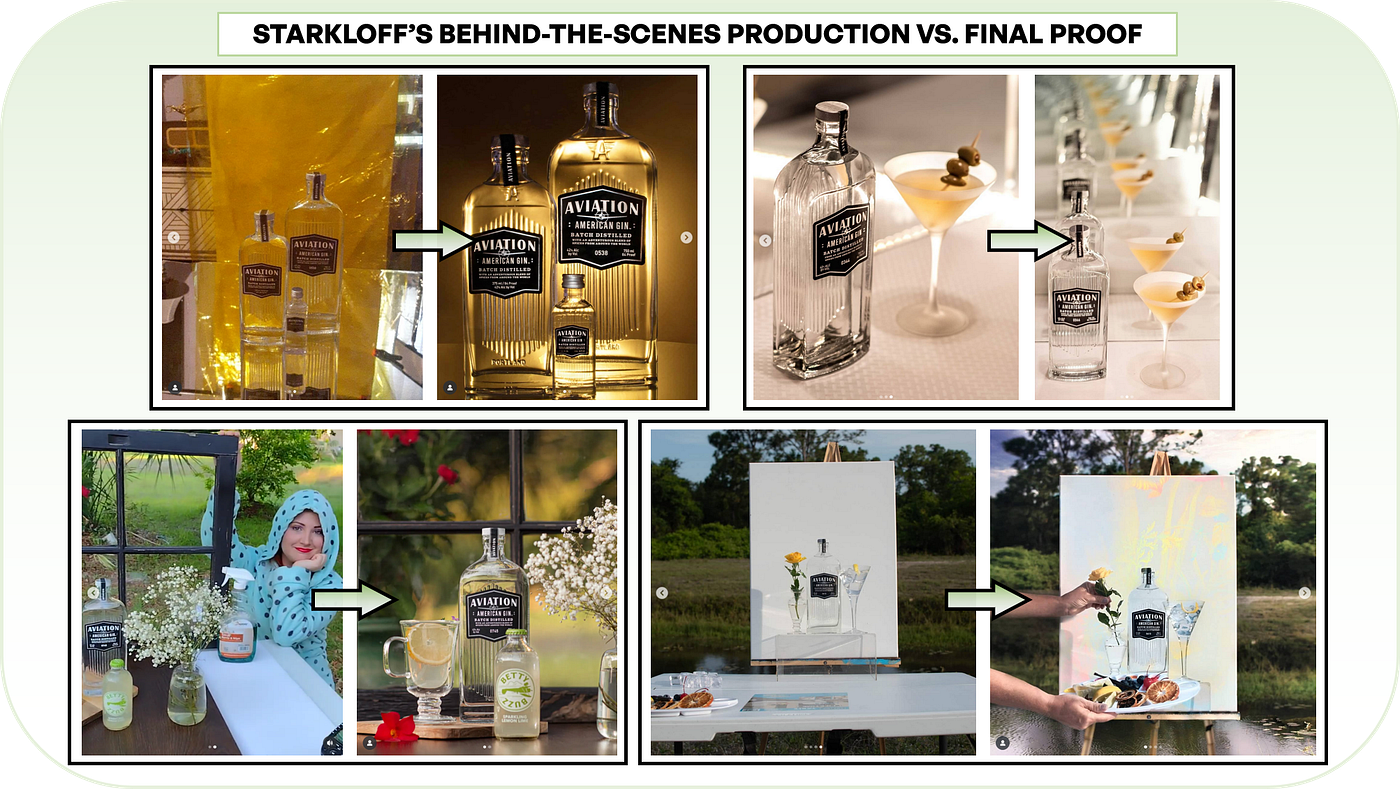
Each photo that Starkloff made to promote Aviation Gin took time, effort, and a strong artistic vision
It’s a level of commitment that artists and other creatives will immediately recognize: deep, innate, and an unavoidable outcome of loving your craft with every fiber of your being.
But maybe, if you’re Ryan Reynolds, all you see is a mark for your next intellectual property heist.
If you would like to hire Marilyn Starkloff and actually pay her what she’s worth, please visit her photography page, Stark Creators.
메타데이터
- post_id
- 8ea02dfd3063
- slug
- ryan-reynolds-used-a-photographer-to-promote-his-company-aviation-gin-for-six-years-and-8ea02dfd3063
- url
- https://medium.com/@eumoniadike/ryan-reynolds-used-a-photographer-to-promote-his-company-aviation-gin-for-six-years-and-8ea02dfd3063
- canonical_url
- https://medium.com/@eumoniadike/ryan-reynolds-used-a-photographer-to-promote-his-company-aviation-gin-for-six-years-and-8ea02dfd3063
- author_url
- https://medium.com/@eumoniadike
- status
- ok
- fetched_at
- 2026-08-02 13:06:25