🏗️ The 7 Most Important Design Patterns in Software Development
Design patterns are reusable solutions to common problems encountered during software development. They are blueprints that help developers…
🏗️ The 7 Most Important Design Patterns in Software Development
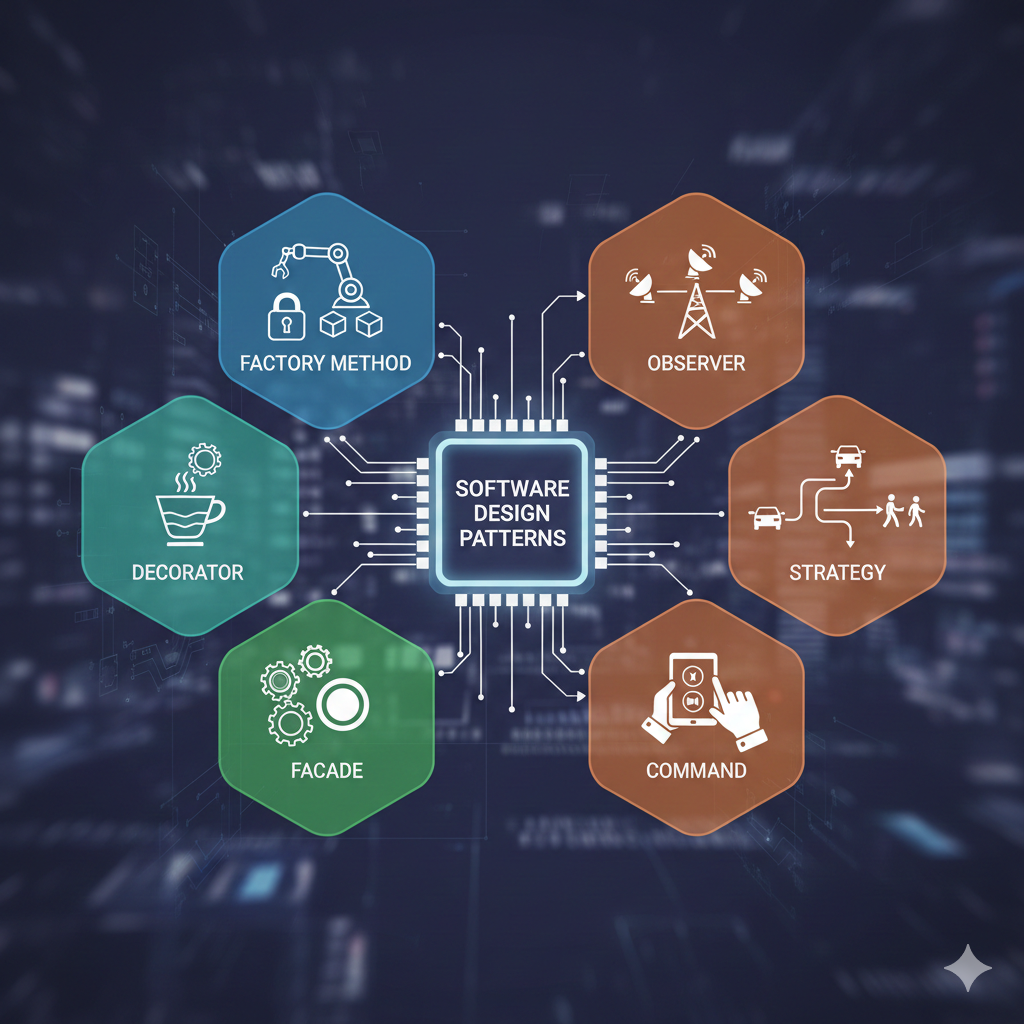
Design patterns are reusable solutions to common problems encountered during software development. They are blueprints that help developers create flexible, maintainable, and efficient code by providing a tested, standard approach to solving known structural and behavioral issues.
These patterns are categorized into three main groups: Creational, Structural, and Behavioral.
I. Creational Patterns (Object Instantiation)
These patterns manage the object creation process, making the system independent of how its objects are created.
1. Singleton (The Unique Instance)
- Goal: Ensures a class has only one instance and provides a global access point to it.
- Why it’s important: It controls object creation and ensures that all parts of the application use the same single resource.
- 💡 Analogy: The President or Prime Minister of a country. There can only be one in the office at a time.
- Use Case: Managing a single database connection pool, a logging utility, or a global configuration settings object.
2. Factory Method (The Abstract Creator)
- Goal: Defines an interface for creating an object, but lets subclasses decide which class to instantiate.
- Why it’s important: It decouples the object creation logic from the client code. You request a “product,” and the factory handles the exact creation logic.
- 💡 Analogy: A Digital Print Shop has a general
createPrintJob()method. The specific product (aBrochureorPoster) is determined by the specific factory chosen. - Use Case: Creating platform-specific UI elements (e.g., a
WindowsButtonvs. aMacButton) without the main application knowing the concrete class.
II. Structural Patterns (Object Composition)
These patterns focus on how classes and objects are composed to form larger structures while maintaining flexibility and efficiency.
3. Decorator (The Wrapper)
- Goal: Allows you to attach new responsibilities to an object dynamically at runtime.
- Why it’s important: It offers a flexible alternative to inheritance for extending functionality, avoiding a proliferation of subclasses.
- 💡 Analogy: Adding ingredients to a coffee (milk, syrup, foam). Each ingredient (decorator) wraps the basic coffee object and adds a new feature or modifies an existing one.
- Use Case: Adding logging, compression, or encryption features to a basic data stream object without modifying the original stream class.
4. Facade (The Simplifier)
- Goal: Provide a simplified interface to a complex subsystem.
- Why it’s important: It hides the complexity of a complex set of classes and functions, making the subsystem easier to use for clients.
- 💡 Analogy: An automatic car wash. You press one button (
StartWash()), and the Facade manages the complex internal process of spraying, scrubbing, and drying the car. - Use Case: Simplifying access to a large, multi-layered library or a legacy code system.
III. Behavioral Patterns (Object Interaction)
These patterns are concerned with communication, algorithms, and the assignment of responsibilities between objects.
5. Observer (Publish/Subscribe)
- Goal: Defines a one-to-many dependency so that when one object (the subject) changes state, all its dependents (the observers) are notified automatically.
- Why it’s important: It implements a publish/subscribe model, promoting loose coupling between objects that need to communicate state changes.
- 💡 Analogy: Social Media Following. A user (Subject) posts, and all followers (Observers) are immediately notified.
- Use Case: Implementing event handlers in UI programming (like responding to a button click) or updating multiple related views when a data model changes.
6. Strategy (Interchangeable Algorithms)
- Goal: Defines a family of algorithms, encapsulates each one, and makes them interchangeable.
- Why it’s important: It allows the algorithm to vary independently from the client code that uses it, letting you switch behaviors at runtime.
- 💡 Analogy: A travel navigation app. The app (Context) can switch between different strategies for calculating the route:
RoadStrategy,TransitStrategy, orWalkStrategy. - Use Case: Implementing different sorting algorithms (e.g., QuickSort vs. MergeSort) or different payment methods (Credit Card, PayPal) that can be selected dynamically.
7. Command (The Encapsulated Request)
- Goal: Encapsulates a request as an object, thereby allowing you to parameterize clients with different requests and support undoable operations.
- Why it’s important: It separates the object that invokes the operation (the Invoker) from the object that knows how to perform it (the Receiver).
- 💡 Analogy: An order at a restaurant. The waiter (Invoker) takes your order (Command object), which contains all the necessary details for the chef (Receiver) to execute the task later.
- Use Case: Implementing undo/redo functionality in an editor, logging commands, or queuing up a series of operations for batch processing.
메타데이터
- post_id
- 8ea5982ec125
- slug
- ️-the-7-most-important-design-patterns-in-software-development-8ea5982ec125
- url
- https://medium.com/@gadallah.hatem/%EF%B8%8F-the-7-most-important-design-patterns-in-software-development-8ea5982ec125
- canonical_url
- https://medium.com/@gadallah.hatem/%EF%B8%8F-the-7-most-important-design-patterns-in-software-development-8ea5982ec125
- author_url
- https://medium.com/@gadallah.hatem
- status
- ok
- fetched_at
- 2026-06-26 06:47:43




