The Man Who Killed Paul McCartney
The incredible, never-before-revealed, true-life event that sparked the greatest rock ’n’ roll rumor of all time.
The Man Who Killed Paul McCartney
The incredible, never-before-revealed, true-life event that sparked the greatest rock ’n’ roll rumor of all time.

THE SET-UP…..
In the February, 1967 (#43) issue of The Beatles Monthly, the Beatles’ official fan club magazine, the following blurb appeared in the “Beatle News” section, entitled “FALSE RUMOUR”:
“Stories about the Beatles are always flying around Fleet Street. The 7th of January was very icy, with dangerous conditions on the M1 motorway, linking London with the Midlands, and towards the end of the day, a rumour swept London that Paul McCartney had been killed in a car crash on the M1. But, of course, there was absolutely no truth in it at all, as the Beatles’ Press Officer found out when he telephoned Paul’s St. John’s Wood home and was answered by Paul himself who had been at home all day with his black Mini Cooper safely locked up in the garage.”
The story goes…
On October 12th, 1969, Detroit disc jockey Russ Gibb of WKNR-FM received a bizarre late-night phone call from a listener. This Deep Throat told him that, if he played several tracks off of the Beatles’ “White Album” backwards, he’d hear some rather interesting things. Curious, Gibb decided “to hell” with his stylus and turntable, and spent the next several hours shredding his copy of the White Album. What Gibb heard was amazing. He discovered that, when played backwards, a formerly indecipherable mumbling from John Lennon at the end of ‘I’m So Tired’ could now clearly be made out as the Literary Beatle moaning “Paul is a dead man, miss him, miss him, miss him.” Also, the oft-intoned words “number nine, number nine” from Lennon’s music concrète opus, ‘Revolution #9’, miraculously transformed into the eerie phrase “turn me on dead man” when spun counterclockwise.
Russ Gibb hears things backward
Clearly, Gibb thought, something was up. So certain was he that he was on to something big, Gibb started digging deeper. He soon discovered various other “clues” relating to the supposed demise of the Cute Beatle sprinkled on various other Beatle songs and album covers, going as far back as their Yesterday….And Today LP, released a full three years earlier! Soon after Gibb began enlightening his Motor City listeners to The Great Cover-up, disc jockeys from competing stations in New York City and beyond picked up this shaggy dog tale, and it wasn’t too very long before the news that “Paul McCartney was dead” began to spread around the world. Within weeks the sale of new and old Beatle albums soared as both the distraught fan and the merely curious bought clean copies just to play them backwards. (The rumors helped the sales of the just-released Abbey Road, Sgt. Pepper’s Lonely Hearts Club Band, Magical Mystery Tour, and The Beatles. Both Sgt. Pepper’s and Magical Mystery Tour, which were released in 1967, reentered Billboard’s Top 200 charts in November of 1969. Both LPs stayed in the Top 200 until Spring, 1970.)
Faced with this preponderance of “evidence”, and coupled with the Beatles’ own real lack of comment, the public decided that the story must be true. “Okay then,” the public said, “we’ve come not to bury Paul (besides, Lennon had already admitted to doing just that at the end of ‘Strawberry Fields Forever’), but to ask if Paul is dead, then how did it happen?”
Mohammed Chtaibi (right) is The Man Who Killed Paul McCartney…
Although there were often as many tales as there were tellers in this story, by 1970 a fairly conclusive and mutually agreed-upon scenario began to develop regarding exactly how Paul had come to meet his maker. As the story goes, on an evening in November, 1966 (probably the 8th, a “stupid bloody Tuesday”), there was an argument between Paul and the other Beatles at Abbey Road Studios. A livid Paul then stormed out of the building, hopped into his Aston Martin, and sped off into the night. In his anger, he failed to notice as the traffic light changed and he spun out of control, ending up smashing into a light pole at full speed, thus decapitating him (in other words, he “blew his mind out in a car”). He was “Officially Pronounced Dead” on the scene, in the early hours of Wednesday the 9th (“number nine, number nine…”). Paul was then carried in secret to the morgue (note the “O.P.D.” patch on McCartney’s left sleeve on the inside gatefold of “Sgt. Pepper’s” which is really OPP for Ontario Provence Police.) Saddened, but faced with the prospect of losing revenue due to the untimely death of the most popular member of their band, (the story goes) the three “surviving Beatles” hired one William Campbell, a man who had supposedly once won a Paul look-alike contest, to fill in for the dead Beatle. The “clues” then became the Fabs way of subtly and gently breaking the tragic news to the fans. (The entire crash scenario is supposed to be played out in full if you play ‘Revolution #9’ backwards.)
Anyway, that’s the story of the Paul Is Dead rumor. But there’s another story that’s never been told — until now. The story of an incredible true-life event that accidentally sparked the greatest rock ’n’ roll rumor of all time.
First some background…
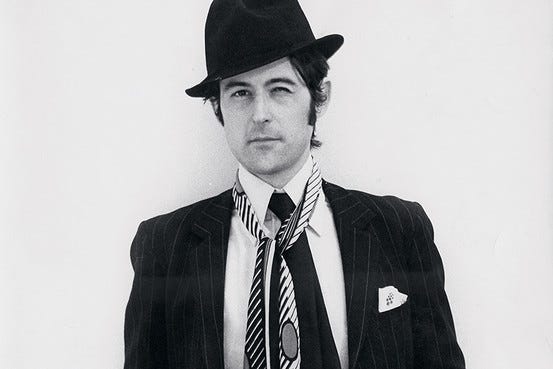
Robert Fraser: Godfather of razz-ma-tazz
If an era can be said to have a father, then London’s Swinging ’60s was the bastard child of Robert Hugh Fraser. Fraser was the son of a wealthy Scots banker and a man who appeared to have everything going for him: looks, class, youth and money. Yet for all of his privileges, Fraser was a frustrated artist at heart who sublimated his creative longings into running one of the best art galleries in London. By 1964, the Robert Fraser Gallery at 69 Duke Street was recognized around the world as being the sharpest, hippest gallery, exhibiting the latest and most important artists of the period. Fraser was also accumulating friends more accustomed to the pop charts than Pop Art.
Musicians like Mick Jagger and Keith Richards, Paul McCartney, John Lennon, Brian Jones and others were regular fixtures at both Fraser’s gallery, and at his Mount Street apartment. To the still scruffy rockers, Fraser represented all that swung about the Swinging ’60s: the money, the sex and (especially) the drugs (after all, Fraser is said to have been the “Dr. Robert” mentioned in the Beatles song of the same name). Fraser was where all of the razz-ma-tazz of the era sprang from. Without him smoking dope was just getting high.
Mohammed Chtaibi first met Robert Fraser in the early 1960s. He was a young Moroccan student, the ward of Mark Gilbey, the multimillionaire heir to the Gilbey liquor fortune, and it wasn’t long before Mohammed Chtaibi (then known as Mohammed Hadjij) and Robert Fraser became fast friends. Soon after he opened his gallery, Fraser asked Mohammed to be his personal assistant and to move into the adjoining penthouse on Mount Street that Fraser watched for an aging movie star who no longer bothered to drop by.
Officially, Mohammed’s job was to pick up and deliver painters and paintings to the gallery, but he soon realized that his real job was to babysit the gallery while Fraser ran off with his famous friends. But sometimes Fraser would invite Mohammed along with him (usually to cook, drive or carry the dope), and this is what he did on the first Saturday of January, in the winter of 1967.
They were going to Paul McCartney’s house to have a party.
***READ MORE***
©2016 Jim Yoakum
메타데이터
- post_id
- 8ea6f9366f0
- slug
- the-man-who-killed-paul-mccrtney-8ea6f9366f0
- url
- https://medium.com/@heath.filmore/the-man-who-killed-paul-mccrtney-8ea6f9366f0
- canonical_url
- https://medium.com/@heath.filmore/the-man-who-killed-paul-mccrtney-8ea6f9366f0
- author_url
- https://medium.com/@heath.filmore
- status
- ok
- fetched_at
- 2026-08-10 07:57:44