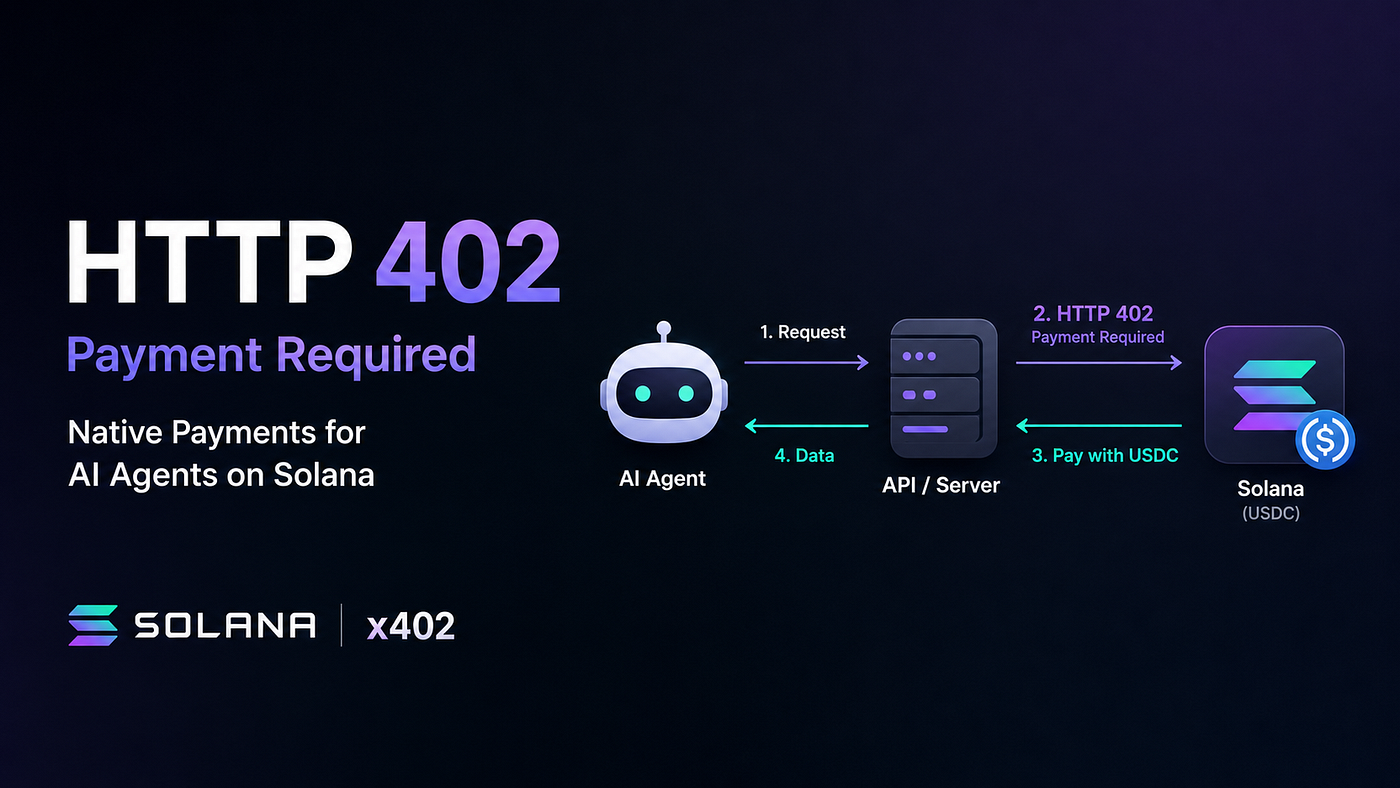
HTTP 402 Is Back: How to Charge for APIs in the Agentic Economy
https://youtu.be/MjEoIU2Z4yk
HTTP 402 Is Back: How to Charge for APIs in the Agentic Economy
In 1997, the authors of the HTTP specification reserved status code 402 Payment Required. It was a visionary nod to a future of seamless, native internet commerce. Yet, for nearly three decades, that vision remained dormant. Instead of instant machine-to-machine micropayments, the web adapted to credit cards, API keys, and monthly billing cycles — solutions designed for humans, not software.
Today, that is changing. With the rise of autonomous AI agents trading data, compute, and services, we need a native financial layer that speaks the language of code. On Solana, HTTP 402 is no longer a placeholder — it is a live checkout path.
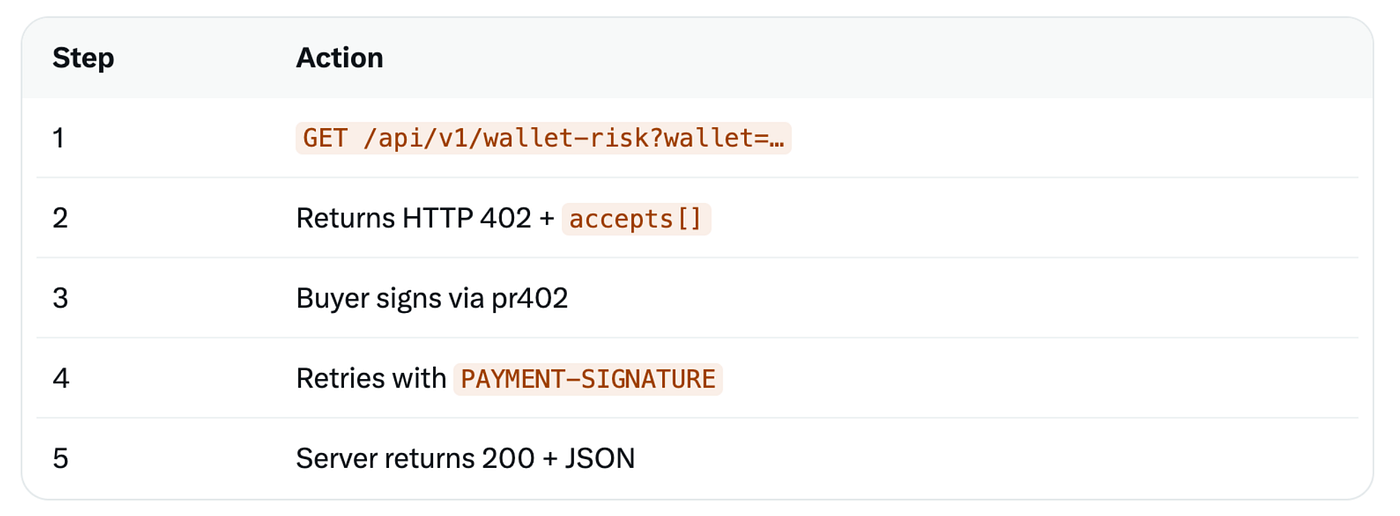
Imagine a workflow where an AI agent calls an API, the server returns the price, the agent pays in USDC, sends the transaction signature in a header, and instantly retrieves the response. Whether you need pay-per-inference, a time-limited subscription, or secure escrow settlement, the pr402(extended x402) protocol makes it possible.
At Miraland Labs, we build pr402 — a production-grade facilitator gateway that translates off-chain REST requests into on-chain Solana transactions. This guide walks you through the ecosystem and shows you how to get started.
🪙 The Vending Machine Analogy
To understand how x402 functions, think of a digital API as a vending machine:
- Press the Button: You send an HTTP request to a premium endpoint.
- Read the Price: The server responds with 402 Payment Required and a JSON envelope detailing the requirements (price, asset, destination).
- Insert Coin: You sign and submit a USDC payment transaction via the pr402 facilitator.
- Retrieve the Product: You retry the request with the transaction signature in the
PAYMENT-SIGNATUREheader, and the server dispenses the resource.
The pr402 Facilitator serves as the coin validator of this vending machine. It handles the blockchain heavy lifting — deriving vaults, validating signatures, and settling funds — meaning your serverless backend does not need to manage complex blockchain RPC connections.
⚡ Three Ways to Monetize Your API
Different resources require different payment economics. The x402 protocol accommodates three main monetization models:
1. Per-Call Payouts (The Instant Micro-Payment)
- Best for: Lookups, single LLM inferences, or stateless API requests.
- How it works: The buyer pays a few cents in USDC per request. Funds are settled instantly on-chain using the
exactrail, splitting revenues between the seller and the facilitator automatically. - Live Reference: solrisk (risk scoring API) and PromptLean (prompt optimization).
2. Time-Window Subscriptions (The Day Pass)
- Best for: High-volume data feeds, scrapers, or continuous polling agents.
- How it works: Gating every single call with a transaction fee is inefficient for high-frequency endpoints. Instead, the buyer calls a
/subscriberoute and pays once via theexactrail. The server issues a JWT token, allowing the agent to authenticate viaAuthorization: Bearerfor the duration of the subscription window (e.g., hourly, daily, or monthly). - Live Reference: x402-subscription-starter.
3. Escrow Settlement (Verified Delivery)
- Best for: High-value data, custom tasks, or slow-fulfillment services where trust is required.
- How it works: Funds are deposited into a secure on-chain escrow program (
sla-escrow). The seller performs the work and uploads evidence. A third-party oracle verifies that the delivery matches the SLA and confirms the release of funds on-chain. - Live Reference: x402-buy-spl-token (escrowed token shop).
🛠️ The Developer Toolkit: Where to Start
Depending on your role in the agentic economy, here is how you can integrate with x402 today:
- Sellers (API Gating): Clone x402-seller-starter (available in Rust, Python, and TypeScript) or follow the interactive Express Seller Lab.
- Buyers (Agent Integrations):
- Buyer Agents (Autonomous Clients): Programmatically call pr402’s transaction building endpoints (
POST /build-exact-payment-txor/build-sla-escrow-payment-tx) to fetch unsigned transactions, sign them locally with a wallet keypair, and settle payments. - Buyer Developers (Human Integrators): Use the installable SDK
@pr402/clientor the@pr402/mcp-serverpackage to quickly connect Cursor or Claude Desktop directly to paid APIs. - Discovery & Directory: Find active paid APIs using the pr402 discovery endpoints or explore listings at pr402-registry.
🔮 A Day in the Life of an Agent
What does this look like in practice? Consider an autonomous trading agent operating on devnet:
- Risk Gating: Before executing a transaction, the agent queries a wallet screening API. It receives an HTTP 402, executes a $0.05 USDC payment, and retrieves the risk score.
- High-Frequency Feeds: The agent needs continuous price telemetry for the next hour. It calls
/subscribe, pays $0.20 USDC for an hourly pass, receives a JWT, and polls the data feed thousands of times without signing another transaction. - Escrow Delivery: Finally, the agent purchases an off-chain data file. It funds a $10.00 escrow. The seller generates the file and submits the proof. An independent file-delivery oracle verifies the hash, releasing the $10.00 to the seller and the file to the agent.
All of this happens autonomously, wallet-to-wallet, programmatically negotiated at the network edge.
🌟 The Vending Machine is Plugged In
Status code 402 waited thirty years for a financial rails layer that could match the speed and scale of the internet. By pairing HTTP handshakes with Solana’s low latency and cheap transaction fees, x402 turns API monetization into a frictionless, native protocol.
The infrastructure is ready. The code is open source. Step up, press the button, and build the future of the agentic economy.
For full specifications and deployment hosts, visit docs.ipay.sh.
메타데이터
- post_id
- 8ea7a53e17fc
- slug
- http-402-is-back-how-to-charge-for-apis-in-the-agentic-economy-8ea7a53e17fc
- url
- https://medium.com/@miraland.labs/http-402-is-back-how-to-charge-for-apis-in-the-agentic-economy-8ea7a53e17fc
- canonical_url
- https://medium.com/@miraland.labs/http-402-is-back-how-to-charge-for-apis-in-the-agentic-economy-8ea7a53e17fc
- author_url
- https://medium.com/@miraland.labs
- status
- ok
- fetched_at
- 2026-06-28 14:26:31