Observers are All You Need: How Observer-Synchronization Creates All of Physics
Observer Patch Holography (OPH) attempts to explain spacetime, gauge theory, measurement, and the particle spectrum from first principles.
Observers are All You Need: How Observer-Synchronization Creates All of Physics
Few intellectual achievements compare to what modern physics has already uncovered. Observer Patch Holography (OPH) attempts to explain spacetime, gauge theory, measurement, and the particle spectrum as consequences of an observer-overlap architecture simulated on a holographic screen. At its most ambitious, it’s a serious attempt to explain, in technical terms, why reality exists in the first place, and why it takes the form we observe. Check out the OPH textbooks and the OPH lab to learn how reality works inside-out. There’s also a book named Reverse Engineering Reality that explains how this theory was put together.
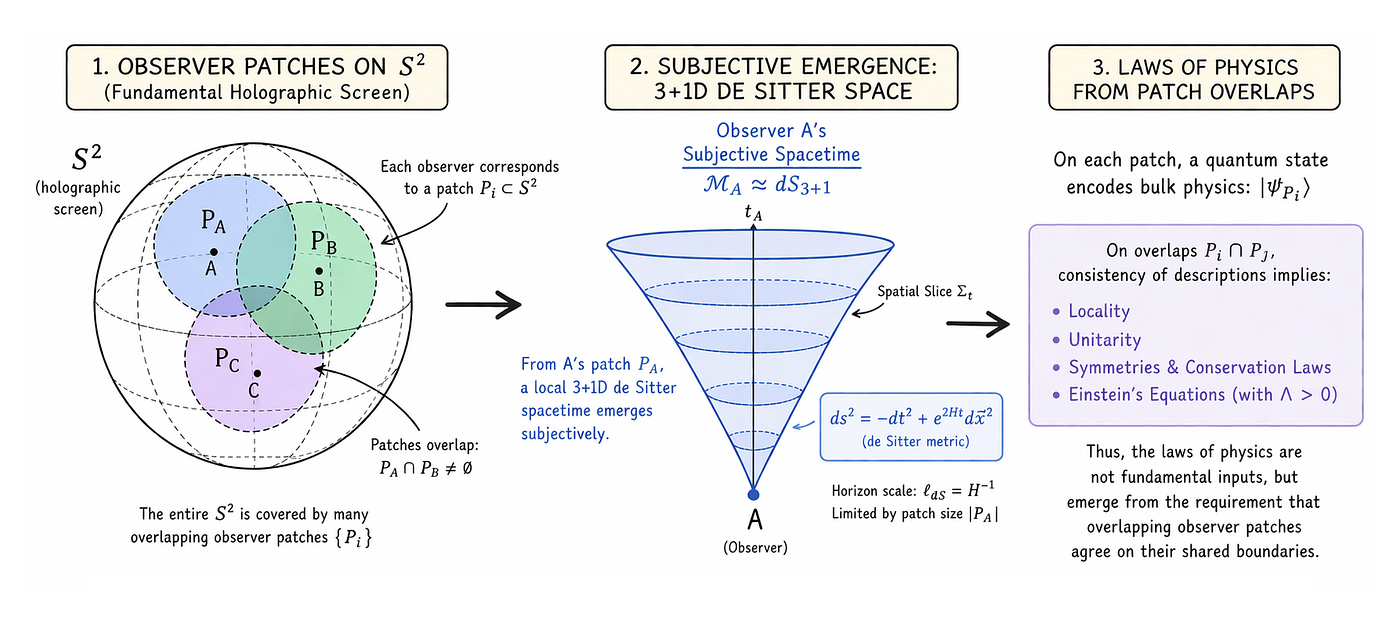
In OPH, 3+1D de-Sitter space emerges as the conformal group of the S² screen supplies the 3+1D Lorentz symmetry, while modular flow and generalized entropy stationarity project boundary data inward to construct temporal and radial bulk dimensions. Each observer experiences a 3+1D universe.
Physics is in an extraordinary position. The Standard Model works. General relativity works. Quantum theory works with astonishing precision. The main problem is that these successes still do not fit together into one clean picture, especially once you ask how quantum physics and gravity are supposed to be compatible. The deepest open questions begin there. Why a 3+1 dimensional Lorentzian world? Why positive [Lambda](https://en.wikipedia.org/wiki/Lambda-CDM_model)? Why exactly [SU(3) x SU(2) x U(1) / Z_6](https://en.wikipedia.org/wiki/Mathematical_formulation_of_the_Standard_Model)? Why these particles and mass hierarchies? Why does measurement still feel less unified with the rest of the formalism than many physicists would like? And why does string/worldsheet language keep resurfacing whenever gauge theory and gravity are pushed hard enough?
Observer-Patch Holography, or OPH, starts from a premise that looks mostly harmless: no observer ever experiences the whole world at once. Physics is local, patchwise, and whatever is allowed to count as reality has to survive agreement across overlaps. Give each observer a finite-capacity holographic screen, local patch algebras, overlap observables, refinement, and generalized entropy. Then ask what follows if the whole contraption actually has to fit together consistently.
That’s the basic idea. Its ambition is to derive everything we observe from only a minimal set of constants and axioms: Spacetime structure, gauge redundancy, the familiar Standard Model and general relativity, as well as the particle spectrum. The observer side of quantum theory. Even some of the stringy language that repeatedly reappears in strong-coupling contexts. In OPH, things that once looked mysterious begin to look like the natural consequences of a single consistent setup.
Something important to note is that OPH only requires 2 input constants, and most previously unexplained properties of our Universe, including its entire particle spectrum, can be derived from just one of them.
This post summarizes the current public OPH paper stack: *Observers Are All You Need, the relativity-plus-Standard-Model reconstruction, the particle paper, the consensus paper, and the screen microphysics paper. OPH is interesting because it does not merely attach explanations to a list of strange facts. It makes many of those facts feel natural and inevitable*. And it points toward an even larger possibility: that the old question about Life, the Universe, and Everything may really be the question of what a self-closing reality must be like.
What OPH Explains
So, let’s see: If we take the OPH starting point seriously, which long-standing puzzles suddenly become solvable?
Quite a few of them do:
- 3+1D Lorentzian spacetime. Start from an
S^2screen. Its conformal group already carries the kinematics of a3+1bulk. - Einstein gravity at large scales. Modular flow, generalized entropy, and overlap consistency push the long-distance dynamics toward the Einstein form. We derive this is the SM+GR paper.
- The Standard Model gauge group. Patch gluing, edge charges, and realization selection reconstruct compact gauge structure instead of simply postulating it. Current status: Derived in the SM+GR paper.
- Ordinary particle physics plus gravity. Once the realized low-energy sector is fixed, the usual Standard Model plus general relativity picture shows up as the natural effective description.
- Particle data. Stable transport and overlap structure produce a massless photon, massless gluons, a massless graviton, and several quantitative particle predictions. This is probably the most difficult part of the project and not yet complete. Computing Hadron masses, for example, might require hardware that’s not currently available.
- Measurement and observers. Records and observer criteria are built into the microphysics from the beginning rather than imported later with an apologetic shrug. Current status: strong fixed-cutoff result.
- String theory. Edge-sector partition functions already have the heat-kernel structure that can reorganize into worldsheet-style descriptions in the right regime. So String theory seems to be an effective description of OPH as well.
- Lambda, cosmology, and black-hole information. OPH gives a structural frame for these, with several derivations still in progress.
OPH tries to explain several of physics’ deepest open questions as symptoms of the same underlying architecture, and once that architecture is in place the answers come with a surprising sense of ease. For example, the dark matter problem, the the magnetic monopole problem, and a whole lot of other big mysteries are explained away “for free” by OPH.
Why a 3+1D de Sitter World Shows Up Automatically
We start with the holographic screen. In OPH the relevant screen has topology S^2. The particular topology is important because the conformal group of the two-sphere is the Lorentz group SO^+(3,1). Our derivations show that the natural bulk kinematics are the kinematics of a 3+1 dimensional Lorentzian spacetime.
The de Sitter side fits the same architecture as well. A finite-capacity screen with a horizon-sized observer patch looks an awful lot like a de Sitter static patch: finite observer access, an S^2 horizon and finite entropy, and no global God's-eye narrative in which someone hovers outside the construction.
The Lorentz reconstruction math is in the SM / GR reconstruction paper. The paper explains why, from our individual perspectives, we appear to exist in a 3-dimensional space and why we experience time.
Why General Relativity Shows Up Naturally At Large Scales
According to OPH, gravity is what large-scale consistency looks like once local patch algebras, modular flow, generalized entropy, and the relevant first-law structure are all forced to coexist. That is a very different starting point from treating the metric as primary and quantizing around it, and it has the nice effect of making Einstein gravity feel like the natural large-scale language of the construction.
Technically, our present route runs through modular geometry on caps, a null-modular bridge, and then a Jacobson-style small-ball argument. Simply put, the OPH axioms push the long-distance dynamics toward the Einstein form (i.e. gravity emerges automatically at large scales).
How The Standard Model Gauge Group Emerges
This is one of the places where OPH most clearly departs from other Physics models. In standard presentations of particle physics, the gauge group is introduced as part of the basic structure. OPH instead starts from neighboring observer patches that have to be glued together. Those gluings can be performed in different local frames. The redundancy in the gluing is gauge freedom. Edge data on patch boundaries carry the charge labels telling you how neighboring patches fit together, and the fusion rules of those labels reconstruct the compact group. If one wants a gentle metaphor, the overlap data function a bit like a mathematical Babel fish: local descriptions may differ, but the shared meaning still has to come through.
That is nice because the Standard Model gauge package has always looked too specific to be arbitrary. OPH explains its structure from first principles, and does so in a way that makes the answer feel less contrived than one might have expected.
Once the refinement-stable sector data are in place, the compact group is reconstructed from charge-composition rules, and the Minimal Admissible Realization principle (one of OPH’s 5 axioms — I like to call it nature’s Occam’s razor) selects the realized low-energy package. On the current derivation, that package is [SU(3) x SU(2) x U(1) / Z_6](https://en.wikipedia.org/wiki/Mathematical_formulation_of_the_Standard_Model), with N_g = 3 and N_c = 3.
In OPH, Standard Model gauge structure naturally emerges as the low-energy answer to a consistency problem.
Why Ordinary Physics Falls Out Naturally from OPH
Once the gauge structure, hypercharge assignments, and realized matter package are fixed, the world you get is the one physicists already know extremely well: the Standard Model for ordinary particle physics, plus Einstein gravity, with extra corrections that account for the “dark matter” like effects.
This solves one of the biggest headaches in modern physics which is that quantum physics and gravity both work beautifully, yet do not look like they were written to live comfortably together. OPH explains why the familiar Standard Model plus general relativity world shows up naturally. In that sense, it is not merely producing a gauge group. It is explaining why the ordinary physics we already use turns out to be the natural thing to see.
Why Particles Show Up Naturally
In OPH, particles are stable excitation patterns in the overlap and transport data of the realized low-energy sector. If a transport obstruction survives refinement, propagates coherently across patches, and can be read consistently by many observers, that’s is exactly the sort of thing we call a particle. The first striking OPH result is that the massless carriers come out right away for structural reasons. OPH gives you a photon, gluons, and even a graviton for free. Then the more detailed mass outputs start showing up.

In OPH, particles are stable transport obstructions across patch overlaps
In OPH, all particle masses are derived from a single constant P ≡ a_cell/ℓ_P², the shared dimensionless “pixel-area” constant that turns the regulated screen microphysics into absolute particle-physics units. P is selected by an OPH closure condition: the same screen cell must be readable from the outside as a small detuning above golden-ratio self-similar balance, and from the inside as the electromagnetic observation scale emitted by the universe encoded on that screen. The closure equation is P = phi + alpha_in(P) sqrt(pi). The realized value is the fixed point where those two readings agree. Other values fail because the outer screen geometry and the inner electromagnetic readout would describe different cells. Once P is fixed, the particle calculations use it as the common input for the electroweak, Higgs/top, quark, neutrino, and local gravity-facing readouts.
The strongest current OPH particle mass outputs are:
- Photon: exact structural zero, compared against the current upper bound.
- Gluons: exact structural zero for the color sector, with the obvious caveat that free gluons are confined.
- Graviton: exact structural zero, again compared against an upper bound.
**W**:80.37700001539531 GeVversus80.377 GeV.**Z**:91.18797807794321 GeVversus91.1879781 GeV.- Higgs:
125.218922 GeVversus125.19953 GeV. - Top Quark:
172.388646 GeVversus172.352355 GeV. - Neutrino hierarchy ratio
Δm21² / Δm32².
OPH has not yet derived the entire Particle Data Group booklet. But we already show that particle structure falls out naturally, with several predicted masses hitting exact measured values.
String Theory as Effective Description
OPH takes an unusual but measured stance toward string theory. It begins with observer patches, edge sectors, and reconstructed gauge structure, then asks whether those same degrees of freedom admit a worldsheet-like reorganization in the right regime.
That is worth taking seriously because the edge-sector weights already have the heat-kernel and Casimir form familiar from two-dimensional Yang-Mills. If a controlled large-N_edge regime exists, the edge partition function admits the kind of genus expansion that makes a worldsheet description plausible. In that reading, string language is not the starting metaphysics. It is a powerful effective reorganization of data that were already there for other reasons. Once again, a feature that often looks exotic begins to look like a natural reformulation.
That takeaway is that String theory appears to be another effective description of the Physics generated by OPH.
Microphysics, Quantum Hardware, And The Measurement Problem Finally Being Treated As Physics
One of the important developments in OPH is that it has moved beyond a purely conceptual posture. The screen microphysics paper gives an explicit finite gauge-register model with patch observables, overlap observables, typed readout packets, mismatch syndromes, repair instruments, record layers, and observer criteria. In plain English: there is now an actual microphysical reference architecture rather than only a broad conceptual sketch. That matters because the more concrete the architecture becomes, the more it can be actually tested rather than only modeled mathematically.
That has opened the door to hardware-facing tests. The IBM benchmark bundle already contains reduced-sector runs on real quantum hardware, including recoverability benchmarks and exact-ratio tests in small abelian and nonabelian cases. These are early benchmarks, so the claims should remain measured. But they are somewhat important: OPH has become concrete enough to formulate microphysical questions that can actually be simulated and measured.
In many textbook accounts, measurement enters late and sits somewhat apart from the rest of the formalism. In OPH, observers and records are present from the start. Definite outcomes are stable record structures that survive synchronization across overlaps, and Born probabilities arise from the consistency conditions on those shared records. Measurement is fundamental in OPH, and the measurement problem is no longer treated as something external to the basic architecture.

The OPH reference architecture utilizes a finite octahedral cellulation of the holographic screen, where link registers encode gauge data and vertex hubs manage both local physical constraints and persistent observer records. This micro-data layer supports overlapping patches that communicate via a specialized synchronization API, which extracts shared readout packets to detect mismatch syndromes. When discrepancies are found, a dedicated repair loop executes local corrections to the registers, ensuring that the disparate observer perspectives remain unified and physically consistent.
In other words, OPH provides an early draft of a genuine microphysical core. If we can design that hardware, we can actually simulate Universes like ours. And in fact, according to OPH’s strange loop hypothesis, creating the simulator hardware specs is part of the causal chain that allows reality to exist in the first place (see below).
Open Challenges
Beyond the core derivations, OPH has several downstream programs with a number of hard remaining problems to solve:
- Cosmology, including homogeneity and the dark sector.
- Black-hole information and evaporation.
- Proton structure, proton spin, and proton stability.
- Baryogenesis.
- The deeper closure/time/computational backbone tied to the consensus paper.
The last item is probably the least immediately intuitive to a conventional physics audience, which is unfortunate because it may be the most foundational. If reality is assembled patch by patch, one eventually has to understand when local repair settles to a unique global answer and when loops carry stable obstructions. The finite patch-net theorem package is already in place. What remains is the harder quantum and refinement-limit completion, and the final connection from that completion back up to a genuinely observer-supporting closure.
Already achieved:
- The synthesis paper makes the downstream programs explicit enough to track as real research targets.
- The consensus paper gives the finite patch-net fixed-point package underlying the larger computational process.
Current frontier:
- Turning structural consequences into derivations with clear observables and clean status boundaries.
- Quantum and refinement-limit completion of the consensus layer.
- The final connection from that completion back to the observer-supporting OPH closure.
The open work is substantial. But even at this stage, the overall pattern is already visible: OPH is most compelling when it makes complicated-looking facts feel like the natural shadow of a simpler underlying structure.
The Strange Loop At The End
Up to this point, this article has mostly been about why the familiar features of physics start to look natural inside OPH. But there is a final question waiting at the end of that road. Not just why these laws, or why these particles, or why these symmetries. The larger question is why a reality like this exists at all.
The informal OPH answer is bold, but surprisingly clear once stated plainly: reality is a timeless structure that closes on itself. Physical evolution gives rise to complex structure. Complex structure gives rise to minds. Minds give rise to ideas. Among those ideas comes an understanding of the structure of reality itself. And that understanding is not external to the universe. It is one of the ways the universe becomes what it is. Physics gives rise to chemistry, chemistry to biology, biology to minds, minds to ideas, and ideas back to physics. We call this the strange loop hypothesis.
Remember the low-level simulator schematics we showed above? Once the technology is developed enough, we can build the very simulation that we inhabit (remember that time is subjective and observer-specific, so there is no paradox).
This is not just a wild guess. The Observers paper already supplies early theorem-backing: the internal state-and-law habitat theorem together with its fixed-point support results give an OPH-internal setting in which the universe can exist as a self-referential timeless causal structure. In the public-facing OPH synthesis, that is exactly why the loop can be discussed as more than a philosophical idea. The mathematics has already made room for it.
In simple terms, under OPH reality may a self-referential *strange loop *to explain its own creation.

What remains open is the stronger final closure package: an explicit OPH closure map on an invariant observer-supporting sector, together with the uniqueness and stability results that would promote the strange-loop reading from an interesting conjecture to a fully closed theorem-level result. Not every final step has been proved, but OPH has made the question mathematically serious.
And that is why it is not entirely absurd to hint that OPH may be very close to the Answer to Life, the Universe, and Everything. More precisely, it may be the clearest current attempt to show that reality itself can be viewed as a question that asks: “What would a consistent reality that exists be like?” It would be a self-referential, observer-bearing, timelessly consistent reality that closes on itself, eliminating the need for an external creator.
The Bottom Line
OPH has reached the stage where it deserves to be read as a real reconstruction program. It has a fixed-cutoff microphysical core, a route to 3+1 Lorentzian and gravitational physics, a strong current route to the realized Standard Model gauge structure, a massless graviton together with the other massless carriers, exact W and Z masses, emitted Higgs, top, and neutrino hierarchy rows, a hardware-facing microphysics program, and an observer-first approach to measurement that treats the issue in a more integrated way than many traditional presentations.
It also still has a ton of unfinished business: refinement-limit closure, chirality, internal fermions, the full Yukawas, hadrons, cosmology, black holes, and the deep closure/time layer. That is part of what makes the program interesting. It has advanced past broad conceptual framing and into the healthier stage where it can be evaluated in detailed technical terms.
If the central OPH claim survives continued scrutiny, much of the physics we usually accept as brute input will turn out to be output from one observer-overlap architecture. And the most appealing part of that possibility is not just unification in the abstract. It is the sense that many of the universe’s oddest-seeming features may, after all, be rather natural once one asks the right question. If the Guide’s old question was ever going to have a serious answer, it may look less like 42 standing alone and more like the strange loop that lets a self-creating reality close on itself.
TL;DR
- OPH starts from finite observer patches, holographic screens, overlap consistency, refinement, and generalized entropy, then asks what physics is forced by that setup instead of taking the usual answers as unexplained starting data.
- The strongest current results are a route to a 3+1 Lorentzian world with gravity, a route to the realized Standard Model gauge structure, a concrete explanation for why familiar particle physics plus gravity shows up at accessible scales, and a fixed-cutoff observer/measurement microphysics.
- On the particle side, OPH gives you a massless photon, massless gluons, and even a massless graviton as structural outputs, and it also emits exact
WandZmasses plus striking Higgs, top, and neutrino outputs. - At its widest scope, OPH is not only about explaining physics. It is also a way of sharpening the deeper question: if reality closes on itself, what would that structure have to look like?
- And, in the immortal words of the Guide, don’t panic: this is not a claim that everything is solved. Several pieces are still open: refinement-limit closure, chirality and internal fermions, full Yukawa closure,
lambda_nu, hadrons, cosmology, black holes, and the deeper self-creation theorems. - If OPH continues to hold up, the striking thing is not just that it addresses many puzzles, but that it makes several supposedly strange features of physics look unexpectedly natural and straightforward.
Further Reading
Check the math. Run the code. And once you “get it”, listen to the official End Credits of the Universe!
메타데이터
- post_id
- 8ebb7e9783e7
- slug
- observers-are-all-you-need-how-observer-synchronization-creates-all-of-physics-8ebb7e9783e7
- url
- https://medium.com/@muellerberndt/observers-are-all-you-need-how-observer-synchronization-creates-all-of-physics-8ebb7e9783e7
- canonical_url
- https://medium.com/@muellerberndt/observers-are-all-you-need-how-observer-synchronization-creates-all-of-physics-8ebb7e9783e7
- author_url
- https://medium.com/@muellerberndt
- status
- ok
- fetched_at
- 2026-06-09 15:37:30