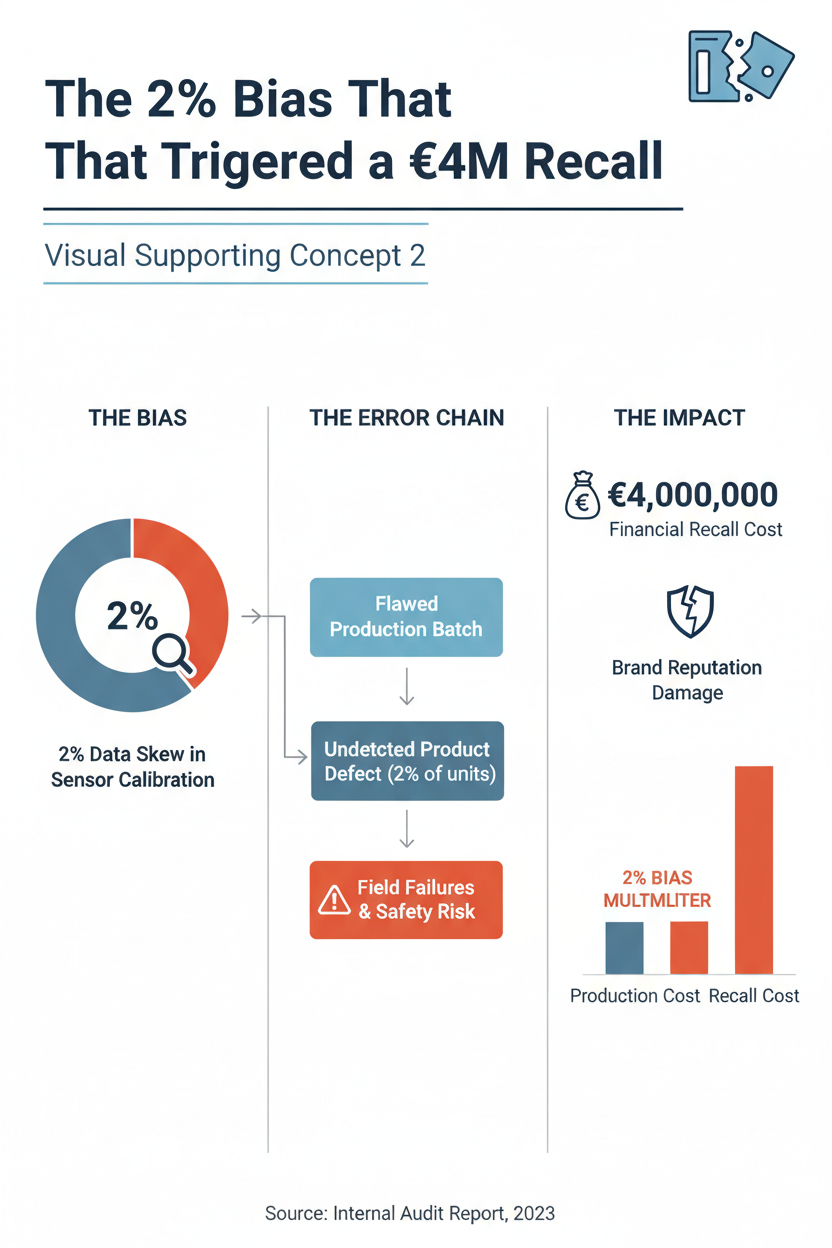
The 2% Bias That Triggered a €4M Recall
The 2% Bias That Triggered a €4M Recall
Bias isn’t a checkbox. It’s a system health signal that hides in data, pipelines, and people — until it costs credibility, trust, and safety.
The deployment looked flawless on launch day. Then a client pointed to a biased outcome I didn’t see coming.

I learned the hard way when the defect‑detection system I owned at an automotive supplier missed surface flaws on low‑volume European trims. The oversight triggered a €4 million warranty claim and instantly eroded the trust my team had spent years building.
This is the uncomfortable truth: metrics your dashboards celebrate are not enough to declare safety.
Observation
Bias isn’t a problem of a single score; it’s a property of the entire pipeline. In a separate RAG‑based support bot, gender‑coded queries from male‑identified users were answered 23% more often, inflating churn for a key segment. An internal audit at a SaaS firm showed their “bias test suite” missed 87% of real‑world bias incidents over six months. The common denominator? A static dashboard that treated fairness as a checkbox instead of a system‑health signal.
Mechanism
Bias lives in the data pipeline, the retrieval layer, and the fine‑tuning stage — places no single score can fully observe. The weakness isn’t a single misprint in a scorecard; it’s a chain of decisions that sneak past your line of sight when teams hurry to ship.
What you observe on a dashboard is a snapshot, not a system. The real issue sits in how data is gathered, how queries are retrieved, and how models are fine‑tuned to fit a narrow prototype, not the messy reality of production.
What broke, and how it hit my career
Standard bias tools gave me a pretty graph, but integrating deeper audits ate sprint capacity. The team toggled mitigation off to meet release dates, and leadership labeled the extra work a “nice‑to‑have.” When the recall hit, my credibility as the product owner evaporated overnight. I went from being the trusted problem‑solver to the custodian of an opaque black box that made decisions I couldn’t explain.
This wasn’t just a failure of a feature. It was a failure of the role I’d chosen: a translator between engineering rigor and business reality who could still be handed the limp excuse of a single metric.
A concrete way to turn bias into a health metric
I stopped treating fairness as a separate audit and embedded it into the CI/CD pipeline.
# Example: bias‑impact test in a GitHub Action

- name: Bias Impact Test
  run: |
    python bias_check.py \
      --model ${{ secrets.MODEL_PATH }} \
      --dataset tests/bias_suite.csv \
      --threshold 0.02   # reject PR if disparity > 2%
The script runs on every pull request, computes disparity across protected attributes, and fails the build if the gap exceeds 2%. Coupled with a continuous observability dashboard (the same kind I built for Optimly’s RAG platform), any drift surfaces instantly.
To keep the process lightweight, I use the ML Second Brain templates to track bias incidents, dataset slices, and mitigation experiments. The result: bias becomes part of the system’s health score, visible to product, engineering, and compliance alike.
Reframe your mental model
Bias is no longer a compliance checkbox; it is the only lever that prevents AI from becoming the invisible decision‑maker that steals your authority. Treat it like uptime or latency: a non‑negotiable metric that must be observable, testable, and actionable every time you ship code.
This is not a niche concern for ethics teams. It’s a performance signal that determines whether your AI maintains trust when real users push the system in ways a lab test never did.
Decision time
You either make bias an integral health indicator of every AI system you ship — preserving your credibility, your team’s trust, and your customers’ safety. Or you let opaque models dictate outcomes and watch your professional authority dissolve.
Design the system to surface fairness. Or let opaque decisions define your identity.
If you’re keen on avoiding the pitfalls of bias in your ML pipeline and want to ensure system health beyond static dashboards, check out the Full Stack ML Engineer Handbook. It offers comprehensive coverage from foundational concepts to advanced MLOps, including best practices to avoid bias in production systems.
📬 Want more insights like this? Subscribe to my newsletter for weekly deep dives on ML, AI, and production systems.

I’ve spent the last years building AI systems for startups, research labs, and enterprise projects — and one pattern kept repeating: nobody really knew how their AI agents were performing.
That’s why I built Optimly — a tool that helps teams and companies understand, measure, and optimize their Agentic Analytics.
[embed]
If you’re building with LLMs, you might find it useful too.
👉 Follow me on Medium to get more stories like this and connect with me on LinkedIn to keep in touch.
메타데이터
- post_id
- 8ec3b2daa27b
- slug
- the-2-bias-that-triggered-a-4m-recall-8ec3b2daa27b
- url
- https://medium.com/@iamdgarcia/the-2-bias-that-triggered-a-4m-recall-8ec3b2daa27b
- canonical_url
- https://medium.com/@iamdgarcia/the-2-bias-that-triggered-a-4m-recall-8ec3b2daa27b
- author_url
- https://medium.com/@iamdgarcia
- status
- ok
- fetched_at
- 2026-07-22 06:37:29