Top 5 AI-Powered Tools Optimizing Telecom Networks
You optimize telecom networks with AI-powered tools that bring automation, predictive intelligence, and efficiency into every layer of…
Top 5 AI-Powered Tools Optimizing Telecom Networks
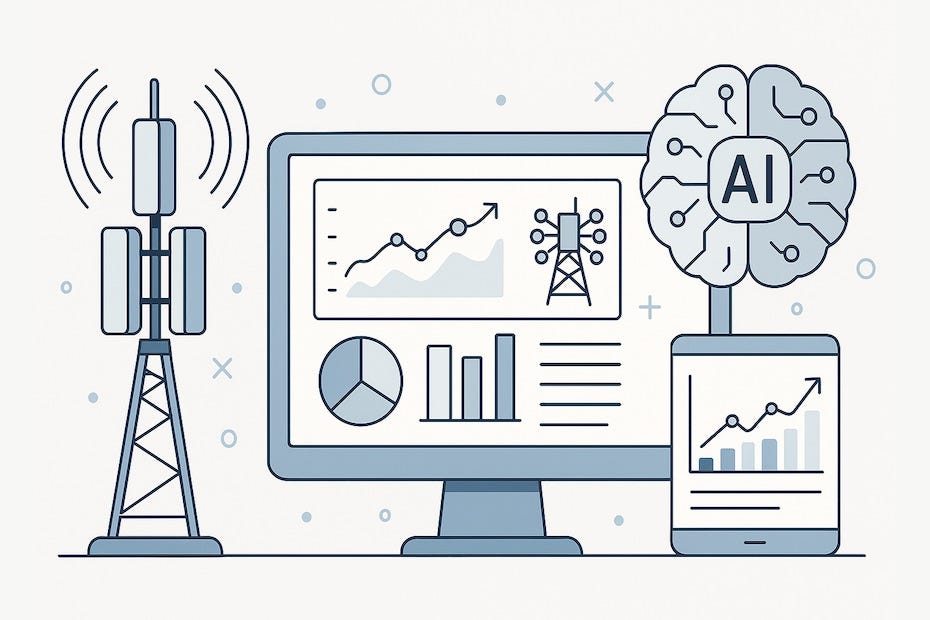
You optimize telecom networks with AI-powered tools that bring automation, predictive intelligence, and efficiency into every layer of operations.
This article highlights the five most influential AI solutions in telecom today. You’ll see how leading carriers deploy them, the measurable benefits they deliver, and what you can do to implement them in your own network.
1. Network AIOps for Automated Detection and Response
Network AIOps (Artificial Intelligence for IT Operations) allows you to process millions of events per second, identify anomalies instantly, and automate corrective actions.
Traditional network operations rely heavily on manual monitoring, rule-based alerts, and reactive troubleshooting. As 5G expands, the volume of signals and events has outgrown human capacity. AIOps solves this problem by ingesting structured and unstructured data, learning baselines, and continuously flagging abnormal conditions.
- Case Study: Google Cloud and Amdocs’ Network AIOps platform has shown that telecom operators can cut mean time to resolution (MTTR) by up to 40%. By reducing “false positive” alerts, it frees engineers to focus on strategic initiatives.
- Result: You get a proactive operations model where outages are prevented rather than resolved after the fact.
AIOps isn’t just a cost-saving measure-it directly strengthens your brand because customers notice fewer disruptions. In highly competitive telecom markets, that reliability becomes a differentiator.
2. Self-Optimizing Networks (SONs) for Autonomous Tuning
Self-Optimizing Networks use AI to autonomously adjust radio access network (RAN) parameters.
When traffic patterns shift-during stadium events, for instance, or in busy urban areas-SONs automatically redistribute resources. They adjust cell coverage, handovers, and power allocation to keep services stable. Without SONs, these adjustments would require manual intervention by engineers who may not respond fast enough.
- Impact: Industry reports show SONs can lower dropped calls by 20–25% and improve data throughput by 15%.
- Operator Example: Vodafone and Telefonica have deployed SON systems to manage RAN complexity, especially in dense 4G and 5G environments.
For you, the business advantage lies in scalability. SON allows you to handle new device categories and bandwidth demands without needing to proportionally expand engineering teams.
3. Dynamic Spectrum Management with AI and ML
Spectrum is one of the scarcest and most expensive resources in telecom. AI and ML optimize its use dynamically.
Dynamic Spectrum Management (DSM) powered by AI identifies idle or underutilized frequencies and reallocates them instantly. ML algorithms learn from traffic behavior and interference patterns, allowing the system to predict where congestion is likely and shift resources preemptively.
- Real-World Example: In India, Reliance Jio has used AI-driven spectrum allocation to support rapid 4G expansion without overspending on new licenses.
- Result: You maximize throughput across available bands and extend capacity to more users with the same infrastructure.
This becomes especially powerful as IoT devices proliferate. From connected cars to industrial automation, billions of endpoints compete for limited spectrum. DSM ensures you serve them efficiently without degradation.
4. Predictive Maintenance to Prevent Failures
AI-driven predictive maintenance allows you to detect equipment stress before it leads to outages.
Telecom networks rely on extensive hardware: towers, fiber lines, switches, antennas, and edge data centers. Any failure in this chain can cascade into service disruption. Predictive AI models ingest sensor data-temperature, vibration, voltage, and signal strength-and forecast failures.
- Quantified Benefit: McKinsey research suggests predictive maintenance can reduce maintenance costs by 30–40% and cut downtime by 50%.
- Industry Example: AT&T uses predictive AI to monitor power supplies and prevent failures that could disrupt mobile and broadband services.
By shifting from reactive and calendar-based maintenance to condition-based interventions, you extend asset lifespan and reduce repair frequency. For you, that means both direct cost savings and higher SLA compliance.
5. AI Simulations and Digital Twins for Smarter Planning
Digital twins powered by AI simulate your network virtually, allowing you to test decisions before applying them to live infrastructure.
Planning telecom expansions has always been capital-intensive and risky. Misplaced towers or under-provisioned data centers can waste millions. Digital twins solve this by replicating the physical and logical elements of your network in a simulated environment.
- Use Case: Ericsson’s AI-driven planning tools let operators test how new 5G small cells affect load distribution and energy consumption before deployment.
- Key Advantage: You reduce trial-and-error in physical deployments and make evidence-based investment decisions.
AI simulations also model “stress events”-like natural disasters, sudden traffic spikes, or cyberattacks-so you can prepare mitigation strategies ahead of time. That foresight is invaluable for resilience planning.
Why AI Matters to Your Telecom Strategy
To put it into perspective, here’s how these tools align with your business objectives:
- Revenue Growth: Better uptime and QoS attract and retain customers.
- Cost Reduction: Predictive and autonomous systems lower maintenance and labor costs.
- Scalability: AI tools let you handle exponential device growth without exponential headcount growth.
- Innovation: Simulations and agentic AI prepare you for new service models such as private 5G and edge computing.
Top AI tools optimizing telecom networks
- Network AIOps for proactive issue detection
- SONs for real-time optimization
- AI-driven spectrum management
- Predictive maintenance for uptime
- Digital twins for planning
In Conclusio
You can no longer manage telecom networks at scale without AI. By integrating AIOps, SONs, spectrum management, predictive maintenance, digital twins, and emerging agentic AI, you position your network for resilience, efficiency, and growth. The competitive advantage lies in execution-how fast and effectively you implement these tools across your operations.
Connect with Alex Clug for more ideas on innovation and technology leadership on Facebook.
Originally published at https://alexandreclug.com on October 17, 2025.
메타데이터
- post_id
- 8eca8cb164d4
- slug
- top-5-ai-powered-tools-optimizing-telecom-networks-8eca8cb164d4
- url
- https://medium.com/@alexclug/top-5-ai-powered-tools-optimizing-telecom-networks-8eca8cb164d4
- canonical_url
- https://medium.com/@alexclug/top-5-ai-powered-tools-optimizing-telecom-networks-8eca8cb164d4
- author_url
- https://medium.com/@alexclug
- status
- ok
- fetched_at
- 2026-06-17 08:20:12