The Stories We Tell Ourselves: How Your Beliefs Shape the Life You Live
We live in an age where answers are only a few clicks away. Need to learn a new skill? Watch a tutorial. Want to build a business? Listen…
The Stories We Tell Ourselves: How Your Beliefs Shape the Life You Live
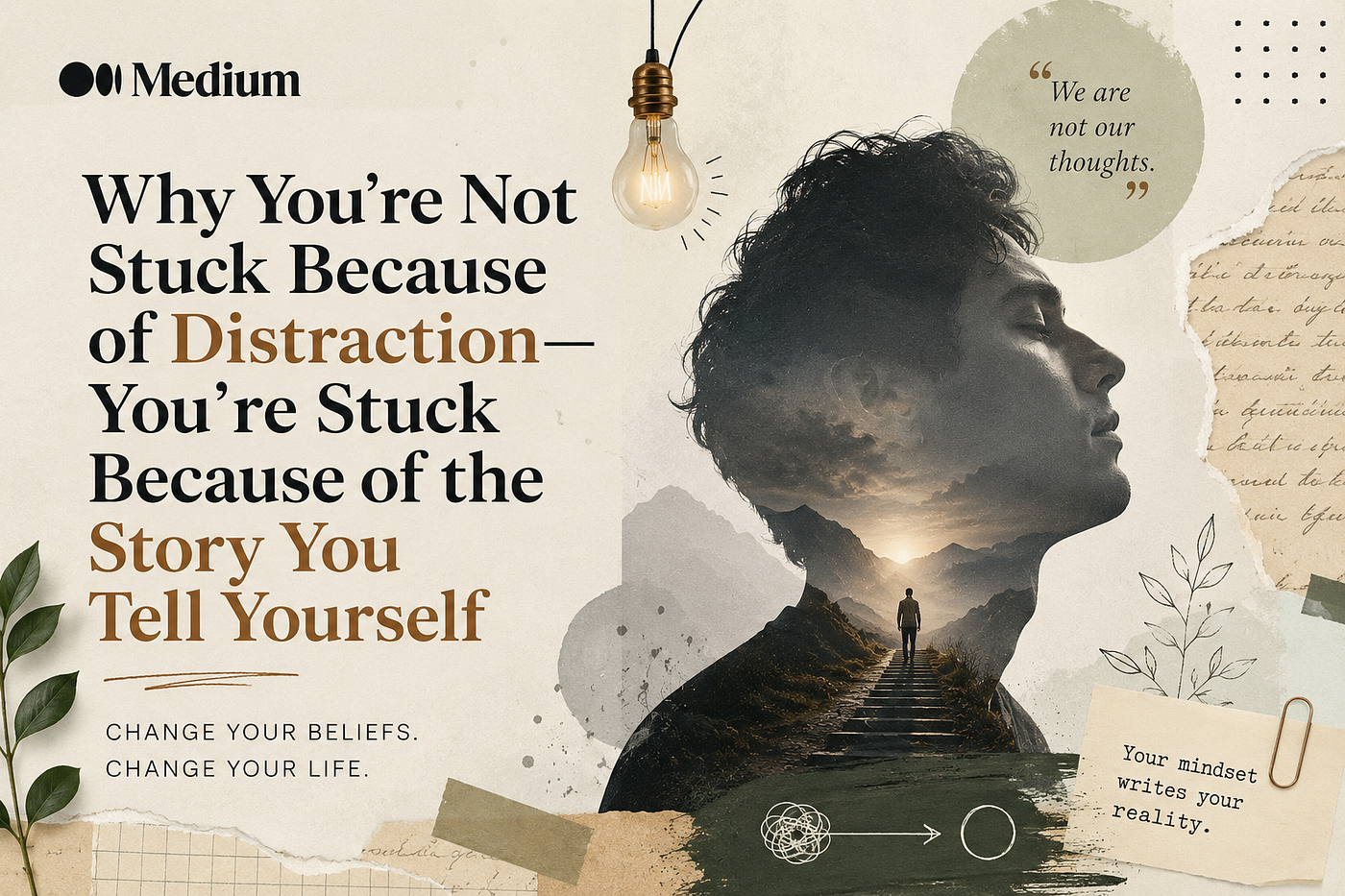
We live in an age where answers are only a few clicks away. Need to learn a new skill? Watch a tutorial. Want to build a business? Listen to a podcast. Looking to improve your habits? There are countless books, videos, and courses promising to change your life.
Yet, despite having more access to knowledge than any generation before us, many people still struggle to make meaningful progress. We know what to eat, how to exercise, why we should save money, and what habits lead to success. But knowing has never guaranteed doing.
That raises an uncomfortable question: if information isn’t the problem, what is?
The answer may lie in something we rarely question — our beliefs. More specifically, the stories we tell ourselves about who we are, what we’re capable of, and what we need to become before we can finally feel fulfilled.
The Real Reason We Struggle to Change
Most people assume they lack discipline. When they fail to stick to a routine or abandon a goal halfway through, they blame their willpower. Others point fingers at technology, believing smartphones, social media, or endless notifications are responsible for their inability to focus. While these distractions certainly play a role, they are rarely the root cause.
Behavioural psychology suggests that distraction often begins long before we unlock our phones. We don’t scroll because our devices demand attention; we scroll because we’re trying to escape something happening within us. It might be boredom, uncertainty, anxiety, loneliness, or even the discomfort of doing difficult work. Technology simply becomes the easiest escape route.
This shift in perspective changes everything. Instead of asking how to eliminate distractions, we begin asking a far more important question: What am I trying to avoid? The answer is often uncomfortable, but it’s also where genuine transformation begins.
Why Information Alone Doesn’t Create Action
If success depended purely on knowledge, the world would look very different. Everyone would be financially secure, physically healthy, and emotionally resilient because the information already exists. The fact that these outcomes remain rare tells us something important: information is only one piece of the puzzle.
Motivation is commonly understood as a relationship between effort and reward. Work hard, achieve the result. While this idea makes sense on paper, it ignores a crucial element that determines whether we continue showing up when things become difficult.
That missing element is belief.
Every action we take is filtered through what we believe about ourselves. Someone may know exactly how to build a successful business, but if they secretly believe they aren’t capable of leading people, they’ll hesitate at every opportunity. Another person may understand how to get fit, but if they’ve convinced themselves they’re “just not disciplined enough,” every setback reinforces that identity.
Beliefs quietly shape behaviour. They influence whether we start, whether we persist, and ultimately whether we succeed. Without recognising them, we often mistake limiting beliefs for objective facts.
Your Brain Isn’t Trying to Make You Successful
One of the most fascinating insights from behavioural science is that your brain wasn’t designed to help you achieve your dreams. Its primary responsibility is much simpler: to keep you alive.
For thousands of years, survival depended on avoiding unnecessary risks. Familiarity meant safety, while uncertainty often meant danger. Although the world has changed dramatically, our brains continue operating under the same ancient programming. Whenever we attempt something unfamiliar — starting a business, changing careers, speaking publicly, or pursuing a creative passion — our minds naturally generate resistance.
That resistance isn’t proof that we’re incapable. It’s proof that our brain is doing exactly what it evolved to do.
Understanding this helps us stop interpreting fear as failure. Feeling uncomfortable doesn’t always mean we’re heading in the wrong direction. Sometimes, it simply means we’re stepping beyond the limits of what’s familiar.
The Invisible Stories That Hold Us Back
Perhaps the greatest obstacle to personal growth isn’t external at all — it’s internal.
Every one of us carries stories that shape how we interpret the world. Some are empowering, while others quietly limit what we believe is possible.
“I’m too old to start over.”
“I’ll never recover from my past mistakes.”
“I don’t have enough talent.”
“I’ll only be happy once I’ve proved myself.”
The challenge is that these statements rarely feel like opinions. They feel like facts.
But beliefs aren’t facts — they’re interpretations. And interpretations can change.
A useful way to identify a limiting belief is to ask whether it reduces your motivation while increasing your suffering. If believing a particular story leaves you feeling anxious, defeated, or incapable of moving forward, it’s probably not serving you.
The difficulty, however, is recognising these beliefs in the first place. We can often identify other people’s limiting narratives with ease, yet struggle to see our own. Like trying to see our face without a mirror, we need deliberate reflection to uncover the stories silently directing our behaviour.
The Power of Hope and Persistence
One of the most compelling lessons in psychology is that hope changes how long we’re willing to keep trying.
Research has repeatedly shown that people persist longer when they believe their efforts can eventually lead somewhere. Hope doesn’t remove pain or difficulty, but it changes how we experience them. Instead of viewing struggle as evidence of failure, we begin seeing it as part of the journey.
This explains why persistence often matters more than talent. Success isn’t always reserved for the smartest or the most gifted. More often, it’s achieved by those who continue long after others have convinced themselves to stop.
Of course, persistence doesn’t mean refusing to quit under any circumstances. Walking away from something that no longer serves you can be a wise decision. The important distinction is whether you’re quitting because the path genuinely has no future, or because temporary discomfort has convinced you that you’re incapable.
Learning to recognise that difference may be one of the most valuable skills anyone can develop.
Rewriting the Narrative
The most transformative part of personal growth isn’t building better habits — it’s questioning the beliefs that drive those habits.
When we feel stuck, our instinct is often to search for better strategies or more motivation. Rarely do we stop to examine the story running quietly in the background.
What if you don’t actually need to prove yourself to deserve happiness?
What if your past doesn’t define your future?
What if the struggle you’re experiencing isn’t evidence that you’re failing, but evidence that you’re growing?
These questions don’t erase life’s challenges. They do, however, create space for new perspectives. The moment we realise our beliefs are stories rather than absolute truths, we gain the freedom to choose different ones.
Replacing a limiting belief doesn’t mean pretending everything is perfect. It means adopting a perspective that encourages growth rather than reinforcing fear.
Instead of saying, “I have to redeem myself before I can be happy,” perhaps the healthier belief is, “I can create meaningful work without carrying the weight of proving myself.”
That single shift can completely transform how we approach our goals.
Final Thoughts
We often believe that change begins with a new routine, a better productivity system, or more discipline. While those things certainly matter, they rarely address the deeper issue. Lasting transformation begins when we change the way we interpret ourselves.
Our beliefs shape our actions, our actions shape our habits, and our habits ultimately shape our lives. If the story we’re telling ourselves is rooted in fear, self-doubt, or the need for constant validation, no amount of external success will feel enough.
The next time you feel stuck, resist the urge to search for another productivity hack. Instead, pause and ask yourself a simpler question:
What story am I believing right now?
Because more often than not, the biggest obstacle standing between you and the life you want isn’t the world around you.
It’s the narrative you’ve unknowingly accepted as the truth.
메타데이터
- post_id
- 8ed1eb3c4bdc
- slug
- the-stories-we-tell-ourselves-how-your-beliefs-shape-the-life-you-live-8ed1eb3c4bdc
- url
- https://medium.com/@ansandhiya/the-stories-we-tell-ourselves-how-your-beliefs-shape-the-life-you-live-8ed1eb3c4bdc
- canonical_url
- https://medium.com/@ansandhiya/the-stories-we-tell-ourselves-how-your-beliefs-shape-the-life-you-live-8ed1eb3c4bdc
- author_url
- https://medium.com/@ansandhiya
- status
- ok
- fetched_at
- 2026-07-14 17:06:34