IBOGAINE: an overthinking ADHD-ers paradise
I didn’t chew bitter African root bark in a remote Baja California ceremony yurt just to return to civilization and politely ask, “how was…
IBOGAINE: an overthinking ADHD-ers paradise
I didn’t chew bitter African root bark in a remote Baja California ceremony yurt just to return to civilization and politely ask, “how was your weekend?”
Let me back up.
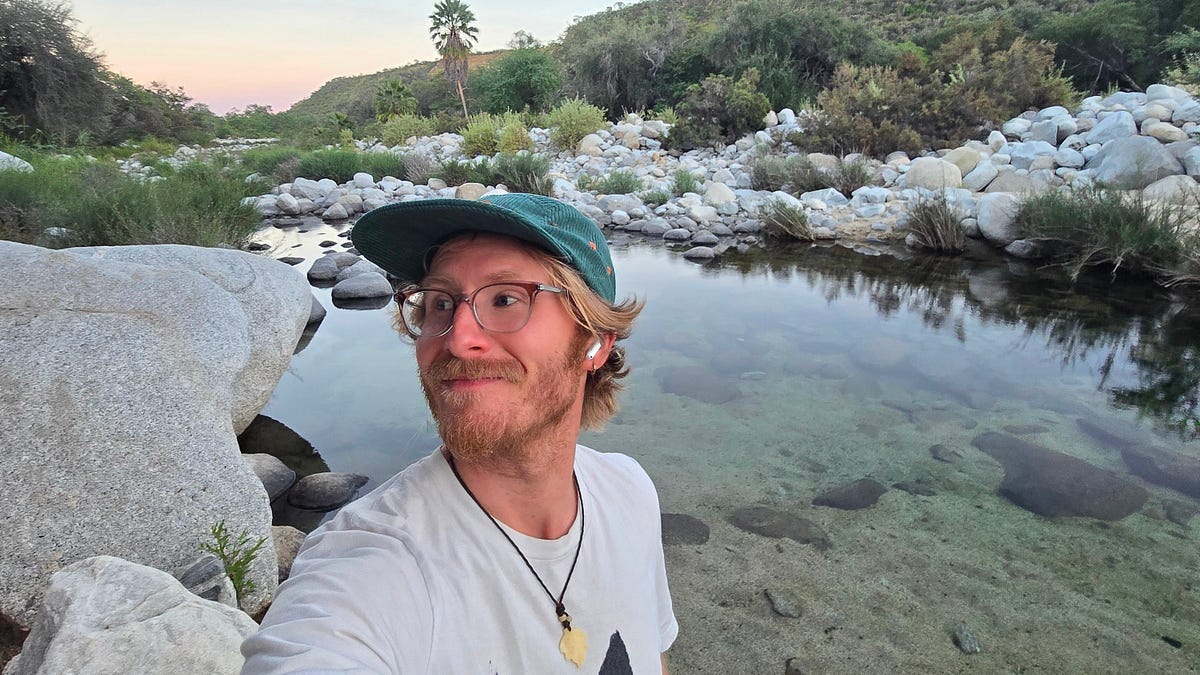
My name is Craigory. I am a 39-year-old University advisor/instructor from Wisconsin currently living in Oregon.
I have at least a dozen documented concussions, a COMT gene that processes dopamine like a DMV processes paperwork — technically proficient, catastrophically slow — and an inner critic who, until December 9th, 2025, had been squatting rent-free in my prefrontal cortex since the Reagan administration.
I went to Mexico to evict him.
Iboga, AKA Tabernanthe iboga, is a shrub native to Central Africa, and it has been used by the Bwiti people of Gabon for spiritual initiation since before anyone reading this article was born. It tastes similar to licking an antique tire iron, with notes of regret and ancient wisdom. The ceremony starts at sunset. It does not end until your soul has filed all its paperwork.
For me, someone with a gargantuan backlog, who took, “the biggest dose — by far” of my cohort — this meant a good 24-hour-long ceremony was in store.
There are about 10 of us in the ceremony space (a circular mesh yurt). We each have a little pad. We each have a bucket. The bucket is, as they say in the pharmaceutical literature, for anticipated emetic events. Hippies call it purging. I call it the body’s editorial process — removing everything that no longer serves the self-hating narrative.
Before the medicine begins, they ask each of us to state our intention.
I say mine out loud: I want to meet the voice that has been telling me I’m not enough, and I want to say goodbye to it forever.
The facilitator nods. He has heard intentions like mine before. He has heard more mundane platitudes. He gives me a look that says: buckle up, Sheboygan.
Here is what they do not tell you about Iboga in the wellness podcasts:
It is not the most luxurious vacation.
It is a 36-hour court proceeding in which you are simultaneously the defendant, the prosecutor, the judge, and the court reporter, and all four of you are extremely biased. The bailiff is a shrub from Gabon that has been watching humans make the same mistakes for ten-thousand years and is exhausted and sick of your shit.
The medicine begins working in approximately forty-five minutes.
(Even faster for me — when the facilitator asked, “anyone feeling it yet?” and nobody raised their hands, I decided to stay quiet to not perturb the other participants.)
The first thing Iboga does is show you your mind’s operating system — not the consumer-facing version with the clean interface and the curated Spotify playlist, but the actual source code. The part with all the legacy programming from 1987 running on patches and workarounds and a core assumption that love always ends — and nobody ever sticks around for long.
My source code, it turns out, has been optimized around one foundational question: what do I need to be so that people will stay?
The medicine looks at this question for a long moment.
That’s the wrong question, it says.
It sounds, suspiciously, like my own voice. But calmer. More affectionate. Zero percent interested in being impressive.
Logistically, I had wanted to do Iboga for about a year between reading about it to laying on a pad facing the sky in remote Mexico. I have been on a 5-year soul-searching journey that began with me getting uprooted out of Senegal, West Africa as a Peace Corps member in March 2020.
Upon leaving the Peace Corps, I had nothing — no job, relationship, nearby friends, apartment, car — nothing. What better time to have a major existential crisis?
Bigger picture: I have been living on lawn furniture since 2004. Unwilling to commit to a life, place, person, or existence.
Iboga welcomes you in skeptically — or at least it did in my experience. My body, as noted, took to the medicine quickly. But, the gatekeepers still treated me tepidly.
I arrived at a big, powerful, iron gate and assessed and looked over before I was invited inside.
Once the medicine deemed me worthy — the show started. The projector was set up and an entire review of my life was conducted — year by year of greatest (and absolute worst) hits. Gliding by like a hyper-accelerated TikTok reel.
Iboga, and the current memoir-style slideshow, was an ADHDers dream. It’s quite difficult to get bored when you’re reliving every single thing you’ve ever said, every person you’ve ever seen, and every thought you’ve ever had in the space of a day.
I followed this pattern of memory recollection over and over — thousands of times. I had a difficult, lonely childhood and I think acceptance of many of my realities — of abuse I’ve received, continuous abandonments, and unfortunate accidents — was something I was never fully willing (or capable) of doing.
Now, in this safe space, I was able to review everything in my entire human-portfolio and: accept it happened.
Zero avoidance.
Iboga is also extremely interactive. I highly recommend procuring a question (or hundreds) in advance. The same you would ask the Wizard of Oz.
One I decided to probe on was, “What is the worst thing I’ve ever done?”
And, I won’t share the results of that question here & now, but I was able to relive an extremely unfortunate and shameful moment in my life. One I would’ve loved to run from and never acknowledge again in my life. One that brought back a lot of pain.
But — one I am now happy I was able to revisit this shameful life event. I knew it was wrong in the moment. Upon reflection, I was able to understand WHY I did it. And, more importantly, I was able to forgive myself for committing such a hurtful mistake.
Now, here is where I have to get nerdy, because I am constitutionally incapable of having a spiritual experience without also immediately consulting the scientific literature.
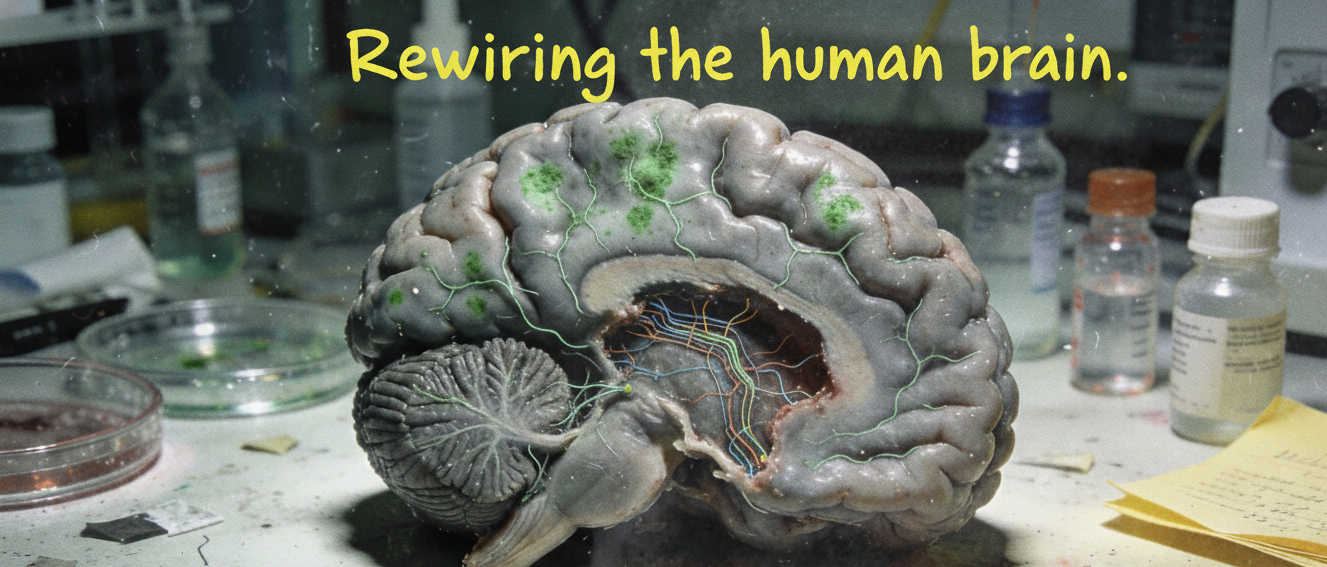
Iboga (or Ibogaine, a single alkaloid derived from the whole iboga plant) is not simply a hallucinogen. It is a complex alkaloid with at least a dozen identified mechanisms of action, and the one that matters most for people like me — people whose neurochemistry arrived with factory defects and field modifications — is this: Ibogaine produces a massive upregulation of GDNF. Glial cell line-derived neurotrophic factor. A protein that tells your brain’s maintenance crew to stop napping and start renovating.
Here is the thing about Iboga and ADHD brains specifically: we are not medicating a deficit. We are resetting a system that has been running compensations for thirty years. The GDNF doesn’t teach the ADHD brain to be neurotypical. It gives it — possibly for the first time — the neurological quiet to actually hear itself.
I also have BDNF Val/Met — a variant in my Brain-Derived Neurotrophic Factor gene that means my neuroplasticity window post-ceremony is more pronounced and more durable than in most people. (Not bragging — it’s just how I was built!)
My FKBP5 CT variant has epigenetically altered my stress response since childhood — my glucocorticoid receptors have been running on anxious toddler settings for thirty-nine years, and Iboga is one of the few medicines on Earth that can reach into that specific mechanism and say actually, what if we tried a different factory default?
My COMT AA genotype means my prefrontal cortex has been swimming in dopamine for decades without adequate clearance — like a bathtub filled with my housemate’s body hair. The inner bully, I now understand, was not a character flaw. He was a coping mechanism for a brain running chronically overstimulated, pattern-matching everything in the environment for threats, narrating the story of my life faster than it was unfolding.
The medicine does not explain any of this to me during the ceremony (and I didn’t do this DNA+medicine research prior to my ceremony).
The medicine simply turns off the narrator.
Somewhere around hour three, I stop being Craigory the Career Coach, Former White House Advisor, Professional Overachiever, and I become something smaller and more accurate: a body on a little pad in Mexico, watching its own psychological architecture dissolve.
The inner bully shows up around hour four.
I have been expecting him. He has been with me since the sixth grade, when I showed up to school having lost sixty pounds on a diet consisting of saltine crackers and stubbornness. He moved in that year, unpacked, made himself comfortable in the part of my brain that was supposed to be for executive function.
For twenty-eight years, he has been the voice that runs the morning briefing.
Too much. Too loud. Too fat. Too ugly. Too weird. Not enough. Not enough. Not enough.
I meet him in the ceremony. He looks, genuinely, like me. An earlier version. Twelve years old. Sheboygan, Wisconsin. Frightened underneath all the bravado, just like I am. Just like I have always been.
He doesn’t argue. He doesn’t have a rebuttal prepared. Twenty-eight years of occupancy and he folds immediately, like he’s been waiting to be asked to leave. He goes, and in his place there is a silence so complete I can hear my own heartbeat, which sounds, for the first time in recent memory — with the weight of the elephant off my chest — like something I am permitted to have.
The pendulum the medicine shows me next is not metaphorical.
I watch my mind swing, in real time, between past and future.
Past: the four-year-old who extended his hand to a girl who was carried away, fading into the distance, and who he has been searching for ever since.
Future: the version of my life where I have finally done/seen/accomplished enough to deserve the things I’ve always wanted.
Back and forth. Back and forth. Never, ever stopping in the middle.
The middle is the present moment.
The present moment, the medicine informs me, is the only place where any of this is actually happening.
I test this theory. I pull my attention into the room: the pad beneath my back, the Baja California air, the ceremonial Bwiti chanting music, the feeling of my own chest rising and falling. The pendulum slows. Then ceases completely.
In the stillness I notice: I am not in danger. I have never, in my actual present-tense life, been in as much danger as my FKBP5 CT stress response has consistently insisted ( aside from my near-death parasitic hospitalization in Peru in 2023).
My nervous system has been responding to a threat assessment calibrated in 1990, based on data input from a Sheboygan single-parent household, running continuously on hardware that has been living out of a backpack since 2004, lived in twelve time zones, has worked in LA (entertainment), DC (politics), and Silicon Valley (tech), dated hundreds of people, and eaten a truly heroic number of bratwursts.
The operating system is outdated.
The hardware, I’m learning, is fine.
Hour eight. I am nauseated and I cannot decide if the nausea is physical or metaphysical, which is, I suppose, the Iboga experience in a sentence.
I do not throw up. This feels like a small victory. I note it the way you note an incredible parking spot on an otherwise shitty day (thanks Alanis) — with disproportionate gratitude.
Hour twelve. The visions shift from architectural to relational. I see my grandmother. Ninety years old, Sheboygan, Wisconsin, same house, same kitchen, same reliable love distributed in the form of (mediocre) food and reliable presence.
She does not speak in the vision. She does not need to. She has been telling me the same thing my entire life with her actual physical presence.
The message is: it doesn’t cost anything to smile
A common saying she misattributes* to Mr. Rogers — one of our favorite people to watch together.
I cry for approximately forty-five minutes.
It is, by some distance, the most useful crying I have ever done.
Looks like the actual quote is as follows: A smile, someone once said, costs nothing but gives much. It enriches those who receive without making poorer those who give. It takes but a moment, but the memory of it sometimes lasts forever. None is so rich or mighty that he cannot get along without it and none is so poor that he cannot be made rich by it. Yet a smile cannot be bought, begged, borrowed, or stolen, for it is something that is of no value to anyone until it is given away. Some people are too tired to give you a smile. Give them one of yours, as none needs a smile so much as he who has no more to give. Smile. It increases your face value.*
- Dale Carnegie How to Win Friends and Influence People
Hour twenty-two. The GDNF is doing its thing.
I know this because the part of my brain that has been running the interference pattern — the part that takes incoming emotional information and immediately converts it into narrative, analysis, and strategic positioning before the feeling can land — that part has gone very quiet. The Iboga has essentially taken my COMT AA pattern-recognition machine offline for scheduled maintenance and installed a temporary replacement system that only does one thing: notice what is actually happening.
What is actually happening is this: I am lying on a mat in Mexico at 4pm and I am thirty-eight years old and I have wanted to be a good father since I was seven years old. I have not yet been one.
I do not know when I will be one and this is, in the present tense of this specific moment, okay.
Not okay like don’t worry about it. Okay like: the ground is here. I am on it. The desire is real and it has not diminished and it will still be there in the morning and I do not need to solve it tonight. I just need to let it exist without immediately making it a problem.
The medicine nods.
That, it says, is what we came here to do.
Around 18-hours into the ceremony I receive bodywork. I was still so, “in the medicine” I regretted booking the appointment.
It ended up being the greatest hour of my life.
On the (extremely slow) walk over — stepped on a GIANT yellow Boa Constrictor.
And the first time, since being a very young child, I truly trusted another human being.
This deserves its own separate story.
I emerge from my tent near-36-hours from the onset of the ceremony, at sunrise. I am walking slower than I have ever walked in my life, which turns out to be, for reasons I couldn’t have anticipated, exactly the speed I needed to be walking.
The morning dip in the river is followed with some group cliff diving and a hike. Perfect reacclimation to the overstimulating world we’ve built and I’d be headed back to.
The facilitators tell me the neuroplasticity window is open. They mean this scientifically: Iboga’s GDNF upregulation creates a period of genuine neural plasticity in which new patterns, new behaviors, and new ways of being in the world encode with unusual durability.
The brain is freshly pruned.
The pathways are clear.
Whatever I install in the next several weeks will go deep.
I make one resolution.
It is not about my career. It is not about romantic relationships. It is not about where to build a life, or the next chapter, or the writing/filming/art I’m failing to make.
It is this: continue walking slow.
Four months later, the bully is mostly dead — evicted. I notice where he used to live — the morning briefing is quieter, the pattern-recognition system is running incredibly, the gap between what I feel and what I say has narrowed from a canyon to a crack.
I am still weird.
I remain, constitutionally and genomically, a person who will tell you the complete truth before you have quite finished the question. My COMT AA dopamine processing has not really improved or changed. My MAOA is still clearing catecholamines at the pace of a sleepy bureaucrat on a Friday afternoon. I still think about loving connection four to five hours a day, which is, according to the scientific literature on MAOB low activity, simply how my brain is built, and something I have decided to stop apologizing for.
But I am walking slower.
And the slower I walk, the more I notice.
The present moment — something I have spent a majority of my life avoiding (with fancy jobs, gambling, travel, higher education degrees, dating, and more) is actually…quite enjoyable.
And, more and more frequently, majestically beautiful.
Many wise people have entered my life and tried to point out the beauty in the present to me. Exes pointing at blooming flowers. Most memorable — my former mentor David Backes (RIP) who taught me how to SEE a tree.
The medicine took thirty-six hours to say what these wise angels have been trying to tell me for thirty-six years.
The Bwiti have one prayer: Thank you for this day.
My grandma and these other wise folks, who have never heard of the Bwiti, have been praying it their entire lives.
I am, at last, beginning to understand.
Thank you, Iboga.
Craigory C. Wiroll “writes” from Eugene, Oregon, where he coaches college students toward futures they didn’t realize were possible, attempts to drum badly but enthusiastically, and is learning, at age 39, to walk at a speed that allows him to notice the blossoming life around him. He has not thrown away the lawn furniture. He is thinking about it.
Originally published at https://wiroll.substack.com.
메타데이터
- post_id
- 8ed2196d45e9
- slug
- iboga-an-overthinking-adhd-ers-paradise-8ed2196d45e9
- url
- https://medium.com/@wiroll/iboga-an-overthinking-adhd-ers-paradise-8ed2196d45e9
- canonical_url
- https://medium.com/@wiroll/iboga-an-overthinking-adhd-ers-paradise-8ed2196d45e9
- author_url
- https://medium.com/@wiroll
- status
- ok
- fetched_at
- 2026-07-11 07:43:06