We Promote the People Who Fight Fires. We Rarely Promote the People Who Prevent Them.
On urgency, judgment, and the cultures that unintentionally create the crises they reward.
We Promote the People Who Fight Fires. We Rarely Promote the People Who Prevent Them.
On urgency, judgment, and the cultures that unintentionally create the crises they reward.
The person who saved the deal at midnight gets recognized.
The person who built the process that meant the deal never needed saving usually does not.
Most organizations would never admit this openly.
Yet many operate exactly this way.
Urgency is visible. Judgment is quiet.
One creates a story. The other creates an absence of one.
And because organizations naturally recognize what they can see, they often end up rewarding the wrong behavior without ever intending to.
The Visibility Problem
Crises are memorable.
They have heroes, deadlines, pressure, and resolution.
Leadership teams talk about them, performance reviews reference them,
promotion discussions remember them.
Prevention operates differently.
The crisis that never happened rarely appears on a dashboard.
The resignation that never occurred does not become a case study.
The compliance issue that was prevented before it emerged never receives the same attention as the one that required an all hands response.
As a result, organizations often become better at recognizing visible effort than invisible judgment. The distinction matters more than it appears.
Because over time, reward systems shape behavior, and behavior shapes culture.
Organizations Eventually Become What They Reward
Every performance culture sends signals.
Not the signals written into leadership principles or value statements.
The signals created by who gets promoted, who gets recognized, who becomes influential and who receives the most visibility.
Employees learn those signals quickly.
If urgency consistently receives more recognition than prevention, people adapt. Not because they are cynical, because they are rational.
The organization has taught them what success looks like. And success, in that environment, looks increasingly tied to solving visible problems rather than preventing them.
The Leadership Pipeline Consequence
This is where the issue becomes more significant.
Organizations do not just reward behavior. They select leaders through it.
The people who rise in urgency driven cultures often become exceptionally capable in crisis. They make decisions under pressure, they respond quickly and they perform well when complexity spikes.
These are valuable capabilities, but they are not the same as building systems that reduce complexity in the first place.
Over time, organizations begin promoting leaders whose careers were built managing fires rather than preventing them.
Eventually, the leadership team itself becomes optimized for response rather than foresight.
The consequences are subtle at first, then structural.
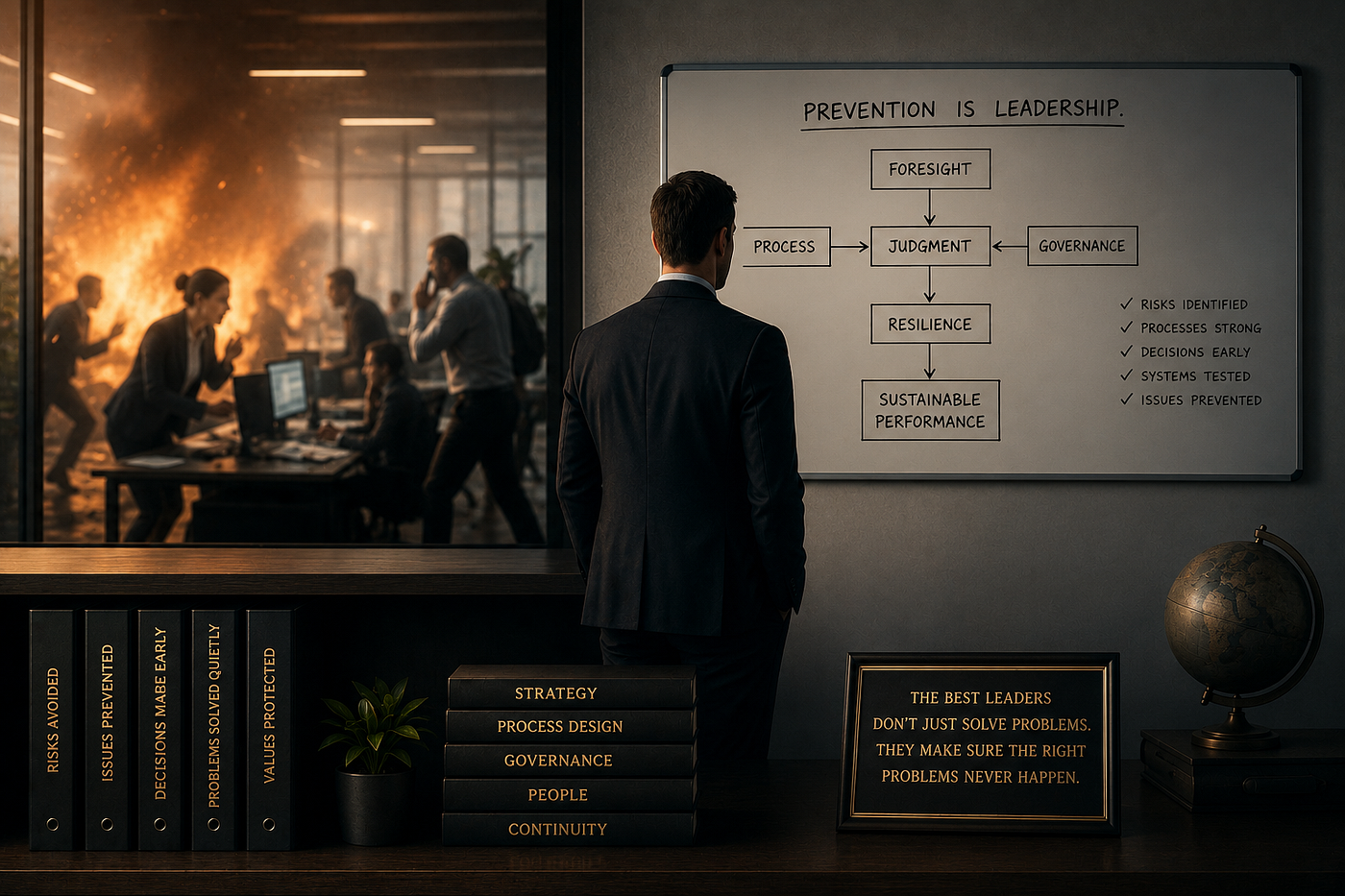
The Culture Starts Generating the Urgency It Rewards
This is the part, organizations rarely see.
When urgency becomes the primary path to recognition, the organization gradually creates conditions that produce more of it.
- Decisions get deferred.
- Process weaknesses remain unaddressed.
- Governance becomes reactive.
- Planning horizons shorten.
The culture does not intentionally manufacture crises. But it creates incentives that make crises more likely.
And when those crises arrive, they generate exactly the kind of visibility the system already rewards. The cycle reinforces itself.
What Strong Organizations Do Differently
The strongest organizations I have worked with do not ignore firefighters.
They recognize them, then they ask a second question:
Why was there a fire in the first place?
The focus shifts from individual heroics to system design. From response to prevention and from effort to judgment.
The goal is not to eliminate urgency.
Every organization will face moments that require extraordinary effort.
The goal is to avoid building a culture that depends on those moments to identify talent.
Because the organizations that sustain performance over time rarely have the best firefighters.
They usually have the fewest fires.
The Leadership Question
Every leadership team should periodically ask itself a simple question:
- Who gets promoted here? Not who should, who actually does.
- What patterns appear?
- What behaviors are consistently rewarded?
- What type of leader is the organization unintentionally producing?
Because cultures eventually become reflections of their incentive systems.
And organizations that reward urgency often discover they have built leadership teams optimized for managing crises rather than preventing them.
Judgment is quieter than urgency. It rarely produces the stories that get told at leadership off sites, but it produces something far more valuable.
Organizations where the systems work:
- The governance holds.
- The succession pipeline is real.
And the crises that consume other organizations happen far less often.
That requires recognizing a different kind of contribution.
Not just the people who showed up when things broke.
The people who made sure they did not.
메타데이터
- post_id
- 8eda4c8ad5f5
- slug
- we-promote-the-people-who-fight-fires-we-rarely-promote-the-people-who-prevent-them-8eda4c8ad5f5
- url
- https://medium.com/@anandrajendran1/we-promote-the-people-who-fight-fires-we-rarely-promote-the-people-who-prevent-them-8eda4c8ad5f5
- canonical_url
- https://medium.com/@anandrajendran1/we-promote-the-people-who-fight-fires-we-rarely-promote-the-people-who-prevent-them-8eda4c8ad5f5
- author_url
- https://medium.com/@anandrajendran1
- status
- ok
- fetched_at
- 2026-06-09 15:37:30



