When Your Dog Gets the Health Insurance Discount
A Story About Goodhart’s Law
When Your Dog Gets the Health Insurance Discount
A Story About Goodhart’s Law
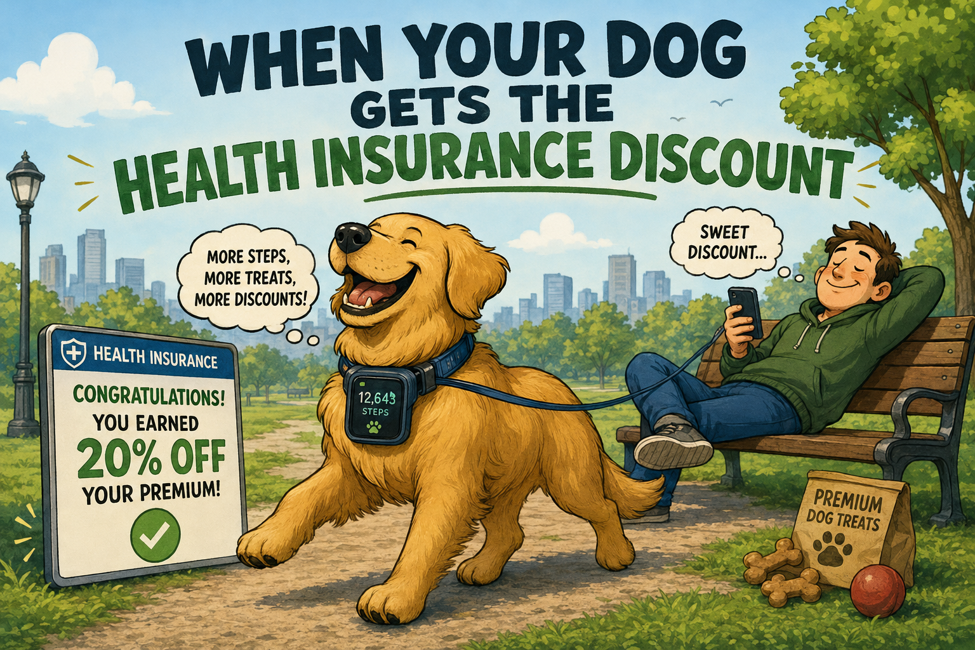
A health insurance company wanted to encourage its customers to adopt a healthier lifestyle.
The idea was simple — and even seemed brilliant.
Each customer received a step-tracking sensor. The more steps you walked, the more benefits and discounts you received. The logic was straightforward: people who walk more are generally healthier, and therefore represent a lower insurance risk.
In other words, the company wanted to measure health.
But health is a complex concept. It is difficult to measure directly.
So the company chose a simple proxy:
Daily step count.
At first glance, this sounds like a great idea. Numerous studies highlight the importance of regular walking and physical activity.
And that is where the problem began.
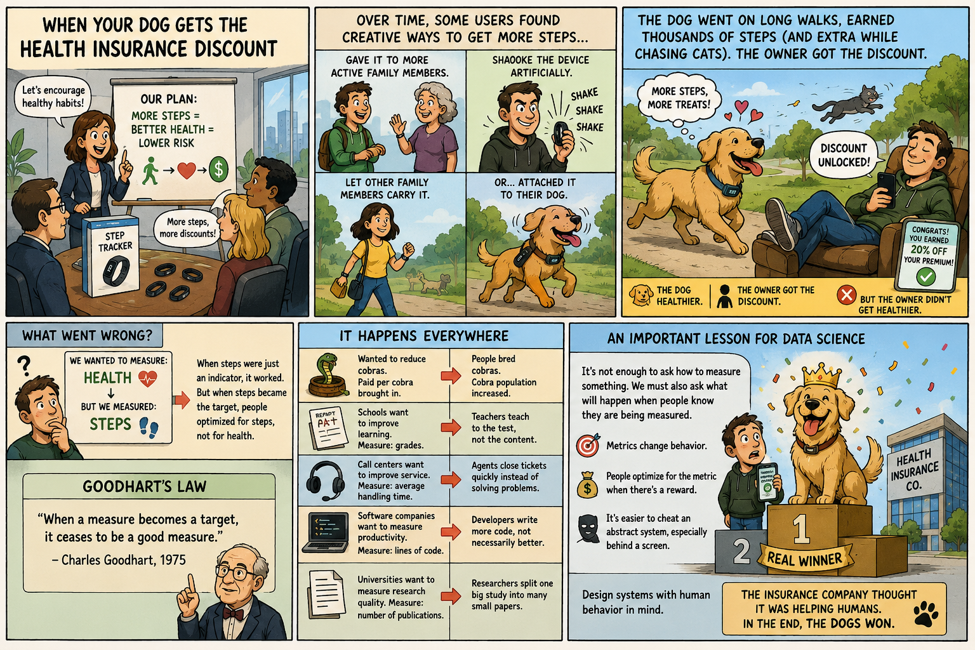
After some time, the company discovered that some users had found remarkably creative ways to accumulate steps. Some gave their sensor to more active family members. Others found ways to shake the device artificially.
Some simply let relatives carry the sensor for them.
But perhaps the most famous story involved people attaching the sensor to their dogs.
The dog went on long walks, accumulated thousands of steps, and likely earned even more while chasing cats. Meanwhile, the owner enjoyed the insurance discount.
The dog became healthier.
The owner received the discount.
But the owner did not become healthier.
What Went Wrong?
At first glance, this seems like simple cheating.
From a data science perspective, however, it is much more interesting.
The company wanted to measure:
Health
But what it actually measured was:
Steps
As long as step count was merely an indicator of health, the relationship was reasonably strong.
However, the moment the steps became a target, something changed.
People stopped trying to become healthier.
They started trying to accumulate more steps.
Goodhart’s Law
In 1975, British economist Charles Goodhart formulated an idea that became one of the most important principles in measurement and decision-making:
When a measure becomes a target, it ceases to be a good measure.
As long as we use a metric to understand reality, it can be useful.
But once we start rewarding people based on that metric itself, they begin optimizing the metric rather than the original objective.

Charles Goodhart
It Happens Everywhere
A famous example comes from British colonial India. The authorities wanted to reduce the cobra population and offered a reward for every dead cobra brought to them.
People responded by breeding cobras.
The result? Instead of reducing the number of cobras, the policy increased it.
Schools want to improve learning.
So they measure test scores.
After a while, teachers start teaching to the test rather than teaching the subject matter itself — a kind of educational overfitting.
Customer support centers want to improve service quality.
So they measure average handling time.
Soon, representatives start closing tickets quickly instead of actually solving customers’ problems.
Software companies want to measure productivity.
In order to do this, they count lines of code.
This led developers to write more code, not necessarily better code.
Universities want to measure research quality.
In view of this, they count publications.
Shortly, researchers split one substantial study into five smaller papers.
An Important Lesson for Data Science
One of the most common mistakes in data science projects is focusing on a metric without considering how that metric will influence the behavior of the people being measured.
Often, the model itself works perfectly.
The problem is that people learn how to work around it.
The moment financial rewards, promotions, bonuses, rankings, or prestige are attached to a metric, people begin optimizing for that metric.
The entire system changes because the metric exists.
This is one of the central lessons of artificial intelligence, economics, and data science:
It is not enough to ask how to measure something. We must also ask what will happen once people know they are being measured.
Behavioral psychology adds another layer to this problem. Research suggests that people often feel more comfortable deceiving an abstract system than deceiving another person face-to-face. They are especially willing to do so when interacting through a screen or with an automated process.
How many people have told a navigation app that they were the driver when they were actually the passenger?
When designing digital systems, we must assume not only that people have incentives to game the system, but also that many will not hesitate to do so in an electronic environment.
On a personal note, I have found that many data science projects and educational programs place a strong emphasis on statistics, mathematics, algorithms, and programming, while often overlooking the human and psychological aspects of the system.
I believe this is a significant gap. The success of a data-driven solution depends not only on the quality of the model, but also on how people interact with it, interpret its outputs, and respond to the incentives it creates. For this reason, UI/UX considerations should be an integral part of any data science project rather than an afterthought.
Moreover, data scientists should be equipped with a fundamental understanding of human behavior, decision-making, and cognitive biases. A technically excellent model can still fail if it is misunderstood, misused, or encourages unintended behaviors. Understanding the human side of data is therefore just as important as understanding the mathematics behind it.
The Real Winners
And perhaps that is the funniest lesson of the entire story.
The insurance company thought it was building a system that would help humans become healthier.
In the end, the ones who benefited the most were the dogs. 🐕
메타데이터
- post_id
- 8edc2ea685ce
- slug
- when-your-dog-gets-the-health-insurance-discount-8edc2ea685ce
- url
- https://medium.com/@uriitai/when-your-dog-gets-the-health-insurance-discount-8edc2ea685ce
- canonical_url
- https://medium.com/@uriitai/when-your-dog-gets-the-health-insurance-discount-8edc2ea685ce
- author_url
- https://medium.com/@uriitai
- status
- ok
- fetched_at
- 2026-07-12 01:29:19