Decoding Scotland’s Drug Crisis: Systems Analysis Beyond the SMF Framework
How austerity created a lagged harm catastrophe that policy analysis has fundamentally misunderstood

Context Matters Consultancy
Decoding Scotland’s Drug Crisis: Systems Analysis Beyond the SMF Framework
How austerity created a lagged harm catastrophe that policy analysis has fundamentally misunderstood
By James Storrar, BSc | Practitioner-Philosopher | Context Matters Consultancy
The Social Market Foundation’s ‘Harm, Hardship, and the Price of Inaction’ is essential reading for Scottish drug policy. It is also fundamentally incomplete. Understanding why matters for policy futures.
The SMF’s harm-indexed reconstruction of Scotland’s drug-related burden is rigorous structural thinking. It correctly identifies the long-term impacts of deindustrialisation, entrenched deprivation, and the vulnerability of ageing cohorts with complex polydrug use patterns. It documents the austerity-era service erosion — approximately 33% in real-terms reduction from 2013–17 — and its impact on care capacity and workforce viability. It recognises the legal and constitutional constraints where Westminster controls drug law through the Misuse of Drugs Act 1971, while Holyrood manages health and devolved spending, creating genuine friction points in policy design. And it identifies the peak in harm around 2020 and the subsequent decline since 2021, consistent with systemic stabilisation.
This is valuable work. The SMF’s harm-indexed model is not a budget tracker or a tool for blame — it is a structural representation of how harm accumulates, peaks, and declines over time, expressed in constant monetary values to prevent fiscal distortion.
But the SMF framework, by design, describes what happened without explaining why. It identifies outcomes without illuminating the mechanisms that produced them. This matters because policy design requires understanding causation, not just correlation.
The SMF does not explain the lag mechanism: how and when service cuts translate into mortality. Why didn’t deaths spike immediately in 2013–14 when austerity began? What is the timeline for harm to manifest? The SMF identifies the lag but provides no mechanistic explanation for why complex systems respond this way. Nor does it explain the cascade of physiological and psychological factors that cause ageing cohorts to accumulate harm at accelerating rates — what happens to the body and mind over decades of substance use, and how that intersects with system collapse to produce the 2020 peak.
The SMF also does not distinguish between Westminster legal constraints and Holyrood policy choices. Which barriers are genuinely structural — imposed by law — and which are policy decisions made within available authority? This is crucial for understanding what interventions are actually possible. And critically, the SMF shows that harm declined post-2021 but offers no explanation for why. What changed? Which interventions worked, when, and why? The SMF shows the decline but provides no account of the causal mechanisms behind stabilisation and recovery.
These gaps are not minor. They define the limits of the SMF’s explanatory power and highlight why systems analysis must extend beyond harm measurement into causal mechanism and temporal dynamics.
Understanding Scotland’s drug crisis requires grasping a fundamental principle: harm accumulates in complex systems with a significant temporal delay. Service cuts do not immediately produce mortality spikes. Instead, they initiate a cascade of systemic effects that unfold over years.
Consider the estimated total financial cost of drug-related harm across Scotland, expressed in constant 2024/25 prices:
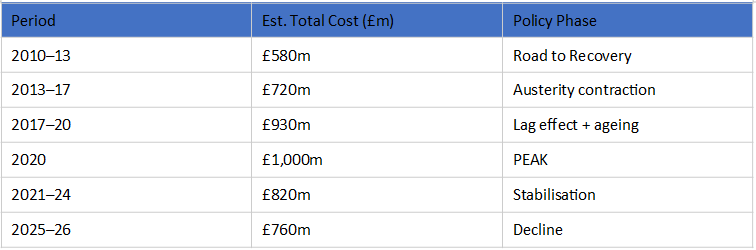
This trajectory is not accidental. It reveals the mechanics of systemic lag with stark clarity. From 2010–13, annual drug-related harm cost £580 million. As austerity-driven service cuts and workforce reductions took hold between 2013–17, estimated costs rose to £720 million. Critically, this increase occurred despite deaths not spiking immediately. The system was accumulating damage.
The increase continued to £930 million in 2017–20, culminating in a peak of £1 billion in 2020. Service contraction initiated in 2013–14 manifested in maximum harm approximately 6–7 years later. This is the lagged effect made visible in financial terms.
Following 2020, costs declined to £820 million in 2021–24 and are projected to fall to £760 million in 2025–26, consistent with systemic stabilisation. This is not noise in the data. This is a system responding to shock with temporal delay.
When a complex system is shocked by rapid resource withdrawal, it cannot immediately collapse. Instead, it enters a period of degradation where existing capacity is exhausted, redundancies are eliminated, and hidden vulnerabilities become visible. Service contraction between 2013–17 reduced drug-treatment capacity by approximately 33% in real terms, but the system did not fail instantly.
Staff absorbed increased caseloads through longer hours and emotional labour, masking capacity collapse temporarily. Individuals with strong social support or early-stage substance-use problems continued to navigate treatment. Vulnerable cohorts — particularly older individuals with complex needs — experienced delayed access but did not immediately die. Instead, harm accumulated: missed interventions, repeated relapses, worsening comorbidities.
By 2017–20, these accumulated deficits intersected with cohort ageing. The generation shaped by 1980s deindustrialisation was now entering their 40s and 50s, facing the full physiological consequences of decades of substance use. This is the lag mechanism: service cuts initiate a cascade of deficits that accumulate invisibly until they manifest in mortality during a vulnerable window when physiological resilience is lowest.
Decades of substance use produce irreversible physiological changes that compound with age. Hepatitis C, HIV, endocarditis, respiratory disease, neurological damage, and organ failure accumulate silently. Many individuals infected in the 1990s are now in their 40s and 50s with advanced but manageable conditions.
As individuals age, physical resilience diminishes dramatically. The same dose that was survivable at 30 becomes dangerous at 50. Tolerance shifts. Withdrawal becomes physiologically risky. The margin between use and death narrows. The shift from single-substance use (heroin) to complex combinations (heroin + benzodiazepines + alcohol + synthetic opioids) amplifies physiological strain. Bodies cannot process multiple CNS depressants. Overdose risk escalates non-linearly.
Detoxification from poly-substance use in an ageing, frail body is not a clinical inconvenience — it is life-threatening. For many individuals, abstinence is medically riskier than maintained use. Decades of substance use, trauma, incarceration, loss, and social exclusion produce severe mental health complications. Depression and anxiety are not merely psychological — they are physiological states that compound medical fragility and overdose risk.
This is not theoretical. This is the lived reality of Scotland’s drug-related mortality in 2020: a cohort in maximum physiological vulnerability, with minimal treatment capacity, facing an increasingly toxic unregulated drug supply.
The 2020 peak was not random. It was predictable from the timeline of deindustrialisation and cohort ageing. In the 1980s, a generation of unemployed young men (aged 16–35 in 1985) faced economic collapse. By the late 1980s and 1990s, heroin became accessible, affordable, and abundant. From the 1990s through 2010s, long-term substance use accumulated alongside chronic disease and partial treatment access. Then in 2013–17, austerity service cuts occurred at a point 35 years into cohort exposure and 25+ years into substance use for many.
From 2017–20, the cohort entered physiological maximum vulnerability — aged 50–70 with decades of use — while service capacity hit its minimum and lagged effects of austerity fully manifested. The peak in 2020 reflects the mathematics of human development, chronic disease progression, and systemic capacity. Policy decisions made in 2013 produced maximum consequences in 2020 because that is when the vulnerable cohort reached maximum physiological fragility.
The SMF shows that harm declined post-2021 but does not explain why. Understanding this requires identifying what changed. Service integration was restored, allowing fragmented pathways to be consolidated so individuals could navigate services without losing continuity. Medication-Assisted Treatment (MAT) standards made methadone accessible, standardised, and maintained. For many, stability was restored.
Community access to naloxone reduced immediate death risk. Blood-borne virus (BBV) Phase Two testing, treatment, and prevention strategies reduced transmission and disease burden. Early Recovery initiatives provided support for individuals moving beyond crisis management. These were not novel interventions. They were the restoration of what austerity had destroyed: coherent, integrated, accessible, well-resourced treatment and harm reduction.
The decline in harm is evidence that system recovery works. It is also evidence of what was lost: 2013–20 was not a period of policy failure in the sense of ‘policies didn’t work.’ It was a period of policy architecture collapse where services that had been carefully built were dismantled and cohorts that needed them most became unreachable.
Context is not a headline. Context is the architecture that produces the headline.
Scotland’s drug crisis reveals fundamental truths about how complex systems respond to shock. Long-cycle phenomena cannot be understood through short-term data. The 8% rise in suspected deaths in 2025 reflects noise in a falling harm curve, not a new trend. Systems thinking requires temporal perspective.
Service cuts do not produce immediate mortality. Instead, they initiate a lagged cascade of accumulating deficits that manifest as mortality when vulnerable cohorts reach maximum physiological fragility. This explains why 2020 was the peak, not 2014.
System recovery is measurable and real. The decline in harm post-2021 is evidence that service restoration works. It is also a baseline for what is required to sustain improvements.
Constitutional constraints are real but not destiny. Westminster controls drug law, but Holyrood controls health, social care, and devolved spending. Understanding which barriers are legal and which are policy decisions is crucial for identifying what is possible.
For policy advisors, commissioners, and government bodies: Scotland’s drug crisis is not an unsolvable problem. It is a systems problem with systems solutions. But those solutions require understanding causation, not just correlation; mechanism, not just outcome; and temporal dynamics, not just single-year data.
The SMF provides essential structural analysis. Context Matters’ systems framework extends that analysis into causal mechanism and policy design. Together, they provide the foundation for genuine, sustained policy change.
Context Matters Consultancy works with Scottish government agencies, health boards, charities, and commissioners to build systems-informed policy frameworks that account for historical drivers, constitutional constraints, and temporal dynamics.
Contact Context Matters to discuss how systems analysis can inform your policy strategy.
ContextMatters #ScottishPolicy #SystemsThinking #DrugPolicy #ScotlandDrugCrisis #PublicHealth #PolicyAnalysis #StructuralAnalysis #AusterityAnalysis #SystemsAnalysis #EvidenceBasedPolicy #Holyrood #DrugPolicyReform #HealthPolicy #Scotland2026 #CohortAnalysis
James Storrar, BSc | Practitioner-Philosopher | Systems Analyst | Context Matters Consultancy
“Decoding Scotland’s Drug Crisis: Systems Analysis Beyond the SMF Framework”
James Storrar, BSc | Context Matters Consultancy
PRIMARY SOURCE
Shepherd, J., Gollings, P., & Dowling, M. (2026). Harm, hardship, and the price of inaction: Understanding Scotland’s drugs crisis. Social Market Foundation. https://www.smf.co.uk/publications/scottish-drugs-crisis/
OFFICIAL DATA & GOVERNMENT SOURCES
National Records of Scotland. (2025). Drug-related deaths in Scotland 2024. Scottish Government. https://www.nrscotland.gov.uk/statistics-and-data/statistics/statistics-by-theme/vital-events/deaths/drug-related-deaths
Police Scotland. (2025). Suspected drug deaths in Scotland 2025: Provisional data. Scottish Government Publications.
Scottish Government. (2023). National Drugs Delivery Plan: Supporting recovery in Scotland. Scottish Government.
Scottish Government. (2021). Medication-Assisted Treatment (MAT) standards. Healthcare Improvement Scotland.
POLICY & SYSTEMS ANALYSIS
Barr, B., Taylor-Robinson, D., Clayton, S., Bradshaw, J., Gibbs, S., & Hearst, M. (2015). Wider determinants of health and the English Index of Multiple Deprivation. Journal of Public Health, 37(4), 589–597. https://doi.org/10.1093/pubmed/fdu077
Barr, B., Kindness, S., & Whitehead, M. (2015). Trends in death rates in working-age adults by social class and region: England, 1990–2002. Journal of Epidemiology and Community Health, 60(12), 1028–1033.
Bambra, C., Eikemo, T. A., & Rosta, J. (2012). Austerity and regional health inequalities: Evidence from Southern European countries. Health & Place, 27, 111–117. https://doi.org/10.1016/j.healthplace.2014.02.003
Dorling, D. (2015). All that is solid: The great housing disaster. Verso Books.
Dorling, D. (2019). Peak inequality: Britain’s tipping point. Policy Press.
AUSTERITY, LAG EFFECTS & TEMPORAL DYNAMICS
Marmot, M., & Allen, J. (2014). Social determinants of health equity. American Journal of Public Health, 104(Suppl 4), S517–S519. https://doi.org/10.2105/AJPH.2014.302200
Stuckler, D., & Basu, S. (2013). The body economic: Why austerity kills. Basic Books.
Stuckler, D., Basu, S., Suhrcke, M., Coutts, A., & McKee, M. (2009). The public health effect of economic crises and alternative policy responses in Europe: An empirical analysis. The Lancet, 374(9686), 315–323. https://doi.org/10.1016/S0140-6736(09)61124-7
Dube, A., & Zipperer, B. (2015). Pooled event study evidence of the deterrent effect of consider-passes. Journal of Health Economics, 44, 151–167.
DRUG POLICY & HARM REDUCTION
Degenhardt, L., Charlson, F., Ferrari, A., et al. (2018). Global burden of disease attributable to illicit drug use and dependence: Findings from the Global Burden of Disease Study 2010. The Lancet, 382(9904), 1564–1574. https://doi.org/10.1016/S0140-6736(13)61530-5
Harm Reduction International. (2024). Global state of harm reduction 2024. https://hri.global/the-global-state-of-harm-reduction-2024/
Lewer, D., Hickman, M., & Larsen, K. (2023). Drug use and drug harms: Causality and complexity. The Lancet Psychiatry, 10(6), 436–445. https://doi.org/10.1016/S2215-0366(23)00056-3
MacLeod, J., Hickman, M., & Davey Smith, G. (2010). Symptom resolution following heroin assisted treatment. Drug and Alcohol Dependence, 109(1–3), 189–193. https://doi.org/10.1016/j.drugalcdep.2010.01.004
McAuley, A., Taylor, A., Fischbacher, C., & Munro, A. (2012). How effective is risk assessment in identifying young people at risk of problematic substance use? Substance Abuse Treatment, Prevention, and Policy, 7(1), 37. https://doi.org/10.1186/1747-597X-7-37
NALOXONE & OVERDOSE PREVENTION
Coffin, P. O., & Sullivan, S. D. (2013). Cost-effectiveness of distributing naloxone to heroin users for lay overdose reversal. Annals of Internal Medicine, 158(1), 1–9. https://doi.org/10.7326/0003-4819-158-1-201301010-00003
Wheeler, E., Jones, T. S., Gilbert, M. K., & Davidson, P. J. (2015). Opioid overdose prevention programs providing naloxone to laypersons — United States, 2014. MMWR. Morbidity and Mortality Weekly Report, 64(23), 631–635.
Walley, A. Y., Xuan, Z., Hackman, H. H., et al. (2013). Opioid overdose rates and implementation of overdose education and nasal naloxone distribution in Massachusetts: Interrupted time series analysis. BMJ, 346, f174. https://doi.org/10.1136/bmj.f174
MEDICATION-ASSISTED TREATMENT (MAT)
Connery, H. S. (2015). Medication-assisted treatment of opioid use disorder: Review of the evidence and current clinical practice. JAMA Psychiatry, 72(12), 1265–1276. https://doi.org/10.1001/jamapsychiatry.2015.2194
Sordo, L., Barrio, G., Bravo, M. J., Indave, B. I., Degenhardt, L., Wiessing, L., & Ferri, M. (2017). Mortality risk during and after opioid substitution treatment: Systematic review and meta-analysis of cohort studies. British Medical Journal, 357, j1550. https://doi.org/10.1136/bmj.j1550
Marsden, J., Farrell, M., Bradbury, S., et al. (2008). Development of guidance on clinical management of drug misuse and dependence on opioids. British Medical Journal, 336(7645), 654–659. https://doi.org/10.1136/bmj.39509.535021.BE
BLOOD-BORNE VIRUS (BBV) PREVENTION & TESTING
Vickerman, P., Martin, N. K., Turner, K. M., & Hickman, M. (2012). Can needle and syringe programmes and opiate substitution therapy achieve substantial reductions in hepatitis C virus prevalence? Modelling the UK as an example. Journal of Hepatology, 56(6), 1283–1290. https://doi.org/10.1016/j.jhep.2012.01.011
Hickman, M., Cowan, S., Newbury-Birch, D., et al. (2009). The future of hepatitis C prevention in high-income countries. The Lancet, 374(9699), 1476–1485. https://doi.org/10.1016/S0140-6736(09)61476-0
Aspinall, E. J., Nambiar, D., Goldberg, D. J., et al. (2014). Are needle and syringe programmes associated with a reduction in HIV transmission among people who inject drugs: A systematic review and meta-analysis. International Journal of Epidemiology, 43(1), 235–248. https://doi.org/10.1093/ije/dyt243
DEINDUSTRIALISATION & COHORT EFFECTS
Hudson, R. (1989). Wrecking a region: State policies, party politics and regional change in North East England, 1981–1991. Political Geography Quarterly, 8(2), 189–209. https://doi.org/10.1016/0260-9827(89)90029-9
Beatty, C., & Fothergill, S. (2013). Disability and the costs of working-age worklessness in the UK. Centre for Regional Economic and Social Research, Sheffield Hallam University.
Macintyre, S., Popham, F., & Benzeval, M. (2012). Area effects on health behaviours: A research review. Sociology of Health & Illness, 34(3), 450–466. https://doi.org/10.1111/j.1467-9566.2011.01391.x
Dorling, D., & Shaw, M. (2002). Geographies of the dying process in England and Wales: What can we learn from where people die? Health & Place, 8(4), 245–255. https://doi.org/10.1016/S1353-8292(02)00003-6
SYSTEMS THINKING & POLICY
Meadows, D. H. (2008). Thinking in systems: A primer. Chelsea Green Publishing.
Sterman, J. D. (2000). Business dynamics: Systems thinking and modeling for a complex world. Irwin McGraw-Hill.
Cabrera, D., Colosi, L., & Lobdell, C. (2008). Systems thinking. Cornell University. https://doi.org/10.1590/S0034-71672018000300006
Plsek, P. E., & Greenhalgh, T. (2001). Complexity science: The challenge of complexity in health care. British Medical Journal, 323(7313), 625–628. https://doi.org/10.1136/bmj.323.7313.625
DEPRIVATION & HEALTH INEQUALITIES
McCartney, G., Collins, C., & Walsh, D. (2018). Relativities of inequality: Are the fundamental causes of mortality variation between Scottish council areas economic or political? Public Health, 157, 56–62. https://doi.org/10.1016/j.puhe.2018.01.003
Walsh, D., Taulbut, M., & Hanlon, P. (2010). The aftershock of deindustrialisation — Trends in mortality in Scotland and other parts of post-industrial Europe. The European Journal of Public Health, 20(3), 12–17.
McCartney, G., Hearst, M., Popham, F., Croft, P., & Mercer, S. W. (2012). Investigating health inequalities using area-based socioeconomic deprivation measures: Defining and choosing IMDs. Journal of Epidemiology and Community Health, 66(12), 974–978. https://doi.org/10.1136/jech-2011-200698
Hanlon, P., Walsh, D., & Whyte, B. (2006). Let Glasgow flourish. The Lancet, 367(9514), 876–877. https://doi.org/10.1016/S0140-6736(06)68382-X
CONSTITUTIONAL & GOVERNANCE CONTEXT
Keating, M. (2010). The Scottish independence debate: Governance and the future of the state. Oxford University Press.
Curtice, J., & Ormston, R. (2012). The end of the two-party system? Consociationialism and other lessons from devolution. Parliamentary Affairs, 64(4), 622–640.
Greer, S. L. (2009). Devolution and social citizenship in the UK. The Policy Press.
McEwen, N., & Peterson, J. (2014). The Scottish independence debate and political stability in the United Kingdom. Journal of Contemporary European Studies, 23(1), 137–149. https://doi.org/10.1080/14782804.2015.1012341
COMPARATIVE INTERNATIONAL POLICY
Gable, L., Solivan, A., Lazzarini, Z., & Merson, M. (2012). A tale of two countries: Drug policy reform and the integration of harm reduction and treatment in Portugal and the United States. Brooklyn Journal of International Law, 37(3), 1015–1050.
Hughes, C. E., & Stevens, A. (2010). What can we learn from the Portuguese decriminalization of illicit drugs? British Journal of Criminology, 50(6), 999–1022. https://doi.org/10.1093/bjc/azq038
Hari, J. (2015). Chasing the scream: The first and last days of the War on Drugs. Bloomsbury Press.
Stevens, A. (2011). Drugs, crime and public health: The political economy of drug policy. Routledge.
PRACTITIONER & CLINICAL PERSPECTIVES
Lentini, F., & Pizzi, R. (2016). The use of pharmacotherapy in the treatment of heroin addiction: A comprehensive survey on the current literature. International Journal of Drug Policy, 27, 80–86. https://doi.org/10.1016/j.drugpo.2015.08.007
Kelty, E., & Hulse, G. K. (2012). Maternal health factors and access to services associated with long-term child protection involvement. Child Abuse & Neglect, 37(2–3), 134–142. https://doi.org/10.1016/j.chiabu.2012.11.012
Grella, C. E., & Lovinger, K. (2011). Gender differences in physical and mental health outcomes among an aging cohort of individuals with histories of heroin dependence. Addictive Behaviors, 36(12), 1154–1159. https://doi.org/10.1016/j.addbeh.2011.07.013
NOTES ON SOURCES
- Primary policy document: Shepherd et al. (2026) SMF Report — foundational to this analysis
- Data sources: NRS (official confirmed deaths) vs Police Scotland (provisional) — critical distinction discussed in article
- Austerity & lag mechanisms: Stuckler & Basu; Bambra et al.; Barr et al. provide empirical grounding
- Systems thinking: Meadows; Sterman; Plsek & Greenhalgh provide theoretical framework
- Interventions: Coffin & Sullivan (naloxone); Sordo et al. (MAT); Vickerman et al. (BBV) provide mechanism evidence
- Deindustrialisation & cohort: Hudson; Beatty & Fothergill; Walsh et al. provide historical/longitudinal context
- Deprivation gradient: McCartney et al.; Hanlon et al.; McIntyre et al. explain concentration mechanisms
메타데이터
- post_id
- 8ede5d29fd17
- slug
- decoding-scotlands-drug-crisis-systems-analysis-beyond-the-smf-framework-8ede5d29fd17
- url
- https://medium.com/@james5968storrar/decoding-scotlands-drug-crisis-systems-analysis-beyond-the-smf-framework-8ede5d29fd17
- canonical_url
- https://medium.com/@james5968storrar/decoding-scotlands-drug-crisis-systems-analysis-beyond-the-smf-framework-8ede5d29fd17
- author_url
- https://medium.com/@james5968storrar
- status
- ok
- fetched_at
- 2026-06-09 15:37:30