Choosing the Right DNA Polymerase for PCR: A Practical Guide
Subtitle: Understanding how DNA polymerases work and why their properties matter for different molecular biology applications.
Choosing the Right DNA Polymerase for PCR: A Practical Guide
Subtitle: Understanding how DNA polymerases work and why their properties matter for different molecular biology applications.
Introduction Since the invention of polymerase chain reaction (PCR), the technique has become indispensable across a wide range of applications — from basic end-point cloning and quantitative gene expression analysis to universal amplification for microarrays and next-generation sequencing.
However, not all DNA polymerases are created equal. Choosing the wrong one can easily lead to failed experiments, low yield, poor specificity, or inaccurate results. In this article, I will explain the working principle of DNA polymerases, introduce the main types available, discuss their key properties (especially fidelity and error rate), and show why these properties are critical when selecting the right enzyme for your specific application.
How DNA Polymerase Works in PCR
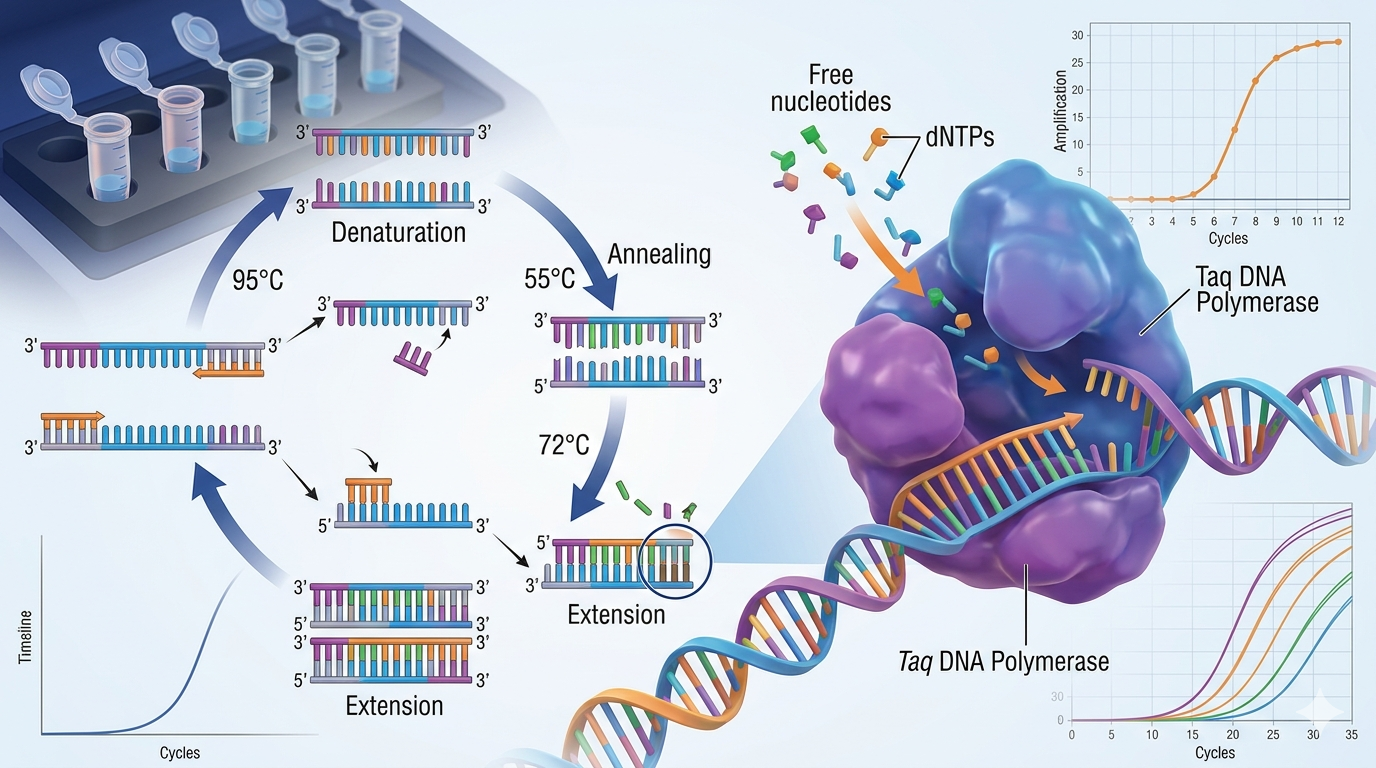
At the heart of every PCR reaction is DNA polymerase — the enzyme responsible for synthesizing new DNA strands. It adds nucleotides (dNTPs) to the 3' end of a primer that has annealed to the template DNA.
The PCR process consists of three main steps:
- Denaturation: The reaction is heated to ~95°C to separate the double-stranded DNA into single strands.
- Annealing: The temperature is lowered, allowing primers to bind to their complementary target sequences.
- Extension: The polymerase extends the primer by adding dNTPs, creating a new complementary DNA strand.
The efficiency, accuracy, and reliability of this extension step depend heavily on the biochemical properties of the polymerase used.
Key Properties of DNA Polymerases
1. Fidelity (Error Rate) Fidelity refers to how accurately the polymerase copies the DNA template. Standard Taq polymerase has a relatively high error rate of approximately 1 error per 1⁰⁴–1⁰⁵ bases. In contrast, high-fidelity polymerases such as Q5 or Phusion possess 3'→5' exonuclease (proofreading) activity, which significantly lowers the error rate to as low as 1 error per 1⁰⁶–1⁰⁷ bases. When a mismatch is detected, the proofreading exonuclease removes the incorrect nucleotide before synthesis continues [2,3].
High fidelity is essential for applications where sequence accuracy is critical, including cloning, site-directed mutagenesis, and sequencing. Using low-fidelity Taq in these cases can introduce unwanted mutations that compromise downstream experiments.
2. Processivity and Performance with GC-rich Templates Processivity describes how many nucleotides a polymerase can incorporate before it dissociates from the template. Higher processivity is particularly important for amplifying long DNA fragments. However, processivity can be strongly affected by secondary structures, high GC content, buffer conditions, and the presence of inhibitors.
High GC content is especially challenging because guanine-cytosine pairs form three hydrogen bonds, leading to stable secondary structures and higher melting temperatures. Additives such as betaine are commonly used to destabilize GC pairs and improve amplification of difficult templates [4,5]. Some modern polymerases have also been engineered for enhanced processivity [6].
3. Hot-Start Capability Hot-start technology prevents non-specific amplification during reaction setup at room temperature. The polymerase is kept inactive (through antibody, chemical modification, or aptamer blocking) until the initial high-temperature denaturation step activates it. This greatly improves specificity by reducing primer-dimers and off-target products [7,8].
Why These Properties Matter for Different Applications
The choice of DNA polymerase should match the specific requirements of your experiment. Here’s a quick guide to help you decide:
- Standard PCR and colony PCR: Regular Taq polymerase is usually sufficient and offers the best cost-performance balance.
- High-accuracy cloning and site-directed mutagenesis: High-fidelity polymerases such as Phusion or Q5 are strongly recommended to minimize unwanted mutations.
- cDNA synthesis and RT-PCR: The polymerase needs robust RNA-dependent DNA polymerase activity and good tolerance for RNA templates.
- Next-generation sequencing (NGS) library preparation: Ultra-high fidelity and minimal amplification bias are essential for reliable results.
- Long-range PCR: High processivity combined with proofreading activity is required to successfully amplify longer DNA fragments.
- Diagnostic or qPCR: Hot-start polymerases are preferred as they improve specificity and reduce non-specific amplification during reaction setup.
- GC-rich or difficult templates: Engineered or GC-optimized polymerases (such as Phusion, Q5, or KOD XL) perform significantly better due to their ability to handle secondary structures.

The practical comparison table summarizing the most suitable polymerase types for common molecular biology applications:
Strategy for Choosing the Right Polymerase or Master Mix A successful PCR reaction depends on more than just the polymerase itself. Many suppliers now offer convenient master mixes that contain optimized concentrations of magnesium, buffer, dNTPs, and sometimes additives. For most routine applications, starting with a well-designed master mix is often the easiest and most reliable approach.
When evaluating options, look at comparison tables provided by manufacturers, request free samples for testing whenever possible, and consider practical factors such as kit availability, delivery time, and cost — especially for newer or less common products.
References
- Miller BR 3rd, Yeager AV, Collins JA, Beane A, Blake A, Tate E, Parish CA, Wu EY. Understanding the Fidelity and Specificity of DNA Polymerase I. ACS Omega. 2025 Dec 15;10(51):62746–62756. doi: 10.1021/acsomega.5c07534. PMID: 41487178; PMCID: PMC12756729.
- Polymerase Fidelity: What is it, and what does it mean for your PCR? (https://www.neb.com/en/tools-and-resources/feature-articles/polymerase-fidelity-what-is-it-and-what-does-it-mean-for-your-pcr?srsltid=AfmBOoqHcE_EusVOa27EtmP31iCc88LrpjrwzgWT6vbvWjc_CbcVU6H8)
- Dodd T, Botto M, Paul F, Fernandez-Leiro R, Lamers MH, Ivanov I. Polymerization and editing modes of a high-fidelity DNA polymerase are linked by a well-defined path. Nat Commun. 2020 Oct 23;11(1):5379. doi: 10.1038/s41467–020–19165–2. PMID: 33097731; PMCID: PMC7584608.
- Chen XQ, Zhang XD, Liang RQ, Cao MQ. Betaine improves LA-PCR amplification. Sheng Wu Gong Cheng Xue Bao. 2004 Sep;20(5):715–8. PMID: 15973996.
- Four tips for PCR amplification of GC-rich sequences (https://www.neb.com/en/nebinspired-blog/four-tips-for-pcr-amplification-of-gc-rich-sequences?srsltid=AfmBOop2R326pf3p8lhucE5anGJmmcULgdPe06iVeHtWfcCiA3ZhWDUJ)
- Coulther TA, Stern HR, Beuning PJ. Engineering Polymerases for New Functions. Trends Biotechnol. 2019 Oct;37(10):1091–1103. doi: 10.1016/j.tibtech.2019.03.011. Epub 2019 Apr 16. PMID: 31003719; PMCID: PMC6745271.
- Antibody-Enzyme Mediated Hot Start PCR Protocol (https://www.sigmaaldrich.com/HK/zh/technical-documents/protocol/genomics/pcr/antibody-enzyme-mediated-hot-start-pcr?srsltid=AfmBOoqVxb1TO3c3bgDlxAGQd3MOiMnRtWD8npSmQ5UhsPQiiseEUiQj)
- How is Hot-Start Technology Beneficial For Your PCR? (https://www.thermofisher.com/hk/en/home/brands/thermo-scientific/molecular-biology/molecular-biology-learning-center/molecular-biology-resource-library/spotlight-articles/hot-start-technology-benefits-PCR.html)
메타데이터
- post_id
- 8ef7e17ef667
- slug
- choosing-the-right-dna-polymerase-for-pcr-a-practical-guide-8ef7e17ef667
- url
- https://medium.com/@siupenyau/choosing-the-right-dna-polymerase-for-pcr-a-practical-guide-8ef7e17ef667
- canonical_url
- https://medium.com/@siupenyau/choosing-the-right-dna-polymerase-for-pcr-a-practical-guide-8ef7e17ef667
- author_url
- https://medium.com/@siupenyau
- status
- ok
- fetched_at
- 2026-06-09 15:37:30