French Revolutionary Wars Explained #2
The War of the Second Coalition
French Revolutionary Wars Explained #2
The War of the Second Coalition
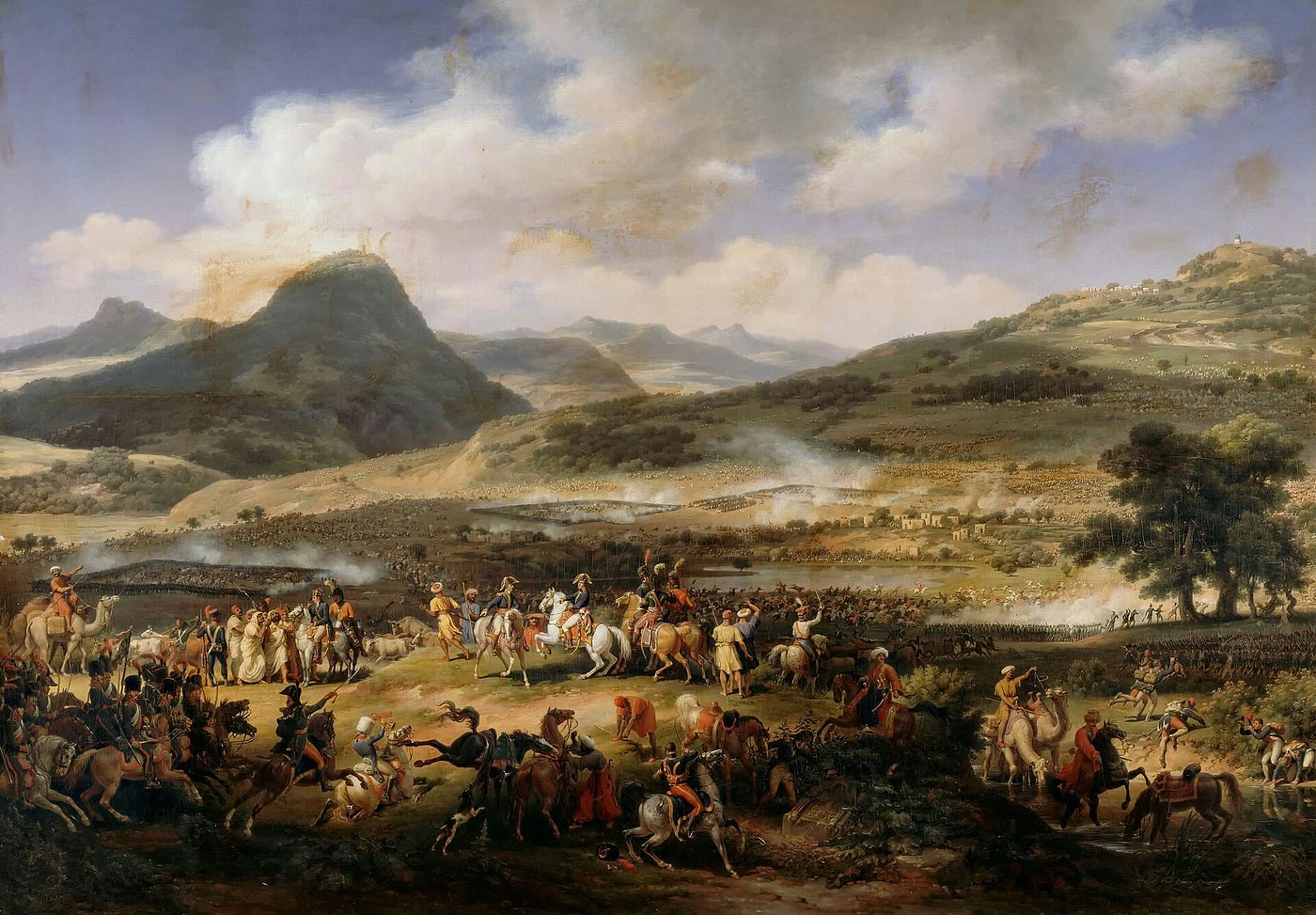
Image Source: Wikimedia Commons, Louis-François, Baron Lejeune
The Peace of Campo Formio restored peace to continental Europe, but peace between Britain and France remained elusive. In 1797, proponents of a moderate settlement within the Directory and the legislative assemblies were purged during the Coup of Fructidor, leading to the collapse of negotiations between London and Paris. Britain alone, however, could not hope to roll back French gains on the continent. For that, Albion needed allies.
The aggressive policies pursued by the Second Directory would soon provide them.
Russia had stood on the verge of intervention during the War of the First Coalition in 1796. Following the death of Empress Catherine the Great, however, her son and successor, Tsar Paul I, cancelled the departure of a 60,000-man expeditionary force. Despite his deep loathing of the French Revolution, Paul initially extended cautious peace feelers toward the Republic. He soon discovered that the new leaders of France had little interest in accommodating Russian concerns.
One source of tension was Napoleon’s negotiation of the French seizure of the Ionian Islands, a move Paul interpreted as a direct threat to Russian interests in the eastern Mediterranean. At the same time, the French showed little regard for Russian sensitivities during the negotiations that followed Campo Formio. The Directory was determined to annex the west bank of the Rhine and compensate dispossessed German rulers through the secularization of ecclesiastical territories within the Holy Roman Empire.
Why did this matter to Russia? The answer was simple. Since 1779, Russia had been a guarantor of the constitutional order of the Holy Roman Empire by treaty. French plans to redraw the map of Germany therefore challenged interests that St. Petersburg considered its own.
The final blow came with Napoleon’s expedition to Egypt and the seizure of Malta. The island belonged to the Knights Hospitaller, whose honorary Grand Master was none other than Tsar Paul himself. Following the French invasion of Egypt, the Ottoman Empire also entered the war against France. The following year, the Sultan granted the Russian fleet passage through the Bosphorus, allowing Russian forces to join the struggle and recapture the Ionian Islands from the French.
Russia and the Ottoman Empire alone, however, were not enough to challenge French dominance, their geographic position was simply too peripheral. Austria and Prussia were also needed. Yet the prospect of gaining territory through the ongoing reorganization of the Holy Roman Empire convinced Berlin that there was little reason to risk another war. No matter how hard British diplomacy pressed, the Prussian court remained steadfastly neutral.
Vienna was another matter.
In the aftermath of Campo Formio, French aggrandizement continued unabated. French-backed regimes appeared across Switzerland and Italy. Between January 1798 and March 1799, Piedmont, Switzerland, Tuscany and the Papal States were transformed into sister republics modeled on revolutionary France, extending Paris’s influence ever deeper into central Europe and the Italian peninsula.
The spark that lit up the continent again came from southern Italy.
In November 1798, the Kingdom of Naples invaded the Roman Republic. Initially outmatched, French forces under General Jean-Étienne Championnet withdrew without offering battle, and Rome quickly fell to the invaders.
The Neapolitan ascendancy, however, proved remarkably short-lived.According to General Roger de Damas, the Neapolitan army was already falling apart by the time it reached Rome:
When the army arrived in Rome, it was in such a state of distress that no general except Mack would have thought it possible to continue the campaign without giving it time to recover. Arms were rusted by the constant rain; shoes were lost; the artillery was scattered over the roads, many of the mules being dead or disabled; the baggage wagons were five days’ march in the rear.
The Neapolitans compounded their difficulties by failing to coordinate their offensive with their future allies. Although Naples was formally aligned with Austria and the Habsburgs were by treaty guarantors of the territorial integrity of Naples, no Austrian assistance would arrive before the spring of 1799.
Championnet seized this opportunity and despite his forces being numerically inferior, he rapidly reorganized his forces and launched a counteroffensive. Within weeks, the French had routed the invaders at Civitavecchia.
After the defeat, the Neapolitan army disintegrated. By December 16, French troops were once again marching victoriously through the streets of Rome. On December 30, the crucial fortress of Gaeta surrendered. Two weeks later, French forces stood at the gates of Naples itself.
Eager to emulate Napoleon’s achievements in northern Italy, Championnet took matters into his own hands and acting without authorization, he began reorganizing the conquered kingdom into yet another French satellite state: the Parthenopean Republic.
With the storm clouds of a new European war already gathering, however, the Parthenopean Republic would prove to be a very short-lived political experiment.
The campaign of 1799 and the fall of the Directory
By January 1799, the war party in Vienna was pressing for immediate action. Emperor Francis II, however, remained cautious. He hoped that diplomacy might secure Austria’s objectives without another costly conflict, but those hopes were dashed when a French ultimatum arrived demanding the expulsion of Suvorov’s Russian army from Habsburg territory. War now seemed unavoidable.
Yet the Directory’s aggressive posture rested on increasingly shaky foundations and Emperor Francis wasn’t entirely wrong in expecting France to be less bellicose. By the beginning of 1799, the great armies of 1794 were a distant memory. French field forces had dwindled to roughly 425,000 men, scattered across Europe, guarding France’s coastlines against British incursions, looking out against unrest at home, and garrisoning a sprawling network of satellite republics stretching from the Netherlands to the Ionian Islands.
Unable to sustain even this reduced military establishment through conventional means, the French armies lived off the land, poisoning relations between the occupiers and the local population. Nowhere was the situation worse than in Italy:
Nearly 80,000 French soldiers and nearly 50,000 Poles, Swiss, Piedmontese, Genoese [and] Romans . . . strove [to decide] who should devour most greedily this new prey of the rights of man. Their conduct recalled to mind that of the Vandals which they surpassed . . . Officers and soldiers all thought of nothing but plunder, not for the Republic but for themselves. The Army of Italy . . . occupied the Modenese . . . Genoa, Piedmont, the Milanese, the Valtelline and the countries of Brescia, Bergamo and Padua. This dispersion of force rendered necessary by the hatred in which the French were held reduced to about 50,000 the number of men whom they could employ in active operations . . . The French and their auxiliaries were scattered over the surface of Italy from the foot of the Alps to the gulfs of Naples and Manfredonia, had constantly to keep in subjection . . . a population of above ten millions of souls and were obliged to guard the coasts of the Mediterranean and the Adriatic upon which hostile troops might at any time be landed by the English, Russian and Turkish fleets.
Nor was the army merely overstretched; it was often demoralized as well. Infantry officer François Roguet later recalled:
In every unit one witnessed the most regrettable disorders . . . Without administration there is no discipline, but without discipline an army becomes a negative force, even a ruinous one . . . Doubtless there are exceptional circumstances in which a state, or those who command its armies, have, despite themselves, to have recourse to means that threaten as much danger as they produce benefit, but such a state of affairs should only be transitory . . . However, to manage civil and military affairs in such a fashion in every circumstance . . . is to raise the banner of crime in the presence of the soldiery, the result being that, ever more daring, they group together in bands whose conduct knows no limits, leaving the army unable to defend itself . . . As for the armies as a whole, meanwhile, they were from every point of view far weaker than they appeared to the naked eye. Indeed, their moral force — the reciprocal confidence that should exist between commanders and their men — had completely disappeared.
Despite these difficulties, the Directory ordered its generals onto the offensive. French armies advanced into Germany, Switzerland, and Venetia, only to suffer a series of costly reverses. In Germany, Jourdan’s outnumbered army was defeated at Ostrach and Stockach. In Italy, General Schérer suffered heavy defeats at Magnano and Cassano. Jourdan was forced to retreat to the Rhine, while Schérer abandoned both the Cisalpine Republic and recently occupied Piedmont.
The disasters in northern Italy left the French occupying Naples with little choice but to retreat northward. Before General MacDonald could unite his army with Moreau’s forces, however, he encountered a combined Austro-Russian army under the legendary Russian commander Alexander Suvorov.

The Battle of Trebbia, where Suvorov smashed the French army of general McDonald. Image Source: Wikimedia Commons , Alexander von Kotzebue
The result was disastrous. At the Battle of the Trebbia, MacDonald suffered a crushing defeat and lost roughly half his army before reaching the relative safety of the Ligurian Republic.
In barely three months, French domination of Italy had unraveled almost completely.
With French forces reduced to defending Liguria, the remaining sister republics collapsed with astonishing speed under the combined pressure of Coalition armies, local insurgents, peasant uprisings, and anti-French guerrilla bands.
The only theatre of the conflict that wasn’t a complete disaster from French perspective was Switzerland, but even after scoring a victory at the Battle of Zurich, general Massena remained cautiously on the defensive.
The summer of 1799, however, was to mark the high-water mark of the Second Coalition, as even at the moment of its greatest success, the seeds of its eventual failure had already been sown.
The problem was one of conflicting objectives, something British diplomat Lord Hawkesbury had recognized months earlier:
Our connections with foreign powers are still subject to great uncertainty and embarrassment. Though the Emperor of Russia is cordially connected with Great Britain in all that relates to the war, he does not agree, nor can he be made to agree, with . . . the Emperor of Germany. The Emperor of Russia pursues the war on the simple principle of restoring . . . all ancient governments. The court of Vienna will look to nothing else but the aggrandisement of . . . the House of Austria, and will not adopt any ancient principle, or support any former system, except so far as it does not interfere with their ambitious views.
While the Allies debated how best to exploit their victories, news of the defeats struck Paris like a thunderbolt and triggered immediate political consequences.
In the Coup of 30 Prairial, the Directory was purged and three of the five Directors were replaced. Over the course of the summer, the Jacobins increasingly came to dominate the legislative assemblies. The new government imposed a large forced loan upon wealthy citizens and enacted the highly controversial Law of Hostages, which allowed authorities to imprison without trial the relatives of émigrés, draft evaders, and individuals accused of rebellion against the Republic.
The new regime was also eager to legitimize itself through military success. To that end, reinforcements were dispatched to Italy under a new commander, the young General Joubert.
The choice proved unfortunate.
Although Joubert had shown promise while serving under Napoleon, he lacked the qualities required for independent command. In August he suffered a severe defeat against Suvorov at the Battle of Novi. During the fighting, the young general was killed while attempting to rally his wavering troops.
Had the Allies acted more decisively, they might have expelled the French from Italy altogether. Suvorov certainly believed so and repeatedly urged his allies to strike the iron while it was hot, but Vienna had different priorities. With the French in Italy now seemingly on the ropes, from Vienna’s perspective Suvorov had outlived his use in Italy and the Habsburgs were now eager to be rid of the overmighty general.
A new strategic plan was adopted. Archduke Charles was ordered to leave Switzerland and move into Germany, while Suvorov was instructed to march his 20,000 Russians into Switzerland and join a second Russian army commanded by General Korsakov.
The poor coordination of these movements created a dangerous imbalance for the coalition, and Masséna instantly realized he had been presented with a window of opportunity to hit the coalition.
Before Suvorov could reach him, Korsakov was attacked by General Masséna and decisively defeated at the Second Battle of Zurich. Outnumbered and outmatched, Korsakov lost nearly half his numbers and 100 guns in the debacle.
By the time Suvorov arrived, the situation was hopeless and French forces were converging on his position from multiple directions, forcing the veteran commander to undertake a desperate retreat through mountainous and impoverished terrain. The retreat was successful, but by the time the ordeal was over, Suvorov’s victorious army of Italy was roughly halved.
Events in the Netherlands unfolded little better for the Coalition. Hoping to open a new front, Britain and Russia launched a joint invasion of the Batavian Republic in August 1799. The expedition proved a fiasco almost from beginning to end.
Although surprise initially gave the invaders the advantage, they soon became bogged down along the coast and were effectively contained by Franco-Dutch forces. As autumn weather worsened and prospects for success evaporated, the Allies negotiated an armistice. In exchange for the release of thousands of Dutch prisoners of war, the French and Dutch agreed to allow the expeditionary force to withdraw unmolested.
By late autumn 1799, the Coalition’s momentum had largely evaporated. Despite the catastrophic defeats of the spring and summer, France appeared safe from invasion, at least for the moment.
The victories, however, had come too late to save the Directory.
By autumn, conspiracies were already underway in Paris to establish a new political order to replace the discredited Directory and even members of the government such as Sieyès and Roger Ducos were plotting. At precisely this moment, General Bonaparte returned unexpectedly from Egypt, abandoning his army and hastening back to France.
Though he did not much like the young general, Sieyès quickly brought the celebrated hero into the conspiracy, and the plotters made plans to stage a constitutional coup to topple the Directory. According to the plan, the Directors will resign simultaneously to create a power vacuum, than use their allies in the legislative to push through a new Constitution that would have transferred power to them.

The Coup of 18 Brumaire. Image Source: Wikimedia Commons, François Bouchot
The plan was sound, but the execution nearly went awry as general Bonaparte’s impatience nearly ruined the plot, but in the end, the Coup of 18 Brumaire succeeded. The Directory was abolished and a new regime took its place under the Constitution of Year VIII, approved by a plebiscite to give the coup the veneer of legality. The new constitution dramatically strengthened executive authority at the expense of the legislative branch. Power was no longer vested in a five-man Directory but in three Consuls, in practice, however, only one truly mattered.
The office of First Consul carried powers that soon rivaled those of Europe’s crowned monarchs. Unsurprisingly, the position fell to Bonaparte, whose prestige and popularity dwarfed those of all his fellow conspirators.
The campaign of 1800 and the victory of France
As the calendar turned to 1800, France’s new ruler was eager to present himself as the bringer of peace to a nation exhausted by a decade of revolution and war. Behind the scenes, however, the First Consul saw matters differently. Napoleon was convinced that peace on the basis of the existing military situation would amount to a poisoned chalice. France had suffered a string of defeats in 1799, and accepting peace under such circumstances would only encourage her enemies to form new coalitions in the future. A decisive military victory, by contrast, could legitimize his newly established regime far more effectively than any diplomatic settlement.
In the words of Napoleon:
If France had made peace at that time under existing circumstances, she would have made it after a campaign of disasters; indeed, she would have drawn back in consequence of a single campaign. This would have been dishonourable, and would only have encouraged princes to form new coalitions against her. All the chances of the campaign of 1800 were in her favour: the Russian armies were leaving the theatre of war; the pacification of the Vendée placed a new army at the disposal of the Republic; in the interior, factions were over-ruled and the chief magistrate possessed the entire confidence of the nation. It behoved the Republic not to make peace until after restoring the equilibrium of Italy; she could not, without abandoning her destiny, consent to a peace less advantageous than . . . Campo Formio.
Nor was Napoleon entirely wrong in his assessment.
The setbacks of late 1799 had shattered relations between Russia and its allies. As British officer Henry Bunbury observed:
Tsar Paul never seems to have doubted the superiority of his rude soldiers over those of western Europe. He expected his Russians to conquer if they found the opportunity to fight as a matter of course. And the wonderful success of his first four and twenty thousand men, who descended into Italy under Suvorov, served to confirm and exaggerate this expectation. In a mind ill-poised by nature, and, thus excited by an over-weening confidence, the disasters which subsequently fell upon the Russian armies were likely to produce, and did produce, a fearful revulsion. The utter defeat of Korsakov, the consequent distresses of Suvorov, and the disappointments and discontents of the army which joined the English in North Holland, fixed in the mind of Paul the . . . persuasion that he was betrayed, insulted, and ill-treated by his allies.
Convinced that further participation in the war represented nothing more than a futile waste of lives and resources, Paul ordered the remaining Russian forces to withdraw from the theatre of war and return home. At the same time, he proved increasingly receptive to the peace feelers extended by First Consul Bonaparte, and by the end of 1800, even a Russo-French alliance seemed likely. The Tsar also organized the Second League of Armed Neutrality, formed by Russia, Prussia, Denmark and Sweden, the league being formed against Britain and aiming to prevent neutral shipping from being inspected for French contraband by the British Royal Navy.
With Russia abandoning the Coalition and the suppression of internal unrest allowing additional troops to be sent to the front, Napoleon entered the campaign of 1800 with considerable confidence. Yet the campaign itself began poorly.
In Italy, the Austrians seized the initiative and trapped the remaining French forces inside Genoa, placing the city under siege. The situation in Germany was more encouraging. There, General Moreau crossed the Rhine and defeated the Austrians at Stockach in May, establishing French presence in central Germany.
Napoleon, however, had no intention of directing the war from Paris. At the head of a newly assembled army, he personally crossed the Great St. Bernard Pass and descended into northern Italy, appearing unexpectedly in the rear of the Austrian army and taking General Melas completely by surprise.
The maneuver was as daring as it was brilliant.
Yet it did not immediately decide the campaign. On June 4, Genoa surrendered, freeing Melas to concentrate his forces against Napoleon’s newly arrived army. Ten days later, the opposing forces met at Marengo.
The battle began disastrously for the French. Napoleon had misread Melas’s intentions completely and dispersed his forces too widely, leaving himself heavily outnumbered when the Austrians fell upon his army in a surprise attack. Thanks o their numerical superiority, throughout much of the day, defeat appeared imminent for the French and Napoleon’s army was pushed back by 5 miles by the afternoon.
Fortune, however, intervened. Earlier the day Napoleon dispatched two divisions to cut off potential routes of Austrian retreat. Once the First Consul realized the mistake he made he sent desperate orders to recall the divisions, and luckily for Napoleon, one division was able to make it back in time to save the day.
A division under General Louis Desaix, one of Napoleon’s closest friends and most capable subordinates, arrived on the battlefield at a critical moment. Desaix’s timely intervention reversed the course of the battle and transformed a looming defeat into the decisive victory Napoleon desperately needed.
Marengo was a near-run thing, but its consequences were immense.
The Austrians lost roughly a third of their army by the time night fell, while the shaken Melas agreed to evacuate the conquests won during the campaign of 1799 in exchange for safe passage back to Austrian territory. A general armistice followed, extending to the German theatre as well.
Yet while the guns temporarily fell silent, peace remained elusive. Throughout the remainder of 1800, negotiations repeatedly failed to produce a lasting settlement.
The War of the Second Coalition was far from over, but Marengo had transformed the strategic situation. What had appeared twelve months earlier to be the beginning of France’s collapse had instead become the foundation of Bonaparte’s rise.
In the aftermath of Marengo, Napoleon once more offered generous terms to Austria, hoping to divide the allies and allow him to concentrate his forces against Britain. Though shaken by the defeats of 1800, the Austrian morale was not yet shattered beyond repair. When Britain offered a large interest free loan, Vienna was tempted to continue the fight.
Negotiations with Britain proved equally frustrating for the First Consul. Though overstretched and under pressure, due to the naval dominance of the Royal Navy Britain was as good as invasion proof and able to conquer the colonies of France and her allies at will, giving significant bargaining leverage to London. A key bone of contention for the First Consul was the fate of his Egyptian conquest, which his forces still held after beating off a large Ottoman army at the Battle of Heliopolis, yet unable to reinforce them, the ultimate surrender of the Army of Egypt seemed more a matter of when rather than if. Malta was almost equally important for Napoleon, and cynically he appeared generous regarding the fate of the island, showing himself willing to reestablish the status quo ante bellum..knowing full well that this outcome was what Tsar Paul desired.
By late autumn, negotiations broke down completely, however, and fighting was resumed along the frontlines. The First Consul intended to travel to Italy once more and take command of operations in Northern Italy, but before he could arrive, the Austrians launched an offensive in Bavaria, trying to take the army of general Moreau by surprise, only to suffer a crushing defeat at the Battle of Hohenlinden. Even more decisive than Marengo, Hohenlinden saw the Austrians lose roughly 15,000 men and more than 70 guns. Even worse than defeat itself was the aftermath, as the collapse of organization of the Austrians allowed Moreau to invade Austria itself.

The Battle of Hohenlinden. Image Source: Wikimedia Commons , Henri Frédéric Schopin
The Peace Treaties
The defeat at Hohenlinden finally broke the will of Vienna, and another armistice was signed, but unlike the one signed after Marengo, this one proved lasting, leading to the signing of a definitive peace agreement in February, the Treaty of Lunneville.
According to the terms of the treaty:
- Austria recognized French control of the left bank of the Rhine
- Compensation for dispossessed German princes
- Recognition of the French sister republics including: the Batavian Republic in the Netherlands, the Helvetic Republic in Switzerland, the Cisalpine Republic in northern Italy, the Ligurian Republic around Genoa.
- Austrian concessions in Italy, Austria abandoning its claims to much of northern Italy. The Habsburgs retained lands belonging to the former republic of Venice in Venetia, Istria, and Dalmatia but recognized French influence over the Cisalpine Republic, which effectively restored the situation that had existed before the Coalition victories of 1799.
- Tuscany was transferred to the Bourbon-Parma line, removing it from the possession of the House of Austria which ruled it since the extinction of the House of Medici in 1737.
Lunneville marked the effective collapse of the Second Coalition. Austria, the strongest continental opponent of France, had been defeated and forced to accept a French-dominated order in Germany, Switzerland, and Italy.
For Napoleon, Lunéville was even more important politically than militarily. It validated the regime created by the Coup of Brumaire and demonstrated that the First Consul could succeed where the Directory had failed. By early 1801, France stood stronger than at any point since the outbreak of the Revolutionary Wars.
Britain remained at war, but after Lunéville it stood almost alone, her sole remaining allies being the Ottoman Empire and Portugal, both too peripheral to put real pressure on France.
To put further pressure on the British, Napoleon planned a joint Franco-Spanish invasion of Portugal, intending to occupy significant portions of the small Iberian kingdom and use the occupied territory as bargaining chips in the upcoming negotiations, but the Spanish proved quite reluctant allies and concluded a peace treaty after a very brief 21 day campaign in 1801.
The First Consul received further blows in 1801 when Tsar Paul was assassinated in a palace coup and admiral Nelson smashed the Danish fleet at the Battle of Coppenhagen, basically eliminating the Second League of Armed Neutrality. French forces in Egypt were also defeated at the Battle of Alexandria by the British and surrendered in September 1801. These British victories convinced Napoleon that no more could be gained from prolonging the war any further, and in any case, with Britain abandoned by her continental allies, he could probably extract highly favorable terms from London even after the setbacks of 1801.
The First Consul was proved right, and the Peace of Amiens, signed in 1802 was overall much more favorable to France than it was to Britain.
According to the treaty, Britain effectively accepted the continental settlement created by the French Revolutionary Wars and consolidated by Napoleon’s victories. French possession of the left bank of the Rhine was recognized, as was the existence of the Batavian Republic in the Netherlands, the Helvetic Republic in Switzerland, and the Cisalpine and Ligurian republics in Italy. Britain also accepted the political reorganization of the Italian peninsula, including the establishment of the Kingdom of Etruria. In effect, London acknowledged that France had become the dominant power of Western Europe.
In return, France made relatively few concessions. The failure of Napoleon’s Egyptian expedition had already removed France from the eastern Mediterranean, and the treaty confirmed the restoration of Egypt to Ottoman control. More significantly, Britain agreed to return most of the colonial possessions it had seized during the war. The Cape Colony was restored to the Batavian Republic, while several Caribbean islands were returned to France.
Britain did, however, retain two important acquisitions. Trinidad, captured from Spain in 1797, remained in British hands, as did Ceylon, seized from the Dutch. Both possessions occupied strategically valuable positions and strengthened Britain’s growing global empire. Nevertheless, many British observers regarded the treaty as disappointing. After years of expensive warfare and a series of naval successes, Britain appeared to be surrendering many of its hard-won conquests while receiving relatively little in return.
So why did the peace break down after a mere 14 months?
The Peace of Amiens rested upon fragile foundations. The most contentious issue at first was the fate of the island of Malta. Captured from the French in 1800, the island occupied a key position in the Mediterranean. Under the terms of Amiens, Britain agreed to evacuate Malta and restore it to the Knights of St. John under the guarantee of the European powers. On paper, the arrangement appeared reasonable. In practice, neither side trusted the other to uphold it. British ministers feared that a withdrawal would merely allow France to re-establish its influence over the island, while Napoleon regarded Britain’s growing reluctance to evacuate Malta as a clear violation of the treaty.
It settled many of the territorial disputes that had emerged during the Revolutionary Wars, but it failed to resolve the deeper question that divided Britain and France. London remained unwilling to accept French predominance on the continent, while Napoleon showed little inclination to halt the expansion of French influence. For a brief moment Europe enjoyed peace, but beneath the surface the rivalry continued, and with neither side willing to curb their ambitions, the ultimate breakdown of peace was as good as inevitable.
Sources
Dwyer, Philip (2009). Napoleon: The Path to Power.
Chandler, David (1973). The Campaigns of Napoleon. Scribner.
Esdaille, Charles ( 2018). The Wars of the French Revolution: 1792–1801. Routledge.
Blanning, Tim (1996). The French Revolutionary Wars, 1787–1802. Hodder Education Publishers
메타데이터
- post_id
- 8ef96503f91a
- slug
- french-revolutionary-wars-explained-2-8ef96503f91a
- url
- https://medium.com/teatime-history/french-revolutionary-wars-explained-2-8ef96503f91a
- canonical_url
- https://medium.com/teatime-history/french-revolutionary-wars-explained-2-8ef96503f91a
- author_url
- https://medium.com/@weeklydoseofhistory
- status
- ok
- fetched_at
- 2026-07-09 08:02:55