The Unexpected Gift of Caring
Sometimes the one who gives care is also the one being quietly healed
The Unexpected Gift of Caring
Sometimes the one who gives care is also the one being quietly healed
Song: Not the Source
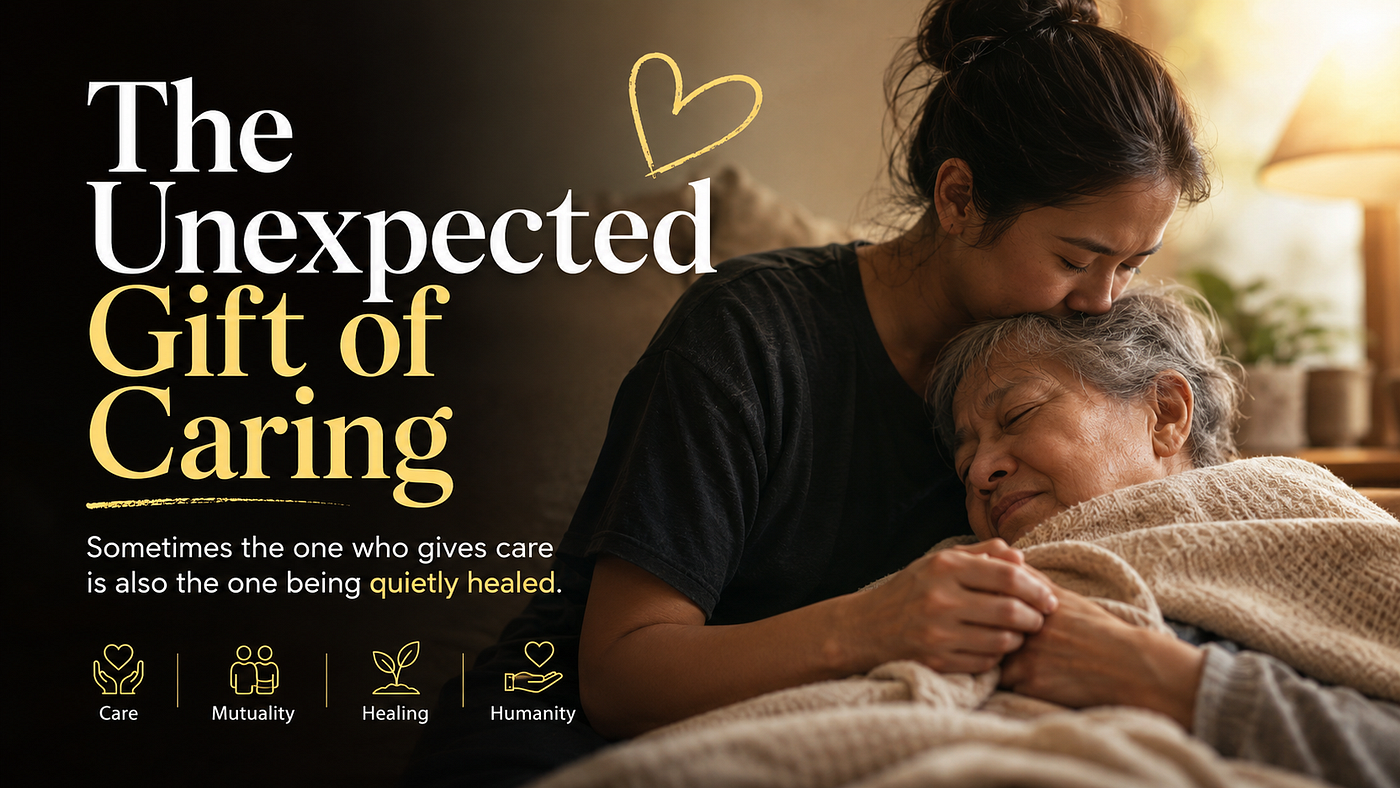
Image by ChatGPT
We often think caregiving is about helping someone weaker than us. But sometimes, in the quiet act of caring, we discover that we are also the ones in need.
There is something deeply human about caring for another person.
Not caring as a duty. Not caring as a role. Not caring as a performance of kindness.
But caring as a quiet movement of the heart.
The kind of care that happens when we slow down enough to notice someone else’s need. The kind that does not always come with applause, visibility, or even gratitude. The kind that may happen in a hospital room, beside an aging parent, in a tired conversation with a spouse, through a message sent to a lonely friend, or in the ordinary patience required to stay present with someone who can no longer give back in the same way.
At first glance, caregiving seems to move in one direction.
One person gives. Another person receives.
One is strong. Another is weak.
One helps. Another is helped.
But life is rarely that simple.
A reflection I once read from Henri Nouwen reminded me that caregiving is not merely about cure. It is not only about fixing, solving, or improving someone’s condition. Caregiving carries within it the possibility of healing — not only for the person being cared for, but also for the one who cares.
That thought stayed with me.
Because many of us enter caregiving with the assumption that we are the giver. We imagine ourselves as the one with something to offer: time, strength, money, attention, wisdom, patience, or presence.
But sooner or later, caregiving quietly exposes us.
It shows us the limits of our patience. It reveals the fragility beneath our competence. It uncovers the hidden need behind our generosity.
We begin to realize that the one who cares is not always stronger. And the one who receives care is not always weaker.
Both are human. Both are vulnerable. Both are carrying something.
The difference is only in where the vulnerability shows.
The person receiving care may carry physical weakness, illness, loneliness, dependence, or fear.
The person giving care may carry exhaustion, guilt, helplessness, impatience, resentment, or the quiet fear of one day becoming dependent too.
Caregiving brings these hidden places into the open.
And perhaps that is why it can become sacred — not because it is always beautiful, but because it is honest.
Care Is More Than Cure
Modern life trains us to solve.
When someone is sick, we want treatment. When someone is sad, we want advice. When someone is aging, we want solutions. When someone is struggling, we want improvement.
There is nothing wrong with wanting things to get better.
But not every pain can be cured quickly. Not every loneliness can be removed. Not every aging body can be restored. Not every wound has a neat ending.
Sometimes care means staying when there is nothing dramatic left to do.
Sitting beside someone. Listening again. Preparing a meal. Holding a hand. Answering the same question patiently. Making space for someone’s dignity when their independence begins to fade.
In such moments, care becomes more than a task.
It becomes a way of saying:
“You are still worth my time.” “You are not a burden to be managed.” “You are still here, and I am here with you.”
That kind of care does not always cure the body.
But it may heal something deeper.
It may heal the fear of being forgotten. It may heal the shame of needing help. It may heal the loneliness of suffering alone.
And strangely, it may also heal the caregiver.
The One Who Cares Also Needs Care
Many caregivers are praised for being strong.
“You are so patient.” “You are so devoted.” “You are amazing.” “I don’t know how you do it.”
These words may be sincere. But sometimes they create another burden: the burden of always appearing strong.
Caregivers often learn to hide their tiredness. They smile while carrying invisible weight. They continue because stopping feels selfish. They feel guilty for feeling exhausted. They feel ashamed when love is mixed with frustration.
But caregiving is not the absence of weakness.
It is love practiced through weakness.
A caregiver is not a machine of compassion. A caregiver is also a human being with limits, wounds, fears, and unfinished places inside.
Sometimes the act of caring reveals what we ourselves still need to receive.
We may discover that we need patience as much as we offer it. We need forgiveness as much as we give it. We need gentleness as much as we try to show it. We need someone to see us too.
This is where caregiving becomes mutual.
Not always mutual in equal action. Not always mutual in visible exchange. Not always mutual in words of thanks.
But mutual in the deeper truth that both lives are being touched.
The one receiving care may receive comfort, dignity, and presence.
The one giving care may receive humility, tenderness, and a new understanding of love.
The Caregiver Is Not the Source of Love
There is one thing I slowly learned from my own journey of becoming a caregiver:
we cannot keep giving care for a long time unless we remain connected to the source of love.
At the beginning, we may think we can endure.
We still have energy. We still have patience. We still have hope. We still believe that love will be enough to carry us through.
But long-term caregiving has a quiet way of testing the depth of the heart.
What exhausts us is not only the physical work. Not only the changing schedules. Not only the repeated routines. Not only the small decisions that must be made again and again.
What often exhausts us most is when our emotions are pulled into the suffering of the one we care for.
We become anxious with them. Sad with them. Afraid with them. Frustrated with them. Wounded when our care is misunderstood. Guilty when our patience runs thin.
At some point, we begin to realize that human love has limits.
Not because our love is false. Not because we are not sincere. Not because we are not good enough.
But because we are not the source of love itself. We are only vessels. And every vessel needs to be filled again.
For some, that source of love is found in prayer. For others, in silence. In a safe relationship. In a community that understands. In nature. In rest. In the quiet awareness that life is larger than today’s exhaustion. In God, the source of love that does not run dry.
Without that connection, caregiving can slowly become a burden that dries the soul.
Love turns into duty. Duty turns into pressure. Pressure turns into irritation. Irritation turns into guilt. And guilt makes us even more tired.
This is where a caregiver must learn something difficult: caring for another person must not mean abandoning oneself.
Because a caregiver who keeps giving without ever receiving may slowly lose the tenderness of the heart. Not because they no longer love, but because they have been giving for too long from an empty place.
So caregiving also requires the courage to pause.
Not to stop loving. But to stop believing that everything must be carried alone.
To pause and breathe again. To pause and receive again. To pause and return to the source of love.
A caregiver is not called to be an endless source of love.
A caregiver is called to be a channel of love — one who keeps returning to the source.
And perhaps this is one of the humbling truths of caregiving:
we cannot offer deep care for another person while continuously neglecting the care our own soul needs.
The caregiver is not a hero without limits.
The caregiver is a human being learning to love within limits.
And precisely because of that, the caregiver also needs to be held.
The Gift Hidden in Vulnerability
There is a strange gift hidden in vulnerability.
We spend much of life trying to avoid it.
We want to be capable. Independent. Useful. Respected. In control.
But caregiving brings us close to the truth we often avoid: every human life is fragile.
The strong may one day need help. The independent may one day need support. The one who leads may one day need to be led by the hand. The one who gives may one day need to receive.
This realization can be frightening. But it can also soften us.
When we care for someone vulnerable, we are not only looking at their weakness. We are also looking at a mirror of our own humanity.
Their need reminds us that we are not self-made. Their dependence reminds us that no one lives alone. Their fragility reminds us that love is not proven by perfection, but by presence.
And sometimes, the unexpected gift of caregiving is this:
We become less arrogant about our strength. Less impatient with weakness. Less obsessed with usefulness. Less afraid of being human.
We begin to understand that dignity is not lost when someone needs help.
Dignity is lost only when we stop seeing the person behind the need.
Caregiving as a School of Love
Caregiving teaches slowly.
It rarely teaches through theory. It teaches through repetition.
The same medicine. The same appointment. The same story told again. The same small act of assistance. The same quiet sacrifice no one notices.
At times, it feels ordinary. At times, exhausting. At times, painfully unfair.
But over time, caregiving may become a school of love.
Not sentimental love. Not romantic love. Not love as a beautiful idea.
But love as patience when we are tired. Love as presence when we cannot fix. Love as tenderness when someone’s dignity is fragile. Love as humility when we realize we are not the savior. Love as faithfulness in small things.
This kind of love does not always feel inspiring while we are living it.
Often, it feels like simply doing what must be done.
But later, when we look back, we may realize that something was being formed in us.
A deeper compassion. A quieter strength. A softer heart. A wider understanding of what it means to be human.
When Caring Becomes Receiving
Perhaps the most surprising part of caregiving is that we may receive something from the very person we thought we were only helping.
A parent who can no longer do much may still teach us patience. A spouse who needs care may still teach us faithfulness. A sick friend may still teach us courage. An aging person may still teach us how to let go. A child with special needs may still teach us a love beyond achievement.
The gift may not come in words.
It may come through silence. Through dependence. Through trust. Through the simple fact that someone allows us to come close to their vulnerability.
To be trusted with another person’s weakness is not a small thing.
It is a form of grace.
Because in that space, we are invited to become more human.
Not more efficient. Not more admired. Not more successful.
More human.
And maybe that is one of the deepest gifts caregiving offers.
It reminds us that life is not only measured by what we achieve, produce, or accumulate.
Life is also measured by how gently we hold one another when strength begins to fade.
A Quiet Question
There is a question worth carrying quietly:
Who is life inviting me to care for?
Not only in a grand way. Not only through heroic sacrifice. Not only when I feel ready.
But perhaps through one small act today.
A call. A visit. A patient reply. A meal prepared. A hand held. A little more understanding. A little less judgment.
And there is another question, perhaps even harder:
Am I willing to receive care too?
Because many of us know how to give better than we know how to receive.
We are more comfortable being needed than being vulnerable. We prefer helping to admitting need. We offer compassion to others while withholding gentleness from ourselves.
But mutuality begins when we accept that every human being is both strong and fragile.
Sometimes we are the hand that holds. Sometimes we are the hand being held.
Both are part of being human.
The Unexpected Gift
Caregiving may begin as something we offer.
But if we stay open, it may become something we receive.
We may enter it thinking we are bringing strength. We may leave it with humility.
We may enter it thinking we are helping another person heal. We may discover that something in us is being healed too.
We may enter it thinking care is about giving.
But slowly, quietly, we may learn that care is also about being changed by love.
And perhaps that is the unexpected gift:
In caring for another, we are invited to become less guarded, less hurried, less self-sufficient, and more deeply human.
Not because caregiving is easy.
But because love, when practiced through vulnerability, has a way of opening both hearts at once.
The one who receives care is not the only one being held.
Sometimes, without realizing it, the caregiver is being held too.
메타데이터
- post_id
- 8f083dcbceeb
- slug
- the-unexpected-gift-of-caring-8f083dcbceeb
- url
- https://medium.com/thoughts-reflections/the-unexpected-gift-of-caring-8f083dcbceeb
- canonical_url
- https://medium.com/thoughts-reflections/the-unexpected-gift-of-caring-8f083dcbceeb
- author_url
- https://medium.com/@habillokadjaja56
- status
- ok
- fetched_at
- 2026-06-14 16:15:44