Bullish on Introspection. Don’t Be the Wile E of Wall Street.
Marc Andreessen says introspection is a weakness. The AI arms race & my own journey say otherwise.
Bullish on Introspection. Don’t Be the Wile E of Wall Street.
Marc Andreessen says introspection is a weakness. The AI arms race & my own journey say otherwise.
We’re going to try something new with this piece. I’m not here to unpack a thesis behind a new position. There’s no earnings breakdown or price target being stress-tested. This will be a thought piece sparked by an X post featuring one of the most widely known names in the VC arena. Because sometimes what I want to pass on to those that I invest for can’t be found in a discussion around a single ticker. It takes a broader discussion around how we think when we invest.
Marc Andreessen, arguably the most influential venture capitalist in Silicon Valley, was asked recently about his levels of introspection. Although he blurs the lines between introspection and retrospection, his answer was clear: **“Zero. As little as possible. Move forward. Go.”**

Andreessen’s take on introspection on the Founders Podcast.
That stuck with me. The man’s Twitter is not for the politically faint of heart, but when it comes to building A16Z into a unicorn farm that got in early on Airbnb, Coinbase, and Databricks, there is no track record like it. And honestly? As someone who professionally came of age in the trenches of startups, speed and execution weren’t nice to haves. It was expected and many times required to keep the business afloat for the next 18 months.
However, when looking at all the CAPEX being burned in the AI race right now, it looks like we could use a bit more introspection. Meta burned $80 billion on a metaverse that only gave everyone the heebie-jeebies. OpenAI just axed Sora after a little more than a year. Meanwhile Apple, the company that even I knocked for not having a clear AI strategy at the time, is suddenly looking like the only strategic adult in the room.
So instead of following Andreessen’s advice, let’s go in the opposite direction. Let’s examine how three AI leaders are operating with varying levels of introspection, how my largest realized loss to date set me on the right path, and why the system I built from my list of failures matters to me more than any winning trade.
The Cost of Just Moving Forward
I want to be fair to Andreessen. I’m not bringing him into this piece just to dunk on his take. I fully recognize that he’s playing a completely different game where hitting on an early stage bet could cover all the losses -and then some. In early-stage startup land, you prototype your way into partnerships and product-market fit. I’ve lived it and get it.
But here’s why his comments land at such an interesting time and sparked some introspection, for lack of a better term. We’re in the middle of an AI arms race that many believe is starting to look a lot like a prisoner’s dilemma. Hyperscalers are pouring billions into infrastructure, launching products at breakneck speed, and racing to plant flags out of fear of missing out on any potential AI revenue.
Even for someone like me who’s been bullish on the underlying technology and the infrastructure powering it over the last few years, the recent wave of backtracking and billion-dollar write-offs has me wondering if the “move fast, break things” mentality is finally starting to run its course.
Meta
Because Meta isn’t a Series A and we’re not talking about burning through a seed round. It took four years and a $80 billion hole in Zuck’s wallet before he finally pumped the brakes on Horizon World and the Metaverse. And honestly? No matter how much money the company now prints from AI ads, Zuck’s lack of introspection makes me extremely nervous about their superintelligence lab and the next chapter for the Family of Apps.

When push comes to shove, will he be able to learn from the past and cut his losses if his superintelligence lab packed with super expensive talent leads to a dead end? I’m not sure, which is why Meta stock is now falling into the “trade not own” territory for me.
That said, Zuckerberg recently announced he’s building an AI agent to help him make decisions as CEO. As ironic and as meme-worthy as the headline is, if tapping an AI sidekick helps Zuck become more reflective, I’m game. Until then, Meta is fundamentally strong and deserves your attention, but I see the lack of introspection leading to more execution risk down the road. Especially if he’s on the verge of creating something new (like Metaverse), as opposed to acquiring an asset and scaling it like Instagram.
OpenAI
Now let’s look at OpenAI. I’ll give Altman a little bit of credit since some introspection is clearly better than none, but zoom out and you start to see how “move forward, go” has caused more harm than good. Sora is the most recent casualty but far from being the only one. The GPT Store never became the consumer-driven marketplace it was hyped up to be. DALL-E pioneered text-to-image and then watched Midjourney take the crown for years. And ChatGPT’s market share continues to slide as users opt for Claude and Gemini.
Altman killing off distractions for the team is the right move, but had he done so sooner, the door wouldn’t have been cracked open just enough for Claude and Gemini to walk right on through and take a seat at the table. With a two year gap between the release of GPT-3 in 2020 and other comparable models in 2022, it doesn’t look like Altman will be able to convert this lead into a compounding moat like NVIDIA has.
I don’t think OpenAI will have issues raising capital and having a historic IPO, but what I find more troubling is how introspection isn’t more deeply rooted in Altman’s DNA. The man led Y Combinator for years, helping early-stage founders steer past shipping too fast, spreading too thin, and losing focus. He also has Nadella and Microsoft in his corner, a company that understands distribution and scale better than anyone else. Yet, OpenAI continues to stumble while their competition closes the gap.
Apple
Then there’s Apple, which I’ve consistently hammered on for sitting on their hands while other hyperscalers had a bias towards action. The jury is still out on whether the move was strategic or serendipitous, but the outcome is undeniable. Apple is about to unleash AI across their 2.5 billion network of active devices with limited scar tissue and an absolutely pristine balance sheet compared to its peers. And regardless of how much better ChatGPT or Claude is, I reckon most of us would gladly opt for a Gemini-backed Siri if it means native AI functionality across iCloud and all of our Apple devices.
I wrote last summer that AAPL wasn’t a core holding of mine because of the AI lag. I still don’t own it. However, I’m starting to recognize Cook’s ability to sit still and introspect as an edge over other tech leaders. I guess the most strategic move at times is to make no move at all, and Apple’s zen approach to AI now has the potential to shake things up for all of Big Tech.
I bring up these timely examples not to take cheap shots at tech CEOs, but to examine the human nature driving the decisions. Although these individuals operate on a much different scale than us retail investors, most of us should be quite familiar with the forces at play. We’ve all had to manage conviction, FOMO, and the reluctance to reverse course when our pride is on the line. Any seasoned investor knows these forces very well, and anyone who doesn’t simply has yet to pay their tuition in full.
I understand why Andreessen wants the CEOs in his portfolio to be untethered by introspection, especially at the stage where their paths cross. That said, the implications of AI on our society have raised the stakes substantially, and we’re now talking about CAPEX figures that are comparable to entire GDPs of small nations. Having zero introspection while leading the charge on such an impactful tech would be irresponsible.
As for those of us who aren’t hardwired to turn off our introspection at a moment’s notice, I refuse to believe that this should be seen as a hindrance or a weakness. Especially in the field of investing, I would argue that the ability to reflect on one’s journey is the only thing keeping us from becoming the Wile E. Coyotes of Wall Street.
SMCI: Paying my Tuition
To talk about how I learned to harness introspection and retrospection as an edge, we’d have to painfully rehash the details around one of my largest realized losses first. The time I lost $17,783 investing in Super Micro Computer (SMCI).
The Chase
This was back in 2024 and I had just scored some wins with big name data center players, and I was hungry to prove that I had the Midas touch. Prior to their most recent scandal, SMCI was at the forefront of building liquid-cooled rack-scale servers for data centers. They had also recently been tapped by the man in the leather jacket himself to become one of NVIDIA’s manufacturing partners for their next-gen AI accelerators.
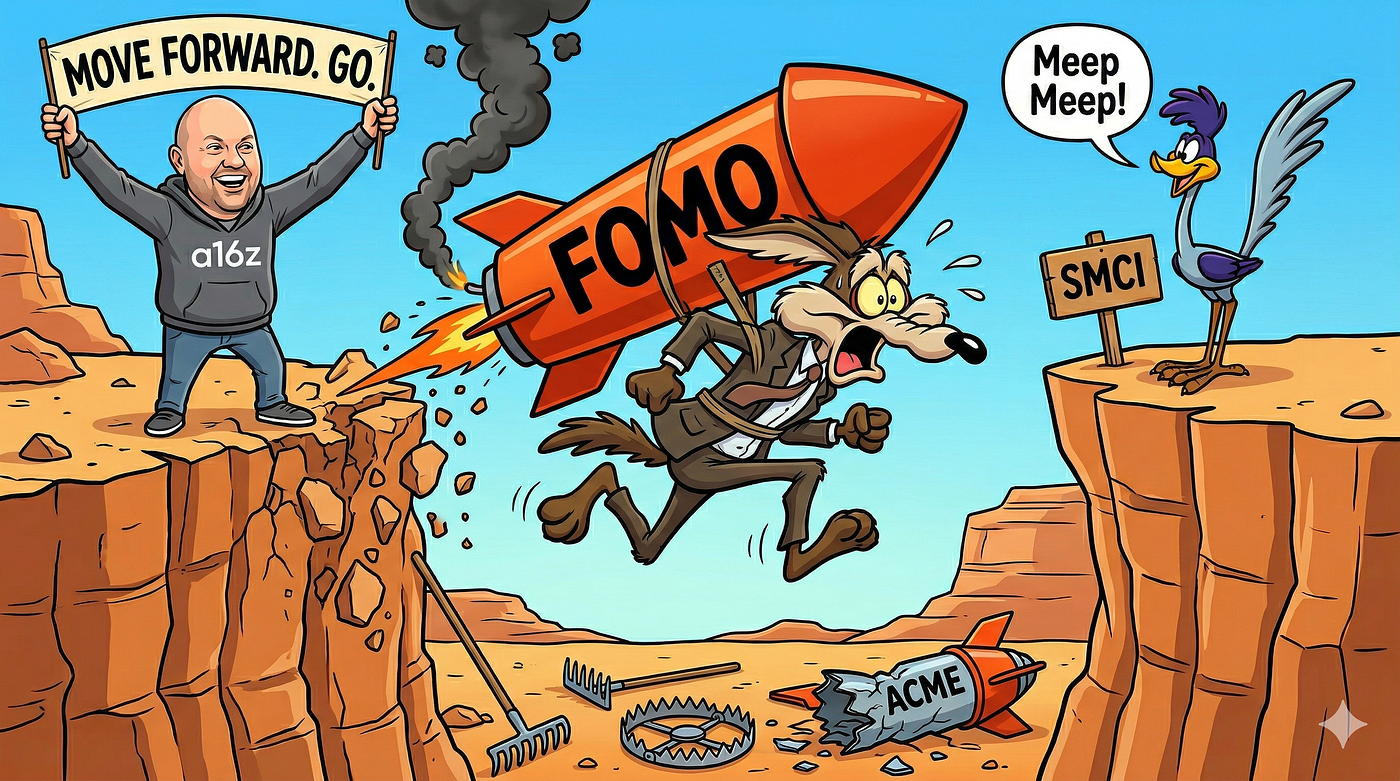
Fueled by a burning desire to beat the rest of the herd to the watering hole, I chased the SMCI roadrunner off the edge of the cliff. Never mind the well-documented battle scars and countless promises I made myself to never chase a stock that had already ripped to all-time highs. Forget about the clearly marked retracement and entry zones that I had been mapping out along the way. Jensen’s partnership became a proxy for my own research.
I bought SMCI eight times in total, a handful of times even on the way down as a Hindenburg Research short report exposed countless sketchy accounting practices. I had been up on my position around 20% at one point, and I wasn’t going to let a couple of salty bears talk me out of strapping myself to Wile E.’s infamous ACME rocket.
Spoiler alert: it ended how it always ended in the Sunday morning cartoons. Following the short report, all Big Four accounting firms refused to put their stamp of approval on SuperMicro’s books, and I lost 72% of my invested capital on the ticker. But as painful as that loss was, it needed to happen. I needed a trade to shake me to my core so violently that habitual introspection would become a permanent part of how I invest.
Which is why I don’t want this piece to be about judging tech CEOs or throwing stones at glass houses. I think most of us have some level of introspection when it comes to making decisions, but for whatever reason, our own systems and rules are so easily cast aside when we’re staring down what always seems like an opportunistic buy of a lifetime.
Having zero introspection might be freeing for some. For me, introspection is the hedge against my own human nature, and the only thing keeping me from stepping on the same rakes over and over again.
The Temptation
Shortly after the dust settled, Seeking Alpha blew up with Buy ratings as value investors piled back into SMCI. Forward P/E at 6.9x, a 63% discount to its three-year average. I would be lying if I told you that the human urge to get a revenge trade in and make up all the losses didn’t cross my mind countless times. Locking in the loss was difficult, but watching the stock make higher highs on its way to a 250% rally might have been the most painful part of the experience.
Fast forward to just earlier this month, after management was caught orchestrating a $2.5 billion scheme to smuggle NVIDIA chips into China and employees were literally taking hairdryers to the serial numbers of NVIDIA GPUs to hide where they were going. SMCI is recirculating amongst investing circles, and even after the indictment, investors are once again calling it a bargain and a buy.

SMCI employees were caught by the warehouse’s security survellance system.
This is important to call out, because even though I was able to chuckle and scroll right by all those bullish articles on SMCI this time around, I recognize that the temptation and human nature never fully go away. Introspection is useful in identifying gaps in your thinking, but it takes application and a system to actually benefit from the reflection.
The reps matter. And every time you journal a trade regardless of outcome, or recall a previous experience to fight off your impulses, you’re force multiplying your edge as an introspective investor. As your confidence grows in your system, that’s when all the noise gets quieter.
The System
I get it. Journaling and building a system sounds like a lot of work, especially when we’re now able to get in and out of multiple trades faster than we can sip our morning coffee. The friction between impulse and acting on it has never been lower. But I’d argue that the same can be said about AI and how it can just as easily remove some of the friction behind building your own guardrails.
Every psychological trap I’ve described in this piece is something I still grapple with every market open. None of that fully goes away with time and experience. What changed is that I built a system that holds a mirror up to my own decision making, recognizes traps and patterns that I’m still painfully oblivious to, and forces me to come face to face with my own convictions and experiences before locking in a trade.
When both CNBC and “finfluencers” can’t stop recommending a ticker, the system pulls up my own thesis from two weeks ago and puts it right in front of me. It helps me cut through the noise and trust in the time and research that I’ve committed to the stock. Same goes for when I’m on the losing end of a trade. My system surfaces all the receipts and reminds me of why I bought in the first place, why I ignored the red flags and developed diamond hands, and forces me to sit with a thesis that might not be working out. You’d be surprised how easily you can start seeing through thought traps when the full story is chronologically laid out in front of you.
And that’s why when Reddit went straight to meming Zuckerberg’s announcement of an AI twin, I actually thought it was a pretty good idea. As someone who’s bootstrapped a system together and has developed a better mindset because of it, I think most folks are dismissing what AI has to offer too quickly.
The popular take is that AI is great for trading because it strips away all emotion from the process. While that might be true, I think AI’s greatest contribution is that it gives you a memory that your ego can’t tamper with. Journaling in theory is a no-brainer, but logging entries takes time. Actually taking the time to review it is a whole other challenge.
AI now turns my transaction logs and notes into a living ledger. One that pattern matches across years of decisions, warns me when a thesis is stale, and effortlessly keeps track of all my analysis, regardless of whether it’s fundamental, technical, or macro narratives. For once, journaling can actually keep up with the pace at which we trade, and has a chance to beat our impulses to the punch when we’re about to pull the trigger.
Closing Thoughts
I started this piece because a very successful VC guy told his audience that introspection is a liability. After looking at how even the top companies stumble with the same advice and paying my own five-figure tuition on SMCI, I’d argue it’s the most undervalued edge any investor can hold.
The funny thing is, the more I refine the system, the more it’s changing how I think about my investing goals. P&L and beating the market will always be a focus. Nowadays, every bad trade I don’t end up taking feels just as good as some of my largest gains. The process is becoming the point, and I’m becoming a stronger investor because of it.
If any of you want to nerd out on trading psychology or are looking for someone to help you get started with a system, you know where to find me. Thanks for reading!
📩 Join Investor’s Handbook Digest — get the best investing, markets, and wealth-building insights each week.
메타데이터
- post_id
- 8f19cd76d2d4
- slug
- bullish-on-introspection-dont-be-the-wile-e-of-wall-street-8f19cd76d2d4
- url
- https://medium.com/the-investors-handbook/bullish-on-introspection-dont-be-the-wile-e-of-wall-street-8f19cd76d2d4
- canonical_url
- https://medium.com/the-investors-handbook/bullish-on-introspection-dont-be-the-wile-e-of-wall-street-8f19cd76d2d4
- author_url
- https://medium.com/@MarketTherapy
- status
- ok
- fetched_at
- 2026-06-09 15:37:30