Twain and Bauby’s Autobiographies as Narratives of Grief through the Space of Memories
Mark Twain and Jean-Dominique Bauby explore their lives as they reflect back and dictate their stories, each in their own unique way. Mark…
Twain and Bauby’s Autobiographies as Narratives of Grief through the Space of Memories
Mark Twain and Jean-Dominique Bauby explore their lives as they reflect back and dictate their stories, each in their own unique way. Mark Twain’s *Autobiography is a disjointed account of his life, told via anecdotes as he retells stories from his life and memories focusing on his daughter Susy after her early death. Bauby’s [The Diving Bell and the Butterfly](https://www.amazon.com/Diving-Bell-Butterfly-Memoir-Death/dp/0375701214) *is his thoughts on life after becoming a victim of “locked-in syndrome.” Due to this condition, Bauby must narrate his story by blinking his left eye, the only part of his body he still has use of.
Both Bauby and Twain write narratives of mourning and grief, Twain for his young daughter, and Bauby for his body and his family. Through the focus each has on their children, it is their respective identities as fathers causing them the most trauma. Bauby and Twain’s narratives both function as an autothanatography, which is defined as the “focus on illness, pain, and imminent death as crucial to the process of that life” as they take their respective readers on a journey throughout their memories (Smith and Watson 138).
Smith and Watson describe “thanatography as a public form of mourning” (Smith and Watson 139). Bauby’s narrative is a thanatography of his own life as he is accepting the fate he would have to endure for the rest of her life.
As Bauby sits with his children and watches them play, he reflects thinking, “My heart is not in the game. Grief surges over me. His face is not two feet from mine, my son Théophile sits patiently waiting — and I, his father, have lost the simple write to ruffle his bristly hair, clasp his downy neck, hug his small, lithe, warm body tight against me” (Bauby 71). It is in this moment that he reflects on his condition saying it “is monstrous, iniquitous, revolting, horrible” (Bauby 71).
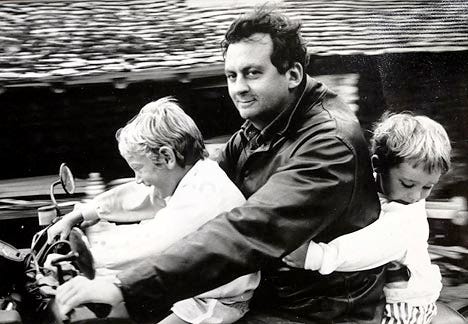
Bauby and his children before his stroke.
Much of Twain’s Autobiography focuses on his daughter Susy who died very young. Twain spends much of the text reminiscing about Susy and her life. Smith and Watson explain narratives of grief to be: “When parents mourn the loss of a child, they probe the grief of outliving one’s own progeny, of youth lost to war or accident or illness. In mourning, parents, siblings, extended family members, partners, and friends are also grieving about their own impending mortality and the menace of life-threatening illness” (Smith and Watson 138).
Although Twain was unable to be with his daughter at the time of her death, he is able to describe the exact circumstance due to a letter written to him and his wife. It describes as “she walked the floor a little in her pain and delirium, then succumbed to weakness and returned to her bed…about noon she became blind…it was only one word that she said when she spoke that last time, and it told of her longing. She groped with her hands and found Katy, and caressed her face and said ‘mamma’” (Twain 181). Twain spends much of the rest of his narrative then exploring her life and his memories of her.
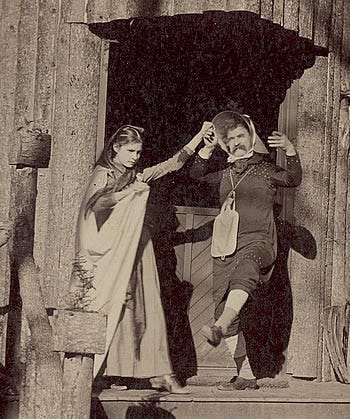
Twain with his daughter Susy.
Both Twain and Bauby discuss how they are “self-reflexive about the problem of remembering” (Smith and Watson 30). For Twain, this fascination with the idea of “truth,” is shown especially in how it pertains to autobiography: “an autobiography is always two things: it is an absolute lie and it is an absolute truth. The author of it furnishes the lie, the reader of it furnishes the truth-that is, he gets at the truth by insight” ( Twain 252). He cares very little for getting the memories correct but thoroughly enjoys getting lost. in the process of remembering.
Bauby deals with memory in focusing on his life before and after his stroke. since he is “locked-in,” he is unable to control his own life in any way, with keeps him focused on reliving the past. He reflects on how “[his] old life still burns within [him], but more and more of it is reduced to the ashes of memory” (Bauby 77).
Twain states that “the right way to do an Autobiography” is to “start at no particular time of your life; wander at your gree will all over your life; talk only about the thing which interests you for the moment; drop it the moment its interest threatens to pale, and turn your talk upon the new and more interesting thing that has intruded itself into your mind meantime” (Twain 44).
While Twain certainly lives out this idea throughout his text, it results in disjointed musings with the occasional heartfelt memory of Susy or another family member. It is in these moments of memory where the reader travels with Twain throughout his memories, that truly draws the reader in.
Bauby on the other hand spends the entirety of his much shorter autobiography acting as a guide, taking the reader with him as he physically moves between spaces, and throughout his memories. Similar to Twain, it is the moments with his family, as he is devastated by his inability to touch his children that the reader feels true sorrow for him.
Bauby, Jean-Dominique. The Diving Bell and the Butterfly. Vintage International, 1997.
Smith, Sidonie, and Julia Watson. Reading Autobiography: A Guide for Interpreting Life Narratives. University of Minnesota Press, 2013.
Twain, Mark. Autobiography of Mark Twain: Reader’s Edition. University of California Press, 2012.
메타데이터
- post_id
- 8f1abe08d805
- slug
- twain-and-baubys-autobiographies-as-narratives-of-grief-through-the-space-of-memories-8f1abe08d805
- url
- https://medium.com/@gracegunther/twain-and-baubys-autobiographies-as-narratives-of-grief-through-the-space-of-memories-8f1abe08d805
- canonical_url
- https://medium.com/@gracegunther/twain-and-baubys-autobiographies-as-narratives-of-grief-through-the-space-of-memories-8f1abe08d805
- author_url
- https://medium.com/@gracegunther
- status
- ok
- fetched_at
- 2026-07-29 14:33:22