Do Christian Values Exist?
I ask because I can’t think of one
Atheism, religion, morality
Do Christian Values Exist?
I ask because I can’t think of one

“Declaration of Independence” by John Trumbull
Take a look at this peculiar tweet:
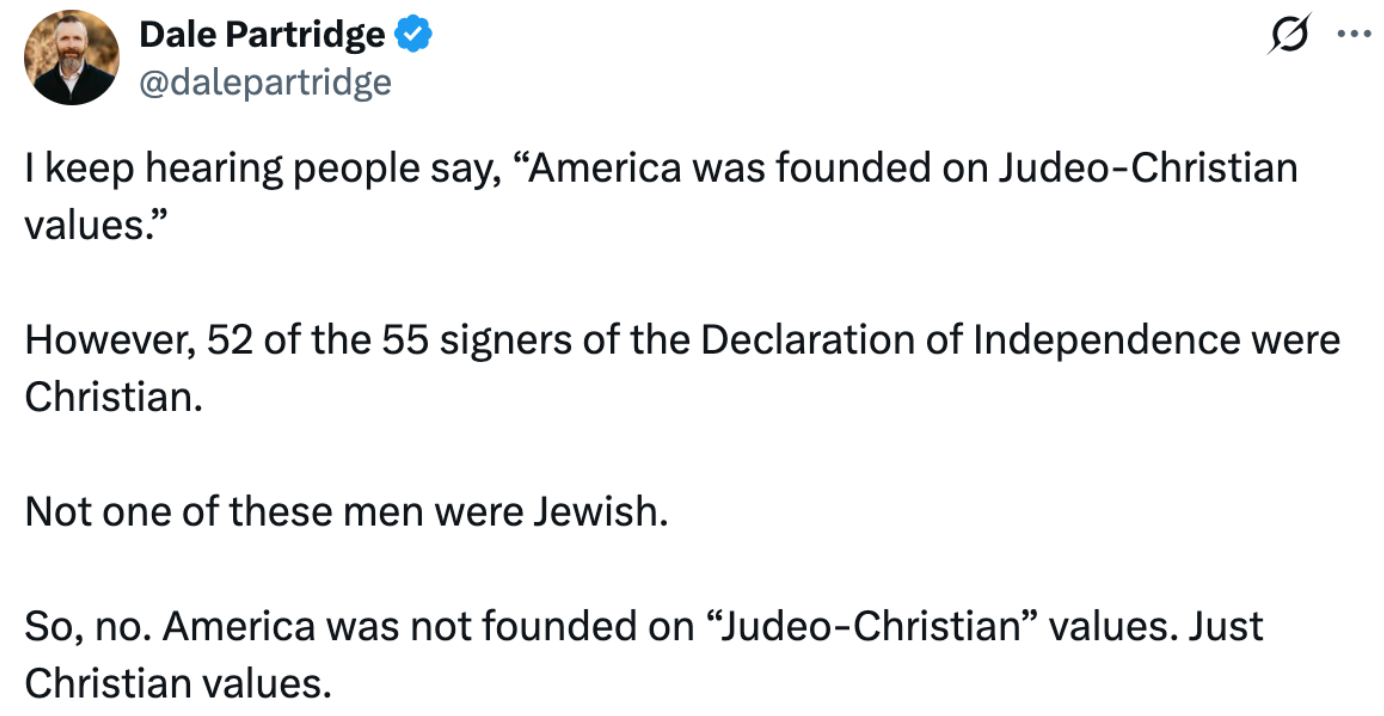
It’s peculiar because Partridge doesn’t seem to know that Jesus was Jewish. What’s more, Judaism, the first of the three Abrahamic faiths — in order: Judaism, Christianity, Islam — existed for thousands of years before Christianity emerged.
As for Partridge’s specific claim about the religious faith of the Founding Fathers, it’s true that most of them were Christians. But it’s also true that many of them had mixed beliefs: some leaned toward deism (God exists but does not interfere in the affairs of man), and some of them outright rejected the supernatural claims that were made in the Bible (Thomas Paine was particularly outspoken in this regard), which is certainly a no-no for the hardcore, everything-in-the-Bible-is-true fundamentalist crowd.
But historical accuracy is not my concern here. I’m interested in adjectives.
If you say a car is blue, it means it’s not red. If you say War and Peace is a long novel, you’re saying it’s not a short novel. A “dead” light bulb is not a “live” (working) light bulb. Adjectives describe the quality or state of a thing — and often with the intent of denoting something unique about what the adjective is describing.¹
With “Christian” functioning as an adjective, “Christian value” is supposed to denote a unique or special or distinctive value that sets it apart from other values or ethical systems, that the value in question wouldn’t exist if Christianity didn’t exist. Thing is, I can’t think of a single, universally understood value that is “owned” by or exclusive to Christianity.²
Love? I’m certain there are Hindus who love each other.
Charity? I’m certain there are atheists who have donated money to a charitable organization.
Selflessness? Ahmed al-Ahmed, a Syrian-born Australian, seemed pretty selfless to me when he tackled that Bondi Beach shooter.
Altruism? Think of people from all sorts of backgrounds who donate blood.
Forgiveness? Nelson Mandela was in prison in South Africa for twenty-seven years. Upon his release, he forgave his jailers and sought reconciliation as part of his effort to end apartheid. Although he was raised in a Methodist household, Mandela’s biographer, Anthony Sampson, has said Mandela wasn’t particularly religious and was inspired more by Ubuntu philosophy.³
To sum up, there are several so-called “Christian mysteries” — the Trinity, the Incarnation, the Resurrection, the Eucharist — but this belief in “Christian values” is perhaps the most mysterious of them all, because as hard as a I try to rack my brain, I just can’t think of a value that’s Christian. If any reader can think of a value that only a self-described Christian can embrace, please tell me what that value is in the comments section below.⁴
¹. However, for something like “women’s rights,” the adjective is used narrowly for the issue under discussion; in no way does “women’s rights” suggest that human rights or animal rights don’t exist or can’t be discussed.
². Some Christians will argue that one must first believe in Jesus because the love that people extend to others is only made meaningful or strengthened when a love for Jesus is placed ahead of the love you might have for a parent or a sibling or a partner. And so, a Christian might argue, there you have it: a unique Christian value. I can agree that the Jesus angle is a specific detail of Christianity, but my argument here concerns broad, universal principles and cross-cultural values that can be found anywhere on the planet. Christianity certainly “owns” this narrow “follow Jesus” dictate — because without Jesus there is no Christianity! — but it doesn’t own the underlying impulse or capacity that all humans have: the ability to love another person.
As for the claim that “love your neighbor” is a Christian value, here’s the kicker: Leviticus 19:18 (KJV): “Thou shalt not avenge, nor bear any grudge against the children of thy people, but thou shalt love thy neighbor as thyself.” This was written centuries before Jesus came around, which is to say the sentiment predates Jesus.
Now, despite some of the delusional things that Jesus believed — a “day of judgment,” for example — the man was a humanist (though not secular) who glommed on to some ideas that were in the air and as a result consequently saw and understood a wider implication of this “love your neighbor” sentiment, which is to say some credit can probably be given to Jesus for amplifying and expanding upon this idea. But to argue that this sentiment originated with Jesus? Not true. Evolutionary psychology and biology explain why “love your neighbor” and related sentiments would eventually come about in human societies, and if a greater comity for others was slow to emerge, with Jesus perhaps putting greater focus on these values more than anyone else (at least in the part of the world where he lived), this doesn’t mean that Jesus was the originator of these ideas. [Update: March 28, 2026: Some scholars argue that the Jews adhered to a limited understanding of “love you neighbor”; see Bart Ehrman on this.]
³. According to Wikipedia, Ubuntu “describes a set of closely related…value systems that emphasize the interconnectedness of individuals with their surrounding societal and physical worlds.” That sounds like humanism to me.
⁴. I broached this question elsewhere in slightly different form (along with a related one): “Two Challenges for Religious People.”
Postscript, April 3, 2026: On the issue of loving your neighbor and how this idea was understood in non-Christian societies, Maarten Boudry told Jerry Coyne that he asked Claude, an AI chatbot, this question: “Is it true that there were a lot of Axial Age religions that promoted counterintuitive and challenging moral codes, like loving your enemy and turning the other cheek, apart from Christianity?” See the response Boudry got here: “Bart Ehrman schools Ross Douthat on Christianity and how to find Biblical ‘truth’.” [For any of you who might snicker at the idea of using an AI assistant to investigate religious issues, keep in mind that these LLMs are simply amped-up search engines that can lead you to multiple sources in response to a query. There is no spooky and independent “artificial intelligence” declaiming anything. These AI chatbots simply spit back information on sources, with summaries, that are more detailed than what a conventional internet search would give you.]
Barry Lyons lives in New York City. He’s written about the Second Amendment, the Indiana Jones movies, and the true meaning of “Trump Derangement Syndrome.”
메타데이터
- post_id
- 8f3e372058f3
- slug
- do-christian-values-exist-8f3e372058f3
- url
- https://medium.com/scientists-free-from-religious/do-christian-values-exist-8f3e372058f3
- canonical_url
- https://medium.com/scientists-free-from-religious/do-christian-values-exist-8f3e372058f3
- author_url
- https://medium.com/@lyonsnyc
- status
- ok
- fetched_at
- 2026-06-23 17:05:31