Java Series #5: The Ultimate Cleaning Crew — Mastering the Garbage Collector
We’ve seen the restaurant in full swing: the chefs are cooking (Threads), the pantry is stocked (Heap), and the fire alarms are ready…
Java Series #5: The Ultimate Cleaning Crew — Mastering the Garbage Collector
We’ve seen the restaurant in full swing: the chefs are cooking (Threads), the pantry is stocked (Heap), and the fire alarms are ready (Exceptions). But there is one final, invisible force that keeps the whole operation from collapsing under its own weight.
In a busy kitchen, scraps of food, empty crates, and used wrappers pile up every second. If the chefs had to stop and clean after every dish, the service would grind to a halt. In Java, we have a dedicated, automated cleaning crew that handles the mess for us: The Garbage Collector (GC).
1. What exactly is “Garbage”? 🗑️
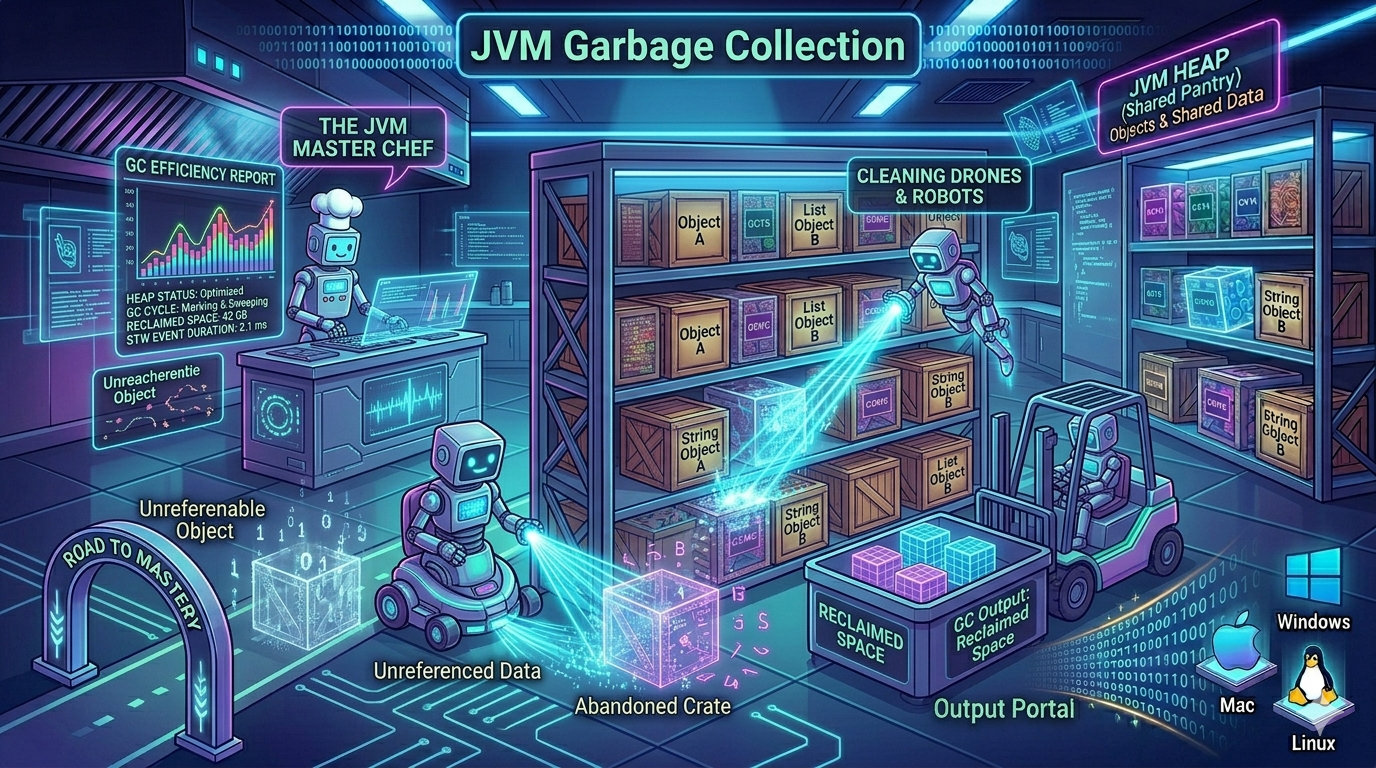
In the JVM, “Garbage” isn’t just a mistake; it’s an object that is no longer reachable.
Imagine a chef grabs a crate of tomatoes (an Object) from the pantry and puts it on the counter. He uses all the tomatoes and then moves on to the next task. The empty crate is still sitting there, taking up space.
If there is no “Label” (Reference) on the Stack pointing to that crate in the Heap, the Master Chef can no longer reach it. It is now officially “Garbage.” The GC’s job is to find these abandoned crates and dissolve them to make room for new ingredients.
2. The Strategy: Mark and Sweep 🔍
The GC doesn’t just start throwing things away at random. It follows a professional two-step protocol:
- Marking: The GC walks through the kitchen and identifies every single crate that still has a label attached to it. It “marks” these as Live Objects.
- Sweeping: Anything that wasn’t marked is considered trash. The GC sweeps through the pantry and clears those spaces.
Behind the Scenes: Sometimes the GC also performs Compaction. Imagine the pantry has small gaps between crates. The GC pushes all the “Live” crates together into one corner, leaving one large, continuous space for new, massive crates.
3. The Generational Hypothesis: Young vs. Old ⏳
Java’s GC is brilliant because it realizes that most objects die young. Think of a paper napkin; you use it once and throw it away. A heavy cast-iron skillet, however, stays in the kitchen for years.
To save time, the GC divides the Heap into two main zones:
- The Young Generation: This is where all new objects are born. It’s cleaned very frequently because most “scraps” here disappear quickly.
- The Old Generation: If an object survives several cleaning cycles in the Young Generation, it gets “promoted” here. This area is larger and cleaned less often, as these are the “heavy pans” of your application.

The “Generational” layout of the JVM Heap, showing how data ingredients are promoted from the fast-paced Young Gen to the stable Old Gen.
4. The “Stop-the-World” Moment
Every cleaning crew needs the chefs to step out of the way for a second so they don’t get tripped over. In Java, this is called a Stop-the-World (STW) event.
For a few milliseconds, the JVM pauses all application threads to perform a major cleanup.
- A Junior Developer ignores STW and wonders why their app “stutters.”
- A Master Developer tunes the GC to make these pauses so short that the “customers” (the users) never even notice.
Summary: The Cleaning Protocol

Bonus Tip: Choosing Your Crew (GC Types)
Depending on your restaurant’s size, you can hire different types of crews:
- G1 GC: The most popular “all-rounder” for modern apps.
- ZGC: The “Invisible Crew” designed for massive kitchens (huge RAM) with ultra-short pause times.

From: Java Developers Community (moderated)
The End of the Tour: Your Road to Mastery 🏁
You’ve done it! You’ve traveled from the JDK Building all the way to the Garbage Collection systems. You no longer see Java as a “Black Box” — you see it as a high-performance, beautifully orchestrated restaurant.
The next time you write public static void main, remember the Master Chef, the robotic Sous-Chefs, and the cleaning crew working tirelessly behind your screen to make your code a five-star success.
- Follow me for more deep dives into Cloud Architecture and Backend Mastery.
- Clap 50 times if this series helped you master the JVM!
- Comment below: Which part of the JVM Kitchen was your favorite?
메타데이터
- post_id
- 8f4abaf0ea8a
- slug
- java-series-5-the-ultimate-cleaning-crew-mastering-the-garbage-collector-8f4abaf0ea8a
- url
- https://medium.com/@r-ragul/java-series-5-the-ultimate-cleaning-crew-mastering-the-garbage-collector-8f4abaf0ea8a
- canonical_url
- https://medium.com/@r-ragul/java-series-5-the-ultimate-cleaning-crew-mastering-the-garbage-collector-8f4abaf0ea8a
- author_url
- https://medium.com/@r-ragul
- status
- ok
- fetched_at
- 2026-06-15 20:49:13