The AI Discipline Gap: Diagnosing Before Prescribing Intelligence
Why the next advantage in enterprise AI will come from choosing the right intelligence for the right problem
The AI Discipline Gap: Diagnosing Before Prescribing Intelligence
Why the next advantage in enterprise AI will come from choosing the right intelligence for the right problem
Recently, a close friend of mine started noticing swelling around the ankles and joints.
At first, it did not look alarming. It looked like one of those common health issues many of us explain away. Maybe it was fatigue. Maybe it was age. Maybe it was diet. Maybe it was some deficiency.
Then came the opinions.
Someone suggested vitamin deficiency. Doctor suspected arthritis. Medicines were prescribed. Tests were discussed. Everyone was looking at the same visible symptom, but each prescription pointed in a different direction.
And for a while, that is what we were doing: treating what we could see.
Treatments did not help. The swelling and pain continued.
On deeper investigation, the actual issue turned out to be far more serious: a heart blockage.
The problem was not in the ankle. The ankle swelling was only a signal.
The lesson was clear: even the right medicine becomes the wrong treatment when the problem is misunderstood.
And that is exactly where many enterprises are with AI today.
We see symptoms everywhere: slow processes, scattered knowledge, manual reviews, delayed decisions, poor customer experience, rising costs, and teams drowning in repetitive work.
We also have extremely powerful models, tools and technology at our disposal. So — we rush — to prescribe intelligence.
A rule-based problem gets an LLM. A workflow problem gets an agent. A data-quality problem gets a chatbot. An integration problem gets a copilot.
Each solution sounds reasonable. Each one can look impressive in a demo. But if the underlying problem has not been diagnosed correctly, the system does not become intelligent. It becomes fragile.
Not because AI is weak. Because the system was never designed with discipline.
The Three Disciplines of Enterprise AI
Enterprise AI rests on three core disciplines: problem class, data, and engineering.
- Problem-class fit: Is the right class of intelligence being applied?
- Data readiness and context: Is the system operating on trusted, current, governed, meaningful data?
- Engineering architecture: Is the solution designed for production reliability, observability, fallback, and cost?
Risk and speed are additional calibrators. They determine how strict each discipline needs to be.
A low-risk prototype can tolerate imperfect data, lighter engineering, and human review. A high-risk production workflow cannot.
The mistake is treating all AI opportunities as if they require the same prescription.
They do not.
Discipline One: Problem-Class
The first discipline is problem classification.
Before choosing a model, agent, copilot, knowledge graph, or workflow architecture, the first question should be:
What class of problem are we solving?
Not every workflow needs an agent. Not every prediction problem needs a large model. Not every business rule needs AI. Not every knowledge problem needs autonomy.
The right question is not:
What is the most powerful AI we can use?
The right question is:
What intelligence suits this problem?
Some problems need deterministic rules. Some need classical machine learning. Some need retrieval. Some need language generation. Some need semantic representation. Some need agentic action. Some need no AI at all.
A payment approval workflow and an internal meeting-summary workflow should not have the same AI prescription. The model may be the same. The problem class is not.

A practical way to classify the problem
The same discipline applies to data representation.
A knowledge graph can be extremely powerful when the problem depends on entities, relationships, lineage, semantics, and reasoning across connected context. Customer 360, fraud detection, supply-chain dependencies, policy reasoning, product relationships, and regulated decision support are examples where graph-based representation may create real advantage.
But a knowledge graph is not a universal prescription.
Some enterprise problems are better served by relational models, document stores, vector search, event streams, feature stores, semantic layers, deterministic rules, or workflow systems.
The right question is not:
How do we build a knowledge graph?
The right question is:
Does this problem require connected, governed, semantic representation to be solved well?
If yes, a knowledge graph may be the right foundation. If not, it may be unnecessary architecture.
The first discipline is: Classify the problem before prescribing intelligence.
Discipline Two: Data Readiness and Context
Even if the problem is correctly classified, AI is likely to fail if the data foundation is weak.
Many enterprise AI conversations assume the challenge is giving AI access to data. That is not enough.
The real challenge is giving AI access to data that is trusted, current, contextual, governed, and usable at the point of decision.
Enterprise data is rarely clean. It sits across ERPs, CRMs, warehouses, SaaS systems, PDFs, emails, spreadsheets, logs, code repositories, tickets, and people’s heads.
The same customer may appear differently across systems. The same product may have different codes across regions. The same policy may exist in multiple versions. The same metric may mean different things to finance, sales, operations, and delivery.
AI does not automatically fix this. It exposes it.
A retrieval system over messy knowledge can retrieve confusion faster. A chatbot over stale documents can become confidently obsolete. An agent acting on incomplete context can become dangerous.
This becomes more important as AI systems gain tool access. When AI can act, weak context is no longer just a quality issue. It becomes an execution risk.
A data-readiness score can be expressed as:

Where:
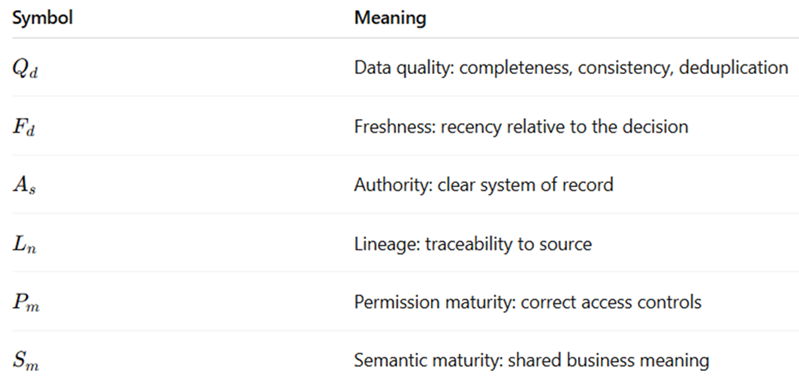
The multiplicative structure is intentional. Good data quality does not compensate for poor permissions. Fresh data does not compensate for weak semantics. Good retrieval does not compensate for unclear source authority.
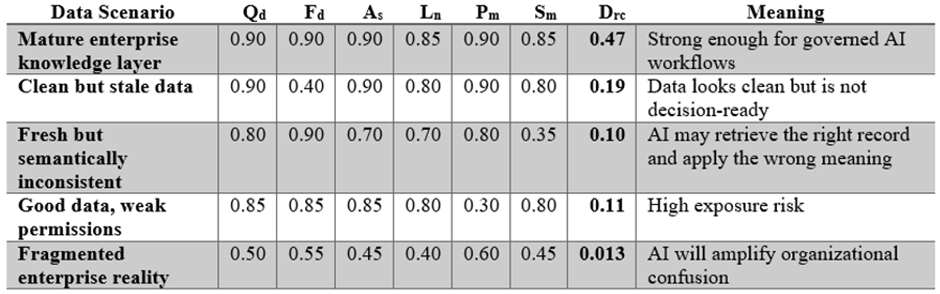
This is one reason why pilots look clean and production gets messy. Pilots run on selected data. Production runs on organizational reality.
The second discipline is: Build trusted, governed, contextual data foundations before expecting intelligent output.
Discipline Three: Engineering Design and Architecture
The third discipline is engineering. This is where AI either becomes infrastructure or remains theatre.
A demo shows the art of the possible. Production asks a harder question: can this work reliably every day, across users, edge cases, failures, costs, policies, audits, and changing data?
Traditional software usually fails loudly. When an API breaks or a job fails — a validation error appears. AI systems often fail quietly. They produce a fluent, confident, well-formatted answer that is wrong.
That changes the engineering problem. You now need to monitor not only uptime and latency, but also grounding, source usage, drift, override rate, hallucination patterns, tool-call failures, cost per task, and downstream business impact.
Production AI is not one model. It is a chain: data pipeline, retrieval, prompt, model, policy layer, tool call, workflow integration, user action, monitoring, and feedback. In a chain, reliability compounds.
A 99% reliable model sitting on an 80% reliable data pipeline and a 70% reliable workflow is not a 99% system. It may still be a fragile system with one impressive component.
In production AI, the question is not just “Did the system respond?” The real questions are: did it use the right source, was the source authoritative, was the answer grounded, was the confidence appropriate, did the user override it, did it trigger an action, can we audit the path, and can we roll it back?
This becomes critical when AI moves from suggestion to action. When AI recommends, the risk is bounded. When AI acts, engineering becomes governance. An agent that incorrectly updates a CRM may create noise. An agent that incorrectly triggers a payment may create exposure. An agent that sends the wrong communication may damage trust. An agent that bypasses policy may create compliance risk.
So, production AI needs boundaries: evaluation before release, observability after release, guardrails during use, fallbacks when confidence drops, human review where risk demands it, audit trails when decisions matter, rollback when actions go wrong, and cost controls before scale breaks the business case.
Without this, organizations risk deploying uncertainty behind a polished interface rather than dependable intelligence.
The third discipline is: Engineer the system before trusting it with real work.
The Calibrators
The three disciplines do not operate in isolation.
They are calibrated by two forces:
- Risk and governance
- Time-to-value
Calibrator One — Risk and Governance
Risk and governance do not replace the three disciplines. They determine how rigorous each discipline must be.
A summarization assistant may need light controls. A payment agent may need deterministic checks, human authorization, audit trails, and rollback. A production-code agent may need sandboxing, scoped access, test gates, deployment controls, and incident response.
The same model can be safe in one context and unacceptable in another.
Governance should appear inside the architecture, not outside it.
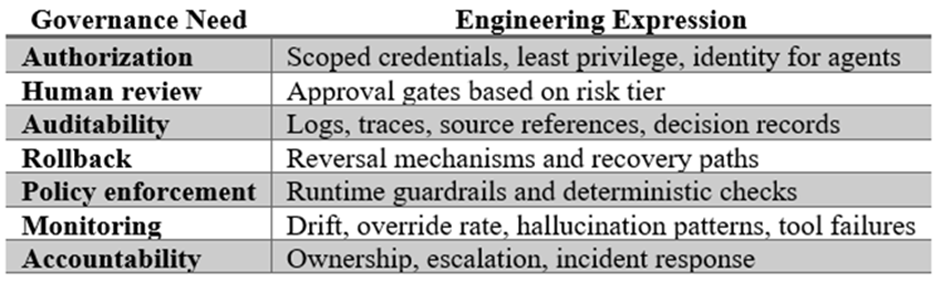
This is why governance is a calibrator. It is system design.
Calibrator Two — Time-to-Value
Time-to-value is a real constraint. Sometimes the business needs to learn quickly. In that case, a lightweight prototype with human review may be appropriate. Sometimes the workflow is too critical for experimentation in live operations. In that case, the system needs stronger evidence before release.
The discipline is not to avoid AI. The discipline is to match assurance to risk and speed.
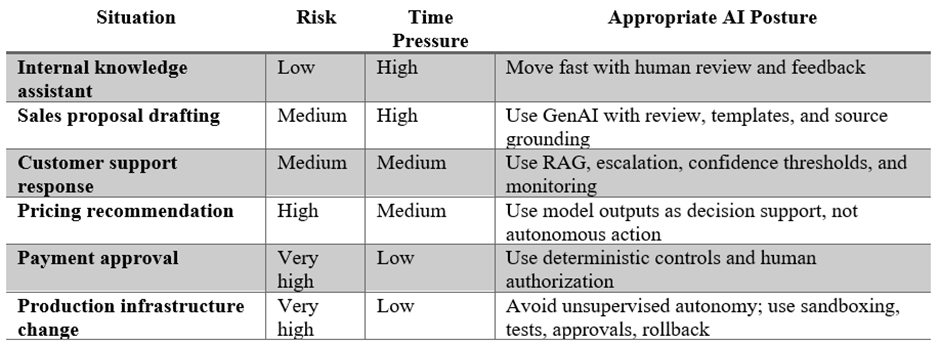
Speed changes what you can tolerate.
A fast prototype can be imperfect if the downside is limited. A high-risk production workflow cannot rely on optimism.
Expected Loss: Why Accuracy Is Not Enough
Executives often ask:
How accurate is the model?
That is useful, but incomplete.
The better question is:
What is the expected loss when the system is wrong?

Where:
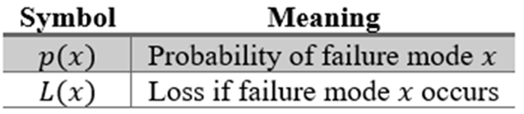
Accuracy alone does not determine whether a system is acceptable. Context matters. Consider the following:

A 95% accurate system may be acceptable for summarization and unacceptable for compliance. A 99% accurate system may still be too risky if the remaining 1% creates severe harm.
The deployment decision should not be reduced to a single accuracy number. It should be based on three questions:
- Is the benefit worth the effort? Will the system materially improve revenue, cost, speed, quality, risk reduction, customer experience, or employee productivity?
- Is the downside acceptable? If the system is wrong, are the financial, operational, customer, regulatory, and reputational consequences within tolerance?
- Are the controls strong enough? Are review, permissions, monitoring, escalation, auditability, and rollback appropriate for the risk level?
This is the heart of enterprise AI discipline.
A system should not be deployed merely because it works in a demo. It should be deployed when the value is positive, the expected loss is within tolerance, the controls match the risk, and the architecture can survive production.
The Real Shift
The next phase of enterprise AI is unlikely to be defined only by a single tool, model, platform, or architecture choice.
The real advantage will come from judgment.
Knowing when to use rules. Knowing when to use classical ML. Knowing when to use retrieval. Knowing when to use LLMs. Knowing when to use agents. Knowing when to use knowledge graphs. Knowing when not to use AI at all.
The enterprises most likely to create durable advantage will not be those that apply AI everywhere by default. They will be the ones that prescribe intelligence carefully.
Final Thoughts
The swelling in the analogy was never the issue. The mistake would have been treating it without proper diagnosis.
Enterprise AI is at the same point. Many visible business pain points are real, but they are not always the diagnosis. The deeper question is what kind of intelligence, data foundation, and engineering discipline the situation actually requires.
We have powerful models. We have serious opportunities. We have enough proof that AI works.
What we need now is discipline.
The discipline to classify the problem. The discipline to fix the data. The discipline to engineer for production. The discipline to calibrate risk. The discipline to respect time-to-value. The discipline to use the right intelligence for the job.
That may be the difference between AI that demos well and AI that changes the business.
The future is likely to favor organizations that know where AI belongs, where it does not, and how to make it work when it truly matters.
메타데이터
- post_id
- 8f74ed12982c
- slug
- the-ai-discipline-gap-diagnosing-before-prescribing-intelligence-8f74ed12982c
- url
- https://medium.com/@varsha.kc.jain/the-ai-discipline-gap-diagnosing-before-prescribing-intelligence-8f74ed12982c
- canonical_url
- https://medium.com/@varsha.kc.jain/the-ai-discipline-gap-diagnosing-before-prescribing-intelligence-8f74ed12982c
- author_url
- https://medium.com/@varsha.kc.jain
- status
- ok
- fetched_at
- 2026-06-09 15:37:30